
Finding percentages is a fundamental skill used in daily life—from calculating discounts and tips to analyzing data and managing personal finances. While the concept may seem intimidating at first, breaking it down into manageable steps makes it accessible to everyone. This guide walks you through practical methods, shortcuts, and real-life applications so you can calculate any percentage with confidence and speed.
Understanding the Basics of Percentages
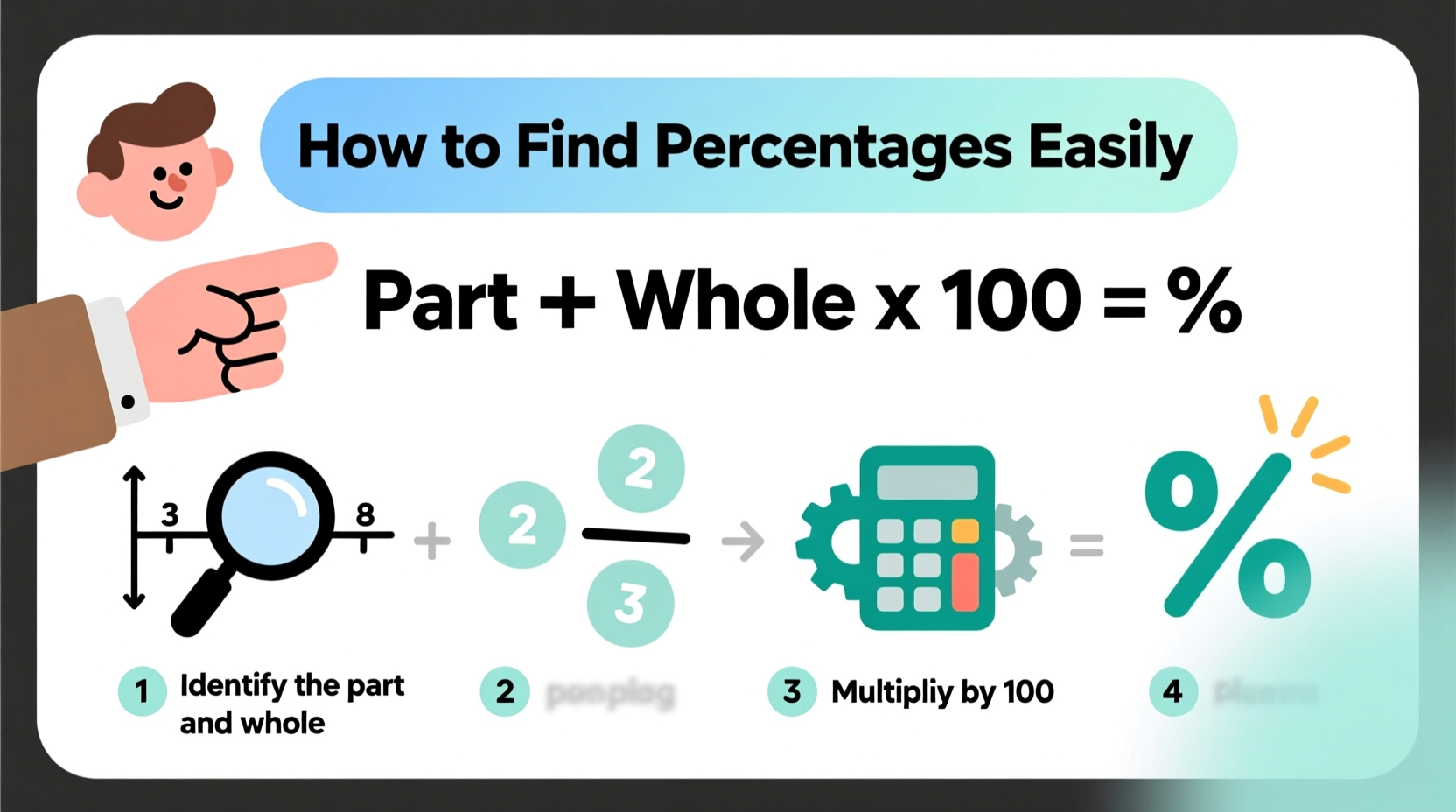
A percentage is a way of expressing a number as a fraction of 100. The word “percent” literally means “per hundred.” For example, 25% means 25 out of 100, or 0.25 in decimal form. Understanding this relationship between percentages, decimals, and fractions is the foundation for all percentage calculations.
To convert a percentage to a decimal, divide by 100. For instance:
- 50% = 50 ÷ 100 = 0.50
- 7% = 7 ÷ 100 = 0.07
- 125% = 125 ÷ 100 = 1.25
To convert a decimal back to a percentage, multiply by 100:
- 0.35 × 100 = 35%
- 0.02 × 100 = 2%
- 1.8 × 100 = 180%
Step-by-Step Method to Find Any Percentage
Follow this universal four-step process to calculate any percentage of a number:
- Convert the percentage to a decimal by dividing by 100.
- Multiply the decimal by the given number.
- Simplify the result if needed.
- Label your answer with the appropriate unit (e.g., dollars, points, items).
Example: What is 30% of 80?
- 30% → 30 ÷ 100 = 0.30
- 0.30 × 80 = 24
- No simplification needed.
- Answer: 24
This method works for any percentage and any number, making it reliable for both simple and complex problems.
Quick Mental Math Tricks for Common Percentages
You don’t always need a calculator. Many common percentages can be calculated quickly using mental shortcuts based on division and multiplication patterns.
| Percentage | Equivalent Fraction | Mental Strategy | Example: 20% of 150 |
|---|---|---|---|
| 10% | 1/10 | Move decimal one place left | 150 → 15 |
| 20% | 1/5 or 2×10% | Double the 10% value | 10% is 15 → 20% = 30 |
| 25% | 1/4 | Divide by 4 | 150 ÷ 4 = 37.5 |
| 50% | 1/2 | Divide by 2 | 150 ÷ 2 = 75 |
| 75% | 3/4 | Half + half of half | 75 + 37.5 = 112.5 |
| 100% | 1 | The whole amount | 150 |
These strategies are especially useful when shopping, tipping, or estimating quickly without paper or device access.
Real-Life Application: A Shopping Scenario
Imagine you're at a store where a jacket originally priced at $120 is marked 35% off. You want to know the discount amount and final price before tax.
Step 1: Find 10% of $120 → $12
Step 2: Multiply by 3 to get 30% → 3 × $12 = $36
Step 3: Find 5% (half of 10%) → $12 ÷ 2 = $6
Step 4: Add 30% + 5% = 35% → $36 + $6 = $42 (discount)
Step 5: Subtract discount from original price → $120 – $42 = $78
The jacket will cost $78 after the discount. Using breakdowns like this turns complex percentages into manageable pieces.
“Mental percentage calculation is one of the most underused yet powerful tools in financial literacy. It builds confidence in decision-making.” — Dr. Alan Torres, Mathematics Education Specialist
Common Mistakes and How to Avoid Them
Even simple math can go wrong if you’re not careful. Here are frequent errors people make when working with percentages—and how to prevent them.
| Mistake | Why It’s Wrong | Correct Approach |
|---|---|---|
| Adding percentages directly to prices without conversion | Forgetting that 15% means 0.15, not adding 15 | Always convert % to decimal before multiplying |
| Confusing percentage of vs. percentage increase | Thinking 50% more than 80 is 50, instead of 80 + 40 = 120 | Distinguish between finding a portion and increasing a total |
| Misplacing decimal points | Writing 5% as 5 instead of 0.05 | Use the two-place rule: move left for decimal, right for percent |
| Assuming successive percentages add up linearly | Two 10% discounts ≠ 20% off; they compound | Apply one discount at a time: e.g., 10% off then another 10% off means 19% total reduction |
Checklist: Mastering Percentage Calculations
Use this checklist to ensure accuracy and build fluency in percentage calculations:
- ☐ Convert the percentage to a decimal before multiplying
- ☐ Use 10% as a base for calculating other percentages mentally
- ☐ Double-check decimal placement when converting
- ☐ Break down complex percentages (e.g., 35% = 30% + 5%)
- ☐ Verify your answer makes sense—e.g., 50% should be about half
- ☐ Practice regularly with real-world examples like bills, scores, or sales
Frequently Asked Questions
How do I find what percentage one number is of another?
Divide the first number by the second, then multiply by 100. For example, to find what percent 45 is of 90: (45 ÷ 90) × 100 = 50%. So, 45 is 50% of 90.
Can I calculate percentages without a calculator?
Yes. Use mental math techniques such as finding 10% and building from there. For example, to find 15% of 60: 10% is 6, 5% is 3, so 15% is 6 + 3 = 9. With practice, most common percentages become second nature.
What’s the fastest way to calculate a 20% tip?
Move the decimal one place to the left to get 10%, then double it. For a $75 bill: 10% is $7.50, so 20% is $15. This method is fast, accurate, and widely applicable.
Conclusion: Build Confidence Through Practice
Percentages are everywhere—in grocery stores, financial reports, fitness goals, and academic results. The ability to calculate them quickly and accurately empowers better decisions and reduces reliance on calculators. By mastering the basic conversion, using mental shortcuts, and avoiding common pitfalls, anyone can become proficient at finding percentages with ease.




 浙公网安备
33010002000092号
浙公网安备
33010002000092号 浙B2-20120091-4
Comments
No comments yet. Why don't you start the discussion?