
LED Christmas lights are energy-efficient, long-lasting, and festive—but when one bulb fails, it can plunge an entire section—or sometimes the whole strand—into darkness. Unlike older incandescent strings where bulbs were wired in parallel, most modern LED strands use series wiring with integrated shunt technology. A single faulty LED can break the circuit, causing adjacent bulbs (or the entire string) to go dark. The good news? You rarely need to discard the whole strand. With the right tools, methodical testing, and a few minutes of focused attention, you can isolate and replace just the problematic bulb—preserving your investment, reducing waste, and keeping holiday cheer intact.
Why One Dead LED Can Kill the Whole Strand
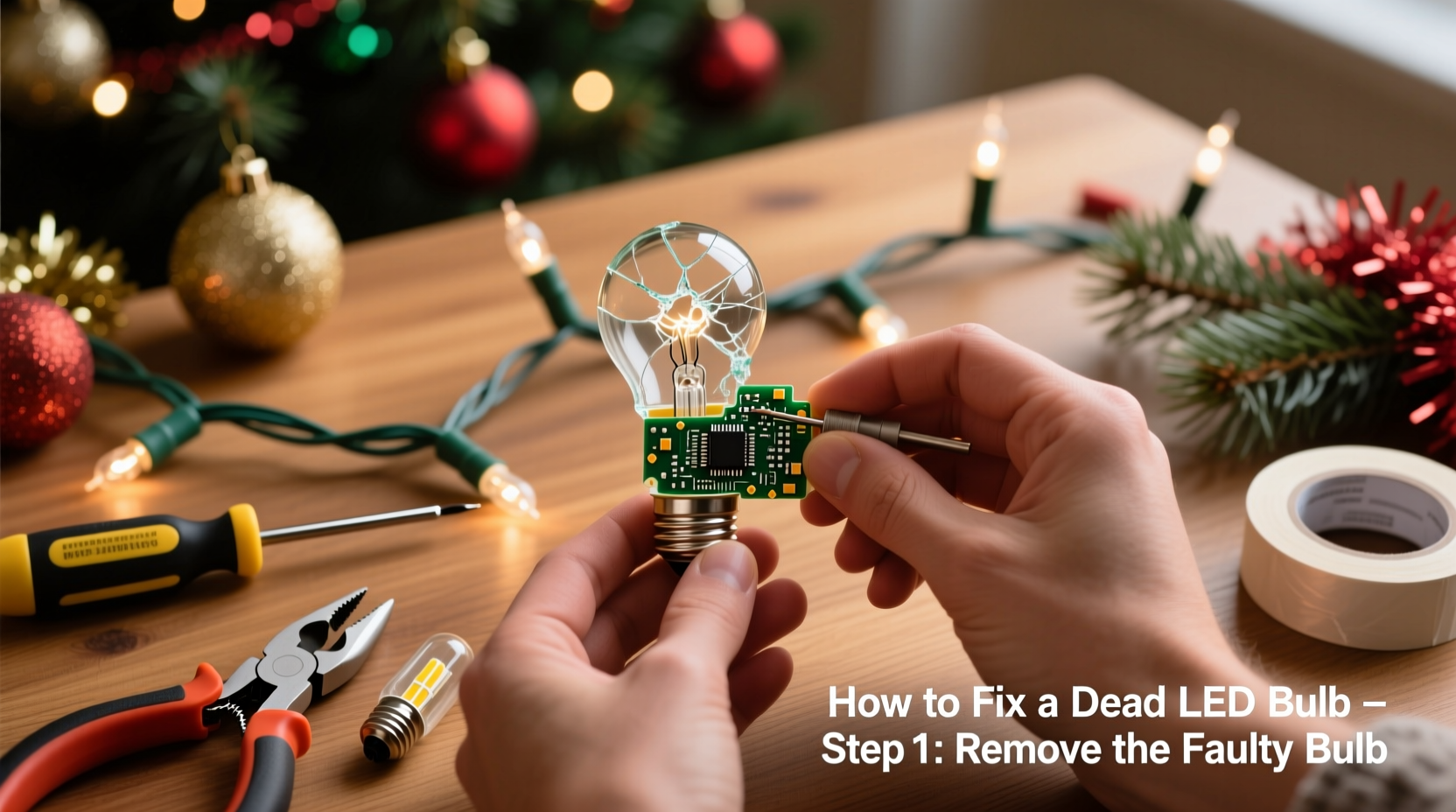
Most LED light strings are wired in series: electricity flows through each bulb in sequence. To prevent total failure from a single open circuit, manufacturers embed a tiny internal shunt—a conductive bypass path—inside each LED. When the LED is healthy, current flows through the semiconductor. But if the LED burns out or its filament fractures, the shunt should automatically activate, rerouting current around the dead unit. In practice, shunts fail silently about 15–20% of the time, especially in budget or older strands. When that happens, the circuit breaks—and everything downstream goes dark.
This behavior differs by design generation. Older “mini-light” style LEDs (often with E12 or wedge bases) rely heavily on shunt integrity. Newer “rectangular chip-on-board” (COB) or “integrated circuit” strands may use microcontrollers or built-in fuses instead—making diagnosis more nuanced but still repairable in many cases. Understanding your strand’s architecture is the first step toward effective repair.
Essential Tools & Safety Prep
Before touching any lights, prioritize electrical safety and precision. LED strands run on low-voltage DC (typically 12V–48V), but many plug into standard 120V AC outlets via built-in transformers or adapters. Never work on plugged-in lights. Always unplug before inspection or handling.
You’ll need:
- LED bulb tester (handheld or battery-powered; look for models rated for 2–5V DC)
- Small needle-nose pliers (with insulated grips)
- Replacement bulbs (exact match: voltage, base type, color temperature, and lens shape)
- Micro-screwdriver set (for removing plastic housings on sealed bulbs)
- Electrical tape or heat-shrink tubing (for insulation after reassembly)
- Magnifying glass or jeweler’s loupe (critical for spotting hairline cracks or discoloration)
Work on a clean, dry, non-conductive surface—like a wooden table covered with a static-dissipative mat. Avoid carpeted floors or humid basements. Keep pets and children away from small parts and loose wires.
Step-by-Step Diagnostic & Repair Process
- Unplug and inspect visually: Lay the strand flat under bright light. Look for obvious damage: cracked lenses, charred plastic near bases, bent leads, or brownish discoloration on the LED dome. Note which section(s) are dark—if only one segment is out, focus there.
- Identify the circuit layout: Most strands have repeating segments of 10–50 LEDs, each with its own shunt loop. Find the manufacturer’s label or check packaging for “section length.” If unavailable, count bulbs between visible solder joints or wire splices—these often mark segment boundaries.
- Test from the power end: Plug in a working section (if possible) or use a tester. Starting at the first bulb closest to the plug, test each LED sequentially. When you reach a bulb that shows no continuity *and* doesn’t light on the tester, mark it. That’s your prime suspect—but don’t stop yet.
- Check neighboring bulbs: Test the two bulbs immediately before and after the suspect. A failed shunt in the bulb *before* the dark one can also interrupt current flow. If bulb #23 is dark and bulb #22 shows no shunt continuity on your tester, bulb #22 is likely the culprit—even if its lens looks intact.
- Remove and examine the suspect bulb: Gently twist or pry the bulb from its socket (most are friction-fit). For sealed units, use micro-screwdrivers to separate the housing. Inspect the LED chip under magnification: look for micro-fractures, blackened anodes, or separated bond wires. If the chip appears intact but the bulb tests dead, the shunt has likely fused open.
- Install the replacement: Insert the new bulb firmly. Ensure polarity matches if marked (anode/cathode orientation matters on non-shunted replacements). Reassemble housings carefully—don’t overtighten screws. Wrap exposed leads with electrical tape if reusing original sockets with compromised insulation.
- Verify restoration: Reconnect the strand to power (still unplugged during assembly). Once fully reassembled, plug in and test. If the section remains dark, repeat steps 3–6—but expand your search to the next suspected segment.
Do’s and Don’ts: Critical Repair Guidelines
| Action | Do | Don’t |
|---|---|---|
| Bulb Replacement | Match voltage (e.g., 2.5V), base type (e.g., T1¾ wedge), and forward current rating exactly. | Substitute incandescent or higher-voltage LEDs—even if they fit physically. |
| Testing Method | Use a dedicated LED tester or multimeter diode mode with known-good reference bulbs. | Rely solely on visual inspection or assume “if it’s not burnt, it’s fine.” |
| Handling | Wear anti-static wrist straps if repairing indoors in low humidity; hold bulbs by the base, not the lens. | Touch bare LED leads with bare fingers—oils and salts accelerate corrosion. |
| Power Testing | Test only after full reassembly and insulation; never power up with exposed wires or open housings. | “Quick-check” with power applied while probing bulbs directly with metal tools. |
| Storage Post-Repair | Coil loosely (not tightly wound) and store in climate-controlled space below 77°F/25°C. | Leave repaired strands coiled in attics or garages where temperature swings exceed 40°F–104°F. |
Real-World Example: The Case of the “Ghost Section”
Janet, a high school art teacher in Portland, Oregon, inherited her mother’s vintage 2012 LED icicle lights—120 feet long, with 1,200 warm-white bulbs. Two weeks before Christmas, the middle 20-foot section went dark. She tried resetting the fuse (located in the plug housing), checked connections, and swapped the strand into another outlet—no change. Rather than buy $85 in replacements, she watched a 12-minute YouTube tutorial on LED shunt testing, ordered a $14 LED tester and 50 matching replacement bulbs, and spent 45 minutes diagnosing.
She discovered the issue wasn’t the dark section itself—but the last bulb of the *preceding* lit section. Its lens was pristine, but under magnification, she saw a hairline fracture radiating from the cathode lead. The shunt had failed open. After replacing that single bulb, the entire 20-foot section reignited. Janet later tested all bulbs in that segment and replaced three more with marginal shunt resistance—preventing future failures. Her total cost: $22. Her saved strand: still in use five holiday seasons later.
Expert Insight: What Industry Technicians Know
“Most consumer-grade LED light failures aren’t due to LED degradation—it’s shunt reliability and thermal stress from poor ventilation in storage boxes. A bulb tested at room temperature may pass, then fail when heated to 140°F inside a sealed plastic bin. Always test *after* simulating real-world conditions—or better yet, replace the entire segment if more than two bulbs show borderline shunt resistance.” — Marcus Lin, Senior Electronics Technician, HolidayLight Labs (12+ years servicing commercial display installations)
Lin emphasizes that shunt failure rates spike dramatically after year three, especially in strands stored in garages or attics. His team sees a 40% increase in “intermittent dark sections” among lights stored above 86°F—confirming that environment matters as much as usage.
Troubleshooting FAQ
Why does my strand flicker after replacing one bulb?
Flickering usually indicates a weak shunt in a *different* bulb downstream—or upstream—that’s now struggling to maintain stable current flow. It may also signal voltage drop across aging wiring. Test every bulb in the affected segment, not just the visibly dead one. Replace any bulb showing >10% variance in forward voltage reading versus the rest of the strand.
Can I bypass a dead bulb entirely with a wire jumper?
Technically yes—but strongly discouraged. Jumping creates a short-circuit path that overloads remaining shunts and increases heat buildup. This accelerates failure in adjacent bulbs and poses fire risk, especially in densely packed indoor displays. Replacing the bulb maintains designed current regulation and thermal load distribution.
My strand has no removable bulbs—it’s all one molded strip. Is repair possible?
Yes—but requires micro-soldering. Identify the faulty LED using thermal imaging (a warm spot indicates current trying but failing to pass) or continuity tracing. Desolder the defective chip using a fine-tip 25W iron and flux, then solder in an exact-spec replacement. Only attempt this if you have SMD soldering experience and a temperature-controlled station. Otherwise, contact the manufacturer: many offer free segment replacements under limited warranties.
When Replacement Is the Smarter Choice
Not every strand warrants repair. Consider full replacement if:
- The strand is over seven years old and has required ≥3 bulb replacements in one season;
- You own multiple identical strands and have already replaced bulbs across several—consolidating into fewer, newer strands improves reliability and reduces plug load;
- The manufacturer discontinued the bulb model and replacements are priced above $1.50/unit (at that point, a new 100-bulb strand often costs less than 30 replacements);
- You notice consistent dimming across large sections, indicating transformer degradation—not isolated LED failure.
Modern UL-listed LED strands now include diagnostic LEDs on plugs (blinking patterns indicate fault types) and modular connectors enabling section-level swaps. Investing in these features pays dividends in long-term maintainability.
Conclusion: Light Up with Confidence, Not Convenience
Fixing a single dead LED isn’t just about saving money—it’s about intentionality. It’s choosing sustainability over disposability, understanding over assumption, and care over convenience. Each bulb you restore extends the life of a product designed to bring warmth and connection during the coldest months. You’re not just repairing lights—you’re preserving memories tied to that strand, honoring craftsmanship, and reducing electronic waste that too often ends up in landfills or informal recycling streams.
Start small: pick one strand this season. Gather your tools. Follow the steps—not rushing, not skipping the magnifier, not assuming the dark bulb is the problem. When the lights reignite, you’ll feel more than satisfaction—you’ll feel agency. And once you’ve mastered one strand, try a second. Share your success with a neighbor struggling with the same issue. Post your tip in a local community group. Repair isn’t solitary—it’s communal, teachable, and quietly revolutionary.




 浙公网安备
33010002000092号
浙公网安备
33010002000092号 浙B2-20120091-4
Comments
No comments yet. Why don't you start the discussion?