
Folding a fitted sheet is one of those household tasks that seems simple in theory but often turns into a crumpled disaster in practice. Unlike flat sheets or pillowcases, fitted sheets come with elastic corners and stretchy fabric that resist neat folding. As a result, many people end up stuffing them into linen closets in a messy heap, only to pull out a tangled wad the next time they’re needed.
The truth is, there’s no magic trick—but there *is* a reliable method. With a little patience and the right technique, you can fold a fitted sheet so it looks clean, stores easily, and doesn’t unravel when you open the drawer. This guide walks you through a precise, repeatable process that professionals and organized households use. Whether you're tackling cotton percale, jersey knit, or deep-pocketed mattress protectors, this approach works across fabric types and sizes.
Why Fitted Sheets Are So Hard to Fold
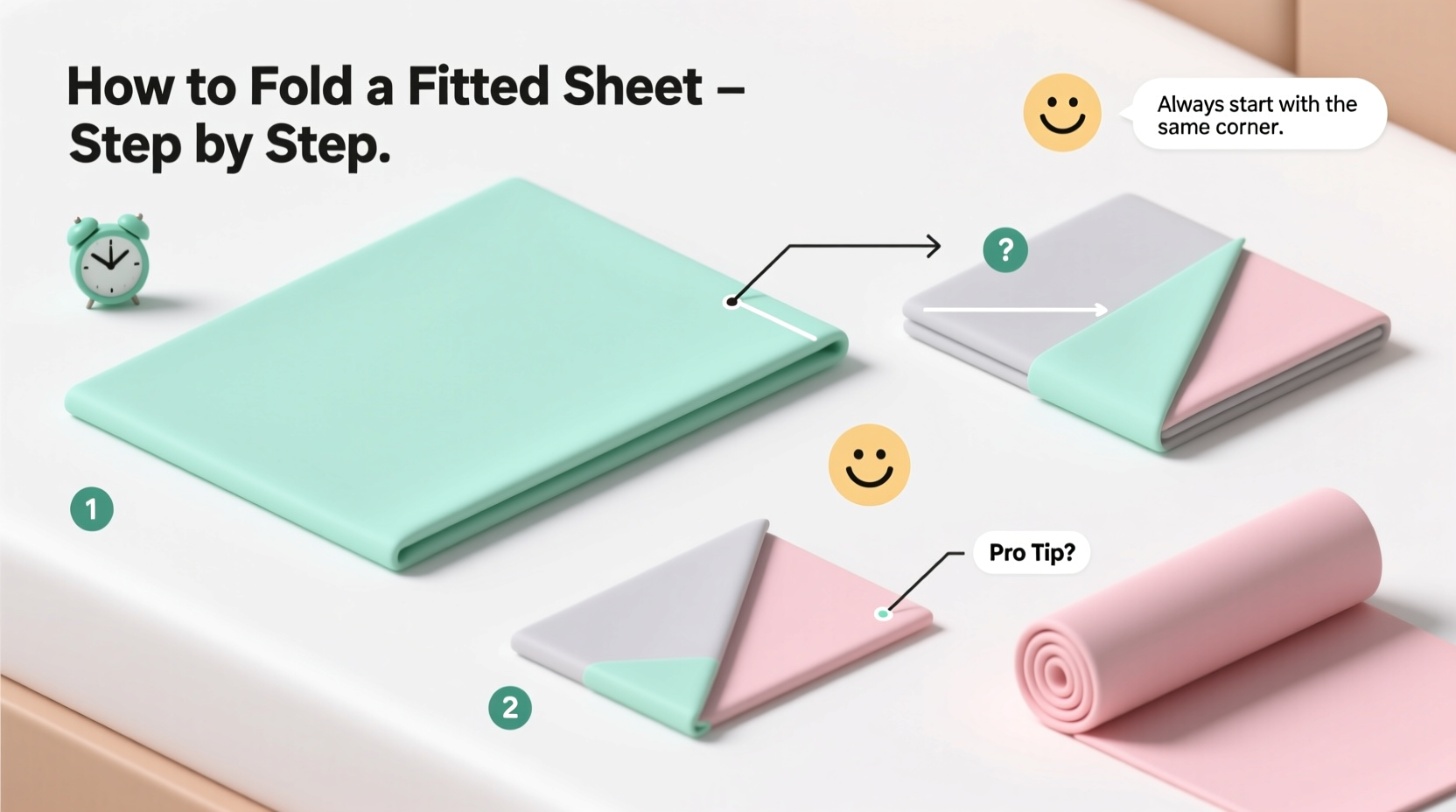
Fitted sheets are designed for function, not storage. Their elasticized edges grip the corners of a mattress to keep them snug and wrinkle-free during use. But that same elasticity makes them floppy and unpredictable when removed. The four corner pockets naturally want to curl inward or twist, which disrupts symmetry and makes alignment difficult.
Additionally, most people try to fold fitted sheets like flat ones—starting from one side and rolling or tucking as they go. This rarely works because the corners don’t lie flat. Without anchoring the elastic corners first, any attempt at folding quickly becomes chaotic.
“Folding a fitted sheet isn’t about force—it’s about structure. You have to neutralize the elasticity before you begin.” — Sarah Lin, Home Organization Consultant
The key lies in reversing the natural shape of the sheet: turning the elastic edges inward and nesting the corners together so they form a stable base. Once that foundation is set, the rest follows logically.
Step-by-Step Guide to Folding a Fitted Sheet Neatly
The following method has been tested by professional organizers, laundry services, and home economists. It takes about 90 seconds once you get the hang of it and results in a compact, rectangular fold that stacks cleanly with other linens.
- Start with the sheet inside out. Hold the sheet so the elastic edges face outward and the fabric that touches the mattress is visible. This might feel counterintuitive, but it gives you better control over the corners.
- Identify two adjacent corners. Reach into one top corner (e.g., top-left) and grasp it with one hand. Then reach into the corner connected to it along the short edge (bottom-left), and place that corner inside the first one. Push it all the way in so both corners are nested together, right sides touching. The elastic edges should now be tucked inside each other.
- Repeat with the opposite pair. Move to the other side of the sheet—the top-right and bottom-right corners. Do exactly the same thing: take one corner in each hand and tuck one inside the other. Again, push them fully together so they form a matched set.
- Bring the paired corners together. Now you have two bundles of nested corners—one in each hand. Bring them toward each other, flipping the fabric gently so the outside (top-facing side) of the sheet begins to lie flat. As you do this, the sheet will naturally start to collapse into a more rectangular shape.
- Lay it down and smooth out wrinkles. Place the sheet on a flat surface like a bed or table. Use your hands to press out any creases, especially along the center where the fabric may still be bunched. At this point, the elastic is contained, and the sheet should resemble a loose rectangle.
- Fold lengthwise once or twice. Fold the sheet in half (or thirds, depending on size) along its longest edge. For a queen or king sheet, folding in thirds helps maintain a compact shape. Press down lightly after each fold to keep layers aligned.
- Finish with crosswise folds. Now fold the sheet upward in even increments—usually two or three times—to create a neat square or rectangle. Tuck any loose edges underneath if necessary.
Common Mistakes That Lead to Failure
Even when following instructions, small missteps can derail the entire process. Here are the most frequent errors—and how to avoid them.
| Mistake | Why It Causes Problems | Solution |
|---|---|---|
| Trying to fold while holding the sheet upright | Gravity pulls corners apart; hard to align edges | Lay it down midway through the process for better control |
| Not fully nesting the corners | One corner slips out, causing asymmetry | Push corners deep inside each other until they lock |
| Folding too quickly before flattening | Bunching leads to an uneven final shape | Pause to smooth fabric after joining corner pairs |
| Starting with the wrong side out | Elastic edges flap around, making pairing harder | Always begin with the mattress-side facing out |
| Using a cluttered or narrow surface | Not enough space to manipulate the fabric | Use a clear bed or dining table for room to work |
How to Store Folded Fitted Sheets for Long-Term Use
A perfectly folded sheet is useless if it gets crushed or tangled moments later. Proper storage preserves your effort and keeps linens accessible.
- Pair with its matching flat sheet. After folding, place the fitted sheet inside the folded flat sheet. Roll or tuck the set together so they stay together as a unit.
- Add a label if needed. If you own multiple sets in similar colors, attach a small fabric tag or safety pin with the size (Twin, Queen, etc.) written on it.
- Store vertically when possible. Like books on a shelf, stacked sheets are easier to browse if stored upright in a basket or bin. This prevents the bottom ones from being squashed.
- Avoid damp environments. Moisture encourages mildew, especially in tightly packed cotton. Keep linen closets well-ventilated and away from bathrooms unless exhaust fans are used consistently.
Real Example: How One Family Reduced Linen Closet Chaos
The Rivera family had four beds and six sets of sheets, all crammed into a single closet. Every weekend, someone would pull out a fitted sheet only to find it twisted, stretched, or missing its mate. “We spent more time untangling than making beds,” said Maria Rivera, a teacher and mother of two.
After watching a folding tutorial based on this method, she spent one Sunday re-folding every sheet using the nested-corner technique. She then placed each fitted sheet inside its corresponding flat sheet and stored them vertically in a woven basket.
The change was immediate. “Now my kids can grab a set without asking me. No more ‘Mom, where’s the other one?’” Within a month, the linen closet required less than half the space it used to, and the sheets stayed fresh longer due to improved airflow.
Checklist: Perfect Fitted Sheet Folding Routine
Follow this checklist every time you fold a fitted sheet to ensure consistency:
- ☐ Wash and dry the sheet completely (damp fabric resists crisp folding)
- ☐ Clear a flat surface (bed, table, or floor)
- ☐ Turn the sheet so the mattress side faces out
- ☐ Nest one pair of adjacent corners (push one inside the other)
- ☐ Repeat with the opposite pair
- ☐ Bring the two corner bundles together, smoothing fabric as you go
- ☐ Lay flat and press out wrinkles
- ☐ Fold lengthwise into thirds (for larger sheets) or in half
- ☐ Fold crosswise into a compact rectangle
- ☐ Store with matching flat sheet and pillowcases
Frequently Asked Questions
Can this method work with extra-deep or oversized fitted sheets?
Absolutely. The technique relies on corner control, not sheet dimensions. For very large sheets (like California King or deep-pocket protectors), you may need a bigger workspace and slightly wider folds, but the sequence remains the same.
What if my sheet loses its shape after folding?
This usually happens if the corners weren’t fully nested or if the fabric wasn’t smoothed before final folding. Try again, taking more time to align the layers. Over time, high-quality cotton blends hold their fold better than thin knits.
Is there a faster way for people in a hurry?
Some recommend the “roll-up” method—rolling the sheet tightly from one end to the other—but this often creates a bulky cylinder that unravels easily. The nested-corner method takes only slightly longer but produces a far more stable result.
Final Thoughts: Mastery Is Just a Few Folds Away
Folding a fitted sheet isn’t a test of strength or agility—it’s a skill rooted in patience and precision. The frustration many feel comes not from inability, but from trying to force a method that ignores the sheet’s design. By working *with* the elastic instead of against it, you transform chaos into order.
Like learning to tie a tie or pack a suitcase efficiently, this technique rewards repetition. The first few attempts may feel awkward, but within a week, you’ll likely find yourself doing it automatically. And once mastered, it brings a quiet satisfaction—a small win in the daily rhythm of home care.




 浙公网安备
33010002000092号
浙公网安备
33010002000092号 浙B2-20120091-4
Comments
No comments yet. Why don't you start the discussion?