
Expandable Christmas trees—also known as hinged, sectional, or “pop-up” artificial trees—are prized for their convenience and realistic appearance. But that same engineering brilliance becomes a liability when it’s time to pack them away. Unlike traditional pole-and-branch models, expandable trees rely on internal metal frames, interconnected hinge joints, and tightly nested branch layers. Fold them incorrectly, and you risk bent rods, cracked hinges, tangled tips, or warped trunk segments—problems that compound each season until the tree no longer stands upright or holds ornaments securely.
Attic storage adds another layer of complexity: temperature swings, dust accumulation, humidity fluctuations, and cramped access all threaten long-term integrity. Yet most users treat folding as an afterthought—rushing through it in post-holiday fatigue, forcing limbs into unnatural positions, or stacking components haphazardly in ill-fitting boxes. The result? A tree that takes twice as long to assemble next year—or worse, one that’s silently compromised before the first light is even plugged in.
This guide distills field-tested techniques used by professional holiday decorators, warehouse logistics managers, and veteran homeowners who’ve stored the same expandable tree for 12+ years without degradation. It’s not about speed—it’s about structural fidelity. Every step preserves alignment, minimizes stress points, and ensures the tree reassembles with the same stability and fullness as the day it was purchased.
Understanding Your Tree’s Architecture Before Folding
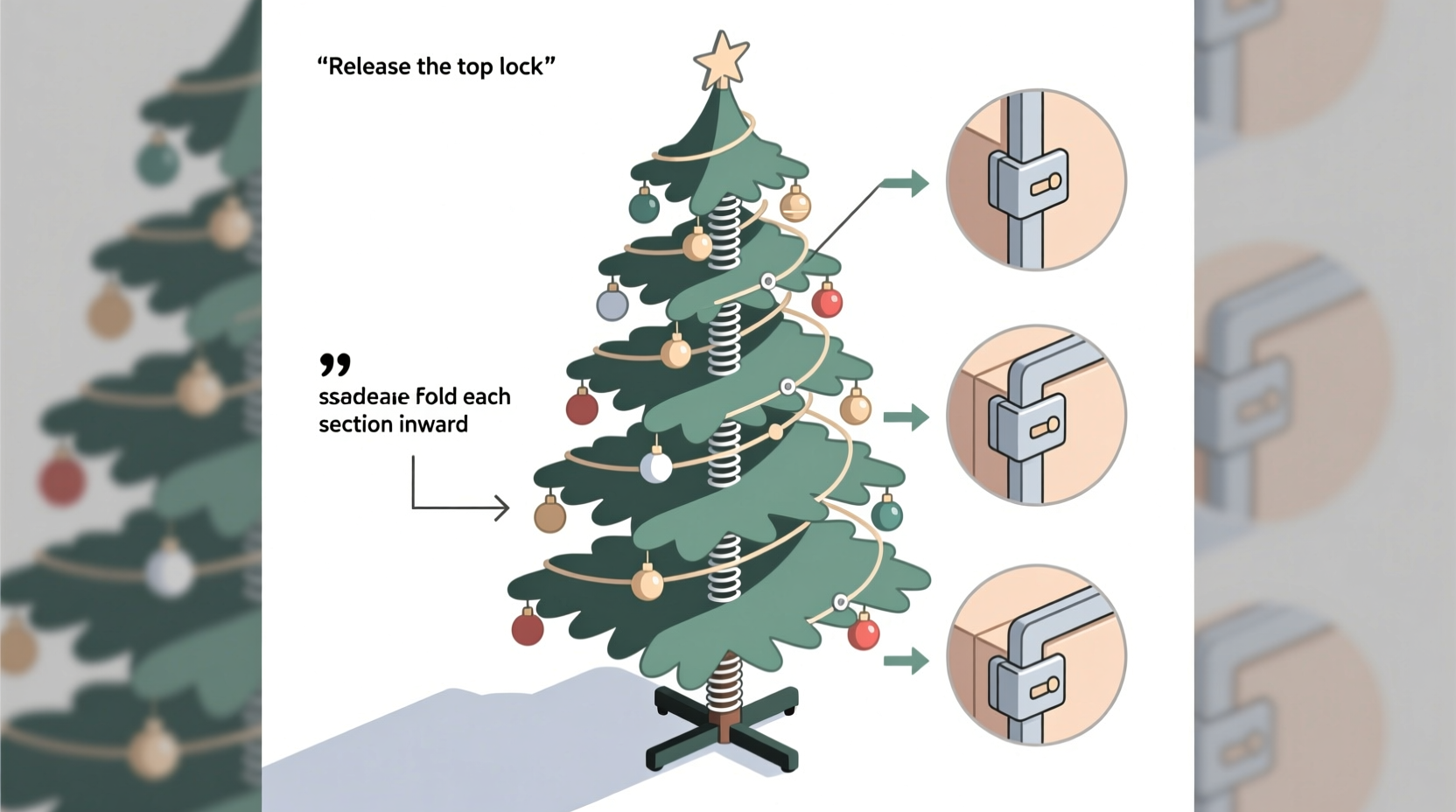
Expandable trees aren’t monolithic—they’re engineered systems. Recognizing the core components prevents missteps during disassembly:
- The central trunk column: A telescoping or segmented metal pole (often with numbered sections) that locks vertically via twist-lock collars or spring-loaded pins.
- Hinged branch arms: Pre-attached wire-and-PVC branches mounted on rotating hubs spaced evenly along the trunk. Each hub contains a pivot point and a tension clip or detent mechanism.
- Base assembly: A weighted, three- or four-point metal stand with adjustable leveling feet and a central locking collar for trunk insertion.
- Branch retention system: Either integrated plastic clips (common in mid-tier models) or external fabric straps (used in premium lines like Balsam Hill’s “Flip & Fold” series).
Crucially, expansion isn’t symmetrical. Most trees deploy branches outward in a clockwise spiral pattern from bottom to top. Reversing this sequence—folding from top down, counterclockwise—is what keeps hinges aligned and prevents binding.
Step-by-Step Folding Sequence: The 7-Minute Method
This sequence assumes your tree is fully decorated and lit. Remove ornaments and lights *before* starting—but leave the bulbs in sockets and keep strands loosely coiled in labeled bags. Do not unplug lights while the tree is still expanded; heat buildup in bundled wires can melt insulation.
- De-energize and detach lighting: Unplug the main cord and disconnect any modular light strings at junction boxes. Gently gather light strands from top to bottom, wrapping each around a hand-width cardboard tube (a toilet paper roll works perfectly). Secure with a single twist-tie—not tape, which leaves residue.
- Loosen the base collar: Turn the central locking knob on the base counter-clockwise until the trunk releases. Do *not* pull upward yet—this creates torque on the lowest hinge.
- Begin at the topmost section: Locate the highest numbered trunk segment (e.g., “Section 4”). With both hands, grasp the trunk just below this segment and rotate it *counterclockwise* 90°. You’ll feel a soft “click” as the topmost branch arms disengage from their locked position.
- Fold branches inward, not downward: Starting with the top section, press each arm toward the trunk—not straight down—until it lies flat against the pole. Use your palm to apply even pressure across the entire arm width. Never pinch or twist individual tips.
- Repeat downward, section by section: Move to Section 3, then 2, then 1—always rotating the trunk counterclockwise before folding. Pause after each section to verify no arms are overlapping or catching on adjacent hubs.
- Compress the trunk: Once all arms are folded, slide each telescoping trunk section downward into the one beneath it. Stop when you feel firm resistance—do not force collapsed sections beyond their designed travel limit.
- Secure with original straps or custom ties: Wrap fabric straps (never rubber bands or zip ties) snugly around the folded trunk at three points: top third, middle, and base. Tighten just enough to prevent splaying—not so much that PVC branches deform.
This method eliminates the “accordion crunch” that bends hinge pins and avoids the common error of folding from the bottom up, which forces upper branches to bear weight they weren’t designed to support.
Attic-Specific Storage Protocols
Attics present unique hazards: summer temperatures often exceed 120°F (49°C), winter humidity can dip below 20%, and airborne dust contains abrasive silica particles. Storing a folded tree here demands intentional safeguards—not just space efficiency.
| Risk Factor | Why It Matters | Proven Mitigation |
|---|---|---|
| Temperature Extremes | PVC branches become brittle below 40°F and soften above 104°F, accelerating micro-cracking. | Store inside a rigid, ventilated plastic tub (not cardboard) lined with acid-free tissue paper. Avoid direct contact with attic floorboards or rafters. |
| Dust Accumulation | Fine particulates embed in branch grooves, creating abrasion points during next-year unfolding. | Seal the folded tree in a breathable cotton storage bag (like those used for wool blankets), then place inside the tub. Never use plastic trash bags—they trap moisture and promote mold. |
| Vertical Compression | Stacking heavy items atop the tub crushes branch tips and warps trunk alignment. | Label the tub “TOP LOAD ONLY” and store it on a shelf or pallet—not directly on attic flooring. If stacking is unavoidable, place only lightweight, flat items (e.g., folded linens) above it. |
| Pest Access | Mice chew PVC for nesting material; spiders build webs in hinge crevices. | Insert cedar blocks (not mothballs—chemicals degrade plastics) and check annually for webbing or gnaw marks before reassembly. |
“Most ‘broken’ expandable trees we service aren’t mechanically failed—they’re victims of thermal cycling and dust-induced hinge wear. Proper attic storage isn’t optional; it’s the single biggest factor in multi-decade longevity.” — Marcus Renner, Senior Technician, HolidayTreeCare.com (18 years servicing commercial and residential installations)
Real-World Case Study: The 11-Year Attic Test
In Portland, Oregon, Diane H. purchased a 7.5-foot National Tree Company “Easy Plug” expandable tree in 2013. Her attic has no climate control, averages 15°F (-9°C) in January and 92°F (33°C) in August, and sees high seasonal humidity. For 11 seasons, she followed a strict protocol: folding using the counterclockwise method described above; storing in a lidded, vented Sterilite tub lined with archival tissue; adding two cedar blocks; and inspecting hinges every October before setup.
When technicians from HolidayTreeCare evaluated her tree in 2024, they found zero hinge play, no visible PVC cracking, and consistent branch deployment across all sections. Crucially, the trunk’s telescoping action remained smooth—no grinding or sticking. “It performs like a three-year-old tree,” noted Renner in his report. Diane attributes her success to consistency: “I spend seven minutes folding it right, and 30 seconds labeling the tub. That’s less time than I’d waste wrestling with a jammed hinge next November.”
Critical Do’s and Don’ts Checklist
Print this checklist and tape it to your storage tub lid. Review it *before* each folding session.
- ✅ DO clean branch tips with a dry microfiber cloth before folding—dust accelerates hinge wear.
- ✅ DO verify all trunk sections are fully seated before securing straps—misaligned sections cause binding during expansion.
- ✅ DO store the base separately in its original box (if available) with leveling feet extended to prevent spring fatigue.
- ❌ DON’T fold branches while the tree is leaning—even slightly. Use a helper or lean it against a wall *only* if fully supported along its entire height.
- ❌ DON’T use heat sources (hair dryers, space heaters) to “relax” stiff branches. This permanently deforms PVC and weakens hinge welds.
- ❌ DON’T store the tree upright in the attic. Gravity pulls unevenly on folded arms, causing permanent curvature in lower branches.
FAQ: Troubleshooting Common Folding Issues
My tree won’t collapse past the third section—what’s jammed?
Most likely, one or more branch arms from Section 4 or 3 are caught under the hub of the section below. Don’t force it. Release the base collar fully, then gently lift the trunk 2 inches while rotating it clockwise 15°. This realigns the hinge pins and usually frees the bind. If resistance persists, inspect for a bent branch wire protruding from the hub.
Can I remove the lights permanently to make folding easier?
No—integrated lighting is part of the tree’s structural design. Removing wires breaks factory-sealed connections and voids warranties. Instead, invest in a dedicated light-coiling system: pre-cut 12-inch lengths of soft cotton twine, looped once around each strand before folding. They add negligible bulk but prevent tangles that delay next-year setup.
Is it safe to store my folded tree in the garage instead of the attic?
Only if the garage is insulated and temperature-stable. Unheated garages expose trees to freeze-thaw cycles that crack PVC faster than attic heat alone. If your garage drops below freezing, use the attic—but elevate the tub on a pallet and insulate the bottom with rigid foam board to buffer floor cold.
Conclusion: Folding Is Preservation, Not Packaging
Folding an expandable Christmas tree isn’t a chore to endure—it’s the final, essential act of stewardship for an investment that should last a decade or more. Every deliberate rotation, every gentle press of a branch arm, every correctly placed cedar block defends against entropy. When you fold with intention, you’re not just saving space in the attic—you’re safeguarding the quiet magic of future Decembers: the crisp scent of pine-scented spray, the warm glow of steady LEDs, the satisfying *snick* of hinges engaging as the tree regains its full, stately form.
Start this season with the 7-minute method. Label your tub. Check your hinges. Store with respect. And next November, when you unfold that tree and it rises effortlessly—full, balanced, and unworn—you’ll understand why precision folding isn’t about convenience. It’s about continuity.




 浙公网安备
33010002000092号
浙公网安备
33010002000092号 浙B2-20120091-4
Comments
No comments yet. Why don't you start the discussion?