
Fitted sheets are the bane of many laundry routines. Unlike flat sheets or pillowcases, their elastic edges and curved corners resist neat folding. Tossed into closets haphazardly, they create clutter and make it harder to find matching sets. But mastering the art of folding fitted sheets isn’t reserved for hotel housekeepers or laundry experts—it’s a practical skill anyone can learn. With the right technique, you can transform that tangled corner of your linen drawer into a model of organization and efficiency.
The key lies in understanding the structure of the sheet and using consistent, deliberate movements. This guide walks you through a reliable method, shares common pitfalls, and offers storage strategies so your linens stay crisp, wrinkle-free, and easy to access.
Why Fitted Sheets Are So Hard to Fold
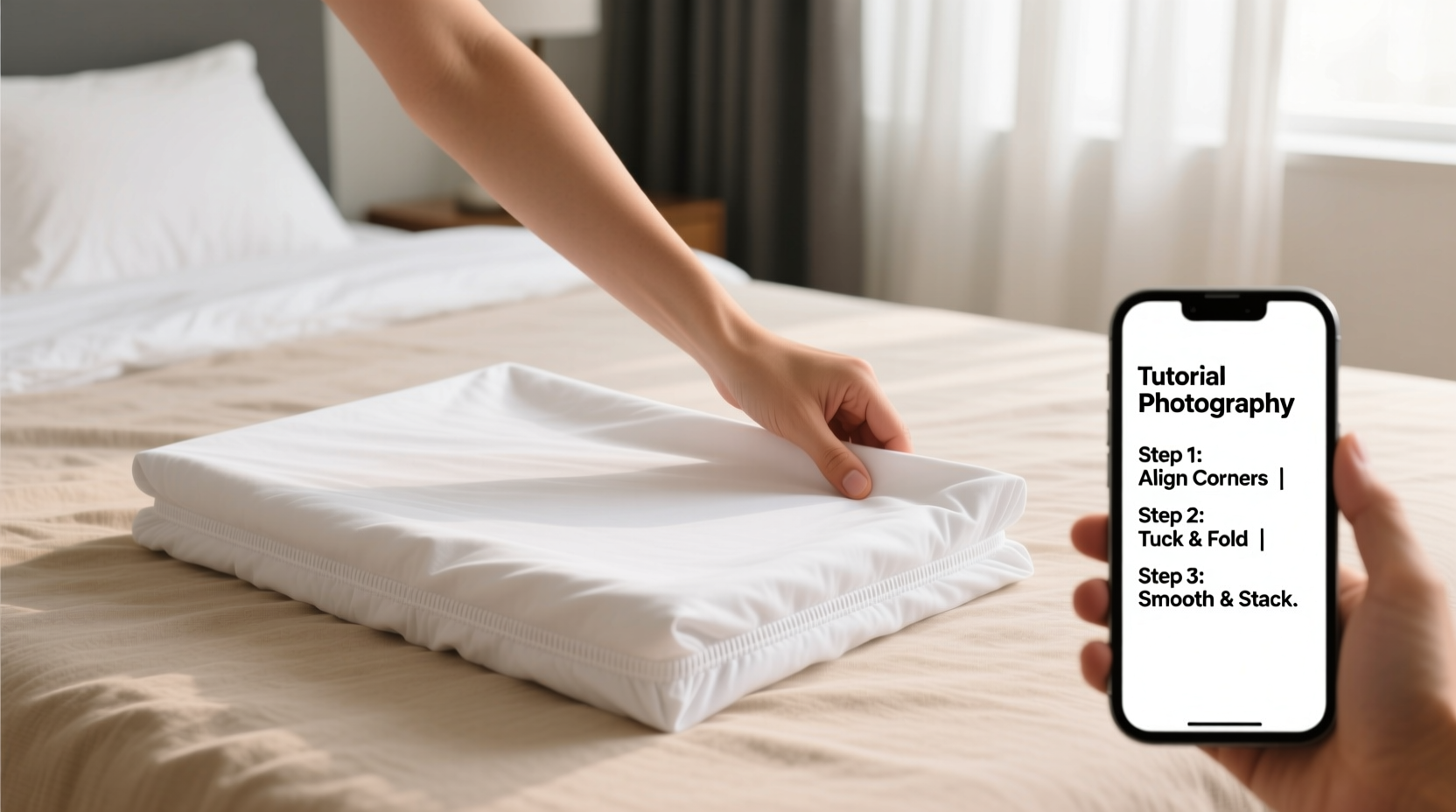
Fitted sheets have elasticized edges designed to grip mattress corners tightly. While this feature makes them functional on the bed, it works against neat folding. The stretchy fabric pulls unpredictably, corners twist, and without a clear folding plane, the sheet resists symmetry.
Most people attempt to fold fitted sheets while still seeing them as a “bed-covering” object, not a flat textile. This mindset leads to scrunching or stuffing rather than folding. The solution? Treat the sheet as a geometric shape and focus on aligning its corners first.
A Step-by-Step Guide to Folding Fitted Sheets Perfectly
This six-step method transforms chaos into order. Practice it slowly at first; within a few tries, it becomes second nature.
- Hold the sheet inside out. Pick up the sheet by two adjacent corners of the shorter edge (usually the top of the bed). Turn both corners inside out so the elastic is facing outward. This reverses the seams and prepares the sheet for alignment.
- Join the first pair of corners. Still holding the first two corners, tuck one hand into the second set of corners (the bottom edge). Bring those corners up and over, then snap them over the fingers of your hands. Now all four corners are paired—two in each hand—and the wrong side of the sheet is facing out.
- Align the corners precisely. With all four corners matched, smooth out any wrinkles down the length of the sheet. You should now see a rectangular shape forming, with the elastic neatly tucked between layers.
- Lay the sheet flat. Place it on a clean, smooth surface like a bed or table. Keep the corners aligned and gently pull the edges taut to flatten any remaining folds.
- Fold in thirds vertically. Take one vertical edge and fold it toward the center, about one-third of the way across. Repeat with the opposite edge, overlapping slightly if needed. This creates a long rectangle.
- Fold horizontally into a compact square. Starting from the bottom, fold the sheet upward in even increments—halves or thirds—until you reach a tidy, stackable size. Aim for consistency across all your sheets so they nest neatly together.
With practice, this process takes under a minute. The result is a crisp, rectangular bundle that stacks cleanly in drawers or shelves.
Do’s and Don’ts When Folding Fitted Sheets
| Do’s | Don’ts |
|---|---|
| Match corners before laying the sheet down | Try to fold without aligning corners first |
| Fold while the sheet is slightly warm from the dryer | Fold when the sheet is completely cold and stiff |
| Use a flat, spacious surface for smoothing | Fold on an uneven or cluttered countertop |
| Store folded sheets with their matching set | Keep fitted and flat sheets separated in different locations |
| Press gently with your palms to remove air pockets | Force folds that create deep creases or bunching |
Expert Insight: What Hotel Staff Know That You Don’t
Professional housekeeping teams fold hundreds of sheets weekly. Their consistency comes from standardized procedures and repetition. According to Maria Thompson, a senior housekeeper at a luxury resort chain with over 20 years of experience, precision starts before folding begins.
“Cleanliness and timing matter just as much as technique. We fold sheets within five minutes of removing them from the dryer. The heat relaxes the fibers, making them easier to manipulate. And we always do it on the bed—never on the floor. Gravity helps keep things flat.” — Maria Thompson, Senior Housekeeper, The Willoughby Hotel Group
She also emphasizes pairing sheets immediately: “We never store fitted and flat sheets separately. They go together, folded as a set, with the pillowcases tucked inside. That way, nothing gets lost, and staff can grab a complete set in one motion.”
Real Example: From Chaos to Closet Harmony
Sarah, a mother of three in Portland, Oregon, used to dread laundry day. Her linen closet was a jumble of mismatched sheets stuffed into baskets. Finding a full set meant unearthing half the shelf. After watching a quick tutorial based on the method above, she decided to reorganize her entire collection.
Over a weekend, she pulled out every sheet set, washed them fresh, and applied the corner-matching fold. She then stacked each set together—fitted, flat, and pillowcases bundled—and labeled small bins by bedroom. The transformation was immediate. Not only did her closet look orderly, but her family members actually started putting sheets away correctly.
“It sounds minor, but it changed my whole relationship with laundry,” Sarah said. “Now I don’t avoid opening that door. In fact, I kind of enjoy seeing everything lined up neatly.”
Checklist: Master Your Sheet Folding Routine
- ✅ Remove fitted sheets from the dryer promptly
- ✅ Identify and grip two adjacent top corners
- ✅ Flip corners inside out to expose elastic
- ✅ Attach bottom corners over top ones to pair all four
- ✅ Lay flat on a clean surface and smooth out wrinkles
- ✅ Fold vertically into thirds
- ✅ Fold horizontally into a compact rectangle
- ✅ Store with matching flat sheet and pillowcases
- ✅ Repeat the same method every time for consistency
- ✅ Re-fold any misshapen bundles during seasonal closet rotations
Alternative Methods for Different Skill Levels
While the corner-matching method is most effective, some prefer simpler approaches—especially when dealing with oversized or extra-deep sheets.
The Burrito Roll: Lay the fitted sheet flat, then roll it tightly from one end to the other, like a burrito. This minimizes creases and works well for delicate fabrics. Once rolled, tuck the ends inward and place in a storage bin.
The Pocket Fold: After aligning corners, fold the sheet diagonally into a triangle, then continue folding into smaller triangles. This method reduces bulk and is ideal for tight storage spaces.
The Compression Bag Method: For seasonal storage, vacuum-seal fitted sheets with their set. Though not traditional folding, this approach saves space and protects against dust and moisture.
No single method suits everyone. Experiment to find what feels intuitive for your routine and storage needs.
Frequently Asked Questions
Can I fold a wet fitted sheet?
It’s not recommended. Folding while damp can trap moisture, leading to mildew or musty odors. Dry completely first. However, removing the sheet from the dryer while still warm—but not wet—is ideal for ease of folding.
What if my fitted sheet has deep pockets or extra elastic?
Deep-pocket sheets require extra attention when aligning corners. Smooth the fabric carefully after pairing corners to ensure excess fabric doesn’t bunch. You may need to adjust folding width slightly to accommodate the added depth, but the core method remains the same.
Should I iron fitted sheets before folding?
Ironing isn’t necessary unless you prefer a crisp, formal look. Most modern cotton blends and percale weaves hold minimal wrinkles when folded promptly after drying. If desired, use a low-heat setting and focus only on visible creases around the edges.
Conclusion: Transform Your Linen Storage Habits Today
Folding fitted sheets like a pro isn’t about perfection—it’s about consistency and intention. Once you internalize the rhythm of matching corners and smoothing fabric, the process becomes automatic. The payoff extends beyond aesthetics: organized linens save time, reduce stress, and extend the life of your bedding by minimizing unnecessary wear from constant unfolding and refolding.
Start with one set. Practice the steps slowly. Then apply it to the rest of your collection. Soon, opening your linen closet will feel less like rummaging and more like selecting from a curated wardrobe of comfort.




 浙公网安备
33010002000092号
浙公网安备
33010002000092号 浙B2-20120091-4
Comments
No comments yet. Why don't you start the discussion?