
Folding a fitted sheet has long been considered one of life’s small but persistent challenges. The elastic corners, uneven edges, and tendency to twist make it difficult to achieve anything resembling neatness. Most people end up with a crumpled ball tucked into a linen closet, hoping no one ever sees inside. But there is a better way—one that’s fast, consistent, and used by professionals and military personnel around the world.
The military method for folding fitted sheets transforms chaos into order. It relies on precision, symmetry, and a systematic approach that turns what feels like an impossible task into a repeatable two-minute routine. Once mastered, this technique ensures your linens are stored uniformly, look professional, and take up minimal space. No more mismatched stacks or tangled corners.
The Problem with Traditional Folding Methods
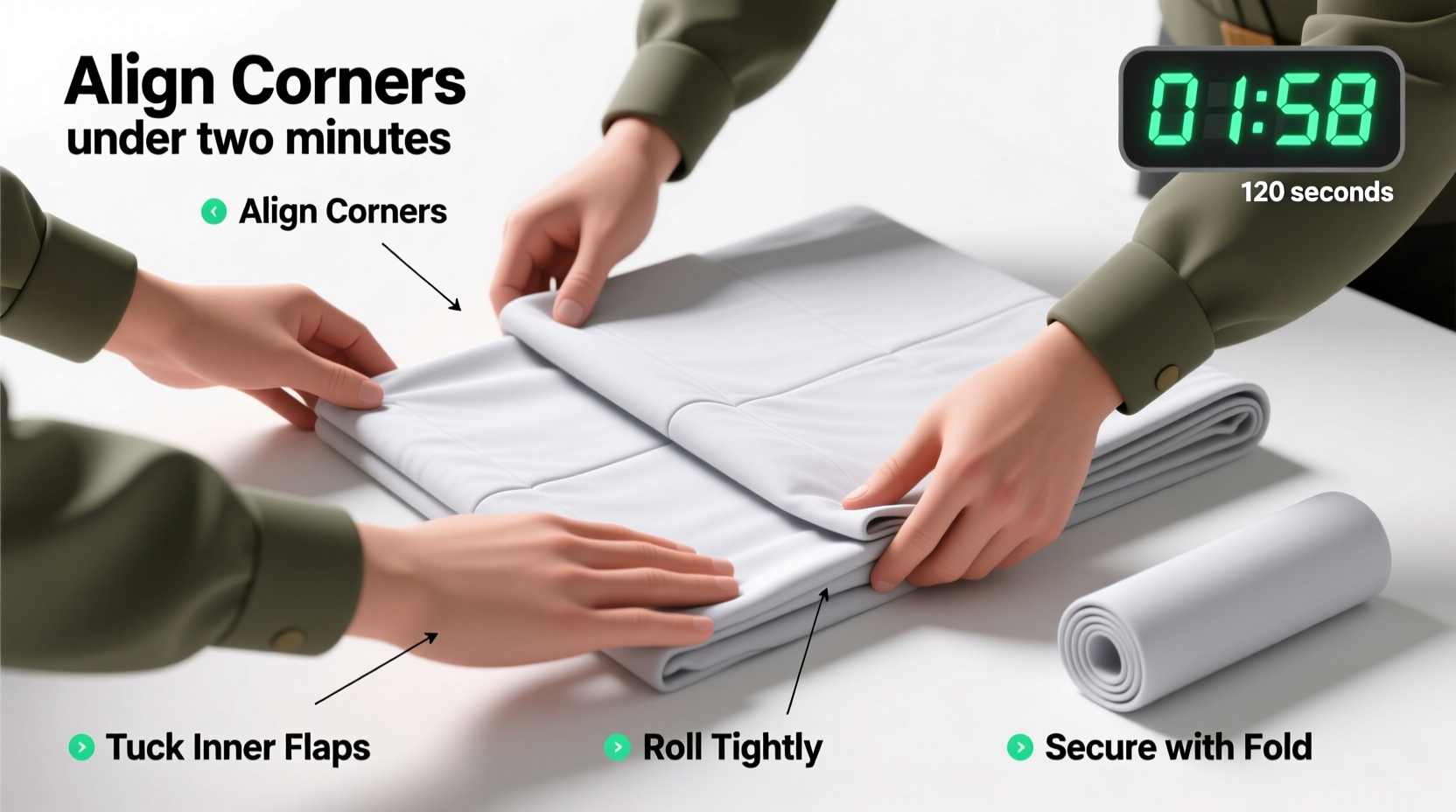
Most home folding techniques for fitted sheets involve random tucking, rolling, or stuffing the fabric into itself. These approaches rarely produce consistent results and often lead to creased, bulky bundles that don’t stack well. Over time, improperly folded sheets develop permanent wrinkles, become harder to iron, and can even degrade faster due to uneven stress on the fabric.
Common mistakes include:
- Folding while the sheet is still slightly damp, leading to mildew and odors
- Starting from the wrong corner, creating asymmetry
- Not aligning elastic edges properly, resulting in bulges
- Relying on speed over structure, which defeats the purpose of neat storage
These issues compound when multiple sets are stored together. A single misfolded sheet can throw off an entire stack, making retrieval frustrating and inefficient. This is why structured systems—like the military method—are so effective. They eliminate guesswork and standardize the process.
Why the Military Method Works
The military method isn’t just about aesthetics; it’s rooted in operational efficiency. In barracks and field operations, space is limited, and every inch counts. Uniformity allows for quick identification, compact storage, and durability over repeated use. These same principles apply at home.
This method works because it:
- Aligns all four corners precisely, eliminating slack
- Uses the sheet’s natural elasticity as part of the folding mechanism
- Creates clean lines and right angles for stacking compatibility
- Takes advantage of tactile feedback—once you’ve done it twice, muscle memory kicks in
“Standardized folding isn’t about perfection—it’s about consistency. In both military and household settings, uniformity reduces clutter and increases efficiency.” — Master Sergeant Elena Ruiz, U.S. Army (Ret.), Household Systems Instructor
The goal isn’t to create museum-worthy origami. It’s to produce a compact, flat rectangle that stores cleanly alongside other linens and unfolds without resistance. That’s exactly what the military method delivers.
Step-by-Step Guide: Folding a Fitted Sheet the Military Way
Follow these steps carefully. With practice, you’ll complete the entire process in under 120 seconds.
- Hold the sheet lengthwise: Stand with the sheet held in front of you, long side horizontal. Identify the top two corners—the ones that go over the head of the bed. Grip one corner in each hand, keeping your arms extended.
- Turn one corner inside out: Without dropping the first corner, bring your right hand inward and flip the right corner over your left hand so the inside of the sheet faces outward. Now both corners are nested, right sides touching, elastic edges aligned.
- Pinch and secure the paired corners: Use one hand to hold both corners together tightly between your fingers. You should feel both elastics gripping your hand uniformly.
- Locate the bottom two corners: Bend forward slightly and pick up the remaining two corners with your free hand. Again, turn one inside out and nest it over the other, matching the previous step. You now have two pairs of joined corners.
- Connect all four corners: Bring the second pair up to meet the first. Tuck them completely inside the first pair so all elastic edges are enclosed and facing the same direction. At this point, the sheet resembles a loose rectangle with no visible elastic.
- Lay flat and smooth: Place the sheet on a firm surface like a table or bed. Smooth out any wrinkles with your palms, ensuring the fabric lies evenly. The backside (non-printed side) should face up.
- Fold in thirds lengthwise: Take the left edge and fold it toward the center, about one-third of the way across. Repeat with the right edge, overlapping slightly if needed. Press down firmly along the folds.
- Fold crosswise into a square: Starting from the bottom, fold the sheet upward in thirds. Each fold should be roughly equal. After three folds, you’ll have a compact rectangle or square, depending on the original size.
- Store immediately: Place the folded sheet into your linen closet or drawer. If storing with its set, place the matching flat sheet and pillowcases inside the folded fitted sheet to keep everything together.
Do’s and Don’ts of Fitted Sheet Folding
| Do’s | Don’ts |
|---|---|
| Align corners by touch and feel—even in low light | Try to fold a wet or damp sheet |
| Use a hard, flat surface for final smoothing | Allow excess fabric to bunch during folding |
| Fold immediately after drying to prevent deep creases | Store folded sheets in plastic bins where moisture can accumulate |
| Label or sort by room to maintain organization | Force the fabric—if it resists, recheck corner alignment |
| Pair fitted and flat sheets before storing | Leave elastic edges exposed—they can snag other fabrics |
Real-Life Application: How One Family Transformed Their Linen Storage
The Thompson family of five had struggled for years with overflowing linen cabinets. Towels were rolled haphazardly, and fitted sheets lived in a jumbled bin labeled “miscellaneous.” After attending a community home organization workshop, Sarah Thompson learned the military folding method and decided to test it for one month.
She began by washing and drying all their sheets fresh, then applied the technique to each fitted piece. Within 45 minutes, she had transformed six mismatched piles into eight perfectly stacked rectangles—each color-coded by bedroom. She placed the corresponding flat sheet and pillowcases inside each folded fitted sheet, creating self-contained sets.
The impact was immediate. Her teenage daughter stopped complaining about not finding clean bedding. Her husband could finally locate the guest towels without emptying the entire shelf. Most importantly, the linen closet now required only half the space, freeing up room for seasonal items.
“I didn’t think folding could change anything,” Sarah said. “But having everything uniform made the whole system work better. We actually *want* to keep it tidy now.”
Checklist: Master the Military Fold in Five Sessions
To build confidence and consistency, follow this five-day practice plan:
- ✅ Day 1: Watch a silent video demo once, then attempt the fold three times with eyes open
- ✅ Day 2: Repeat the process focusing on tactile cues—notice how the elastic snaps when corners align
- ✅ Day 3: Time yourself. Aim to complete the fold in under three minutes
- ✅ Day 4: Fold two different sizes (e.g., twin and queen) back-to-back to test adaptability
- ✅ Day 5: Teach the method to someone else. Explaining it solidifies your understanding
By the end of the week, the sequence will feel automatic. Many users report needing only three attempts to internalize the rhythm of the fold.
Frequently Asked Questions
Can this method work with deep-pocket or extra-thick sheets?
Absolutely. The military method is scalable. For deeper pockets, take an extra moment to ensure all layers are pulled taut before the final smoothing. Thicker fabrics may require firmer pressure during folding, but the sequence remains unchanged.
What if my sheet has a pattern or design? Does orientation matter?
For visual consistency, always fold so the patterned or finished side faces down when stored. That way, when you unfold it later, the design appears immediately without flipping. During the folding process, lay the sheet with the non-patterned side up for easier handling.
I keep ending up with lopsided folds. What am I doing wrong?
Lopsided results usually stem from misaligned corners. Double-check that both pairs of corners are fully nested and that the elastic bands are flush. Also, ensure you’re folding on a flat surface—carpet or beds can distort the shape. Re-smooth the fabric before each fold.
Final Thoughts: Turn a Chore Into a Ritual
Folding fitted sheets shouldn’t be a source of frustration. The military method proves that with the right technique, even the most unruly laundry item can be mastered quickly and consistently. What once took trial, error, and resignation now becomes a brief, satisfying ritual—part of a larger commitment to order and care in the home.
Think of it as more than just folding. It’s about reclaiming control over the small details that shape daily life. A neatly folded linen closet isn’t just visually pleasing; it reflects intention, discipline, and respect for your belongings. And when guests pull back the covers at bedtime, they won’t just see crisp sheets—they’ll sense the quiet pride behind them.




 浙公网安备
33010002000092号
浙公网安备
33010002000092号 浙B2-20120091-4
Comments
No comments yet. Why don't you start the discussion?