
For urban dwellers in studio apartments, micro-lofts, or minimalist homes, the traditional freestanding Christmas tree often clashes with spatial reality. Floor space is precious—and sometimes nonexistent. Yet the emotional resonance of a holiday tree—the scent of pine (real or faux), the glow of lights, the ritual of ornamenting—remains non-negotiable. Enter the wall-mounted Christmas tree: a design-forward solution that transforms vertical surfaces into festive focal points. This isn’t novelty decor; it’s intentional spatial intelligence. When executed thoughtfully, a wall-hung tree delivers visual impact without footprint, enhances architectural lines, and aligns with contemporary aesthetics—from Scandinavian simplicity to industrial-chic and mid-century warmth. More than just space-saving, it invites creativity in material selection, lighting strategy, and personalization. Below, we break down exactly how to install one safely, stylishly, and sustainably—grounded in structural principles, real-world constraints, and interior design best practices.
Why Wall-Mounted Trees Work Better Than You Think
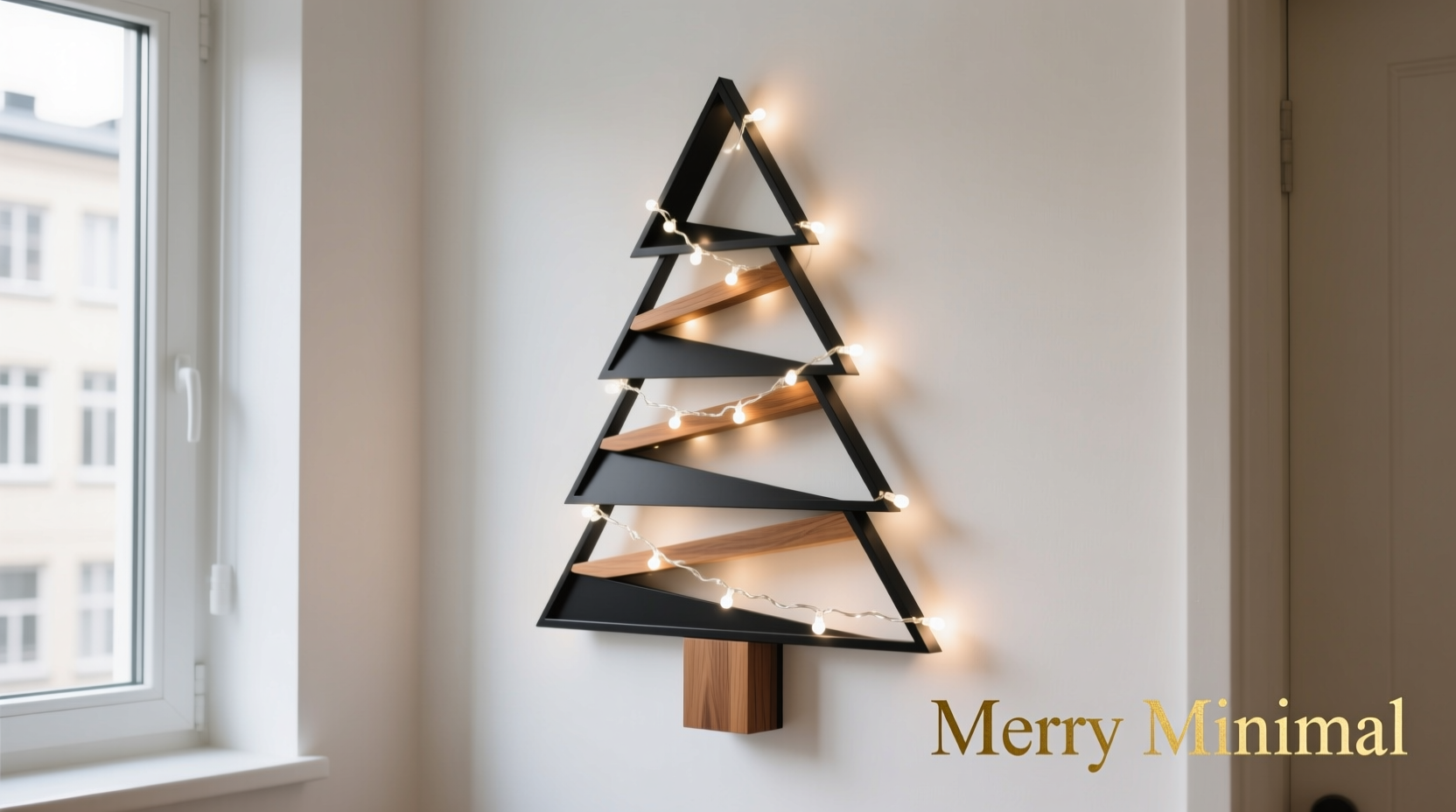
A wall-mounted tree bypasses three persistent pain points of conventional setups: cluttered floor space, tripping hazards (especially with pets or young children), and seasonal storage logistics. Unlike corner trees or tabletop versions, a wall installation anchors the holiday presence at eye level—where human attention naturally rests—making it feel immersive rather than incidental. Structural engineer and sustainable interiors consultant Lena Torres notes, “Vertical installations distribute load across multiple anchor points, reducing point stress compared to a single-floor base. When properly engineered, they’re often *more* stable than lightweight freestanding trees prone to tipping.” This stability increases when using low-profile, flat-profile trees—typically 3–6 inches deep—that minimize protrusion while maximizing visual depth through layered branches and strategic lighting. Crucially, wall mounting also eliminates the need for water reservoirs, stands, or bulky bases—cutting maintenance time by up to 70% according to a 2023 Apartment Therapy survey of renters in cities with median square footage under 650 sq ft.
Hardware & Structural Safety: What You Absolutely Must Know
Wall-mounting isn’t about brute force—it’s about precision anchoring. The wrong hardware can compromise drywall integrity, damage plaster, or worse, cause detachment. Begin with a stud finder: locate and mark every wall stud behind your intended mounting zone. Standard wood studs are spaced 16 inches apart (center-to-center) in most North American construction; metal studs require toggle bolts rated for steel framing. For drywall-only mounting (i.e., no access to studs), use heavy-duty hollow-wall anchors rated for *at least* 50 lbs per anchor—never rely on plastic drywall plugs or basic picture hangers. A typical medium-sized wall tree (4–5 ft tall) exerts dynamic load due to wind movement, ornament weight, and vibration—so calculate for 3× static weight. If your tree weighs 12 lbs, plan for anchors supporting 36+ lbs collectively.
Mounting configuration matters. Two-point suspension (top and bottom) is optimal: a top bracket bears primary load; a lower stabilizing bracket prevents forward sway and rotation. Use stainless steel or zinc-coated brackets designed for outdoor signage or art hanging—they resist corrosion from ambient humidity and tree resin. Avoid adhesive strips, command hooks, or magnetic systems for anything over 5 lbs; these lack shear strength and degrade unpredictably in temperature fluctuations.
| Hanging Method | Max Safe Weight | Best For | Risk If Misapplied |
|---|---|---|---|
| Stud-mounted L-bracket (dual) | 60–100 lbs | All tree types, real or faux, up to 6 ft | None—when installed correctly |
| Hollow-wall toggle bolt (4-point) | 30–45 lbs | Faux flat-profile trees (≤ 4.5 ft) | Anchor pull-through, drywall cracking |
| French cleat system | 50–80 lbs | Custom-built wooden or plywood trees | Improper angle causes slippage |
| Over-the-door hook + wall strap | 8–12 lbs | Lightweight mini-trees (≤ 3 ft), temporary use | Door warping, strap failure, top-heaviness |
A Step-by-Step Installation Guide (Tested in Real Small Spaces)
- Measure and map your wall zone. Identify a clear vertical area at least 6 inches wider than your tree’s widest branch span. Mark centerline and stud locations. Ensure 12+ inches of clearance above and below for visual breathing room.
- Select and prep your tree. Opt for a flat-profile faux tree (polyethylene or PVC with memory wire branches) or a custom-cut plywood silhouette. Trim any excess branch wire or protruding stems that could interfere with wall contact.
- Install upper bracket first. Using a level, mount a heavy-duty L-bracket centered on a stud at the tree’s intended top height (usually 6–12 inches below ceiling). Pre-drill pilot holes; tighten screws fully but avoid over-torquing drywall anchors.
- Attach lower stabilizer. Measure down 18–24 inches from the top bracket. Install a second bracket aligned vertically—this prevents torque. For extra security, add a discreet wall strap anchored to the tree’s base and a nearby stud.
- Hang and adjust. Lift tree carefully and slot top branch loop or mounting bar into upper bracket. Gently settle base into lower bracket. Check level side-to-side and front-to-back. Tighten all connections.
- Test before decorating. Apply light pressure at the tree’s outermost branch tip. Observe for movement, creaking, or bracket flex. If present, re-evaluate anchor depth or add a third support point.
Modern Styling Strategies for Visual Impact
A wall-mounted tree shouldn’t look like an afterthought—it should feel like curated architecture. Start with silhouette: asymmetrical profiles (e.g., tapered left, full right) echo mid-century line work; geometric cutouts (star, hexagon, or abstract fractal shapes) suit industrial lofts; and organic, hand-sketched outlines bring warmth to white-walled minimalism. Lighting transforms flatness into dimension: string 100–200 warm-white LED micro-bulbs (2700K color temp) along outer branch contours only—avoid filling the interior, which flattens depth perception. For drama, backlight the tree with a slim LED strip mounted 1–2 inches behind its perimeter, casting a soft halo on the wall.
Ornamentation follows a restrained hierarchy. Skip dense clusters. Instead, place 3–5 statement pieces: one large matte-black glass orb at the apex, two brushed-brass stars mid-canopy, and two minimalist ceramic baubles near the base. Let negative space breathe—this is where modern flair lives. Background treatment matters too. Mount your tree against textured plaster, limewash paint, or a subtle grasscloth wallpaper. Avoid glossy paint or mirrored walls unless intentionally amplifying reflection as part of the concept.
“Wall trees succeed when they stop being ‘trees’ and become integrated elements—like a sculptural shelf or floating planter. The moment it reads as furniture, not decoration, you’ve nailed it.” — Diego Marquez, Interior Designer and Founder of Compact Living Studio
Mini Case Study: The 380-Sq-Ft Brooklyn Studio
Maya R., a graphic designer living in a converted 1920s walk-up, faced a recurring dilemma: her 500-sq-ft studio had zero unused floor area. Her previous solutions—a 3-ft tabletop tree (obscured by her dining table) and a corner tree (blocking hallway flow)—felt like compromises. In December 2023, she installed a 4.5-ft flat-profile faux tree on her living room’s longest wall, directly opposite her sofa. She used dual stud-mounted brackets, added a hidden black velvet cord running from base to floor molding for subtle grounding, and strung warm LEDs only along the outer silhouette. She chose ornaments in monochrome charcoal, ivory, and brushed nickel—echoing her kitchen hardware and bookshelf accents. The result? Guests consistently comment on the “intentional calm” of the space. Maya reports no safety concerns, easy vacuuming beneath it, and a 40% reduction in pre-holiday setup time. Most importantly, her tree remains visible from every vantage point—including her bed—without obstructing movement. “It doesn’t live *in* my space,” she says. “It lives *with* it.”
FAQ
Can I hang a real pine or fir tree on the wall?
No—real cut trees lack structural integrity for vertical mounting. Their trunks aren’t load-bearing in compression, sap weakens adhesives and corrodes metal, and rapid drying causes branch brittleness and fire risk. Flat-profile faux trees made from flame-retardant materials are the only safe, code-compliant option for wall mounting.
Will this damage my painted wall or wallpaper?
Not if installed correctly. Stud-mounted brackets leave only two small screw holes. Hollow-wall anchors create slightly larger punctures—but these are easily patched and repainted. Avoid adhesive-based systems, which peel paint and leave residue. Always patch and touch up *after* removal, not before.
How do I store it year-round without taking up closet space?
Flat-profile trees disassemble into 2–3 panels or fold completely flat. Store vertically between bookshelves or behind a headboard—no box required. Label each panel with orientation arrows. For plywood silhouettes, hang them like artwork on a closet door using removable hooks.
Conclusion
Hanging a Christmas tree on the wall isn’t a concession to small-space living—it’s a declaration of design confidence. It signals that holiday tradition and contemporary aesthetics don’t compete; they collaborate. By prioritizing structural integrity over speed, embracing negative space over clutter, and treating the tree as architectural punctuation rather than standalone object, you transform constraint into distinction. You reclaim square footage not by removing joy, but by relocating it—upward, intentionally, beautifully. This season, skip the stand, skip the water tray, skip the floor battles. Measure your wall. Choose your silhouette. Anchor with care. Light with purpose. And let your space speak the quiet, confident language of modern celebration.




 浙公网安备
33010002000092号
浙公网安备
33010002000092号 浙B2-20120091-4
Comments
No comments yet. Why don't you start the discussion?