
Every year, the moment the tree goes up, so does the visual tension: a sturdy metal or plastic stand—often utilitarian, sometimes rust-spotted, always functional—sits exposed at the base of an otherwise curated holiday centerpiece. It’s the one element that breaks the illusion of magic. Yet hiding it isn’t just about aesthetics; it’s about intentionality. A concealed stand signals care, cohesion, and attention to detail—the hallmarks of a thoughtfully decorated space. This isn’t about camouflage. It’s about integration: transforming a necessary mechanical component into a deliberate design feature. What follows are field-tested, safety-conscious, and genuinely stylish solutions—drawn from interior stylists, professional holiday decorators, and real homes—that go far beyond tucking in a skirt.
Why Hiding the Stand Matters (Beyond Looks)
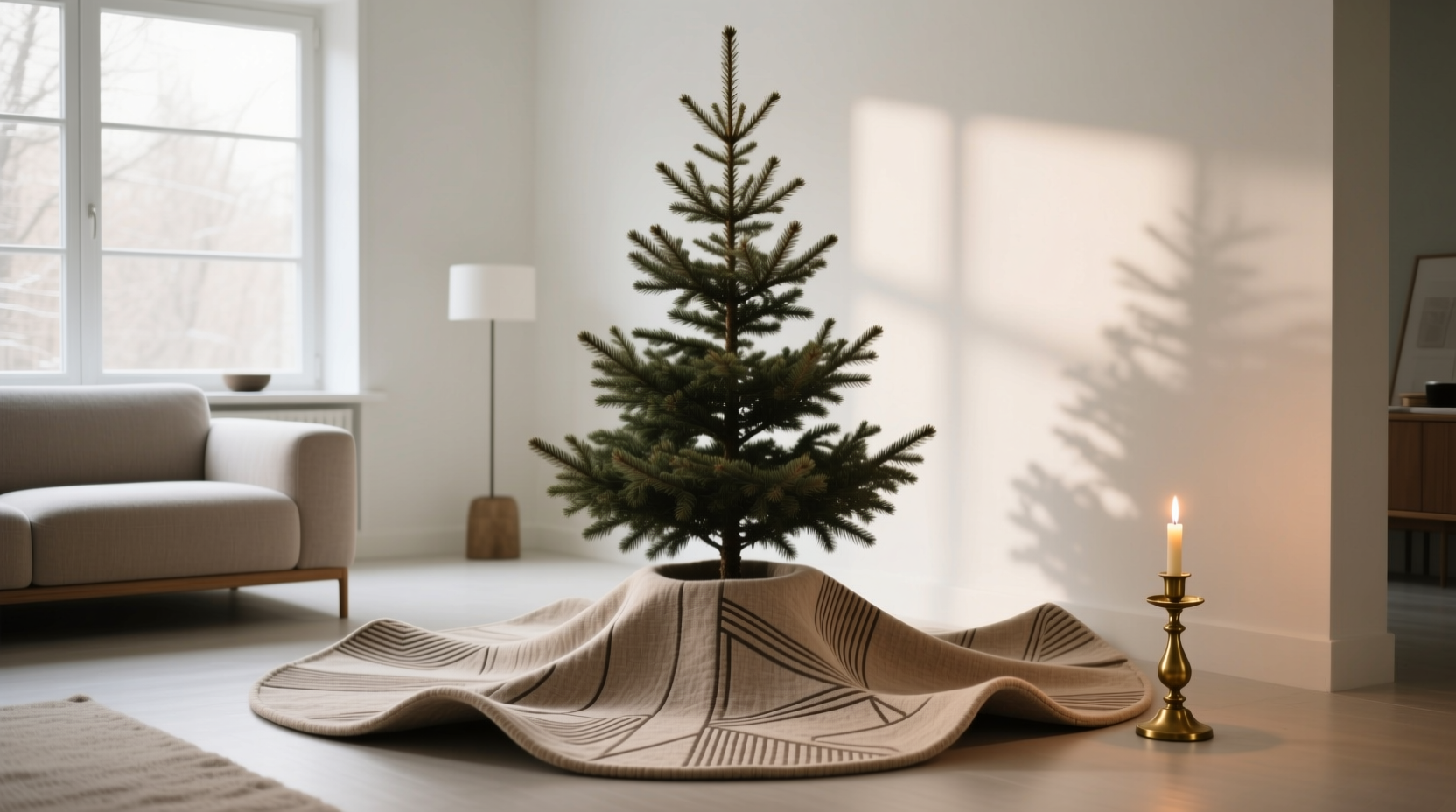
Most people assume concealment is purely cosmetic—but there are layered benefits. First, safety: an exposed stand creates tripping hazards, especially for children and pets drawn to low-hanging ornaments or lights near the base. Second, stability perception: a visible, angular stand can subconsciously undermine the sense of rootedness and grandeur a well-proportioned tree should convey. Third, maintenance access: many effective concealers—like removable fabric wraps or modular planters—are designed to lift or open easily, allowing quick water level checks and tightening without full disassembly. Finally, longevity: stands left uncovered are more prone to corrosion from spilled water, pine resin, and ambient humidity. A thoughtful cover acts as a micro-barrier, extending the life of both the stand and surrounding flooring.
7 Proven Methods to Conceal Your Tree Stand (Ranked by Practicality & Style)
These methods are ordered not by trendiness, but by real-world reliability, ease of setup, accessibility of materials, and long-term usability across multiple seasons. Each includes material notes, time investment, and key considerations.
- The Tiered Planter Stack — Uses three nested, shallow ceramic or concrete planters (12\", 16\", and 20\" diameters) placed concentrically around the trunk. Fill the outermost ring with faux moss, pinecones, and dried orange slices; the middle with battery-operated fairy lights; and the innermost with preserved eucalyptus. The stand remains fully accessible via the center opening.
- The Tailored Fabric Skirt (with Hidden Support) — A custom-sewn skirt using heavyweight linen or velvet, lined with fusible interfacing for structure, and fitted with a reinforced inner band that slips over the top rim of the stand—not the trunk. Includes discreet Velcro closures and a 3\" slit at the back for hose access.
- The Reclaimed Wood Cradle — Built from 1\"x6\" reclaimed oak boards cut into six 18\" segments, joined with brass corner brackets and sanded smooth. Designed to sit *over* the stand, not inside it—so the stand’s leveling feet remain grounded. Stained matte black or whitewashed to match floor trim.
- The Woven Basket Wrap — A large, rigid-walled seagrass or willow basket (minimum 24\" diameter), inverted and placed around the trunk. Trim the bottom 2\" off the basket base for clearance, then line the interior with moisture-resistant craft felt. Secure with two small neodymium magnets embedded in the felt and basket rim.
- The Faux Fur & Pine Bough Collar — Layered approach: first, wrap the stand’s vertical supports with wide, dense faux fur strips (glued with fabric adhesive); then nestle fresh-cut boughs (Douglas fir or blue spruce) into the fur’s texture, anchoring them with thin floral wire. Refresh boughs every 5–7 days.
- The Minimalist Concrete Ring — A single, 3\" thick, 22\" diameter precast concrete ring with a 10\" central void. Weighted enough to stay stable, textured on top with subtle leaf impressions, and sealed with penetrating silane-based sealer to resist water stains.
- The Vintage Trunk Base — A repurposed mid-century wooden trunk (no hinges or latches on the lid) placed directly over the stand. Lid removed and leaned against wall or stored. Interior lined with cedar planks to absorb moisture and deter pests.
What to Avoid: The Stand-Concealment Don’t List
Some popular “quick fixes” compromise safety, stability, or tree health. Interior designer Maya Lin, who has styled trees for luxury retail spaces for over 14 years, emphasizes this blunt truth: “If it looks like it might catch fire, tip over, or suffocate the trunk, it doesn’t belong near your tree—even for one night.” Here’s what professionals consistently reject:
| Method | Why It’s Risky | Better Alternative |
|---|---|---|
| Loose fabric draped over stand and tucked under tree skirt | Creates fire hazard near lights; traps heat and moisture against trunk; restricts airflow and accelerates rot | Tailored skirt with structural support and ventilation gap |
| Plastic storage bins or cardboard boxes | Non-breathable, promotes mold; static-prone (attracts dust and pet hair); easily knocked over | Concrete ring or planter stack with open base |
| Foam insulation or spray-on expanding foam | Chemical off-gassing near indoor air; irreversible; blocks all access to stand hardware | Modular wood cradle with removable side panels |
| Decorative rugs or runners wrapped around base | Tripping hazard; absorbs water and becomes slippery; hides leaks until damage is done | Woven basket with moisture barrier lining |
| Overloading with heavy ornaments or glass balls at ground level | Unbalances tree center of gravity; increases risk of toppling during minor contact | Strategic placement of lightweight, weighted decor (e.g., ceramic mushrooms, stone animals) outside the concealment zone |
Real-World Case Study: The Apartment Condo Dilemma
When Elena R., a graphic designer in Portland, moved into her 650-square-foot condo, she faced a triple constraint: hardwood floors she couldn’t risk scratching, a narrow 32\" doorway limiting tree width, and HOA rules prohibiting open flames—including candles near trees. Her 6.5' Fraser fir came with a standard 20\" tripod stand—bulky, black, and impossible to ignore against light oak flooring. She tried two failed attempts: a gauzy tulle skirt (slipped constantly) and a woven basket (too short, exposing the stand’s legs). Then she adapted the tiered planter method—using only two planters (14\" and 18\") due to space limits—and added a custom-cut 1/4\" plywood base painted matte charcoal to unify the look and protect the floor. She drilled four small holes in the plywood to align with the stand’s water-fill port and drainage screw. Result? The stand vanished visually, water access remained effortless, and her tree became the focal point—not its foundation. “It took 45 minutes to assemble,” she says, “and I reused every piece last year. That’s the win: no disposable decor.”
Step-by-Step: Building the Tailored Fabric Skirt (Under 60 Minutes)
This method delivers maximum polish with minimal tools. It works for stands up to 24\" in diameter and accommodates most common trunk diameters (4\"–8\").
- Measure & Draft: Measure the stand’s outer diameter and height. Add 1\" seam allowance to diameter; add 3\" to height for hem and overlap. Sketch a circle template on kraft paper.
- Cut Fabric: Fold heavyweight linen (or upholstery-weight cotton) in half. Pin template to fold. Cut two identical circles. Cut one 2.5\" wide strip, length = stand circumference + 2\".
- Create Inner Band: Fold strip in half lengthwise, wrong sides together. Press. Sew along raw edge. Turn right-side out and press flat. Insert 1/4\" braided elastic (12\" long) into channel, overlapping ends by 1\". Hand-stitch closed.
- Assemble Skirt: Place one circle right-side up. Center inner band on top, elastic side down, aligned with circle edge. Pin. Baste in place. Layer second circle (right side down) on top. Pin all layers. Sew 1/2\" from edge all around.
- Finish & Install: Clip curves. Turn right-side out through a 3\" opening left unsewn. Press seams flat. Hand-stitch opening closed. Slip over stand—elastic band grips the top rim securely. Adjust drape. Attach Velcro at back seam.
“The best concealers don’t shout ‘I’m hiding something.’ They whisper ‘this was always part of the plan.’ That requires precision—not padding.” — Javier Mendez, Lead Stylist, Evergreen Holiday Collective (12+ years styling for Nordstrom, Williams-Sonoma, and private residences)
FAQ: Standing Questions Answered
Can I use a tree skirt and a concealment method together?
Yes—but only if the skirt sits *outside* the concealment zone, not over it. For example: a tailored fabric skirt covering the stand itself, plus a traditional lace or burlap tree skirt extending outward 12–18\" beyond it. Never layer soft fabric directly over a warm light string or electrical cord near the base.
Will concealing the stand make watering harder?
Not if designed correctly. Every recommended method includes either a dedicated access point (slit, removable panel, central void) or sufficient clearance (minimum 1.5\") between the concealment and the stand’s fill cap. If you’re unsure, mark your water level with a waterproof pen on the stand’s interior before installing the cover.
How do I clean or maintain my concealment piece between seasons?
Planter stacks: Wipe ceramic with damp cloth; refresh dried botanicals annually. Fabric skirts: Spot-clean with mild detergent; store flat, not folded. Wood cradles: Light sanding and re-oiling every 2–3 years. Concrete rings: Rinse with water; reseal every 18 months. All should be stored in climate-controlled, dry areas—never attics or garages where temperature swings cause warping or cracking.
Conclusion: Make the Foundation Part of the Story
Your Christmas tree isn’t just a decoration—it’s a ritual object, a gathering point, a symbol of continuity. And like any meaningful structure, its strength lies not in what’s visible, but in what holds it upright, steady, and nourished. Hiding the stand isn’t about erasure. It’s about honoring the whole system: the living tree, the engineered stand, and the human hands that tend them. When you choose a method that balances beauty with breathability, elegance with access, and tradition with ingenuity, you’re not just dressing up a base—you’re deepening the intention behind the season. Start small: pick one method that fits your space, skills, and style. Build it, test it, refine it. Then next year, improve it. That’s how lasting holiday traditions begin—not with perfection, but with presence.




 浙公网安备
33010002000092号
浙公网安备
33010002000092号 浙B2-20120091-4
Comments
No comments yet. Why don't you start the discussion?