
Every year, an estimated 790 home fires in the U.S. are attributed to holiday decorations—nearly half involving Christmas trees, lights, or electrical malfunctions (NFPA, 2023). While festive lighting and ornaments bring joy, they introduce real, measurable risks: overheating wires, dry tree ignition, undetected water leaks from live-tree stands, and unattended candles near combustibles. Traditional “set-and-forget” decoration habits no longer suffice in homes with aging wiring, multi-room setups, or families with young children or pets. A smart home sensor integration strategy transforms passive decor into an active safety layer—one that monitors, interprets, and responds before danger escalates. This isn’t about adding complexity; it’s about embedding quiet vigilance into the rhythm of the season.
Why Sensor-Based Safety Outperforms Conventional Checks
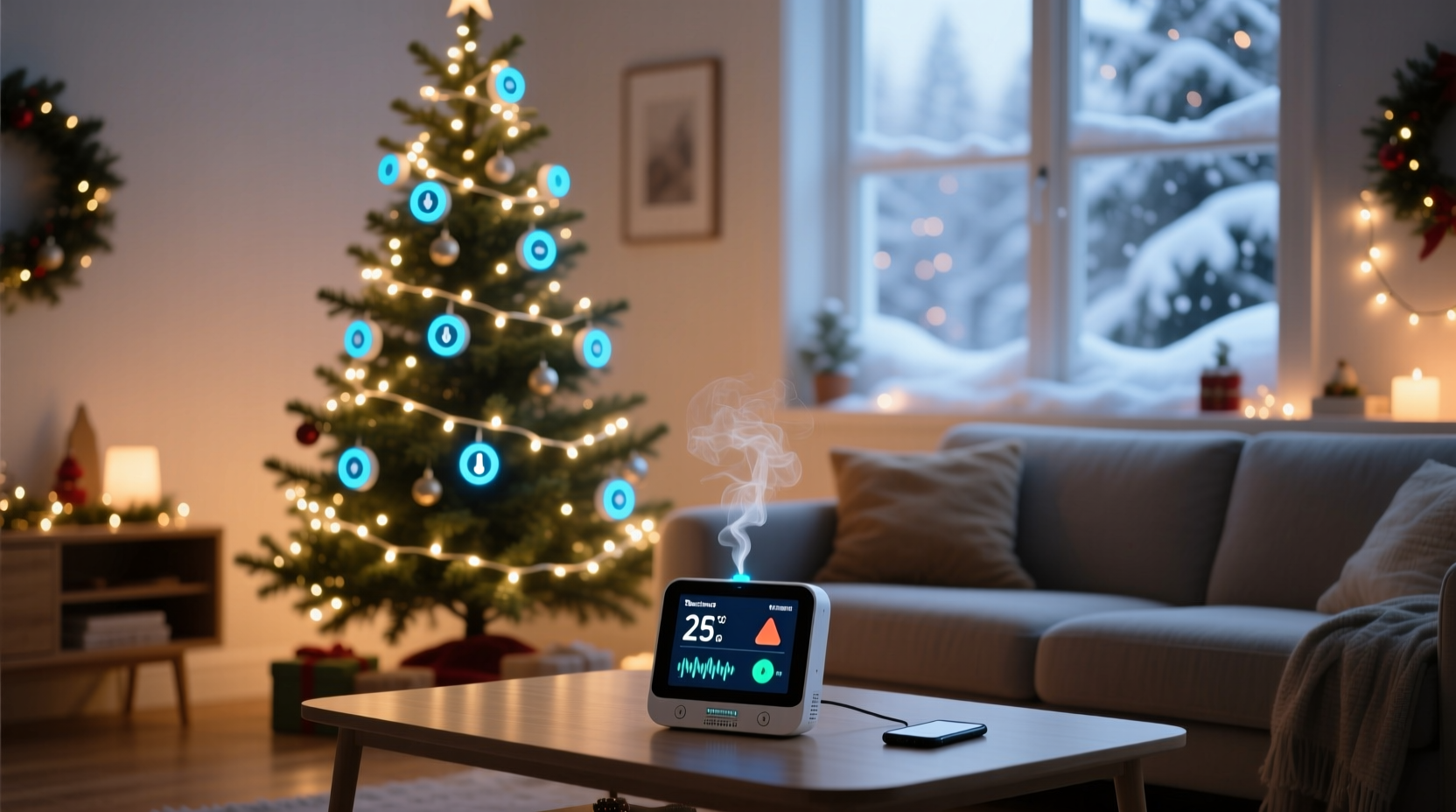
Manual inspections—checking for warm cords, smelling for burning insulation, or remembering to turn off lights before bed—are reactive and inconsistent. Human attention wanes during holidays. Sensors, by contrast, operate continuously, objectively, and without fatigue. Temperature sensors detect abnormal heat buildup in light strings long before visible discoloration appears. Contact sensors confirm whether a tree stand is properly filled—or if evaporation has dropped water levels below safe thresholds. Smart plugs with energy monitoring identify sudden current spikes that signal short circuits, often before fuses blow. Crucially, these devices don’t just collect data—they feed it into a unified logic layer. When a smoke detector triggers *and* a temperature sensor near the tree rises 15°F above ambient in under 90 seconds, the system can silence non-urgent notifications and prioritize an emergency alert to your phone—not a generic “motion detected” ping.
Core Sensors & Their Holiday-Specific Roles
Not all smart sensors serve equal purpose during December. Selecting the right combination requires matching device capability to seasonal risk vectors. Below is a functional breakdown of essential sensor types, their deployment rationale, and real-world limitations.
| Sensor Type | Primary Holiday Use Case | Critical Placement Guidance | Limitations to Acknowledge |
|---|---|---|---|
| Non-contact infrared (IR) temperature sensor | Detects overheating in light string junctions, transformer housings, and base of artificial trees | Mount within 12–18 inches of power adapters and where multiple light strands converge; avoid direct sunlight exposure | Cannot measure internal wire temperature—only surface radiance; calibrate against ambient room temp first |
| Water leak sensor | Monitors live Christmas tree stands for low-water conditions (dry stands increase fire risk 3x) | Place flat on stand base, centered beneath trunk; use adhesive backing to prevent displacement when refilling | False positives possible if stand overflows onto floor—pair with tilt sensor to distinguish overflow vs. depletion |
| Smart plug with real-time energy monitoring | Identifies abnormal power draw in decorative lighting circuits (e.g., shorted LEDs, failing transformers) | Plug *all* decorative lights on a single circuit into one monitored outlet; avoid daisy-chaining multiple smart plugs | Does not detect ground faults or arc faults—requires GFCI/AFCI breakers for full protection |
| Magnetic contact sensor | Confirms door closure on utility closets housing extension cords or power strips; detects accidental dislodgement of tree stand fill caps | Install on closet doors near breaker panels or on removable caps of reservoir-style tree stands | Use only weather-rated models outdoors; standard versions fail below 32°F due to brittle plastic housings |
| Particulate (PM2.5) + VOC sensor | Early detection of smoldering insulation, melting plastic, or candle wax combustion byproducts | Mount 6–8 feet high on wall near main tree location; avoid placement directly above heat sources | Requires baseline calibration over 72 hours pre-holiday; sensitive to cooking vapors—schedule alerts only during overnight/low-occupancy hours |
A Real-World Implementation: The Henderson Family System
The Hendersons live in a 1940s bungalow with original knob-and-tube wiring in two upstairs bedrooms—where they display heirloom glass ornaments and vintage light strings. Last year, their 12-foot Fraser fir caught fire at 3:17 a.m. after the stand ran dry and the lower branches ignited from proximity to a space heater. No one was injured, but $22,000 in damage resulted. This December, they deployed a layered sensor network:
- A LeakSmart Water Leak Sensor placed inside the tree stand triggered a push notification when water dropped below 1.5 inches—prompting a refill before branch desiccation began.
- Three TP-Link Kasa KP125 smart plugs powered separate light zones (tree, mantel, staircase). When the staircase circuit registered a 40% current surge at 11:03 p.m., the system automatically cut power and alerted them via Alexa: “Staircase lights show abnormal draw—check for damaged bulbs or pinched wires.” They found a crushed LED bulb casing causing intermittent arcing.
- An Aqara T1 IR thermometer mounted beside the tree’s power hub logged a steady 82°F—until Day 14, when it spiked to 104°F over 12 minutes. Cross-referencing with the smart plug’s data revealed the transformer was cycling erratically. They replaced it before thermal runaway occurred.
No false alarms. No missed warnings. Just precise, contextual data that turned passive observation into proactive intervention.
Step-by-Step Integration Timeline (Pre- to Post-Setup)
- Week 4 Before Christmas: Audit existing electrical infrastructure. Identify circuits powering decorations. Note outlet locations, breaker labels, and any GFCI/AFCI coverage. Map high-risk zones (near heaters, on stairs, above furniture).
- Week 3: Purchase certified sensors (UL 2043 for smoke/heat, UL 60730 for controllers). Prioritize Matter-compatible devices for cross-platform reliability. Avoid proprietary hubs unless fully integrated with your primary ecosystem (Apple Home, Google Home, or Home Assistant).
- Week 2: Install and calibrate sensors *before* decorating. Test each device individually: trigger water leak sensor with damp cloth, verify IR sensor reads ambient correctly, confirm smart plug reports wattage accurately using a Kill-A-Watt meter.
- Week 1: Decorate as usual—but route all lights through monitored smart plugs. Mount temperature and PM2.5 sensors per placement guidelines. Integrate into automation platform: create rule “IF tree stand water < 1.5 inches AND time is between 22:00–06:00 THEN send urgent push + flash living room lights.”
- Christmas Eve: Run full system test. Simulate low water, mild temperature rise, and minor current fluctuation. Document response times and adjust alert sensitivity if needed. Share emergency override instructions with all household members.
“Sensors don’t replace electrical safety fundamentals—they expose what we overlook. A 10°F anomaly in a light string is often the first whisper of failure. Catch it early, and you prevent the shout of smoke alarms.” — Dr. Lena Torres, Electrical Safety Researcher, Underwriters Laboratories
Essential Setup Checklist
- ☑ All smart plugs rated for continuous load (not just ‘intermittent use’) and compatible with your decorative lighting’s total wattage (e.g., 150+ strings of LEDs = ~120W; vintage incandescents = 600W+)
- ☑ Temperature sensors shielded from HVAC vents and direct sunlight to avoid false baselines
- ☑ Water leak sensors tested with actual tap water—not just a damp paper towel—to validate conductivity response
- ☑ Automation rules include time-based suppression (e.g., disable tree-stand alerts during scheduled watering windows)
- ☑ Physical backups exist: working smoke alarms on every level, accessible fire extinguisher (Class C rated), and unplugged decorations when leaving home >4 hours
Frequently Asked Questions
Can I use battery-powered sensors near live trees or candles?
Yes—provided they carry UL 2034 certification for smoke/heat detectors or UL 2043 for environmental sensors. Lithium batteries are preferred over alkaline for stable voltage output in cooler rooms (below 60°F), but avoid placing any battery device within 3 feet of open flames or heat sources exceeding 104°F. Always check manufacturer specs for operating temperature ranges.
Do I need a professional electrician to install this system?
No—for sensor integration alone. These devices operate on existing outlets and wireless protocols. However, if your home lacks GFCI protection on outdoor or basement circuits used for lights, or if you plan to hardwire smart switches into lighting circuits, a licensed electrician is legally required and strongly advised. Never bypass grounding or modify plugs to fit older outlets.
Will this system work if my Wi-Fi goes down?
Local automation (e.g., “IF water sensor triggers THEN smart plug cuts power”) will continue functioning if your hub supports local execution (Home Assistant, Apple Home with Thread border router, or Samsung SmartThings Hub v4). Cloud-dependent actions (e.g., SMS alerts, remote camera feeds) will pause until connectivity resumes. Always configure critical safety actions—power cutoffs, local sirens—to execute locally.
Conclusion: Safety Is the Most Meaningful Ornament
Christmas decorations reflect care, tradition, and intention. So should their safety. Integrating smart sensors isn’t about trading warmth for technology—it’s about honoring the people gathered beneath those lights with unwavering vigilance. A well-calibrated temperature sensor doesn’t diminish the sparkle of tinsel; it safeguards the laughter echoing around it. A water leak alert doesn’t interrupt carols; it preserves the memory-making moments that define the season. This system pays dividends far beyond December: the same IR sensor monitors your attic furnace in January; the same smart plug tracks your sump pump’s energy signature during spring thaws; the same automation logic secures your home when you travel. Start small—add one smart plug and a water sensor this year. Document your setup. Refine thresholds based on your home’s unique behavior. Share your configuration in community forums. Because the most resilient safety systems aren’t built in isolation—they’re strengthened by shared knowledge, tested experience, and quiet, persistent attention to what matters most.




 浙公网安备
33010002000092号
浙公网安备
33010002000092号 浙B2-20120091-4
Comments
No comments yet. Why don't you start the discussion?