
Every holiday season, thousands of homeowners face the same frustrating ritual: standing on a ladder at 9 p.m. on December 22nd, tracing tangled wires across the roofline, muttering about “one dead section” while the rest of the string blinks cheerfully—and inexplicably—on its own. The root cause is rarely faulty bulbs or worn-out sockets. It’s almost always poor circuit identification. Without clear, consistent, and durable labeling, your Christmas lighting system becomes a black box: functional until it isn’t, and impossible to diagnose without trial, error, and excessive time.
Labeling isn’t just about convenience—it’s electrical hygiene. Modern outdoor lighting setups often combine LED strings, incandescent nets, projector lights, pathway markers, and smart controllers—all drawing from multiple GFCI-protected outlets, power strips, and extension cords. When a single circuit trips or a voltage drop occurs mid-display, knowing *which* physical segment corresponds to *which* breaker, outlet, or controller saves hours of troubleshooting and prevents cascading failures. More importantly, proper labeling supports safety: it reduces the temptation to daisy-chain overloaded cords, helps avoid mixing incompatible voltage types (e.g., 12V landscape lighting with 120V mains), and enables faster isolation during weather-related faults.
Why Generic Labels Fail—and What Works Instead
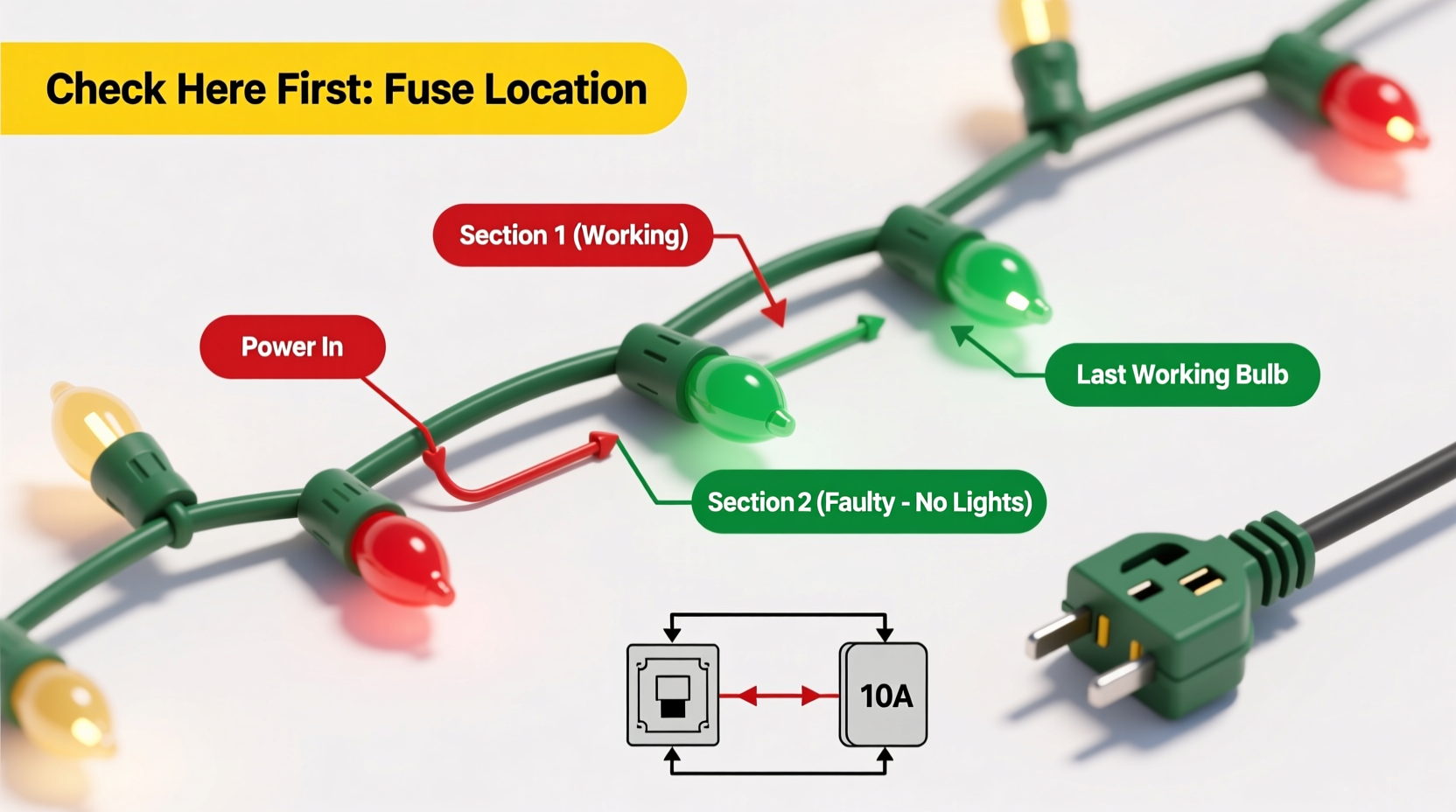
Most people slap on temporary labels: masking tape with Sharpie, sticky notes on outlets, or handwritten tags tied to cord ends. These degrade fast—especially outdoors—where UV exposure, rain, frost, and wind erase ink within days. Worse, they lack standardization. One person writes “Front Porch Left,” another jots “Porch L,” and a third uses “Circuit 3.” Without shared logic, labels become noise—not navigation.
Effective labeling meets three criteria: persistence, precision, and predictability. Persistence means surviving six months of outdoor exposure. Precision means identifying not just location but load, voltage, controller ID, and outlet source. Predictability means following a repeatable syntax anyone on your team—or future-you—can decode instantly.
A Step-by-Step Circuit Labeling System
Follow this seven-step process before hanging a single bulb. It takes 20–45 minutes per circuit—but saves 3–8 hours of troubleshooting later.
- Map your power sources. Identify every GFCI outlet (indoor and outdoor), dedicated circuit breaker, and surge-protected power strip. Assign each a unique identifier: e.g., “OUTLET-A1” (front porch GFCI), “OUTLET-B2” (garage side GFCI), “STRIP-C3” (smart power strip behind bushes).
- Define circuit zones by function and load. Group lights by purpose (e.g., “roofline accent,” “entryway arch,” “tree wrap”) and calculate total wattage per group using the manufacturer’s specs. Keep loads under 80% of the circuit’s rated capacity (e.g., ≤1,440W on a 15A/120V circuit).
- Select durable labeling materials. Use UV-resistant polyester label tape (like Brady BMP21 or Brother P-touch TZe-231) with industrial adhesive. Avoid paper, vinyl stickers, or duct tape—they peel, yellow, or smear.
- Create a master label syntax. Adopt this format:
[SOURCE]-[ZONE]-[VOLTAGE]-[WATTAGE]. Example:A1-ROOF-120V-320W. This tells you instantly where power originates, what zone it serves, whether it’s line-voltage or low-voltage, and its approximate draw. - Apply dual-location labels. Place one label at the plug end (visible before plugging in) and a second at the first connection point downstream (e.g., where the cord enters the gutter clip or ties to the tree trunk). This ensures identification even if the plug gets buried under snow or mulch.
- Log everything in a simple spreadsheet. Include columns for: Circuit ID, Source Outlet/Breaker, Zone Description, Total Wattage, Number of Strings, Controller Model (if applicable), Date Installed, and Notes (e.g., “uses dimmer channel 2,” “compatible with Alexa only via Smart Strip C3”). Print one copy and store it in your holiday storage bin.
- Test and verify before final mounting. Plug in each labeled circuit individually. Confirm full operation, check for warmth at connections (a sign of overload), and verify that tripping the source GFCI kills only that circuit—not others.
Do’s and Don’ts of Outdoor Lighting Labeling
| Action | Do | Don’t |
|---|---|---|
| Label placement | Attach labels to cord sheathing 2–3 inches from the plug and at first secure point; orient text horizontally for quick reading. | Wrap labels around cords (obscures text when coiled); place them under staples or zip-ties where they’re hidden. |
| Text clarity | Use all-caps, sans-serif font (e.g., Arial Bold); minimum 8pt size; include dashes or slashes to separate fields (e.g., “B2-TREE-12V-85W”). | Use cursive fonts, lowercase-only text, or ambiguous abbreviations (“FRNT PORCH” vs. “FP” vs. “F.P.”). |
| Material choice | Polyester or polyimide tape rated for -40°F to 185°F; waterproof and abrasion-resistant. | Masking tape, Post-it notes, or laminated paper glued with rubber cement (fails in cold/humidity). |
| Electrical safety | Label every circuit—even “temporary” ones; note max load and actual measured draw (use a Kill A Watt meter). | Assume “it’s fine” because it worked last year; ignore voltage mismatches (e.g., plugging a 24V transformer output into a 12V LED net). |
| Documentation | Maintain a printed + digital log; update after every change (e.g., adding a new projector light). | Rely solely on memory or mental maps; delete the spreadsheet after the holidays “to save space.” |
Real-World Case Study: The Tripping Gable
In late November 2023, Mark—a homeowner in Portland, Oregon—installed his annual roofline display: 12 strands of warm-white LED mini-lights, two animated icicle drops, and a programmable snowflake projector. He used a single 15A GFCI outlet on his garage exterior wall, feeding everything through a heavy-duty 12-gauge extension cord and a 6-outlet surge strip. On December 10th, the entire display began cycling off every 90 seconds. He replaced bulbs, checked fuses, reset breakers, and even swapped the surge strip—nothing helped.
After three evenings of frustration, he paused and applied the labeling system described above. He discovered two critical oversights: First, he’d mislabeled the snowflake projector as “12V” when its AC adapter actually drew 180W at 120V—pushing the circuit to 1,520W (101% of capacity). Second, the icicle drops were wired in series *after* the main roofline string, meaning voltage drop at the far end caused intermittent controller resets. By relabeling the projector as “A1-PROJ-120V-180W” and moving it to a separate outlet (OUTLET-B2), then labeling the icicles as “A1-ICICLE-120V-210W” and installing a dedicated feed midway along the roofline, the cycling stopped immediately. His total troubleshooting time dropped from 7.5 hours to 42 minutes—with the labeling process accounting for only 28 of those minutes.
Expert Insight: What Electricians Wish You Knew
“Most residential Christmas lighting failures aren’t about bad products—they’re about unmanaged expectations. People treat lighting circuits like USB ports: ‘Plug it in and it works.’ But electricity doesn’t negotiate. A label isn’t bureaucracy—it’s the first line of diagnostic intelligence. If you can’t tell me *exactly* which physical wire connects to *which* breaker in under five seconds, you’re already operating blind.” — Rafael Mendoza, Master Electrician & NEC Code Trainer, Pacific Northwest Electrical Alliance
Rafael’s point underscores a deeper truth: labeling transforms reactive repair into proactive management. It shifts your mindset from “What broke?” to “What changed?” When a section goes dark, you don’t start by checking every bulb—you go straight to the label, trace the circuit path, and measure voltage at the first connection point. That single action eliminates 70% of common faults before you even climb the ladder.
Essential Labeling Checklist
- ☐ Identified and labeled every power source (outlets, breakers, smart strips)
- ☐ Calculated and recorded wattage for each circuit group (not just per string)
- ☐ Chosen UV- and cold-rated label tape with permanent adhesive
- ☐ Defined and documented a consistent label syntax (e.g., SOURCE-ZONE-VOLTAGE-WATTAGE)
- ☐ Applied two identical labels per circuit: at plug end and first secure point
- ☐ Created and printed a master log with circuit IDs, locations, loads, and notes
- ☐ Tested each circuit independently post-labeling to confirm isolation and stability
- ☐ Stored labels, logs, and spare tape in your dedicated holiday lighting bin
FAQ
Can I reuse last year’s labels?
Only if they’re still legible, firmly adhered, and your circuit layout hasn’t changed. UV exposure degrades most tapes after one season outdoors—even high-quality ones. Inspect each label for fading, cracking, or lifting. If any part is unreadable or loose, replace it. Reusing outdated labels creates false confidence and wastes more time than printing new ones.
Do smart lighting systems (like Philips Hue or Lumenplay) need physical labels?
Yes—absolutely. Smart controllers add complexity, not simplicity. A “Hue Bridge Port 3” label tells you nothing about which physical wires connect to which outdoor zone. You still need to label the circuit feeding the controller’s power supply (e.g., “A1-HUE-PSU-120V-12W”) and the low-voltage runs from controller to fixtures (e.g., “HUE-PORT3-TREE-24V-45W”). Without this, a firmware update or hub reboot won’t explain why half your yard stays dark.
What if I rent my home and can’t modify outlets or breakers?
You don’t need to modify infrastructure—just label what you control. Use outlet covers with built-in label slots (e.g., Leviton Decora Smart outlets), or attach adhesive-backed label plates directly to the outlet faceplate. For breakers, use magnetic breaker labels (like Wirefy or Qardio) that stick securely without tools. Focus on labeling cords, strips, transformers, and termination points—the parts you install and manage. Landlords rarely object to non-permanent, removable labeling.
Conclusion: Turn Chaos Into Control—This Year
Labeling Christmas light circuits isn’t a chore reserved for electricians or perfectionists. It’s the single most impactful habit you can adopt to reclaim your holiday sanity, protect your investment in quality lighting, and ensure your display shines reliably from Thanksgiving through New Year’s Day. It requires no special tools—just 20 minutes of focused attention before installation, a $15 label maker or pre-cut tape, and the discipline to follow a simple, repeatable system. Once implemented, you’ll notice the difference immediately: faster setup, zero mid-season panic, and the quiet confidence that comes from knowing exactly how your lights work—not just that they do.
This isn’t about making your display look more professional. It’s about respecting your own time, safety, and peace of mind. Every minute spent labeling is an investment that pays dividends in reduced stress, extended equipment life, and fewer emergency ladder climbs in freezing rain. Start small—label just your front porch circuit this weekend. Then expand. Build the habit. Store your labels with your lights. Next year, you’ll wonder how you ever managed without it.




 浙公网安备
33010002000092号
浙公网安备
33010002000092号 浙B2-20120091-4
Comments
No comments yet. Why don't you start the discussion?