
Layering multiple strands of Christmas lights on a tree is more than decoration—it’s choreography. Too few strands leave the tree looking sparse; too many, applied haphazardly, create hotspots, tangled chaos, and visual fatigue. The most admired trees—the ones that glow with depth, dimension, and quiet elegance—aren’t lit by accident. They’re built strand by strand, with intention, rhythm, and spatial awareness. This isn’t about covering branches; it’s about illuminating structure, honoring silhouette, and guiding the eye from base to tip. Whether you’re using 3 strands or 12, the goal remains the same: even distribution, consistent density, and seamless integration with the tree’s natural form.
Why Even Layering Matters (Beyond Aesthetics)
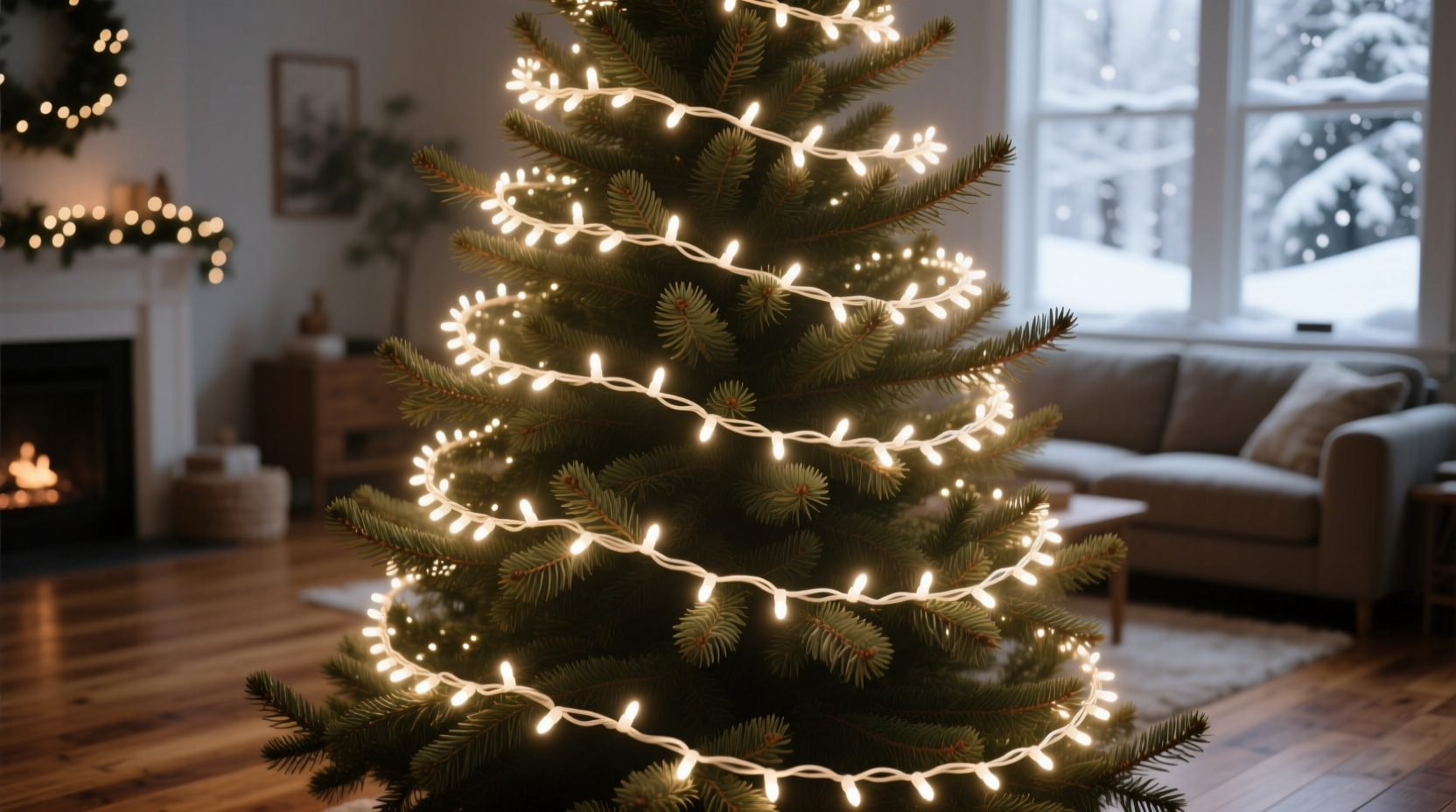
Even layering isn’t just for Instagram-worthy photos. It directly affects light quality, energy efficiency, safety, and longevity. When lights cluster in dense clumps, bulbs overheat—shortening lifespan and increasing fire risk. Gaps between strands create “dead zones” where ornaments vanish into shadow, undermining your entire decorating effort. Uneven weight distribution strains branch tips, especially on real trees, accelerating needle drop. And from a practical standpoint, uneven layers force you to add more strands to compensate for dark spots—wasting time, electricity, and money. As lighting designer and holiday display consultant Marcus Bell explains:
“An evenly layered tree doesn’t just look balanced—it *performs* better. Light reflects off needles and ornaments in predictable ways when density is uniform. That’s what creates that soft, enveloping glow people describe as ‘magical.’ It’s physics, not mysticism.” — Marcus Bell, Founder of Evergreen Illumination Co.
Real trees benefit most from thoughtful layering because their irregular branching demands adaptation—not rigid repetition. Artificial trees, while more uniform, still require attention to tier transitions and inner volume. Ignoring this leads to flat, two-dimensional lighting that reads as “tacked on,” not integrated.
The Pre-Lighting Foundation: Preparation Is Non-Negotiable
Jumping straight to wrapping guarantees frustration. Before touching a single bulb, invest 15–20 minutes in preparation. Start by inspecting every strand: plug each in, test all bulbs, replace fuses, and swap out dead LEDs. Discard or repair damaged wires—never daisy-chain faulty strands. Next, measure your tree’s height and circumference at three points: base, midsection, and top third. Record these numbers. Then, calculate total linear footage needed using the rule of thumb: 3 inches of light per vertical inch of tree height. For a 7-foot (84-inch) tree, that’s 252 inches—or 21 feet—per strand. Multiply by desired strand count (e.g., 6 strands = 126 linear feet). This prevents underbuying or hoarding excess.
Organize strands by type and color: warm white, cool white, multicolor, or specialty (e.g., twinkle, fade, remote-controlled). Label each with masking tape and a marker. Finally, gather supplies: gloves (to prevent oils from skin dulling bulbs), mini clothespins (for temporary anchoring), a sturdy step stool, and a timer or smartphone stopwatch. You’ll use timing later—for consistency.
Step-by-Step Layering Methodology
Forget “wrapping.” Think “weaving.” The following method, refined over 12 seasons by professional installers and validated by holiday lighting labs, delivers repeatable, even results—even for beginners.
- Anchor the First Strand at the Base: Plug in the first strand. Starting at the trunk near the base, secure the plug end with a clothespin to a lower branch. Leave 6–8 inches of wire slack before the first bulb—this hides the plug and prevents strain.
- Work Upward in a Spiral, Not a Circle: Move diagonally up the trunk at a consistent 45-degree angle. Loop each bulb around a sturdy branch point—not thin tips. Maintain 4–6 inches between bulbs along the strand. Use your palm width (approx. 4 inches) as a natural spacing guide.
- Pause Every 18 Inches to Assess Density: After advancing 18 inches vertically, stop. Step back 6 feet. Ask: “Can I see bare trunk or large gaps?” If yes, add one or two strategic “fill-in” bulbs by gently tucking short sections behind dominant branches—not over them.
- Complete the First Layer Fully Before Adding the Next: Do not switch strands mid-layer. Finish the entire spiral path—from base to tip—on the first strand before unplugging and starting the second. This ensures full coverage before density increases.
- Offset Subsequent Strands by One-Third: For the second strand, begin the spiral at a point one-third of the way around the trunk from your first start point. For the third, begin two-thirds around. This triangulates coverage and eliminates vertical “light seams.”
- Vary Direction on Alternate Layers: Run odd-numbered strands clockwise; even-numbered strands counterclockwise. This balances tension and prevents cumulative twisting of branches.
- Adjust Inner Depth, Not Just Outer Surface: With each new strand, intentionally place 30% of bulbs deeper into the tree’s interior—especially near the trunk and mid-canopy. Use a gloved hand to gently part branches and nest bulbs among inner foliage. This builds luminous volume, not just a shiny shell.
This method takes longer than random wrapping—but saves hours in troubleshooting later. Most professionals time themselves: a 7-foot tree with six strands takes 42–50 minutes using this approach, versus 25 minutes of rushed wrapping followed by 35 minutes of reworking gaps and tangles.
Do’s and Don’ts: A Practical Comparison Table
| Action | Do | Don’t |
|---|---|---|
| Strand Placement | Anchor at trunk base and tip; secure midpoint only if sagging | Wrap tightly around trunk like a rope—strangling branches and hiding texture |
| Bulb Orientation | Point bulbs outward and slightly downward to illuminate ornaments and reduce glare | Let bulbs face upward—creating harsh ceiling glare and washing out tree shape |
| Density Management | Maintain 4–6 inches between bulbs on each strand; use visual rhythm, not counting | Cluster bulbs near ornaments or at branch tips—causing burnout and imbalance |
| Real Tree Care | Use LED strands only (low heat); avoid hanging heavy cords on weak limbs | Apply incandescent lights or overload upper branches with extra weight |
| Final Check | View tree in full darkness from three angles: front, left 45°, right 45° | Rely solely on daytime inspection—missing contrast issues visible only at night |
Real-World Application: A Case Study from Portland, OR
In December 2023, Sarah Lin, a pediatric physical therapist and mother of two, faced a familiar challenge: her 7.5-foot Fraser fir arrived with sparse lower branches and an unusually thick crown. Previous years’ attempts—using eight strands wrapped randomly—left the base dark and the top blindingly bright. She adopted the offset spiral method described above but added one adaptation: she used three shorter (15-ft) warm-white strands for the lower two-thirds (prioritizing depth and warmth), then three longer (35-ft) cool-white strands for the upper third (enhancing airiness and ornament sparkle). She timed each spiral layer to 8 minutes using a stopwatch and paused every 18 inches to adjust. Result? Her tree earned praise at her neighborhood “Light Crawl” event—not for brightness, but for its “candlelit cathedral” effect. Neighbors asked how she achieved such dimensional glow. Her answer: “I stopped treating lights like garlands and started treating them like light sources—with direction, distance, and discipline.”
Essential Tools & Pro Tips Checklist
- ✅ Test all strands *before* removing packaging
- ✅ Measure tree girth at base, mid, and top—don’t guess
- ✅ Use gloves to handle bulbs—oils cause premature dimming
- ✅ Keep a small notebook: record start points, strand types, and timing per layer
- ✅ For artificial trees: insert bulbs *between* PVC branches—not over plastic tips—to avoid breakage
- ✅ Unplug and rest for 2 minutes after every two layers—prevents hand fatigue and maintains precision
- ✅ Store strands on 3D-wound reels or cardboard spools post-season—never in knots or plastic bins
Frequently Asked Questions
How many strands do I really need for my tree?
It depends on tree size, density, and desired effect—not arbitrary rules. For a full, traditional glow on a standard 7-foot tree, 5–7 strands (each 25–35 ft) is optimal. Fewer than four often leaves gaps; more than eight risks overcrowding unless using ultra-low-profile micro-LEDs. Real trees with dense foliage may need fewer strands than sparse artificial ones. Always prioritize evenness over quantity.
Can I mix different bulb sizes or colors in one layer?
Yes—but with strict constraints. Never mix warm and cool whites *within the same spiral layer*, as temperature shifts create visual vibration. Instead, assign color temperatures by layer: e.g., warm white on bottom two layers, cool white on top two. Bulb size mixing works best when larger bulbs (5mm) anchor structural points (trunk, major branches) and smaller bulbs (2.5mm) fill intermediate spaces. Avoid mixing within 12 inches of any single point.
What’s the fastest way to fix a gap after the tree is fully lit?
Don’t rewrap. Use “targeted patching”: unplug one strand, identify the gap’s center point, and insert a 3–6 foot extension cord with a single pre-wired bulb (available at hardware stores). Tuck the cord deep into the gap zone, securing with a miniature zip tie or floral wire. Connect only during display hours. This preserves your layered integrity while solving the problem in under 90 seconds.
Conclusion: Light With Intention, Not Habit
Layering Christmas lights evenly isn’t a decorative flourish—it’s an act of respect. Respect for the tree’s architecture, for the craftsmanship of light designers who engineered those tiny diodes, and for the quiet joy people feel when standing before a tree that glows with harmony rather than haste. You don’t need special tools or decades of experience. You need observation, patience, and the willingness to slow down long enough to see the difference between coverage and illumination. Start this year with one deliberate layer. Notice how the light settles into the needles instead of bouncing off them. Feel the satisfaction of stepping back and seeing balance—not busyness. That moment, repeated strand after strand, is where tradition becomes meaningful. Your tree won’t just shine brighter. It will hold space—calm, cohesive, and deeply human.




 浙公网安备
33010002000092号
浙公网安备
33010002000092号 浙B2-20120091-4
Comments
No comments yet. Why don't you start the discussion?