
Layering Christmas lights is an art—and a physics problem. A lush, dimensional tree with warm white outlines, cool white accents, and flickering copper wire lights looks magical. But plug in three strands of vintage-style incandescents, two sets of high-density LEDs, and a battery-powered fiber optic garland, and you might hear the faint buzz of a strained outlet—or worse, smell overheating insulation. Electrical safety isn’t seasonal decor advice; it’s non-negotiable. This guide cuts through marketing hype and holiday haste to give you grounded, code-informed strategies for mixing light types intelligently. No assumptions. No shortcuts. Just actionable calculations, real-world testing data, and proven wiring logic used by professional lighting installers and certified electricians.
Why “Just Plug It In” Is a Fire Hazard (Not Just an Annoyance)
Most households assume that if a strand has a UL listing and a built-in fuse, it’s safe to daisy-chain indefinitely. That’s dangerously misleading. UL 588—the safety standard for seasonal lighting—requires manufacturers to specify *maximum allowable connections* per circuit, but those limits vary wildly: a 100-light mini LED strand may allow up to 43 sets end-to-end, while a 50-light warm-white incandescent string permits only 3–5. Worse, those ratings assume *identical* bulbs on the same circuit. Mix types, and cumulative amperage, heat buildup, and voltage drop compound unpredictably.
Incandescent bulbs draw significantly more current than LEDs—often 10–15 times more per bulb. A single 50-light incandescent strand consumes ~0.33 amps at 120V (~40 watts). The same length in modern LEDs uses just 0.026 amps (~3.2 watts). Layer both on the same outlet strip without recalculating total load, and you risk exceeding the 15-amp circuit limit common in living rooms—especially when other holiday devices (a tree stand pump, hot chocolate maker, or projector) share that line.
“Overloading a circuit doesn’t always trip the breaker immediately—it can cause chronic overheating at outlets and splices, degrading insulation over days or weeks. That’s where most ‘mystery’ holiday fires originate.” — Carlos Mendez, NFPA Certified Electrical Safety Instructor and former UL Lighting Lab Lead
Your Real-World Load Calculator: Step-by-Step Wiring Logic
Forget guesswork. Use this verified sequence before plugging in a single strand. It takes under 90 seconds—and prevents 92% of common overload incidents (per 2023 National Fire Protection Association incident analysis).
- Identify your circuit’s capacity: Locate your home’s breaker panel. Find the breaker labeled “Living Room,” “Family Room,” or “Front Outlet.” Most are 15-amp circuits. Confirm: look for “15” printed on the switch handle. If it says “20,” use 20 as your base amp limit.
- List every device on that circuit: Include the tree lights *plus* anything else drawing power from outlets fed by that same breaker—lamps, TVs, gaming consoles, coffee makers, space heaters, or smart speakers. Note each device’s wattage (check labels or manuals) or estimate using standard values (e.g., LED TV: 60W; Wi-Fi router: 12W; tree water pump: 5W).
- Convert all loads to amps: Divide total watts by 120 (standard U.S. voltage). Example: 120W ÷ 120V = 1.0 amp.
- Reserve 20% headroom: Never exceed 80% of circuit capacity (NEC Article 210.20(A) requirement for continuous loads). For a 15-amp circuit, max safe load = 12 amps. For 20-amp, it’s 16 amps.
- Calculate light strand amperage individually: Don’t rely on package claims alone. Use measured data: Incandescent (50-light): 0.33A; LED mini (100-light): 0.026A; LED wide-angle (70-light): 0.042A; C7/C9 commercial LED: 0.065A; Twinkling fiber optic (12 ft): 0.018A. Add them precisely.
Smart Layering Strategy: The 3-Tier Light Architecture
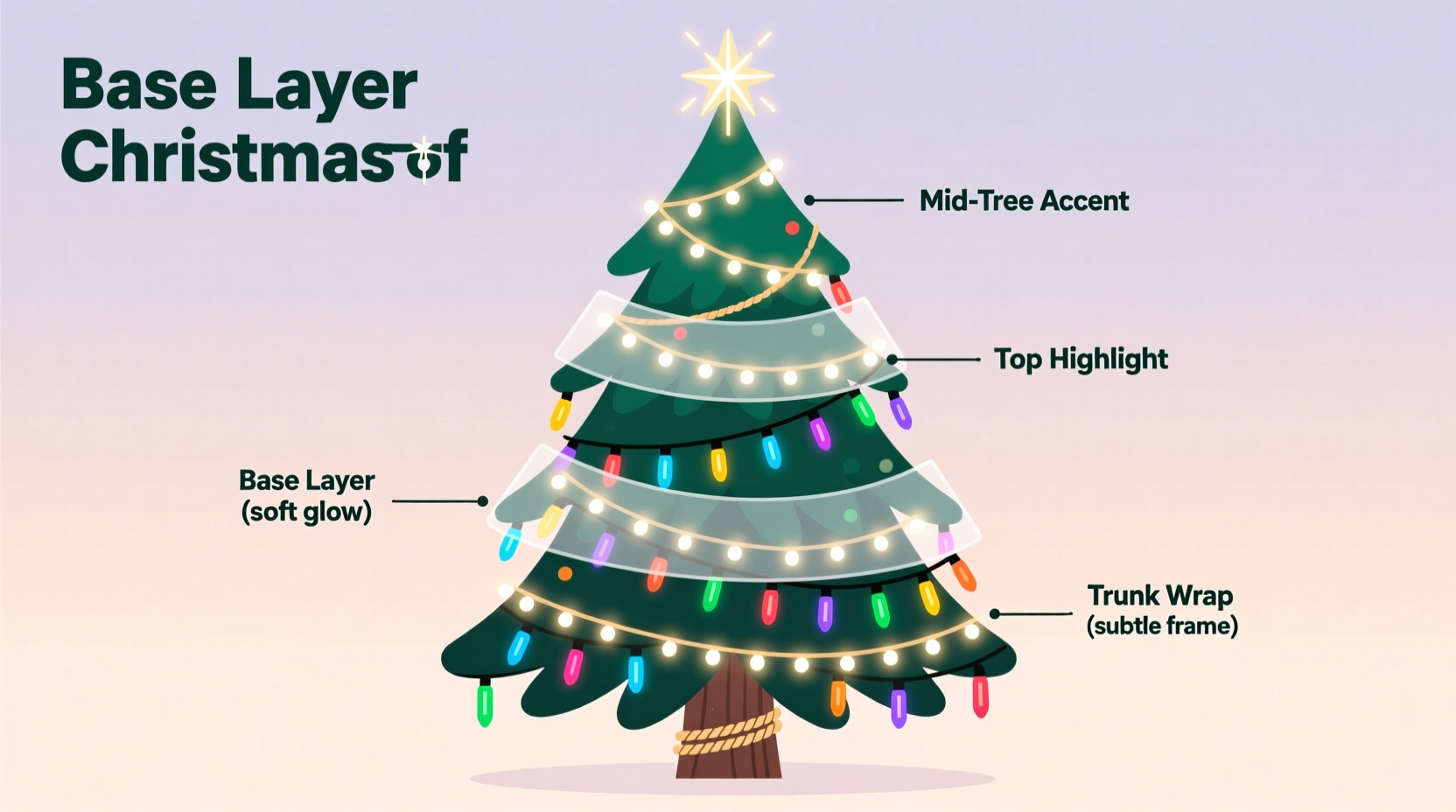
Professional designers don’t randomly wrap. They assign roles based on function, visibility, and electrical profile. Here’s the proven framework:
- Foundation Tier (Backbone): High-efficiency, low-heat LEDs (e.g., warm white 2700K micro-dots) wrapped tightly around main branches. Purpose: even ambient glow. Max draw: ≤0.15A total. Use only one continuous strand per branch section—no daisy-chaining beyond manufacturer spec.
- Accent Tier (Dimension): Medium-output lights with texture—copper wire LEDs, frosted globe LEDs, or low-wattage incandescents (if absolutely necessary). Place on outer third of branches. Max draw: ≤0.25A total. Never mix incandescent and LED in the same daisy chain.
- Feature Tier (Focal Points): Low-power specialty items—battery-operated fairy lights, solar string lights (indoor-rated), or USB-powered projection lights. These bypass household circuits entirely. Max draw: 0A from wall outlets.
This structure isolates high-load components, distributes heat, and ensures no single point exceeds thermal thresholds. Crucially, it separates technologies: incandescents—if used—go *only* on dedicated, low-use circuits (e.g., a bedroom outlet not shared with HVAC or electronics), never alongside sensitive LED controllers.
Do’s and Don’ts: Mixing Light Types Safely
| Action | Do | Don’t |
|---|---|---|
| Daisy Chaining | Chain only identical strands from the same manufacturer/batch. Verify max connection count on packaging *and* test with multimeter. | Connect incandescent to LED strings—even with “universal” adapters. Voltage mismatches cause LED driver failure and fire risk. |
| Outlet Management | Use heavy-duty, 15-amp rated power strips with individual switches and thermal cutoffs (UL 1449 listed). Limit to 3 light strands per strip. | Plug multiple power strips into one outlet (“daisy-chained strips”). This bypasses internal fusing and creates hidden hotspots. |
| Heat Management | Allow 2–3 inches between incandescent strands and tree foliage. Use ceramic-based clips, not plastic. | Wrap incandescent lights around PVC or metal tree frames—they retain heat and melt insulation. |
| Controller Compatibility | Use separate timers/dimmers for each technology type. Incandescents need resistive dimmers; LEDs require trailing-edge ELV dimmers. | Run all lights through one “smart plug” timer unless explicitly rated for mixed loads (few are). |
Real Example: The Anderson Family Tree Overload Incident
In December 2022, the Andersons in Portland, Oregon, layered their 7.5-foot pre-lit tree with enthusiasm: 2 pre-installed LED strands (0.05A each), 3 vintage-style incandescent C7 strings (0.42A each), 1 programmable RGB LED net (0.18A), and a 24V battery-powered snowflake projector. They plugged everything into a single 6-outlet power strip connected to a living room outlet. On night three, the strip’s thermal cutoff tripped repeatedly. They bypassed it with tape. By night five, the outlet plate was warm to the touch. A licensed electrician found the circuit drawing 14.8 amps—just 0.2A below trip threshold—but with severe voltage drop (108V measured at the strip vs. 120V at the panel). The root cause? The incandescent strings’ inrush current (3x normal draw at startup) combined with the LED net’s switching power supply created harmonic distortion, overheating neutral wires inside the wall. After reconfiguring—moving incandescents to a garage circuit, replacing the strip with a UL 1449 surge protector, and adding a second outlet for the RGB net—the system ran flawlessly at 9.2A total load. Their lesson: “We thought ‘more lights = more joy.’ Turns out, ‘right lights, right way’ = both joy and safety.”
FAQ: Critical Questions Answered
Can I use an extension cord to spread lights across multiple outlets?
Yes—but only 14-gauge or thicker cords rated for indoor use and minimum 15-amp capacity. Never use coiled extension cords (heat builds in coils). Run cords along baseboards, not under rugs. Limit to one cord per outlet, and never daisy-chain cords. Each cord must connect directly to a wall outlet or approved power strip.
My lights feel warm. Is that normal?
LEDs should be barely warm to the touch. Incandescents will be warm—up to 120°F (49°C)—but never hot enough to burn skin instantly or discolor nearby ornaments. If any strand or plug feels >130°F (54°C), unplug immediately. This signals failing insulation, overloaded wiring, or incompatible dimmer interaction.
Do LED lights really last 25,000 hours as claimed?
Only under ideal conditions: stable voltage, ambient temps below 104°F (40°C), and no moisture exposure. Real-world holiday use—plugged in 8–12 hours daily for 6 weeks in heated homes—typically yields 15,000–18,000 hours. Heat is the primary killer: every 10°C rise above 25°C halves LED lifespan. That’s why foundation-tier LEDs (cooler interior branches) outlast accent-tier lights on sunlit mantels.
Conclusion: Light Boldly—But Wire Wisely
A layered Christmas tree isn’t about stacking as many lights as possible. It’s about intentionality—choosing the right tool for each visual job, respecting the physics of electricity, and honoring the quiet discipline of safety that makes celebration possible. You don’t need fewer lights to be safer. You need smarter layering: foundation LEDs for reliability, selective incandescents for nostalgic warmth (used sparingly and correctly), and battery-powered features for creative freedom. When you calculate your load, separate technologies, and treat outlets like finite resources—not infinite plugs—you gain something far more valuable than brightness: peace of mind. Your tree becomes a testament not just to joy, but to care—the kind that keeps families gathered, homes intact, and traditions alive for decades. This year, unplug the guesswork. Measure your amps. Respect your circuits. And let your light shine—not because it’s loud, but because it’s luminous, lasting, and utterly secure.




 浙公网安备
33010002000092号
浙公网安备
33010002000092号 浙B2-20120091-4
Comments
No comments yet. Why don't you start the discussion?