
Layering necklaces is a powerful way to elevate your everyday style with depth and intention. But for those who favor minimalist aesthetics—clean lines, delicate chains, and subtle elegance—the challenge isn’t just about looking good. It’s about maintaining order. Tangled necklaces aren’t just frustrating; they can damage fine chains, weaken clasps, and ruin the effortless vibe minimalist styling aims to achieve.
The key lies in strategy: thoughtful selection, intentional arrangement, and consistent care. With the right approach, you can build layered looks that are both visually balanced and practically manageable. Whether you’re stacking dainty pendants or mixing metals, this guide delivers actionable techniques to keep your jewelry tangle-free while enhancing your personal aesthetic.
Choose the Right Chain Lengths Strategically
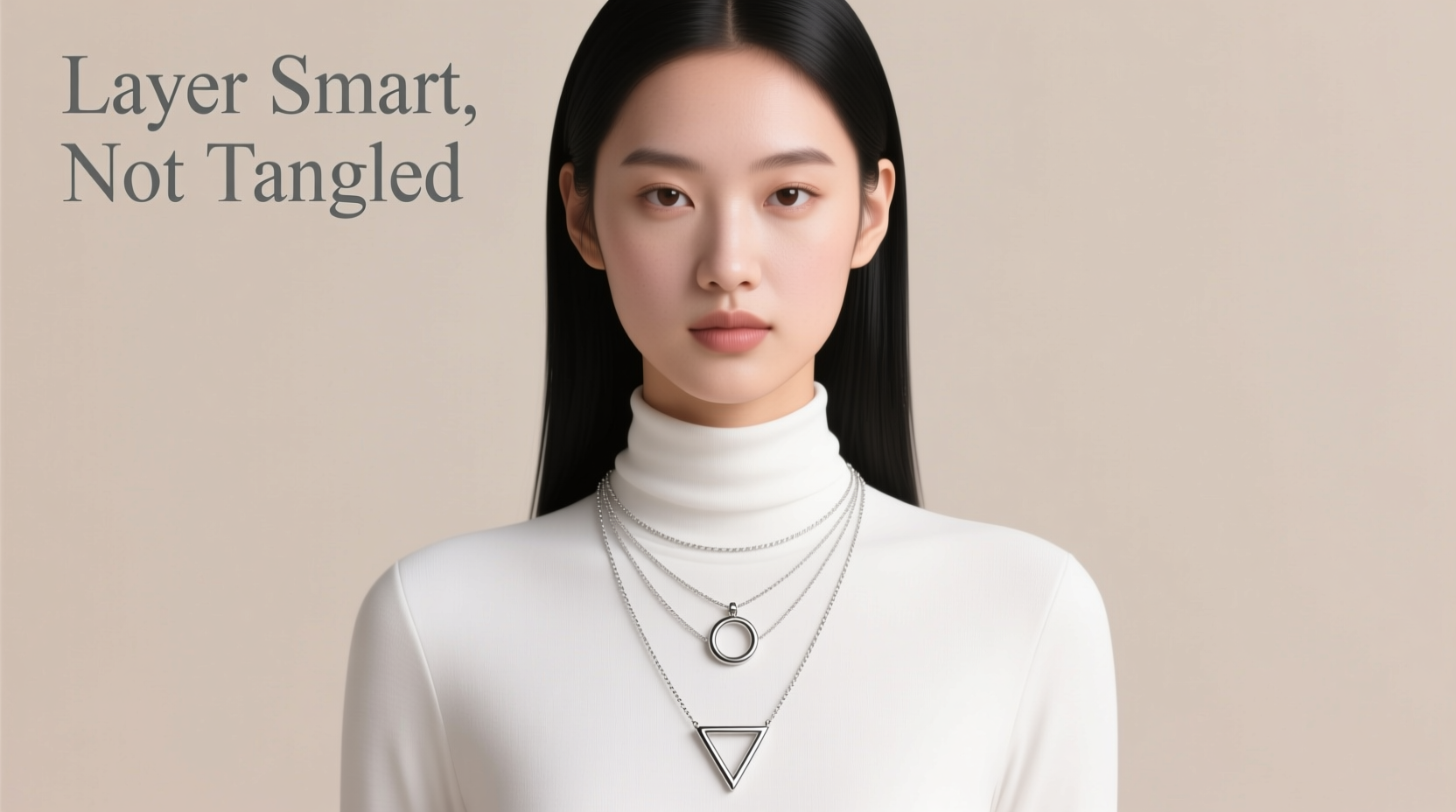
One of the most effective ways to prevent tangling is by varying necklace lengths. When chains rest at different levels around the neck, they naturally avoid contact. This spatial separation reduces friction and entanglement, especially during movement.
A well-layered stack typically includes three distinct tiers:
- Choker (14–16 inches): Sits snugly at the base of the neck. Ideal for small pendants or solitaires.
- Princess (17–19 inches): Falls just below the collarbone. The most versatile length for daily wear.
- Matinee (20–24 inches): Drapes over the neckline, perfect for drawing attention downward or balancing shorter pieces.
Spacing each chain by at least 1–2 inches minimizes overlap. For example, pairing a 16-inch choker with an 18-inch pendant and a 22-inch chain creates a cascading effect that flows smoothly without interference.
Material and Thickness Matter
Not all chains behave the same. Delicate styles like cable, box, or snake chains are more prone to kinking and knotting than sturdier options such as rope or Figaro. When layering, consider combining one thicker statement piece with two finer chains to create contrast and structural stability.
Thicker chains act as anchors, reducing the movement of lighter ones around them. For instance, placing a medium-width curb chain between two thin paperclip chains helps separate them physically and visually.
Metal choice also influences durability. Solid gold or platinum resists kinking better than gold-filled or plated options, but it comes at a higher cost. If you're working with delicate materials, extra care in storage and wear becomes non-negotiable.
“Minimalist layering isn’t about quantity—it’s about precision. A single millimeter difference in chain thickness can determine whether a set stays smooth or knots within hours.” — Lena Park, Jewelry Designer & Stylist
Step-by-Step Guide to Tangle-Free Layering
Follow this five-step process to assemble a layered look that stays intact throughout the day:
- Start with the longest chain. Put it on first so it settles deepest on your chest. This prevents shorter necklaces from slipping underneath and catching.
- Add mid-length next. Let it rest just above the first, creating a clean visual tier without overlapping.
- Finish with the shortest. This sits highest on the neck and completes the gradient effect.
- Adjust positioning gently. After putting all on, use your fingers to nudge pendants into place and ensure chains lie flat.
- Secure clasps properly. Double-check that each clasp is fully closed and positioned toward the back. Front-facing clasps increase snag risk.
This sequence leverages gravity and design logic. Longer chains naturally fall lower, so starting with them avoids repositioning later—a common cause of accidental twisting.
Smart Storage Solutions for Daily Protection
Most tangles happen not during wear—but when necklaces are stored together. Even brief contact in a drawer or travel pouch can lead to stubborn knots. Preventative storage is essential.
Here are proven methods to protect your pieces:
- Use individual pouches: Soft fabric bags (like anti-tarnish velvet) keep each necklace isolated.
- Invest in a jewelry roll: Compartments hold chains separately while allowing compact packing.
- Hang on a stand: Wall-mounted or tabletop displays let you organize by length and reduce handling.
- DIY button method: Thread a necklace through a large buttonhole and fasten the clasp to the button. The button acts as a spacer.
Avoid tossing multiple chains into a single box. Even short-term co-storage increases friction. Instead, designate specific spots based on frequency of use—daily wearers go on a stand; occasional pieces stay in padded cases.
| Storage Method | Best For | Tangle Risk |
|---|---|---|
| Individual Fabric Pouches | Daily carry, travel | Low |
| Jewelry Roll | Vacations, multi-piece sets | Low-Moderate |
| Hanging Stand | Frequent rotation, display | Very Low |
| Open Drawer (unorganized) | High-risk, avoid if possible | High |
Curated Minimalist Stacking Formulas
Minimalism thrives on repetition with variation. Try these tested combinations to build cohesive stacks that resist tangling:
1. The Monochrome Gradient
Three sterling silver chains in ascending thickness: 1mm, 1.5mm, 2mm. Each varies by 2 inches in length (16\", 18\", 20\"). No pendants. Clean, modern, and highly resistant to snags due to uniform metal and staggered spacing.
2. The Mixed Metal Balance
A rose gold choker (16\") paired with a yellow gold 20\" chain and a white gold 22\" lariat. The differing hues create visual separation, reducing the urge to adjust them midday—a major cause of tangles.
3. Pendant Hierarchy
Shortest chain: 16\" with a tiny initial pendant. Middle: 19\" with a minimal bar charm. Longest: 24\" with a small geometric stone. Pendants break up chain continuity, making twists less likely to propagate.
Real Example: Sarah’s Morning Routine
Sarah, a graphic designer in Portland, wears layered necklaces daily but used to spend ten minutes untangling them each morning. Her collection included four delicate chains—one with a moon charm, another with a heart, and two plain.
She started organizing by length and storing each in a labeled fabric pouch. She now layers them in reverse order (longest first), using a 20\", 18\", and 16\" trio. She removed one chain that was too close in length to another (only 0.5\" apart), which had been causing constant friction.
Result? No tangles in six weeks. “I don’t even think about it anymore,” she says. “It feels like my jewelry finally works *for* me instead of against me.”
Do’s and Don’ts of Minimalist Layering
| Do | Don't |
|---|---|
| Space lengths by at least 1 inch | Wear three chains within 1-inch range |
| Use a mix of textures (e.g., rope + cable) | Combine multiple flimsy chains |
| Store necklaces flat or hanging | Throw them loose into a bag |
| Apply anti-tarnish strips in storage | Store near perfumes or lotions |
| Check clasps weekly for wear | Ignore frayed ends or weak closures |
FAQ
How many necklaces can I layer without tangling?
For minimalist styling, three is the sweet spot. More than that increases contact points and adjustment frequency. If you want more layers, use rigid designs like stiff collars or lockets that don’t drape freely.
Can I sleep in layered necklaces?
Not recommended. Movement during sleep causes chains to twist and pull. Even hypoallergenic metals can kink under prolonged pressure. Remove them before bed to extend their life and prevent tangles.
What’s the easiest way to untangle a knotted chain?
Place the necklace on a flat surface. Use a pin or fine needle to gently loosen the knot from the outside in. Apply a drop of olive oil if needed to reduce friction. Never pull hard—this stretches or breaks fine links.
Checklist: Tangle-Free Layering Routine
- ✅ Measure all necklace lengths and label them
- ✅ Select 2–3 pieces with at least 1-inch length differences
- ✅ Choose one anchor chain (slightly thicker or textured)
- ✅ Store each necklace separately in soft pouches or on hooks
- ✅ Put on in order: longest first, shortest last
- ✅ Inspect clasps monthly for signs of wear
- ✅ Avoid wearing during high-movement activities (e.g., workouts)
Final Thoughts
Minimalist necklace layering should enhance your presence—not become a maintenance burden. By respecting the physics of length, weight, and movement, you can craft refined stacks that remain pristine from morning to night. The beauty of minimalism lies in restraint, and the same principle applies to organization: fewer, smarter choices yield lasting results.
It’s not about owning more necklaces. It’s about curating a system where each piece has space, purpose, and protection. When you get the balance right, your jewelry stops being something you manage—and starts being something you enjoy.




 浙公网安备
33010002000092号
浙公网安备
33010002000092号 浙B2-20120091-4
Comments
No comments yet. Why don't you start the discussion?