
Layering necklaces is one of the most expressive ways to elevate an outfit. Whether you're stacking delicate chains for a minimalist look or combining bold pendants with fine links for dramatic effect, the art of layering adds depth, personality, and sophistication. But there's a universal frustration that comes with this style: the dreaded tangle. One wrong move in your jewelry box, and what was once a curated cascade of elegance turns into an impenetrable metal knot. Untangling can be time-consuming, stressful, and even damaging to delicate pieces. The good news? With the right techniques, organization habits, and styling strategies, you can layer necklaces confidently—without ever facing another knot nightmare.
Understanding Why Necklaces Tangle
Before solving the problem, it helps to understand why it happens. Necklaces tangle due to movement, friction, and proximity. When multiple chains are stored together loosely—especially lightweight or fine ones—they shift and wrap around each other with even the slightest disturbance. Factors like chain thickness, length variation, clasp type, and metal composition all influence how prone a necklace is to knotting.
Thin chains such as cable, snake, or wheat styles are especially vulnerable because they’re flexible and lightweight. Longer necklaces have more surface area to loop around shorter ones. And when different lengths interact during wear or storage, the risk multiplies exponentially.
“Tangles aren’t just annoying—they can weaken chains over time, especially at stress points near clasps.” — Lena Torres, Jewelry Designer & Restoration Specialist
Preventing tangles isn’t about luck; it’s about intentionality in both wearing and storing your pieces.
Smart Layering Techniques to Prevent Tangling While Wearing
The way you put on and wear layered necklaces plays a big role in whether they stay neat throughout the day. A few mindful steps can make all the difference.
Start with the Longest Necklace First
Always begin layering from longest to shortest. This prevents shorter chains from slipping under longer ones, which creates loops and snags. For example, if you’re wearing three necklaces measuring 18\", 20\", and 24\", put on the 24\" first, then the 20\", and finally the 18\". This creates a natural cascade where each piece sits independently.
Use Different Chain Styles for Separation
Varying textures help reduce tangling by minimizing surface contact. Pair a smooth box chain with a twisted rope chain or a flat curb link. These distinct surfaces slide against each other less than two identical fine cables would.
Secure Pendants Strategically
Pendants act as natural anchors—but only if placed correctly. Heavy pendants tend to hang straight down, reducing sway and movement. Position them so they don’t dangle directly into another chain. If you’re wearing multiple pendant necklaces, alternate their drop positions (left, center, right) to prevent collisions.
Limit Movement with Strategic Fastening
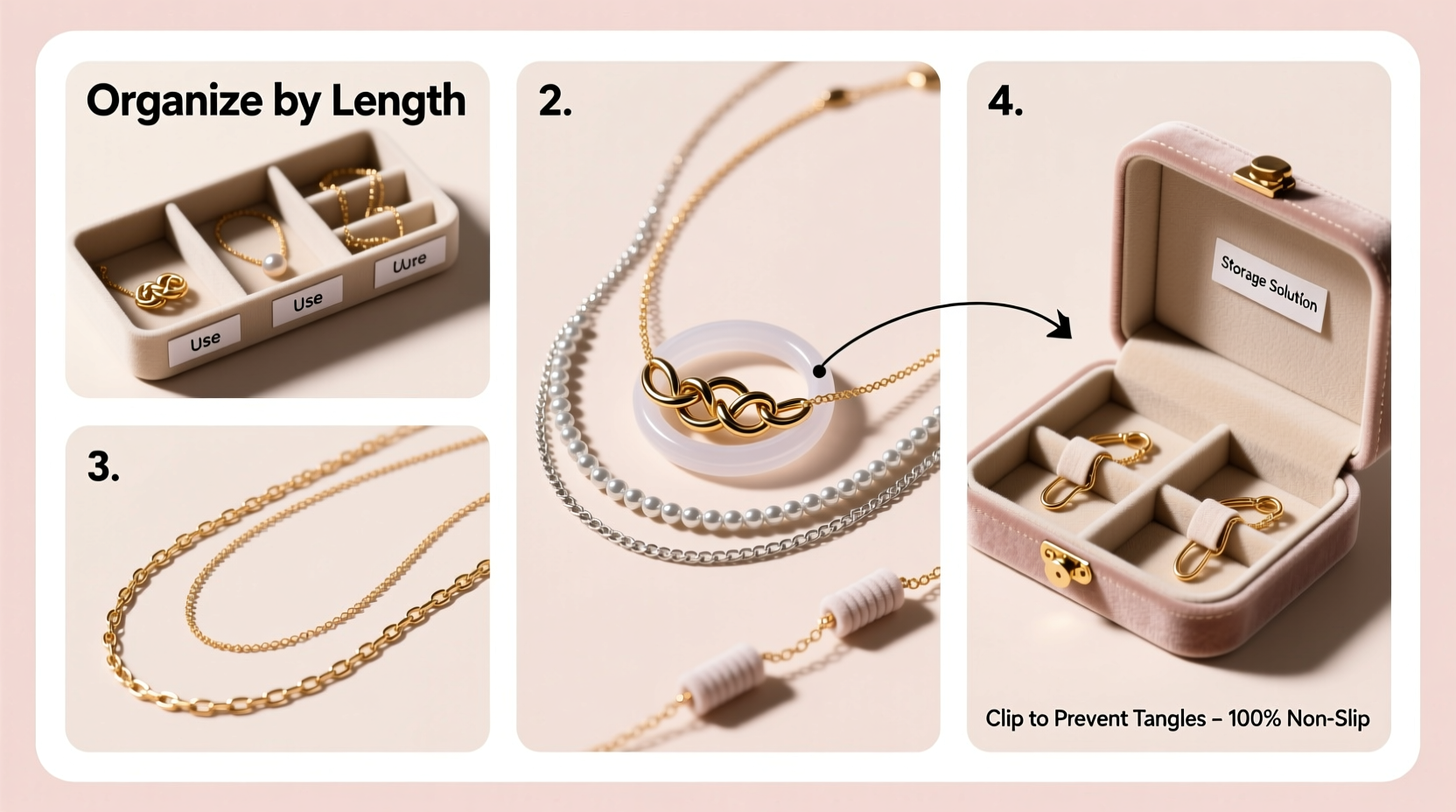
Some jewelry enthusiasts use discreet jump rings or tiny lobster clasps to temporarily connect adjacent necklaces at key points. For instance, linking the midpoint of a longer chain to the back of a shorter one keeps them aligned without restricting style. Just remember to disconnect before storing.
Step-by-Step Guide to Tangle-Free Necklace Storage
Most tangles happen not while wearing, but during storage. Without proper organization, even a single night in a cluttered drawer can result in chaos. Follow this step-by-step system to protect your collection.
- Sort by Length and Weight: Group necklaces into categories—short (14–18\"), medium (20–22\"), long (24\"+), and statement (30\"+). Store heavier pieces separately from delicate ones to avoid crushing or snagging.
- Untangle Immediately After Use: Don’t toss tangled necklaces into storage. Spend 30 seconds untangling them while fresh—before knots tighten overnight.
- Roll or Wrap Delicate Chains: Take a soft cloth strip (microfiber works well) and lay the necklace straight across it. Gently roll the cloth around the chain, securing the ends. This isolates the piece and cushions it from abrasion.
- Hang Longer Pieces Vertically: Use a wall-mounted jewelry organizer with hooks or slots. Hanging prevents coiling and allows air circulation, reducing moisture buildup that can accelerate tarnish.
- Seal Loose Ends with Tape (Temporarily): For travel or short-term storage, place a small piece of clear tape over the clasp to secure the chain end. Never leave tape on long-term—it can degrade metal finishes.
- Use Individual Compartments: Drawer dividers, ziplock bags, or fabric-lined boxes with partitions keep each necklace isolated. Label compartments by length or occasion for quick access.
Avoid These Common Storage Mistakes
| Mistake | Why It’s Harmful | Better Alternative |
|---|---|---|
| Tossing necklaces into a pile | Constant friction causes kinks and weakens solder joints | Use individual pouches or hanging organizers |
| Storing in humid bathrooms | Moisture accelerates tarnishing and corrosion | Keep in a dry bedroom drawer with silica gel packs |
| Leaving necklaces on dress forms overnight | Gravity pulls chains unevenly, increasing twist risk | Remove after photoshoots or events |
| Using magnetic clasps near electronics | Can interfere with devices; also attract metal debris | Store away from phones, laptops, and speakers |
Real Example: From Chaos to Curated Collection
Sophie, a fashion blogger based in Portland, used to dread her jewelry drawer. She owned over 20 necklaces—ranging from heirloom lockets to trendy Y-neck designs—but every morning began with a frustrating 10-minute detangling session. “I’d yank too hard and break a $120 gold chain,” she recalls. “It felt unsustainable.”
After researching tangle prevention, Sophie implemented a new system: she purchased a vertical acrylic display stand with labeled hooks for each length tier. She rolled her finest chains in microfiber strips and stored them in a cedar-lined box with anti-tarnish lining. She also started layering with intention—always putting on the longest first and mixing chain types. Within two weeks, she hadn’t encountered a single tangle. “Now my necklaces look like museum pieces,” she says. “And I can mix and match in seconds.”
Checklist: Your Daily & Weekly Tangle Prevention Routine
- ✅ Remove necklaces gently after wear—don’t pull over head aggressively
- ✅ Inspect for minor twists and correct them immediately
- ✅ Store each piece separately using rolls, pouches, or hooks
- ✅ Clean chains monthly with a polishing cloth to maintain smoothness
- ✅ Rotate layered combinations weekly to reduce strain on specific links
- ✅ Keep a mini toolkit: needle-nose tweezers, magnifier, and lubricant spray for tight clasps
- ✅ Travel with necklaces in rigid pill cases or molded plastic containers
Expert Tips for Detangling Without Damage
Even with precautions, tangles happen. When they do, patience is essential. Rushing increases the risk of snapping a chain or damaging a clasp.
Begin by laying the necklace on a flat, well-lit surface. Use a magnifying glass if needed. Gently separate visible loops with a toothpick or sewing needle—never pliers unless absolutely necessary. Apply a drop of thread conditioner or Johnson’s Baby Shampoo (diluted in water) to lubricate tight spots. Work from the outside inward, loosening one loop at a time.
If the knot is near the clasp, try opening the closure to give yourself more slack. For persistent knots, let the piece soak in warm soapy water for 10 minutes, then reattempt with a soft brush. If all else fails, consult a professional jeweler—many offer free or low-cost detangling services.
Frequently Asked Questions
Can I layer necklaces of the same length?
Yes, but with caution. Two necklaces of identical length will naturally rub and tangle unless connected. Use a small connector charm or clip them together at the back with a decorative finding. Alternatively, vary the pendant position so they don’t overlap.
How do I keep necklaces from tangling in my suitcase?
Use a hard-shell travel jewelry case with individual compartments. If unavailable, place each necklace in a sealable plastic bag and lay them flat between layers of clothing. For extra protection, wrap chains in straws or toilet paper rolls to maintain shape and separation.
Are certain metals less likely to tangle?
Not exactly. Metal type doesn’t prevent tangling, but stiffer chains (like thick Figaro or rigid herringbone styles) resist twisting better than fluid ones (like mariner or trace chains). However, stiffness may come at the cost of comfort, so balance practicality with wearability.
Conclusion: Style Without the Snarl
Layering necklaces should be a joyful expression of personal style, not a daily battle with knots. By understanding the mechanics of tangling, adopting smart wearing habits, and investing in thoughtful storage, you can preserve both the beauty and integrity of your jewelry. The key is consistency—small actions taken regularly compound into long-term protection.
Start tonight: take out your most tangled piece, gently free it, and store it properly. Tomorrow, reach for it with confidence. Build systems that support your lifestyle, whether you're a minimalist with three go-to chains or a maximalist with a rotating gallery of statement pieces. With these strategies, your necklaces won’t just look better—they’ll last longer, perform better, and bring you more joy.




 浙公网安备
33010002000092号
浙公网安备
33010002000092号 浙B2-20120091-4
Comments
No comments yet. Why don't you start the discussion?