
Diffusing holiday scents is more than decoration—it’s atmospheric storytelling. A well-layered Christmas diffuser evokes memory, comfort, and seasonal intention: the crackle of pine boughs, the spice of mulled wine simmering on the stove, the quiet sweetness of beeswax candles. Yet many people unintentionally sabotage this effect—not with poor ingredients, but with poor layering. Overloading a diffuser with too many oils, mismatched notes, or unbalanced ratios doesn’t create richness; it creates olfactory static. The result? A cloying, flat, or even headache-inducing haze that defeats the purpose of fragrance altogether.
This isn’t about adding more—it’s about adding *meaningfully*. Layering is a deliberate act of scent architecture: building top, heart, and base notes across time and temperature to mirror how real holiday experiences unfold. It requires understanding volatility, diffusion rates, molecular weight, and psychological response—not just personal preference. When done right, layered diffusing extends aromatic longevity, deepens emotional resonance, and keeps your space inviting for hours—not minutes—without triggering sensory fatigue.
Why “More Scents” Doesn’t Equal “Better Ambiance”
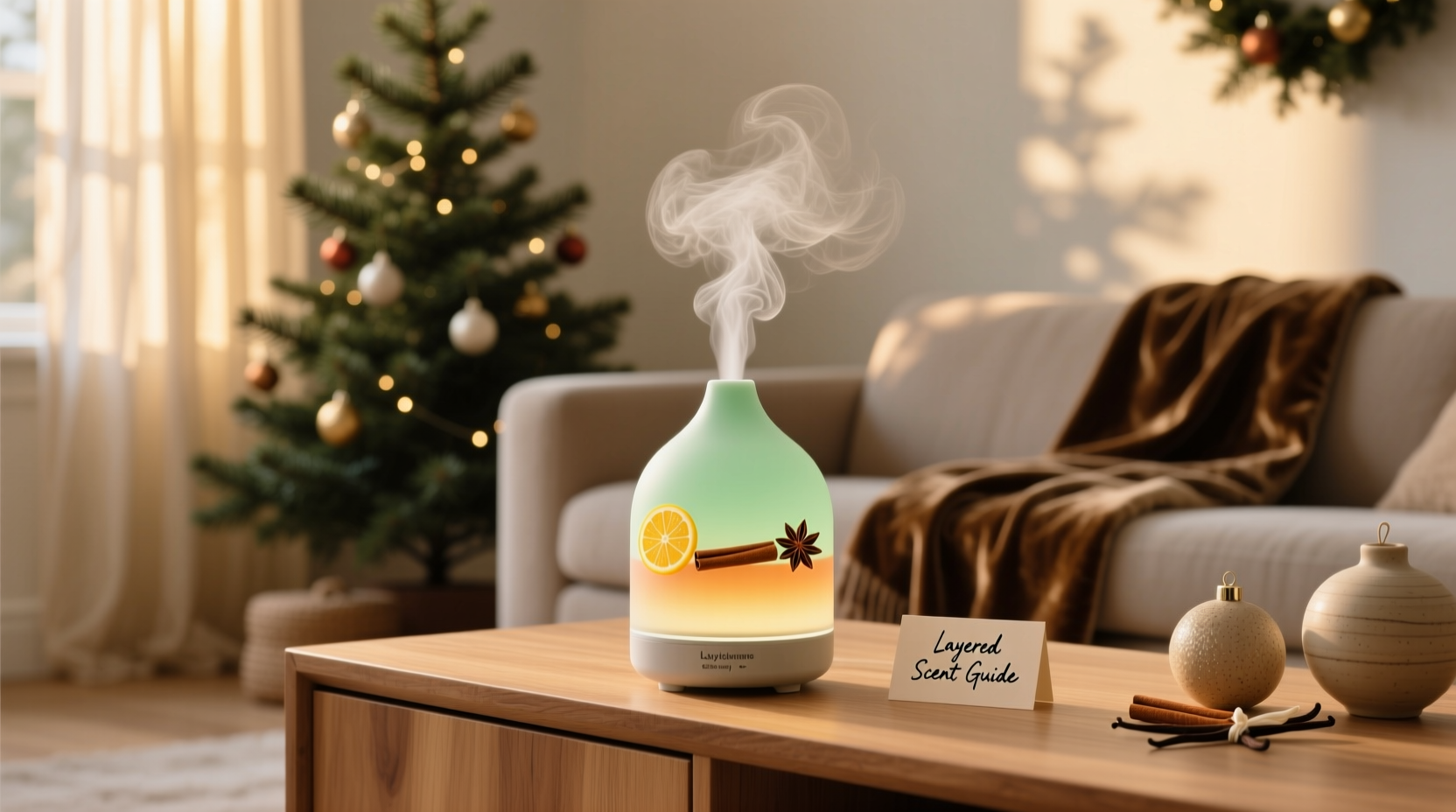
The human olfactory system adapts rapidly. Within 15–20 minutes of continuous exposure to the same volatile compounds, neural receptors begin to desensitize—a process called olfactory fatigue. In a diffuser context, this means that an aggressively layered blend (e.g., peppermint + cinnamon + clove + orange + fir + vanilla—all at full strength) may feel vibrant for the first five minutes, then vanish entirely—or worse, morph into a synthetic, medicinal, or burnt-sugar off-note as certain molecules dominate or degrade.
Compounding this is the physics of cold-air diffusion. Unlike heat-based methods (candles, stovetop simmers), ultrasonic diffusers break essential oils into microscopic particles suspended in cool mist. Lighter, more volatile top notes (citrus, mint, eucalyptus) evaporate fastest—often within 30–45 minutes—while heavier base notes (vanilla absolute, sandalwood, cedarwood, benzoin) linger longer but require time and warmth to fully express. Without intentional sequencing, you get a disjointed experience: bright citrus up front, then a sudden void, followed by a muddy, indistinct woody aftertaste.
The Three-Tier Scent Architecture for Holiday Diffusing
Effective layering follows classical perfumery structure—but adapted for ambient, non-skin application. For Christmas diffusing, the goal isn’t personal sillage (the trail left behind), but spatial immersion: a scent that feels grounded, evolving, and emotionally coherent over time.
| Layer | Role | Volatility | Christmas Examples | Recommended % in Blend |
|---|---|---|---|---|
| Top Note | First impression—bright, light, attention-grabbing. Sets the festive tone. | High (evaporates in 15–45 min) | Bergamot, sweet orange, grapefruit, white fir needle, spearmint | 40–50% |
| Heart Note | Emotional core—warm, rounded, comforting. Bridges top and base; lasts 2–4 hours. | Medium (evaporates in 2–5 hrs) | Nutmeg, cardamom, ginger CO2, frankincense, blue tansy, Siberian fir | 30–40% |
| Base Note | Anchoring depth—earthy, resinous, or creamy. Provides longevity and warmth; lingers 4+ hours. | Low (evaporates slowly over 6–12+ hrs) | Vanilla CO2 (not synthetic), vetiver, cedarwood atlas, benzoin resinoid, copaiba | 10–20% |
Note: Avoid using pure vanilla *essential oil*—it doesn’t exist commercially. Instead, opt for vanilla CO2 extract (a gentle, solvent-free method preserving true aroma) or a high-quality, alcohol-free vanilla infusion made with organic vanilla beans and fractionated coconut oil. Synthetic vanillin or fragrance oils lack the complexity needed for authentic layering and often clash with natural terpenes in other oils.
A Step-by-Step Guide to Building Your Christmas Diffuser Blend
- Select your anchor base note first—choose one that reflects your desired emotional foundation (e.g., cedarwood for rustic warmth, benzoin for nostalgic sweetness, vetiver for earthy calm). Use no more than 2 drops per 100 mL water.
- Add heart notes next, selecting 1–2 complementary spices or resins. Prioritize steam-distilled or CO2-extracted versions for purity (e.g., ginger CO2 over ginger essential oil, which can be overly sharp). Total heart notes: 3–4 drops per 100 mL.
- Finish with top notes—one bright, clean element to lift the blend and prevent heaviness. Avoid peppermint if sensitive to menthol; opt for spearmint or sweet orange instead. Top notes: 4–5 drops per 100 mL.
- Mix in a small glass dropper bottle first, not directly in the diffuser tank. Swirl gently (don’t shake—this creates foam). Let the blend rest for 10 minutes to allow initial molecular integration.
- Test before committing: Add 1 drop of your pre-mixed blend to 1 tsp of carrier oil (jojoba or fractionated coconut), dab on a scent strip, and observe how it evolves over 30 minutes. Does the top note fade too fast? Does the base emerge as harsh or medicinal? Adjust ratios before scaling up.
- Diffuse mindfully: Run your diffuser in 30-minute cycles with 30-minute breaks—especially during daytime hours. This prevents olfactory fatigue and allows the room air to reset, so each cycle feels fresh.
Real-World Example: The “Hearth & Holly” Blend in Practice
Sarah, a Portland-based interior stylist and wellness educator, hosts weekly open houses during December. Her living room—a high-ceilinged 1920s bungalow with large windows and hardwood floors—had long suffered from “scent whiplash”: guests would enter, smell strong cinnamon, then report the room smelling “empty” or “dusty” 20 minutes later. She experimented with layering using the three-tier method and discovered her previous blend (cinnamon bark + clove bud + orange + pine) was top-heavy and chemically unstable—clove and cinnamon contain high levels of eugenol, which oxidizes quickly in air and water, turning bitter.
She rebuilt her blend around benzoin resinoid (base, 1.5 drops/100 mL) for its warm, vanilla-balsamic sweetness; added cardamom CO2 (heart, 3 drops) for spicy-sweet complexity without heat; and finished with white fir needle (top, 4.5 drops) for crisp, forest-air brightness. She omitted citrus entirely—relying on fir’s natural limonene for lift—and ran her diffuser on 25-minute intervals. Guests now consistently describe the space as “calmly festive,” “like walking into a cozy mountain lodge,” and “never cloying.” Most tellingly, Sarah noticed her own sense of seasonal presence deepened—she no longer associated the holidays with olfactory exhaustion.
Expert Insight: The Science Behind Scent Harmony
“Fragrance layering isn’t about stacking smells—it’s about choreographing molecular release. Citrus monoterpenes diffuse rapidly but degrade fast in water; sesquiterpenes like those in vetiver or patchouli bind to airborne moisture and release steadily over hours. A balanced Christmas blend uses volatility as a timeline—not a volume knob.” — Dr. Lena Cho, Aromachemist & Senior Research Fellow, Institute for Sensory Science, University of Reading
Dr. Cho’s research confirms what seasoned aromatherapists observe clinically: blends exceeding six components rarely improve perception—instead, they increase cognitive load on the limbic system, raising stress markers in controlled trials. Simpler, thoughtfully sequenced layers consistently score higher in subjective comfort and emotional resonance metrics.
What to Avoid: The Christmas Diffuser Don’ts
- Don’t mix fragrance oils with essential oils—synthetic musks, aldehydes, or coumarin derivatives react unpredictably with natural terpenes, often producing off-notes or accelerating oxidation.
- Don’t use “holiday blend” pre-mixed oils without checking ingredients—many contain undisclosed solvents, synthetic extenders, or phototoxic bergamot FCF (furocoumarin-free is safe; regular bergamot is not).
- Don’t diffuse overnight in bedrooms—prolonged exposure disrupts sleep architecture, especially with stimulating top notes like rosemary or peppermint. Reserve those for living areas and daytime use.
- Don’t reuse old water—stale water breeds bacteria and degrades oil integrity. Always empty, rinse, and dry your diffuser tank daily.
- Don’t ignore your diffuser’s capacity—overfilling dilutes concentration; underfilling risks overheating the ultrasonic plate. Stick to the manufacturer’s water line.
Frequently Asked Questions
Can I layer scents by running different oils in succession?
Yes—but only with intentional pauses. After finishing one blend, run plain water for 10 minutes to clear residual mist and reset the chamber. Then introduce the next blend. Avoid back-to-back diffusion of clashing profiles (e.g., peppermint followed immediately by vanilla); allow at least 45 minutes between radically different aromatic families to prevent perceptual confusion.
Is it safe to layer carrier oils or absolutes in a diffuser?
No. Only water-soluble or properly emulsified materials belong in ultrasonic diffusers. Carrier oils (jojoba, almond), absolutes (jasmine, rose), and resinoids (unless specifically formulated for diffusion) will coat the ultrasonic plate, impair function, and potentially damage the unit. Stick to certified 100% pure essential oils, CO2 extracts, and water-soluble isolates.
How do I know if my blend is too strong?
If you catch yourself holding your breath unconsciously, experiencing mild eye or throat irritation, or noticing that guests pause at your doorway before entering (“What’s that smell?” rather than “Mmm, lovely!”), the blend is overpowering. Scale back by 30% across all notes—or remove the top note entirely and let the heart and base shine. True sophistication in scent lies in suggestion, not saturation.
Conclusion: Breathe Deeply, Not Loudly
Christmas scenting shouldn’t demand attention—it should invite presence. Layering isn’t about accumulation; it’s about intentionality. It’s choosing a base note that grounds your space like fallen pine needles underfoot, a heart note that warms like shared laughter around the table, and a top note that lifts like the first snowflake catching the light. When each element has space to unfold, your diffuser becomes less of a device and more of a quiet collaborator in cultivating the season’s deepest gifts: stillness, connection, and embodied joy.
Start small this year. Build one thoughtful, three-note blend. Observe how it moves through your room over time—not just how it smells at first, but how it settles, softens, and lingers. Notice when your breath slows, when shoulders drop, when strangers comment on the “feeling” of your home rather than just the fragrance. That’s the mark of successful layering: scent that serves the soul, not the senses alone.




 浙公网安备
33010002000092号
浙公网安备
33010002000092号 浙B2-20120091-4
Comments
No comments yet. Why don't you start the discussion?