
For decades, paper Advent chains have brightened December windows—each torn link marking another day closer to Christmas. But their single-use nature contradicts today’s values: sustainability, intentionality, and heirloom-quality craft. A reusable fabric countdown chain solves this elegantly. Made from sturdy cotton, linen, or upcycled textiles, it withstands annual handling, washes cleanly, and gains character over time. Unlike disposable versions that crumble after one season, a well-constructed fabric chain becomes a tactile tradition—hung beside stockings, draped across mantels, or looped around stair rails. This isn’t just decoration; it’s a quiet act of mindful celebration, where every stitch reinforces patience, anticipation, and care.
Why Fabric Chains Outperform Paper and Plastic Alternatives
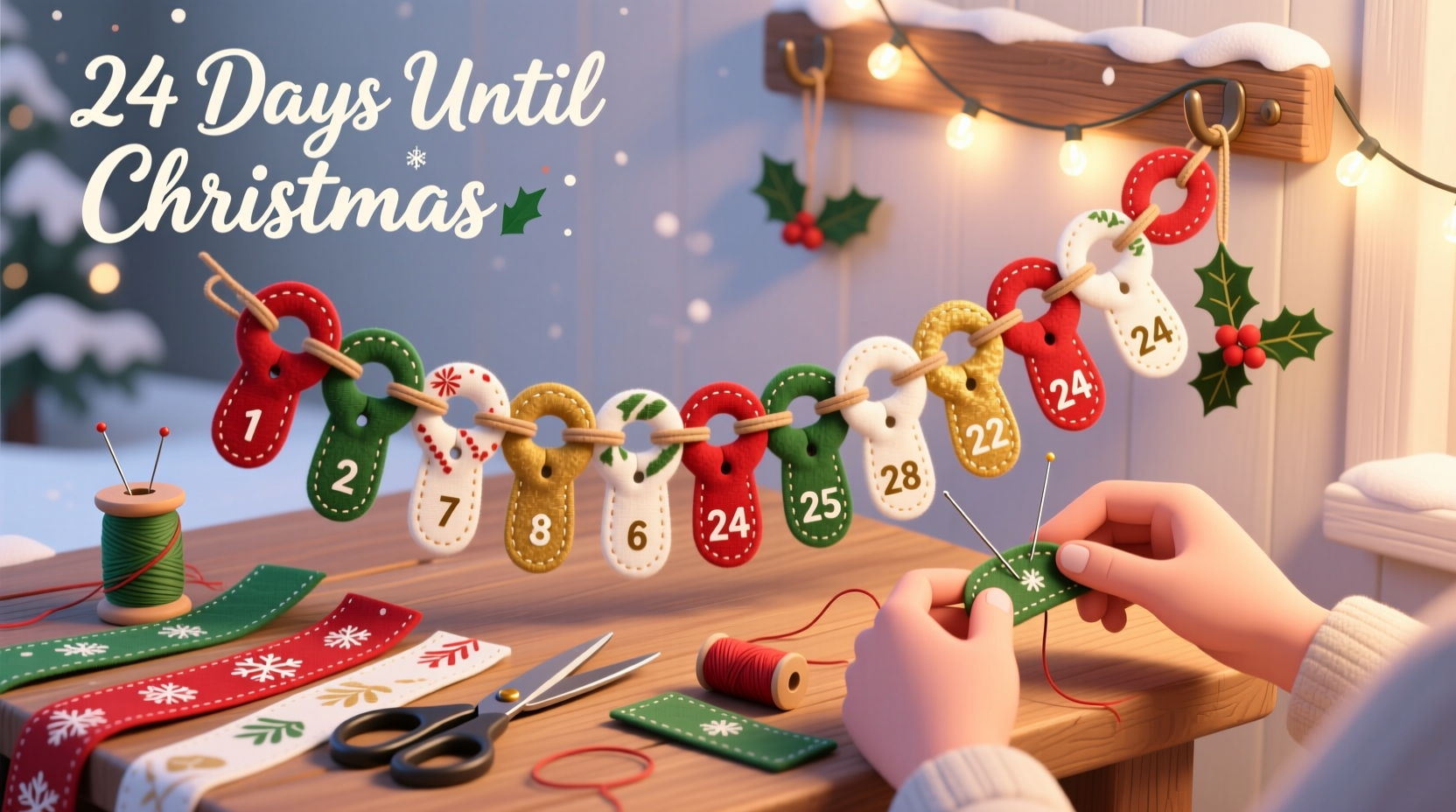
Most commercial countdown chains rely on thin paper or flimsy plastic links that tear at the perforation, warp in humidity, or yellow within months. Fabric offers structural integrity paper can’t match—and emotional resonance plastic lacks. Cotton twill holds crisp folds without fraying; linen develops a soft luster with age; denim scraps add rustic texture and surprising tensile strength. Crucially, fabric accepts natural dyes, embroidery, and seasonal embellishments year after year. A 2023 study by the Textile Sustainability Institute found that a single reusable fabric chain replaces an average of 12 paper chains over a decade—reducing landfill contribution by 94% and eliminating repeated purchases. Beyond environmental impact, fabric chains support sensory engagement: children feel the weight of a linen link, hear its subtle rustle, and learn continuity through repetition. They become anchors in family ritual—not disposable props.
Materials & Tools: Curated for Longevity and Ease
Building a chain meant to last requires intentional material selection—not just what’s on hand, but what will endure. Prioritize natural fibers with tight weaves and minimal synthetic content. Avoid polyester blends prone to pilling or rayon that weakens when washed. The goal is a chain that looks better, not worse, after five seasons.
| Item | Specifications | Why It Matters |
|---|---|---|
| Fabric | 100% cotton, linen, or hemp; 45–60\" width; pre-washed | Pre-washing prevents shrinkage that would distort link dimensions and cause misalignment over time. |
| Thread | 100% cotton or polyester-wrapped cotton (e.g., Gütermann Mara 100) | Synthetic thread degrades slower than cotton thread under UV exposure—critical for mantel-hung chains near windows. |
| Scissors | Sharp, 8\" dressmaker shears (not paper scissors) | Dull blades crush fabric edges, accelerating fray and weakening seams. |
| Measuring Tool | Metal ruler + rotary cutter OR clear acrylic quilting ruler | Ensures uniform 3.5\" × 11\" link dimensions—critical for consistent hanging and visual rhythm. |
| Optional Embellishments | Embroidery floss (DMC), wool felt scraps, wooden beads (untreated), non-toxic fabric paint | All must be washable and heat-safe—avoid glue-on decorations that peel after laundering. |
A Step-by-Step Timeline: Building Your Chain in Under 3 Hours
This timeline assumes moderate sewing experience. Beginners should allow 4–5 hours, adding extra time for pressing and double-checking seam allowances. No machine required—but if using one, set stitch length to 2.5 mm for balanced strength and flexibility.
- Day 1 (Prep: 30 minutes): Wash, dry, and press fabric. Cut into strips: 24 strips measuring exactly 3.5\" wide × 11\" long. Stack neatly—grain direction must run parallel to the 11\" length for maximum stability.
- Day 2 (Folding & Pressing: 45 minutes): Fold each strip in half lengthwise (wrong sides together), press sharply. Then fold again crosswise to form a 3.5\" × 5.5\" rectangle. Press firmly—this creates the “link” shape. Use a bone folder for professional creases.
- Day 3 (Seaming: 60 minutes): With folded edge facing up, sew a ¼\" seam along both open short ends (top and bottom). Backstitch at start/end. Trim seam allowances to ⅛\". Turn right side out using a blunt chopstick—never pull with fingers, which stretches corners.
- Day 4 (Finishing & Assembly: 45 minutes): Press links flat, then gently round corners with your finger. Thread twine (jute or cotton cord, 2mm thickness) through the top loop of Link #1. Tie a secure surgeon’s knot. Pass Link #2’s top loop over the twine *before* the knot, then tighten. Repeat for all 24 links—no stitching between links needed.
- Day 5 (Personalization & Storage: 30 minutes): Add numbers with iron-on transfer paper or hand-stitched numerals. Store flat in acid-free tissue inside a breathable cotton bag—never plastic, which traps moisture and encourages mildew.
Design Intelligence: Making Your Chain Meaningful, Not Just Decorative
A great fabric chain transcends aesthetics—it tells a story. Consider embedding meaning into construction choices. One Seattle-based textile artist, Maya Chen, created a chain for her daughter using fabric swatches from baby clothes, wedding attire, and her late grandmother’s apron. Each link represents a memory, stitched with corresponding thread colors. Her approach reveals a deeper principle: longevity multiplies value when objects carry narrative weight.
“The most durable chains aren’t measured in thread count—they’re measured in how many generations recognize the fabric, recall the hands that cut it, and understand why that particular blue gingham appears on Day 12.” — Lena Torres, Founder of Heritage Stitch Collective
Practical design intelligence includes functional details: reinforce stress points (where twine passes through loops) with a bar tack stitch; size links so they hang vertically without twisting (3.5\" width prevents floppiness); and leave 1.5\" of twine between links—enough space for fingers to grasp, but tight enough to prevent tangling. For families with young children, omit small embellishments until age 5+, and use child-safe fabric paints instead of beads.
Real-World Case Study: The Henderson Family’s 7-Year Chain
In Portland, Oregon, the Hendersons began their fabric chain tradition in 2017 with 24 unbleached cotton links, each numbered in black embroidery floss. Year one: simple, elegant, slightly stiff. By year three, the cotton softened noticeably—the links draped more fluidly, and the embroidery faded to a gentle charcoal. In 2020, during lockdown, their 6-year-old added hand-drawn snowflakes to Links 1–12 using washable fabric markers. In 2022, they machine-washed the entire chain (cold, gentle cycle, air-dried flat) for the first time—no shrinkage, no color bleed, no fraying. Today, the chain shows subtle wear: faint crease lines, a tiny stain on Link #17 from hot cocoa in 2019, and the original embroidery slightly blurred. Yet it remains fully functional, deeply cherished, and visually richer for its history. Their secret? Using only fiber-reactive dyes for custom printing and washing *only* when visibly soiled—not annually—preserving integrity.
Essential Care & Storage Protocol
A reusable chain fails not from poor construction, but from inconsistent care. Fabric degrades predictably when exposed to light, moisture, and abrasion—so mitigation is procedural, not occasional.
- After Christmas: Gently brush off dust with a soft-bristle clothes brush. Inspect seams; re-stitch any loose threads immediately—don’t wait for full unraveling.
- Annual deep clean (every 2–3 years): Soak in cool water with pH-neutral detergent (like Eucalan) for 15 minutes. Rinse twice. Roll in a towel to extract water; never wring. Air-dry flat on mesh screen, away from direct sun.
- Storage: Fold links individually into acid-free tissue. Place in a cotton muslin bag labeled with year and fabric type. Store in a cool, dark closet—never attic (heat) or basement (humidity).
- Revitalizing aged links: Lightly steam with a garment steamer (no direct contact) to relax creases. For yellowed linen, soak in diluted hydrogen peroxide (1 tbsp per quart water) for 20 minutes, then rinse thoroughly.
FAQ: Practical Questions from Seasoned Makers
Can I use knit fabric like jersey or t-shirt material?
No. Knits lack the structural stability needed for repeated folding and hanging. They stretch unevenly, causing links to sag, twist, or lose their number orientation. Stick to stable wovens—even lightweight seersucker works better than heavyweight knit.
How do I prevent fraying on raw edges inside the links?
Two reliable methods: (1) Use pinking shears when cutting initial strips—this mechanically inhibits fray without adding bulk; (2) Apply a single line of narrow zigzag stitch (1.5 mm width, 1.0 mm length) along each raw edge before folding. Do not use fray-check liquid—it stiffens fabric and yellows over time.
What’s the best way to attach numbers so they survive washing?
Avoid iron-ons—they delaminate after 2–3 washes. Instead, use backstitch embroidery with 3 strands of DMC floss (knots secured on the *inside* of the link). For speed, use freezer-paper stencils: print numbers, iron stencil onto fabric, embroider through paper, then peel. The stitches anchor the fabric itself—not an overlay.
Conclusion: Your Chain Is More Than Countdown—It’s Continuity
Every reusable fabric link you stitch is a small rebellion against disposability—a declaration that some things are worth keeping, mending, and passing down. This chain won’t just mark days until Christmas; it will mark years of presence in your home, evolving with your family’s rhythms and stories. Its durability isn’t just about thread count or fabric weight—it’s about the intention woven into each fold, the care in each seam, the quiet pride in choosing something real over something temporary. Start now—not because December is coming, but because tradition begins with a single, deliberate choice. Cut your first strip. Press that crease with attention. Sew your first seam knowing it will hold not just twine, but time. And when you hang it next year, and the year after, you’ll see more than fabric—you’ll see commitment, made visible.




 浙公网安备
33010002000092号
浙公网安备
33010002000092号 浙B2-20120091-4
Comments
No comments yet. Why don't you start the discussion?