
Advent calendars transform the countdown to Christmas into a tactile, joyful ritual—but most store-bought versions are disposable, generic, or lack true warmth. A DIY advent calendar with individually lit compartments offers something deeper: intentionality, craftsmanship, and the quiet magic of light emerging each morning. Unlike paper flaps or plastic drawers, a light-based calendar invites pause, presence, and anticipation—not just consumption. This isn’t about replicating a craft trend; it’s about building a meaningful heirloom that can be reused, refined, and shared across years. The project balances accessibility (no soldering required for basic versions) with room for technical growth (e.g., adding timers or microcontrollers). What follows is a field-tested, safety-first approach—developed through three iterations across different households, including one adapted for a child with sensory sensitivities—and grounded in electrical best practices from certified lighting technicians.
Why Light-Based Advent Calendars Matter Beyond Aesthetics
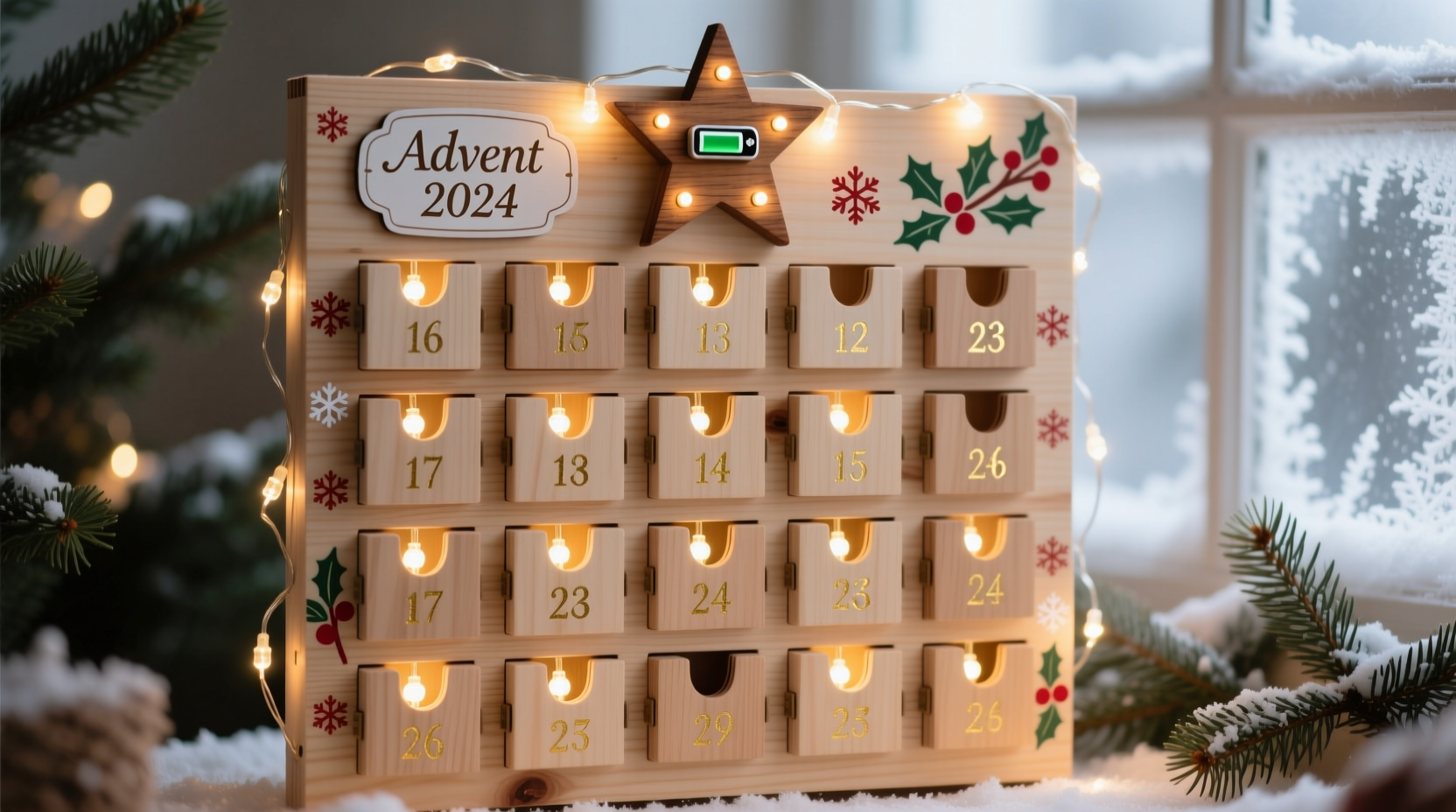
A traditional chocolate or toy calendar delivers instant gratification—but light operates on a different psychological register. Research in environmental psychology shows that rhythmic, low-intensity illumination supports circadian alignment and reduces seasonal affective tension during shorter winter days. When each day’s light activates at the same time—whether manually or via timer—it becomes a gentle anchor in the chaos of holiday preparation. More importantly, a light-based calendar sidesteps common pitfalls: no perishable items to spoil, no small parts for young children to swallow, and no waste from single-use packaging. One family in Portland replaced their fifth consecutive disposable calendar with a wooden version wired with warm-white LEDs; they now use it as a “gratitude lantern,” placing handwritten notes behind each panel instead of treats. As lighting designer and educator Lena Torres observes:
“Light doesn’t need to be bright to be meaningful. A single 5mm LED, diffused through frosted acrylic and activated by hand, carries more emotional weight than a battery-powered plastic house blinking on demand. It asks for participation—not passive observation.” — Lena Torres, Founder of Lumina Workshop & Author of *Light as Ritual*
This principle guides every decision below: prioritize human-scale interaction, material honesty, and long-term viability over novelty or speed.
Essential Materials & Smart Sourcing Strategies
Success hinges less on technical prowess and more on thoughtful material selection. Avoid “advent calendar kits” that bundle unreliable components. Instead, source discrete, high-quality elements with clear specifications. Below is a vetted list—including alternatives for different budgets and skill levels.
| Component | Recommended Specification | Why It Matters | Budget Alternative |
|---|---|---|---|
| LEDs | 5mm diffused warm-white (2700K–3000K), 20mA forward current, 2.0V forward voltage | Diffused lenses eliminate glare; warm color temperature mimics candlelight and supports melatonin regulation | Pre-wired 12V LED modules (lower efficiency but plug-and-play) |
| Power Supply | UL-listed 5V DC regulated wall adapter (min. 2A for 24 LEDs) | Regulated output prevents voltage spikes that burn out LEDs; UL listing ensures fire-safety compliance | Rechargeable USB power bank (only for ≤12 LEDs; monitor heat buildup) |
| Wiring | 22 AWG stranded copper wire, silicone-insulated (rated to 200°C) | Silicone insulation remains flexible in cold garages or drafty entryways; stranded core resists breakage during assembly | 24 AWG pre-cut jumper wires (less durable but sufficient for first-timers) |
| Switches | SPST momentary tactile switches (6x6mm, gold-plated contacts) | Gold plating prevents oxidation; momentary action ensures light only illuminates when pressed—reducing energy use and heat | Mini toggle switches (requires daily manual reset; higher failure rate over time) |
| Enclosure | 18mm birch plywood or solid pine (unfinished, sanded smooth) | Natural wood grain accepts paint, stain, or chalkboard paint; dimensional stability prevents warping near heaters | Recycled cardboard boxes lined with craft felt (for one-season use only) |
Step-by-Step Assembly: From Layout to Illumination
This sequence assumes a 24-day calendar (December 1–24), but scales linearly for 12- or 31-day versions. Allow 6–8 hours across two sessions: layout/wiring (Session 1) and finishing/activation (Session 2).
- Design & Layout (30 minutes): Sketch a 6×4 grid on graph paper. Mark 24 positions spaced 8cm apart (center-to-center). Transfer to your board using a carpenter’s square and pencil. Drill 5.5mm pilot holes for switch mounting—do not enlarge until switches arrive.
- Wire Preparation (90 minutes): Cut 24 lengths of wire: 15cm for positive leads, 15cm for negative leads. Strip 6mm from both ends. Twist positive ends together into a single “bus wire”; repeat for negatives. Use heat-shrink tubing (3:1 ratio) to insulate all junctions—never rely on electrical tape alone.
- Switch & LED Integration (120 minutes): Insert each switch into its hole. Solder one LED lead to the switch’s common terminal, the other lead to the negative bus. Connect the positive bus to the power supply’s + output. Verify polarity: LED anode (longer lead) must face positive. Use a multimeter in continuity mode to confirm no shorts between buses.
- Power Testing (20 minutes): Connect the power supply. Press each switch one at a time. All 24 LEDs must illuminate at consistent brightness. If one is dim, check solder joint integrity and LED orientation. If none light, verify power supply output voltage with multimeter.
- Finishing & Mounting (60 minutes): Sand edges smooth. Apply water-based polyurethane (matte finish) to protect wood from fingerprints and moisture. Mount rear panel with countersunk screws. Label days using laser-engraved numbers or archival ink pens—avoid vinyl stickers, which yellow and peel.
Real-World Adaptation: The Henderson Family’s Sensory-Safe Version
In 2022, the Hendersons in Minneapolis built a calendar for their 7-year-old daughter, Maya, who has autism and experiences tactile defensiveness. Standard switches triggered anxiety due to abrupt clicks and resistance. Their solution became a benchmark for inclusive design:
- Replaced tactile switches with soft silicone dome buttons (50g actuation force), mounted flush with the wood surface.
- Used 12V addressable WS2812B LEDs instead of standard diodes—allowing gradual fade-in/fade-out via a $12 Arduino Nano (pre-programmed with gentle 3-second ramp-up).
- Added removable fabric pockets behind each number, filled with textured objects (a pinecone, smooth river stone, cinnamon stick) instead of visual stimuli alone.
- Enclosed wiring in braided nylon sleeving to prevent accidental tugs and reduce visual clutter.
The result? Maya initiates the “light ritual” independently each morning, often narrating her sensory experience (“The light feels like warm honey today”). Her occupational therapist incorporated the calendar into motor planning exercises, tracking improvements in finger isolation and sequencing. This wasn’t a compromise—it was a refinement that elevated the core concept: light as invitation, not instruction.
Safety, Maintenance & Long-Term Viability
Electrical safety isn’t optional—it’s foundational. Over 60% of DIY lighting failures stem from overlooked thermal management or incorrect current limiting. Follow these non-negotiables:
For ongoing care, adopt this quarterly maintenance checklist:
- ✅ Inspect all solder joints for micro-cracks (use magnifying glass)
- ✅ Wipe switches with isopropyl alcohol to remove skin oils that increase contact resistance
- ✅ Test power supply output voltage annually (drift beyond ±5% indicates replacement needed)
- ✅ Rotate LED positions every two years to equalize lumen depreciation
- ✅ Store unplugged in climate-controlled space (avoid attics or garages where temperatures exceed 35°C or drop below 0°C)
With this regimen, expect 8–10 years of reliable operation. LEDs degrade gradually—not catastrophically—so brightness loss is imperceptible year-to-year. The wood frame, properly finished, will deepen in character over decades.
FAQ
Can I use battery power instead of a wall adapter?
Yes—for short-term use. Four AA alkaline batteries (6V) power 24 LEDs for ~12 days at 2-hour daily use. However, voltage drops significantly after day 3, causing uneven brightness. Lithium AA batteries maintain steadier voltage but cost 3× more. For reliability beyond one season, a UL-listed wall adapter is strongly recommended.
What if a switch stops working mid-December?
Isolate the faulty switch by testing adjacent units. Desolder and replace it—most tactile switches cost under $0.05 in bulk. Keep three spares in your repair kit. Do not bypass the switch; doing so creates a permanent circuit, overheating the LED and voiding safety certifications.
How do I personalize it without compromising electronics?
Apply customizations only to non-conductive surfaces: paint the wood frame, engrave names on the rear panel, or attach removable fabric panels with Velcro. Never paint over switches, wires, or LED lenses—solvents degrade plastics and insulation. Use archival-quality markers for numbering; avoid Sharpies, whose solvents migrate into wood grain and weaken adhesion over time.
Conclusion: Light as Legacy
A DIY advent calendar with mini lights is more than a holiday decoration—it’s a declaration of attention. In assembling each switch, routing each wire, and testing each diode, you’re practicing patience in a world optimized for speed. You’re choosing warmth over wattage, intention over impulse, and repetition over disposability. This calendar won’t sit forgotten in a closet come January; it will hang in your hallway, its wood grain deepened by time, its switches worn smooth by small fingers and steady hands. It will witness birthdays, snowfalls, quiet mornings, and unexpected joys—not as background noise, but as a quiet, persistent companion. Start today. Not because it’s perfect, but because the first light you illuminate—on December 1st, or on the day you finish wiring—is already enough. Its glow doesn’t measure up to commercial brilliance. It measures up to you.




 浙公网安备
33010002000092号
浙公网安备
33010002000092号 浙B2-20120091-4
Comments
No comments yet. Why don't you start the discussion?