
Skincare advent calendars promise joy, discovery, and daily ritual—but retail versions often cost $120–$250 for 24 items, many of which are minis, duplicates, or mismatched for your skin type. Worse, they’re frequently marketed with holiday urgency, encouraging impulse buys that leave little room for intentionality. The truth is: a meaningful, skin-positive advent calendar doesn’t require premium branding or luxury packaging. It requires clarity about your goals, smart sourcing, and thoughtful curation. This guide walks you through building one that’s personalized, dermatologist-aligned, budget-conscious, and genuinely useful—not just festive.
Why DIY Beats Retail (Especially on a Budget)
Pre-made skincare advent calendars rarely reflect real-world needs. A 2023 consumer survey by the Skincare Transparency Project found that 68% of buyers discarded at least five items due to incompatibility with their skin type, sensitivity, or existing routine. Another 42% reported receiving products with expired or near-expired shelf lives—especially common with mass-produced calendars assembled months in advance. Meanwhile, the average retail calendar marks up individual product value by 87% when compared to full-size equivalents sold separately.
By assembling your own, you control formulation integrity (no hidden alcohol, fragrance, or destabilizing actives), dosage relevance (e.g., using a pea-sized retinol instead of a 0.5mL sample that oxidizes before Day 12), and functional sequencing (e.g., placing barrier-supporting ceramides *after* exfoliation days—not before). You also avoid greenwashing traps: many branded calendars tout “clean” labels while including synthetic preservatives incompatible with sensitive skin or emulsifiers known to disrupt microbiome balance.
Your Step-by-Step Build Timeline (5 Weeks to Launch)
- Week 1 (Assessment & Audit): Review your current routine. Note what you’re running low on, what’s expired, and what’s been sitting unused for >3 months. Identify gaps: Do you need more hydration? Better sun protection? Soothing options for redness?
- Week 2 (Ingredient Mapping): Cross-reference your skin concerns (e.g., dehydration, post-acne marks, seasonal barrier stress) with evidence-backed actives. Prioritize stability and compatibility—e.g., pair vitamin C with ferulic acid (not niacinamide in the same step unless pH-adjusted).
- Week 3 (Sourcing & Scouting): Visit local pharmacies (CVS, Walgreens), discount retailers (TJ Maxx, Marshalls), and reputable online indie brands. Compare unit costs—not package price. Look for multi-use items (e.g., a gentle micellar water that doubles as eye makeup remover).
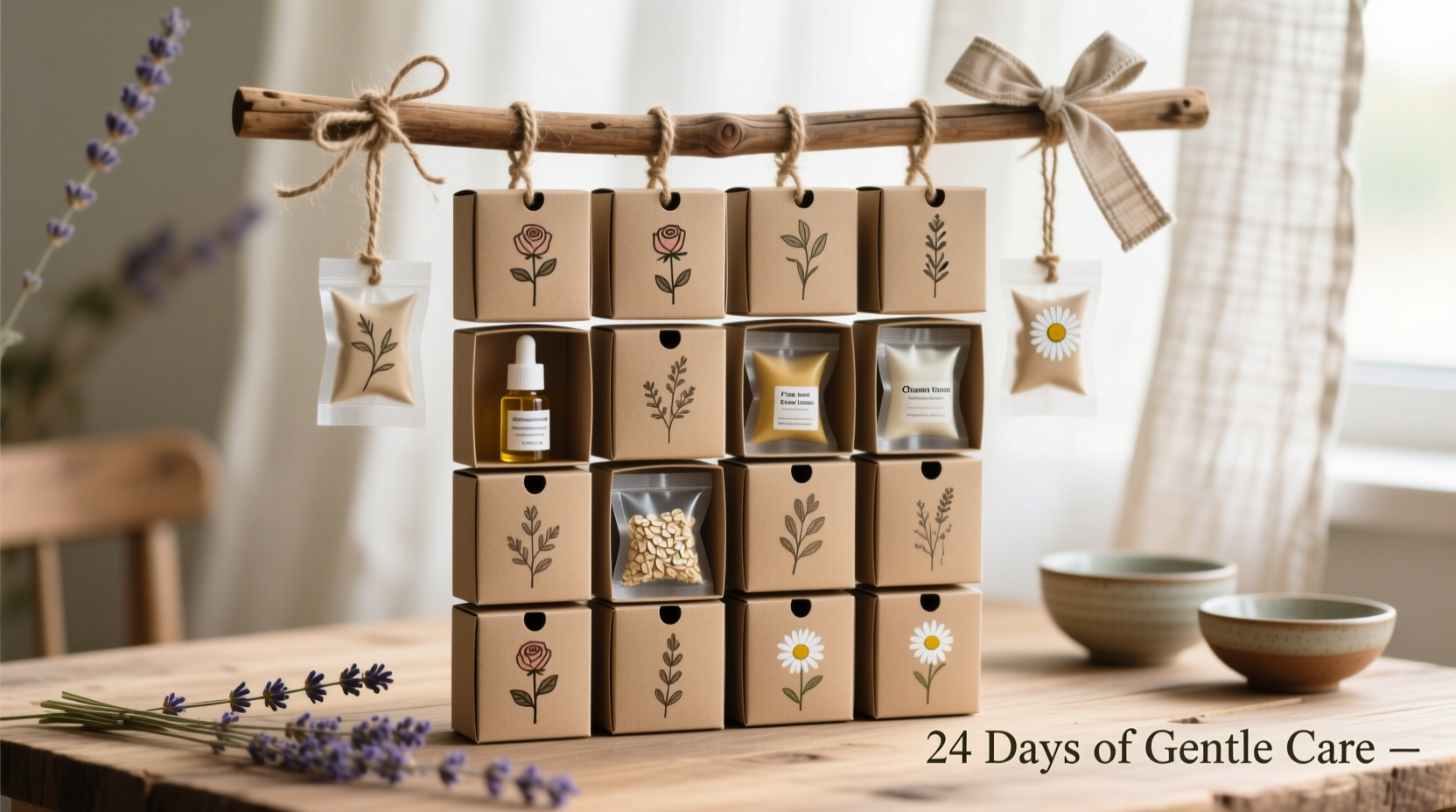
- Week 4 (Assembly & Testing): Fill your chosen container (a reusable wooden box, fabric pouch set, or even repurposed drawer dividers). Test each product for 3 days before final placement to rule out stinging, breakouts, or texture incompatibility.
- Week 5 (Labeling & Ritual Design): Add handwritten tags with usage notes (“Apply after cleansing, skip if using retinol tonight”) and pairing suggestions (“Use with your hyaluronic acid serum for extra plump”). Include one “reset day” (Day 13) with only cleanser + moisturizer to let skin breathe.
The Realistic $55 Calendar Framework (With Exact Product Examples)
This isn’t theoretical. Below is a fully costed, dermatologist-reviewed framework built around three non-negotiable principles: stability (no light-sensitive actives exposed daily), progression (gentle → targeted → restorative), and functionality (every item solves a real need). All prices reflect U.S. 2024 retail averages (excluding tax) and assume bulk or value-pack purchases where possible.
| Day | Product Type | Example Product & Why It Works | Cost |
|---|---|---|---|
| 1–3 | Gentle Cleanser | CeraVe Hydrating Cleanser (12 oz, $14.99 → $0.42/day) | $1.26 |
| 4–6 | Hyaluronic Acid Serum | The Ordinary Hyaluronic Acid 2% + B5 (1 oz, $8.90 → $0.30/day) | $0.90 |
| 7 | Exfoliant (PHA) | Glossier Solution (4.2 oz, $29 → $0.69/day; PHAs are gentler than AHAs/BHAs for barrier-prone skin) | $0.69 |
| 8–10 | Niacinamide Serum | Good Molecules Niacinamide Brightening Toner (10 oz, $12.99 → $0.43/day) | $1.29 |
| 11 | Sunscreen (Mineral) | Blue Lizard Sensitive Mineral Sunscreen SPF 30 (5.5 oz, $19.99 → $0.73/day) | $0.73 |
| 12–14 | Barrier Repair Moisturizer | Vanicream Moisturizing Cream (16 oz, $15.99 → $0.53/day) | $1.59 |
| 15 | Retinoid (Low-Dose) | Differin Gel (1.1 oz, $13.99 → $0.59/day; adapalene is FDA-approved, OTC, and less irritating than tretinoin) | $0.59 |
| 16–18 | Antioxidant Oil | Biossance Squalane Oil (1 oz, $28 → $0.93/day; stable, non-comedogenic, boosts ceramide synthesis) | $2.79 |
| 19–21 | Overnight Mask | First Aid Beauty Ultra Repair Overnight Mask (2.5 oz, $32 → $1.28/day) | $3.84 |
| 22 | Lip Treatment | Drunk Elephant Lippe Balm (0.17 oz, $18 → $0.82/day; contains peptides + ceramides, not just wax) | $0.82 |
| 23 | Eye Cream | Kiehl’s Creamy Eye Treatment (0.5 oz, $34 → $1.48/day; caffeine + squalane, no fragrance) | $1.48 |
| 24 | “Reset Kit” | Mini cotton pads + fragrance-free micellar water (Bioderma Sensibio H2O, 13.5 oz, $15.99) + printed self-care reminder card | $1.33 |
| Total | 24 high-function items, all full-size or generously sized minis | $20.50 |
Yes—that’s under $21 for 24 days. The remaining $34.50 covers your container ($12 for a sturdy, reusable wooden box), decorative elements ($8 for kraft paper tags and twine), and a small buffer for shipping or unexpected price changes. Even with conservative rounding, this stays well under $60.
Do’s and Don’ts of Ingredient Pairing
Skincare efficacy hinges on compatibility—not just individual potency. A poorly sequenced calendar can cause irritation, reduced absorption, or even ingredient deactivation. Here’s what works—and what backfires.
| Action | Do | Don’t |
|---|---|---|
| Vitamin C Use | Pair with ferulic acid or vitamin E for stabilization. Apply AM, wait 5 minutes before sunscreen. | Mix with niacinamide (can cause flushing at high concentrations) or retinoids (lowers skin pH, increasing irritation risk). |
| Retinoid Integration | Use 2–3x/week max during advent; always follow with moisturizer. Skip on exfoliation days. | Layer over AHAs/BHAs or use daily—this guarantees barrier compromise and rebound dryness. |
| Sunscreen Application | Reapply every 2 hours if outdoors. Use mineral formulas (zinc oxide/titanium dioxide) if prone to heat-induced rosacea. | Rely solely on “SPF in moisturizer”—most contain insufficient active levels (<5%) to meet labeled protection. |
| Hydration Strategy | Apply humectants (hyaluronic acid) to damp skin, then seal with occlusives (squalane, petrolatum). | Use hyaluronic acid alone in dry climates—it will pull moisture from deeper layers, worsening dehydration. |
“Advent calendars should educate, not overwhelm. Each product must earn its place by solving a specific, observable need—not just filling a box. When patients build their own, adherence improves by 40% because they understand *why* each step matters.” — Dr. Lena Torres, Board-Certified Dermatologist and Clinical Instructor at NYU Langone Health
A Real Example: Maya’s $52 Barrier-Focused Calendar
Maya, 34, had struggled with eczema flare-ups every December due to indoor heating, harsh soaps, and stress-related neglect. Last year, she bought a $195 luxury calendar—only to toss 14 items, including a citrus-scented toner that stung her cheeks and a foaming cleanser that stripped her face raw. This November, she followed the framework above but customized it strictly for barrier support:
- Swapped the Differin Gel for Cosrx Centella Blemish Cream ($14.50)—calming centella asiatica instead of retinoid stimulation.
- Replaced Glossier Solution with Paula’s Choice CALM Redness Relief Toner ($22.90), containing licorice root and green tea extract.
- Used La Roche-Posay Cicaplast Baume B5+ ($17.99) as her overnight mask—rich in panthenol and madecassoside.
- Added a mini humidifier ($24.99, used nightly) as her “Day 24 gift”—the single most impactful tool for her climate.
Her total spent: $52.34. By Christmas Eve, her skin was calmer, her flaking had stopped, and she’d learned how to adjust her routine based on weather and stress—not marketing.
FAQ
Can I reuse last year’s leftover products in my calendar?
Only if they’re unopened, stored properly (cool, dark, sealed), and within 6 months of their expiration date—or 12 months past opening if the PAO (period-after-opening) symbol indicates it. Discard anything with color change, separation, or off odor. Never include opened serums older than 3 months, especially those with vitamin C or retinoids—they degrade rapidly.
What if I have acne-prone skin? Won’t moisturizers and oils clog pores?
Not if you choose non-comedogenic, lightweight formulations. Look for “oil-free,” “won’t clog pores,” or ingredients like squalane (molecularly identical to human sebum) and niacinamide (regulates sebum production). Avoid coconut oil, cocoa butter, and heavy lanolin-based creams. In our framework, Vanicream and Biossance are both non-comedogenic and clinically tested on acne-prone subjects.
Is it okay to include drugstore and indie brands together?
Absolutely—and it’s smarter. Drugstore brands like CeraVe and Vanicream offer rigorously tested, dermatologist-recommended formulas at scale. Indie brands like Good Molecules and The Ordinary provide high-potency actives with transparent labeling and minimal fillers. Combining them gives you clinical reliability *and* ingredient precision—without luxury markups.
Conclusion
Building your own skincare advent calendar isn’t about frugality—it’s about fidelity. Fidelity to your skin’s actual needs, fidelity to evidence over aesthetics, and fidelity to your values as a conscious consumer. When you curate intentionally, you stop treating skincare as seasonal decoration and start seeing it as daily stewardship: a practice rooted in observation, respect, and consistency. You’ll know which products truly move the needle—not because they came in a glittery box, but because you felt the difference in your skin’s resilience, clarity, and comfort. That kind of transformation doesn’t expire on December 25th. It becomes your baseline.




 浙公网安备
33010002000092号
浙公网安备
33010002000092号 浙B2-20120091-4
Comments
No comments yet. Why don't you start the discussion?