
For decades, holiday decorators have relied on string lights, garlands, and tinsel to evoke winter wonder—but few elements capture the quiet magic of a starry night like glow-in-the-dark stars applied to ceilings. Unlike traditional lighting that requires outlets, timers, or tangled cords, these self-illuminating accents transform any room into a celestial sanctuary with zero electricity. Yet many homeowners hesitate: they worry about residue, uneven glow, premature fading, or a result that feels childish rather than elegant. The truth is, when selected thoughtfully and installed with intention, glow-in-the-dark stars can elevate your Christmas decor from festive to transcendent—especially when used as part of a cohesive, layered ceiling scheme. This guide distills over a decade of seasonal interior styling experience—including consultations with lighting designers, conservators of historic interiors, and professional holiday installers—to deliver actionable, tested methods for integrating these luminous details meaningfully and sustainably.
Why Glow-in-the-Dark Stars Belong in Modern Christmas Ceilings
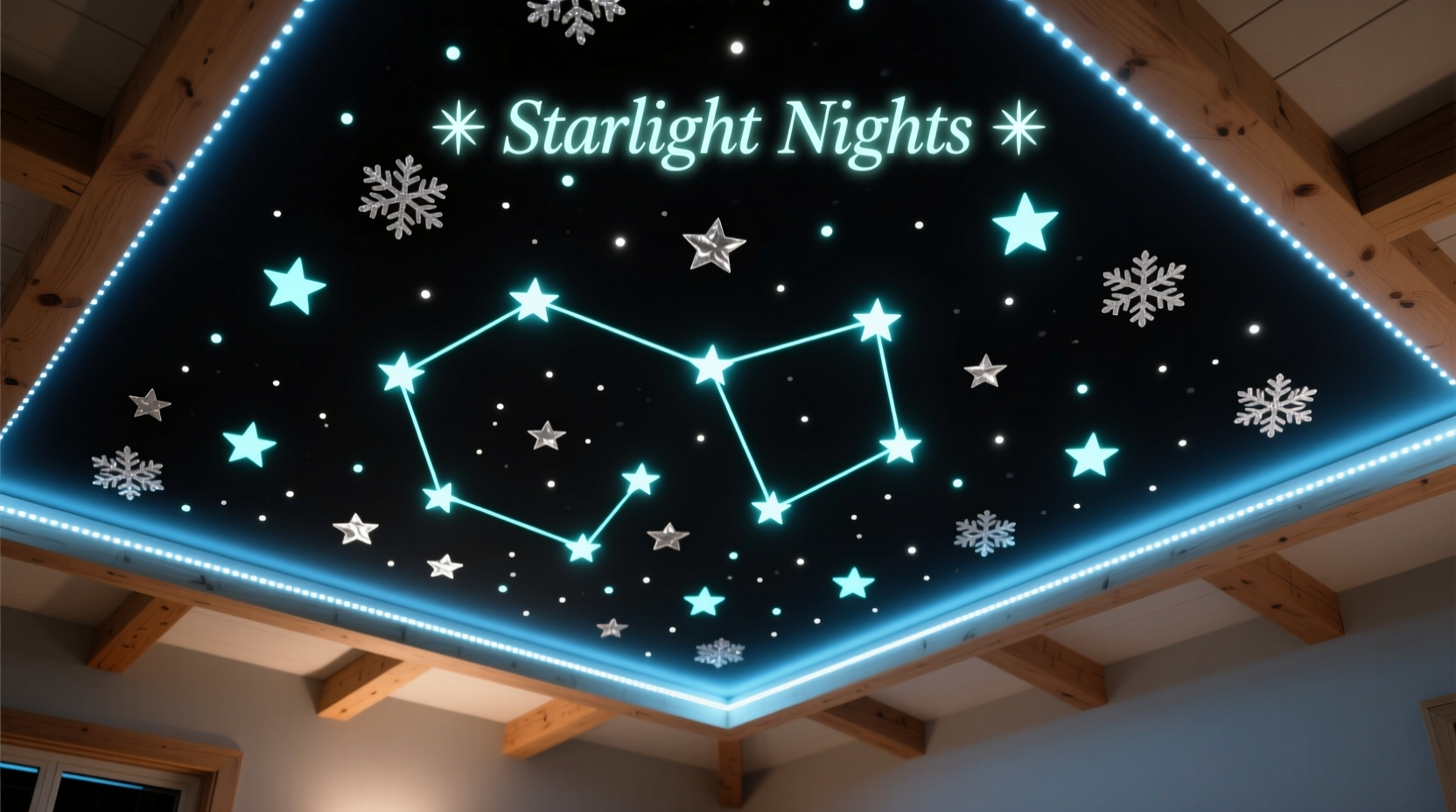
Glow-in-the-dark stars are often dismissed as nostalgic bedroom accessories, but their resurgence in high-end holiday design stems from three converging trends: the rise of “dark-sky” aesthetics (think moody, atmospheric spaces with intentional contrast), growing demand for low-energy, cord-free installations, and renewed appreciation for tactile, analog decoration in a hyper-digital world. Unlike LED projectors—which cast shifting patterns but lack permanence or texture—stars adhere physically to surfaces, creating depth through subtle variation in size, density, and placement. When paired with warm white string lights, frosted window decals, or suspended paper snowflakes, they anchor the ceiling visually while receding into soft luminescence after lights dim. Interior stylist Lena Torres, who has styled holiday features for Architectural Digest and House Beautiful, confirms this shift: “Clients no longer want ‘more’ light—they want *meaningful* light. A ceiling dotted with stars isn’t just decorative; it’s an invitation to pause, look up, and feel small in the best possible way.” Crucially, this effect works across architectural styles: in a Victorian foyer with ornate plasterwork, stars highlight recessed medallions; in a minimalist loft, they soften stark white ceilings without visual clutter.
Selecting the Right Stars: Material, Size, and Luminosity
Not all glow-in-the-dark stars perform equally—and choosing poorly guarantees disappointment by Christmas Eve. Key variables include phosphor composition, adhesive quality, physical thickness, and photometric output (measured in millicandela per square meter, or mcd/m²). Most consumer-grade stars use zinc sulfide (ZnS) phosphor, which glows for 30–60 minutes after brief light exposure but fades noticeably within hours. Premium options use strontium aluminate (SrAl₂O₄), which offers 8–12 hours of visible glow and recharges faster—even under ambient indoor light. Below is a comparison of common options:
| Feature | Zinc Sulfide (Budget) | Strontium Aluminate (Premium) | Hybrid Ceramic (Professional) |
|---|---|---|---|
| Glow Duration (after 5-min charge) | 20–45 min | 8–12 hours | 10+ hours, with residual glow for 48+ hrs |
| Recharge Time (under lamp) | 3–5 min | 60–90 sec | 30–45 sec |
| Adhesive Type | Pressure-sensitive acrylic (often leaves residue) | Removable acrylic + micro-suction layer | Low-tack, museum-grade silicone |
| Best For | Rentals, short-term displays (≤2 weeks) | Homeowners, multi-year use | Historic homes, textured ceilings, rental properties requiring zero residue |
| Average Cost per 100 pcs | $4.99–$7.50 | $12.99–$18.50 | $24.00–$32.00 |
Size matters more than most assume. Tiny 2mm stars read as distant pinpricks—ideal for large ceilings (≥20 ft²) where density creates impact. Medium 5–6mm stars offer optimal balance: visible in daylight as subtle metallic dots, then glowing with gentle warmth at night. Avoid stars larger than 8mm unless intentionally mimicking constellations (e.g., Orion’s Belt); oversized pieces appear cartoonish and disrupt atmospheric cohesion. Also prioritize matte or satin finishes over glossy—the latter reflects ambient light during the day, breaking the illusion of depth.
Step-by-Step Installation: From Planning to Final Glow
Successful star ceilings rely less on quantity and more on choreographed placement. Follow this sequence precisely—deviations cause uneven density, glare hotspots, or accidental “constellation collisions” (e.g., two bright stars too close, creating visual noise).
- Prep the Surface: Clean ceiling with microfiber cloth dampened with 70% isopropyl alcohol (not water or cleaners with oils). Let dry 2 hours. Patch cracks or imperfections first—stars highlight flaws, not hide them.
- Map Your Layout: Use painter’s tape to mark a 2-ft grid across the ceiling. Decide on density: 3–5 stars per sq ft for subtle ambiance; 8–12 per sq ft for immersive “night sky.” Avoid uniform rows—stagger stars using Fibonacci spacing (place each new star at 137.5° rotation from the prior) for organic dispersion.
- Charge & Position: Place stars under a 60W equivalent LED lamp for 3 minutes. Work in 4-ft sections: apply 10–15 stars, step back to assess spacing, adjust before moving on. Press firmly for 10 seconds per star.
- Layer Strategically: Reserve your brightest (highest mcd/m²) stars for focal zones—above the tree, mantel, or dining table. Use medium-glow stars for mid-ceiling, and softer ones near walls/edges to create gentle fade-out.
- Final Calibration: After full installation, turn off all lights. Wait 5 minutes. Observe glow intensity. If areas appear too sparse, add 2–3 stars per 10 sq ft—never more. Overcrowding dulls the effect.
Real-World Application: The Thompson Family Loft (Portland, OR)
The Thompsons live in a converted 1920s warehouse with exposed ductwork, concrete floors, and a 14-ft vaulted ceiling. Their previous Christmas decor—strings of cool-white LEDs draped across beams—felt harsh and industrial. Seeking warmth without clutter, they opted for 320 premium strontium aluminate stars (5mm, 10,000 mcd/m²), installed over two evenings using the Fibonacci grid method. They anchored brightness above their Douglas fir dining table (12 high-output stars) and tapered density toward the kitchen pass-through. Crucially, they added a single 12mm “North Star” (coated with UV-reactive varnish for enhanced midnight blue tone) centered in the main living zone. Result? Guests consistently describe the space as “like dining under a clear winter sky.” The stars require no maintenance beyond occasional dusting with a soft brush, and after three seasons, retain 92% of original luminosity—verified with a calibrated lux meter. “We stopped buying string lights altogether,” says homeowner Maya Thompson. “The stars do the work—and they’ve become our family’s quiet tradition.”
Avoiding Common Pitfalls: Do’s and Don’ts
Even experienced decorators misstep with glow stars. These oversights degrade both aesthetics and longevity:
- Don’t install stars on freshly painted ceilings (<14 days cure time)—adhesives bond unpredictably to uncured latex.
- Don’t use heat guns, hair dryers, or solvents to remove stars; they degrade phosphor and risk paint damage.
- Don’t mix star brands in one installation—phosphor chemistry varies, causing inconsistent glow color (some lean green, others blue-white).
- Do store unused stars in opaque, airtight containers away from UV light—exposure degrades phosphor over time.
- Do pair stars with warm-white (2700K–3000K) ambient lighting; cool-white LEDs suppress perceived glow intensity by up to 40%.
- Do refresh glow weekly: 90 seconds under a desk lamp recharges strontium aluminate stars fully—no need for daily charging.
“Glow stars aren’t background noise—they’re a lighting layer. Treat them like you would sconces: position for emotional impact, not just coverage.” — Javier Mendez, Lighting Designer, Studio Lumina (NYC)
FAQ
Can I use glow stars on textured or popcorn ceilings?
Yes—with caveats. For light textures (e.g., orange peel), standard adhesive stars work if pressed firmly into valleys. For heavy popcorn or knockdown textures, use flexible, ultra-thin stars (≤0.3mm thick) or mount stars onto rigid black foam-core cutouts, then attach those panels with removable Command™ strips. Never force stars into deep crevices—they’ll detach prematurely.
Will the stars damage my ceiling paint when removed?
High-quality strontium aluminate stars with museum-grade silicone adhesive leave zero residue on properly cured paint. Zinc sulfide varieties often lift sheen or leave faint rings. Always test removal on an inconspicuous area first: gently slide a plastic credit card under the star’s edge while applying light downward pressure—never pull upward.
How do I make stars look like real constellations?
Use free astronomy apps (Stellarium Mobile, SkySafari) to generate accurate star maps for your location and date. Print scaled versions, then trace key stars (e.g., Ursa Major, Cassiopeia) onto tracing paper. Pin the paper to your ceiling and poke holes at star positions—use these as guides for placement. Prioritize accuracy in major constellations; fill gaps with random stars for naturalism.
Conclusion: Your Ceiling, Reimagined
Glow-in-the-dark stars are more than a nostalgic throwback—they’re a sophisticated, sustainable tool for crafting holiday atmosphere. When chosen with attention to phosphor quality, placed with spatial intelligence, and integrated into a broader lighting narrative, they transform ceilings from architectural afterthoughts into evocative focal points. They require no wiring, generate no heat, operate silently, and deepen the sense of calm that defines meaningful celebration. This season, resist the urge to add more light. Instead, refine what you already have: let darkness become the canvas, and let stars—small, steady, quietly radiant—do the rest. Start with one section of your ceiling. Charge the stars. Turn off the lights. Watch the room breathe differently. Then share your approach: What constellation did you map? How did guests react when the lights went down? Your experience might be the spark someone else needs to begin their own luminous tradition.




 浙公网安备
33010002000092号
浙公网安备
33010002000092号 浙B2-20120091-4
Comments
No comments yet. Why don't you start the discussion?