
Staring at a stubborn jar of pickles or pasta sauce that refuses to budge is a common kitchen frustration. The vacuum seal that keeps food fresh also makes the lid nearly impossible to twist off—especially for those with limited hand strength or arthritis. But before you resort to calling for help or risking injury, consider this: most homes already contain tools capable of breaking that seal. With a few clever tricks and common household objects, opening even the tightest jar lids becomes manageable, safe, and often effortless.
The key lies in improving grip, reducing friction, or disrupting the vacuum seal—all without damaging the container or hurting your hands. This guide explores multiple reliable methods using only items typically found in drawers, cabinets, or toolkits. Each approach is tested, safe, and adaptable to different situations and physical abilities.
Why Jar Lids Get So Tight
Jar lids are designed to create an airtight seal that preserves food by preventing air and bacteria from entering. When hot food is sealed in a jar and cools, it creates a partial vacuum, pulling the lid down tightly. This suction effect is what makes jars difficult to open, not just the initial torque applied during sealing.
Additionally, metal lids can slightly corrode or bind with glass threads over time, especially if stored in humid environments. Moisture, salt residue, or dried food particles may contribute to adhesion. Understanding these factors helps explain why brute force alone rarely works—and often leads to sore hands or spilled contents.
“Many people injure themselves trying to open jars because they rely on grip strength instead of physics. A small amount of leverage or pressure equalization goes much further.” — Dr. Alan Prescott, Occupational Therapist
Step-by-Step Guide: 7 Effective Methods Using Household Items
No specialized tools required. These techniques use common household objects to increase grip, apply leverage, or break the vacuum seal.
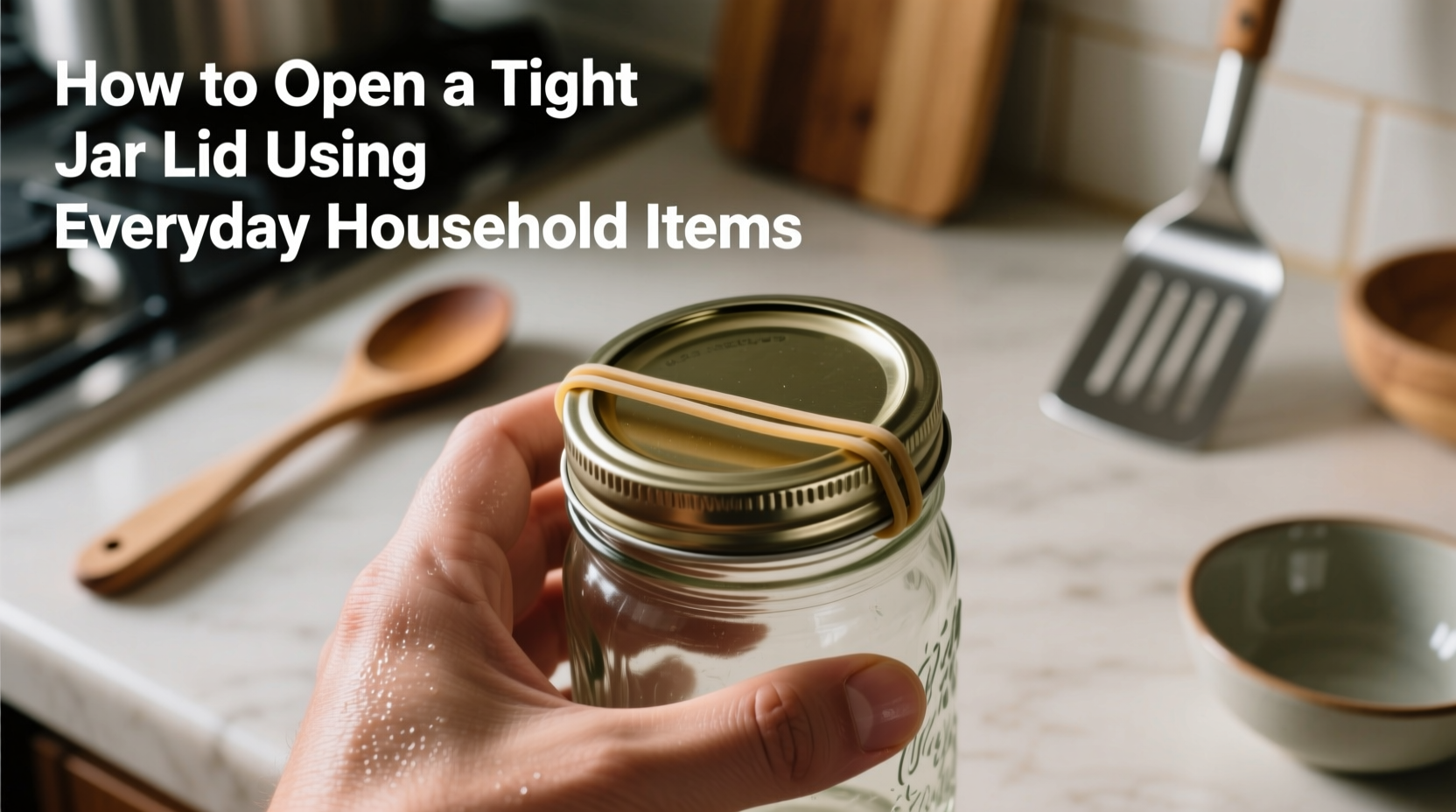
1. Rubber Band Grip Boost
If the issue is slipping rather than suction, enhance your grip instantly with a rubber band.
- Wrap one or two thick rubber bands around the lid.
- Ensure the bands sit across the ridges for maximum traction.
- Hold the jar firmly on a stable surface and twist the lid counterclockwise.
The rubber grips the skin and lid simultaneously, increasing friction. This method is ideal for smooth or greasy hands.
2. Use a Silicone Oven Mitt or Dish Glove
Silicone oven mitts have textured surfaces designed to handle hot pans—perfect for gripping cold, slick lids.
- Put on a silicone glove or place a dishcloth with rubber dots over the lid.
- Press down slightly to engage the texture with the metal.
- Apply steady, firm twisting motion while keeping the jar base stable.
This method combines improved traction with heat resistance, making it useful even for recently refrigerated jars.
3. Tap and Release the Vacuum Seal
Break the internal suction by slightly flexing the lid.
- Hold the jar upside down.
- Gently tap the edge of the lid against a hard surface like a countertop or sink edge.
- Rotate the jar and repeat 3–4 times around the circumference.
- Flip upright and try twisting.
Tapping bends the lid microscopically, allowing outside air to enter and equalize pressure. You might hear a faint “pop” when the seal breaks.
4. Run Under Warm Water
Heat expands metal faster than glass, loosening the lid’s grip.
- Hold the jar upside down under warm running water for 30–60 seconds.
- Focus the stream on the lid, not the glass body.
- Dry thoroughly and attempt to open with a towel for added grip.
This method is particularly effective for metal lids on glass jars stored in cool pantries or refrigerators. Avoid extreme temperature changes to prevent cracking.
5. Use a Butter Knife and Light Leverage
Carefully release the vacuum with a thin, sturdy utensil.
- Insert the tip of a butter knife or teaspoon under the edge of the lid.
- Gently twist the handle to lift the lid slightly—just enough to hear air enter.
- Remove the utensil and twist the lid off by hand.
Caution: Do not use excessive force. The goal is to break the seal, not pry the lid off completely. This method requires precision to avoid damaging the lid or injuring fingers.
6. Apply a Coin or Spoon Edge for Extra Torque
Create mechanical advantage using a coin or spoon as a lever.
- Place a quarter or dime between your thumb and the lid’s edge.
- Squeeze firmly—the coin acts as a grip enhancer and pressure distributor.
- Twist steadily while holding the jar base with the other hand.
Alternatively, hook the edge of a metal spoon under the lid and press upward gently to pop the seal before twisting.
7. Use a Strap Wrench or Improvised Alternative
When nothing else works, maximize torque with a strap-style tool—or fake one.
- Cut a section from an old fabric belt, strong shoelace, or nylon strap.
- Loop it around the lid and pull both ends in opposite directions—one forward, one back—to simulate rotation.
- Anchor one end under your foot or against a wall for stability if needed.
This mimics a mechanic’s strap wrench and applies even force without damaging the jar.
Do’s and Don’ts: Best Practices for Opening Jars Safely
| Do’s | Don’ts |
|---|---|
| Use a rubber band or silicone glove for better grip | Don’t use oily cloths—they reduce traction |
| Tap the lid gently to break the vacuum | Don’t hit the jar too hard—risk of breakage |
| Run warm water over the lid to expand metal | Don’t submerge hot jars in cold water—thermal shock risk |
| Store jars with lids slightly loosened after first use | Don’t leave metal lids wet—promotes corrosion |
| Use leverage tools like spoons or straps carefully | Don’t use sharp knives aggressively—risk of injury |
Real-Life Example: Sarah’s Pasta Sauce Struggle
Sarah, a retired teacher with mild arthritis, regularly struggled with jars. One evening, she bought a large jar of tomato sauce but couldn’t open it despite using towels and tapping. Remembering a tip from her daughter, she wrapped a thick rubber band around the lid. Still stuck. Then she ran the lid under warm water for 45 seconds, dried it, and tried again. This time, the lid twisted off easily.
She now keeps a dedicated “jar helper kit” in her kitchen drawer: a silicone glove, a small rubber mallet, a rubber band, and a butter knife. “It’s not about strength,” she says. “It’s about knowing what to do.”
Checklist: How to Open a Stubborn Jar – Quick Reference
Follow this sequence before resorting to force:
- ✅ Check if the lid has a rubber band wrapped around it for extra grip
- ✅ Put on a silicone oven mitt or use a textured dishcloth
- ✅ Tap the edge of the lid gently on a counter to release suction
- ✅ Run warm water over the lid for 30–60 seconds
- ✅ Insert a butter knife at the seam and twist slightly to let air in
- ✅ Try using a coin or spoon for added leverage
- ✅ Use a strap or belt for full rotational force if still sealed
- ✅ If opened, clean threads and store with slight looseness
Frequently Asked Questions
Can I use WD-40 or oil on a jar lid?
No. Lubricants like WD-40 are toxic and can contaminate food if they seep into the seal. They also degrade rubber gaskets. Stick to non-toxic, mechanical methods only.
Why does tapping the lid sometimes work instantly?
Tapping flexes the metal lid slightly, breaking the airtight vacuum. Once outside air enters, the pressure difference disappears, and the lid requires far less torque to remove.
What if the jar is full and I don’t want to turn it upside down?
Use the warm water method with the jar upright, directing water only on the lid. Alternatively, wrap a heated towel around the top for 1–2 minutes to achieve similar expansion.
Expert Insight: Ergonomics and Accessibility
For individuals with reduced hand strength, repetitive strain, or conditions like carpal tunnel, traditional jar opening poses real challenges. Occupational therapists often recommend adaptive tools—but many household alternatives exist.
“Simple modifications make independence possible. A rubber band or warm water trick isn’t just convenient—it’s empowering for older adults and people with disabilities.” — Dr. Lena Torres, Rehabilitation Specialist
Consider transferring contents to resealable containers after first use, especially for frequently used items like spices or sauces. Wide-mouth jars with pump dispensers or screw-top pour spouts also reduce long-term effort.
Conclusion: Stop Fighting Jars—Work With Physics
Opening a tight jar lid doesn’t require superhuman strength. It requires understanding the forces at play and using simple tools to counteract them. Whether it’s enhancing grip with a rubber band, breaking suction with a tap, or expanding metal with warmth, each method leverages basic principles of physics and mechanics available in every home.
The next time a jar resists, pause before straining your wrists or asking someone else. Try one of these techniques—you’ll likely succeed quickly and safely. And if you discover a method that works especially well in your kitchen, share it. Someone else might be struggling with the same pickle jar right now.




 浙公网安备
33010002000092号
浙公网安备
33010002000092号 浙B2-20120091-4
Comments
No comments yet. Why don't you start the discussion?