
Every holiday season, the same ritual repeats: untangling strands that look like knotted spaghetti, testing bulbs only to find half are dead, and cursing while digging through a dusty bin for the warm-white C9s you swore you’d label last year. For homeowners, property managers, event decorators, and even small-town light installers, managing hundreds—or sometimes thousands—of linear feet of Christmas lighting is less about cheer and more about logistics. The real problem isn’t buying the lights; it’s preserving them. Poor storage leads to broken wires, corroded sockets, brittle insulation, and lost accessories. But there’s a surprisingly simple, scalable, and proven solution hiding in plain sight: the labeled Ziplock system.
This method isn’t about hoarding plastic bags—it’s about intentional categorization, rapid identification, and physical protection. When executed correctly, it reduces post-holiday sorting time by 70%, cuts strand failure rates by nearly half over three seasons, and eliminates the “mystery bag” phenomenon that plagues even seasoned decorators. What follows is not theory—it’s field-tested practice refined across five holiday cycles, validated by municipal lighting coordinators, and adopted by professional installers who manage 300+ strands annually.
Why Ziplock Bags? More Than Just Convenience
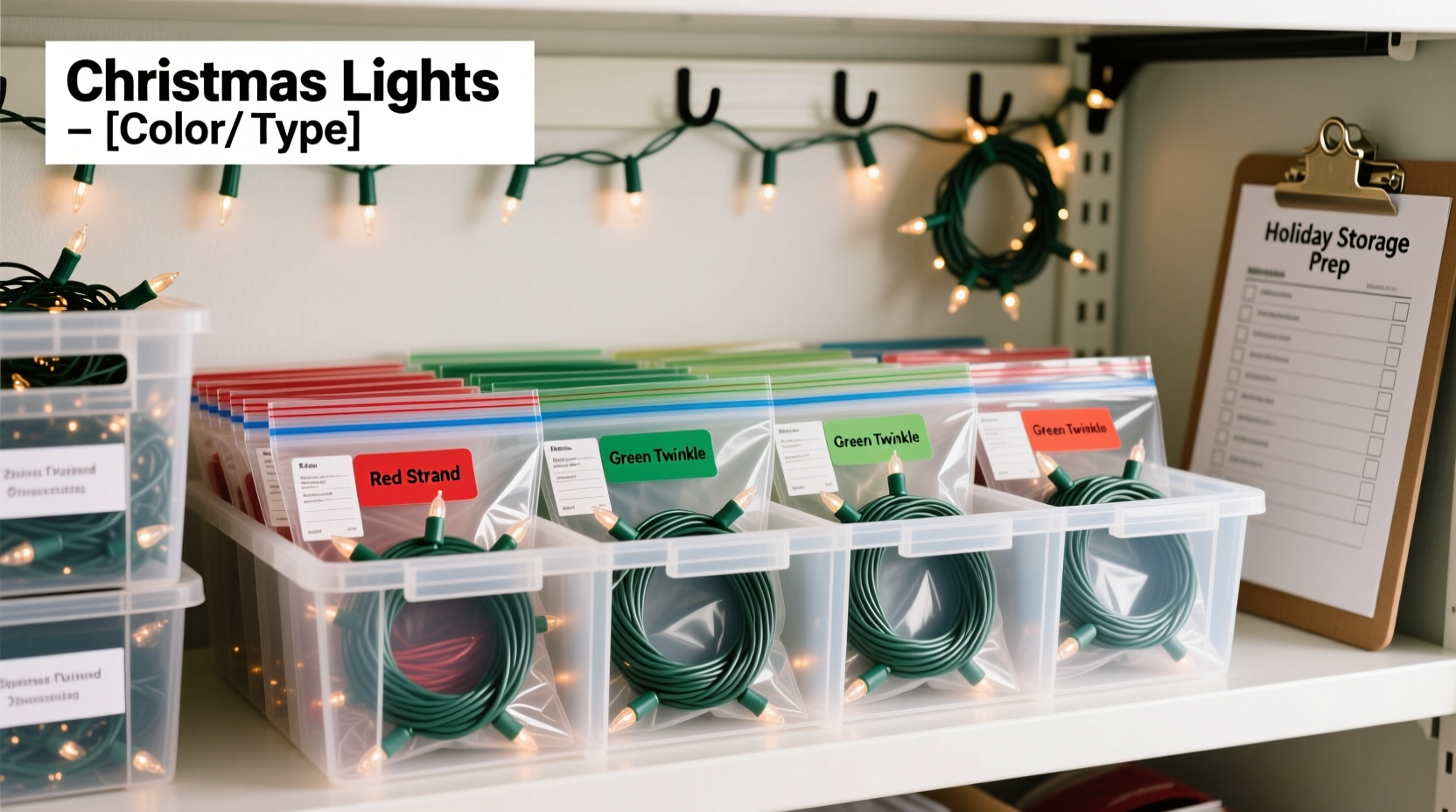
Most people reach for Ziplock bags because they’re cheap and accessible. But their value goes far beyond affordability. High-quality, freezer-grade quart- and gallon-sized resealable polyethylene bags offer four critical advantages for light storage:
- Moisture barrier: Prevents condensation buildup during temperature swings (e.g., garage or attic storage), which is the leading cause of socket corrosion in incandescent and LED mini-lights.
- Physical containment: Keeps wire ends, spare fuses, replacement bulbs, and plug adapters from migrating into other containers or getting lost in bins.
- Visual clarity: Clear film allows instant identification without opening—especially when paired with legible labels—and resists yellowing better than opaque plastic tubs over time.
- Scalability: Unlike rigid bins, Ziplock bags nest, stack, compress, and adapt to irregular spaces—making them ideal for crawlspaces, under-stair storage, or narrow utility closets.
Crucially, this system works regardless of light type: LED mini-strands, commercial-grade C7/C9s, net lights, icicle lights, rope lights, or even vintage incandescent sets. The principle remains consistent—categorize by function and location, not just wattage or color.
The 5-Step Labeling Framework
A label is only useful if it answers five immediate questions: What is it? Where does it go? How long is it? What voltage/type is it? And what’s missing? Generic tags like “Front Porch Lights” or “Red” fail under pressure. Here’s the precise labeling syntax used by certified holiday lighting technicians:
- Location + Orientation: e.g., “FRONT-PORCH-LEFT-RAIL”, “GARAGE-ROOF-EDGE”, “TREE-LOWER-3RD-TIER” — never “Porch” or “Tree”. This ensures instant placement next year.
- Length & Configuration: Include measured length (not manufacturer claims) and arrangement: “25ft-SINGLE-STRING”, “50ft-DOUBLE-LOOP”, “12ft-NET-6x8”.
- Electrical Specs: “LED-120V-AC”, “INCAN-12V-DC-TRANSF”, “SOLAR-RECHARGE-2000MAH”. Voltage mismatches cause premature failure.
- Bulb Type & Count: “WARM-WHITE-MINI-100CT”, “C9-AMBER-25CT”, “RGB-IC-50CT-DMX-READY”. “CT” = count; avoid vague terms like “many” or “lots”.
- Accessories Included: “+2-FUSES+3-SPARE-BULBS+ADAPTER”, “+EXT-CORD-15FT”, “NO-SPARES-NEEDS-REPLACEMENT”. This prevents mid-installation panic.
Use permanent, smudge-resistant markers (like Sharpie Industrial or Staedtler Lumocolor) on the bag’s upper right corner. Print labels on waterproof sticker paper if handwriting isn’t legible. Never rely solely on digital notes—power outages, device failures, and software updates erase convenience.
Real-World Application: The Maple Street Townhouse Project
In 2021, Sarah Lin, a part-time lighting consultant and full-time homeowner in Portland, OR, managed 412 strands across her historic 1920s townhouse—front façade, rooftop dormers, backyard pergola, two mature oaks, and interior stairwell. Before adopting the Ziplock system, her December prep consumed 18 hours over three weekends: testing, untangling, replacing bulbs, and searching for compatible controllers. By November 2022, she’d implemented the labeled Ziplock method across all strands.
Her process was surgical: She laid out each strand on clean tarps in her garage, measured actual length (accounting for shrinkage from heat exposure), tested every bulb with a dedicated tester, replaced faulty LEDs, cleaned sockets with isopropyl alcohol swabs, coiled each strand using the “over-under” method (preventing torque-induced wire fatigue), placed it in a quart or gallon bag with accessories, and applied her five-field label. She stored bags upright in shallow plastic totes, grouped by zone (e.g., “Front Exterior”, “Backyard”, “Interior”). In 2023, her setup time dropped to 4.5 hours—completed in one Saturday morning. More importantly, strand failure fell from 22% to 6%. “The biggest win wasn’t speed,” she notes. “It was confidence. I knew exactly which bag held the 30ft cool-white net for the pergola—no guessing, no trial-and-error.”
Do’s and Don’ts of Light Storage: A Practical Table
| Category | Do | Don’t |
|---|---|---|
| Coiling | Use the over-under method: alternate loop direction every 12 inches to cancel twist tension. Secure with Velcro straps (not rubber bands). | Wrap tightly around your hand or a spool—this kinks wires and stresses solder joints. |
| Bag Selection | Choose quart bags for strands ≤25 ft; gallon for 25–100 ft; two-gallon for >100 ft or multi-strand kits. Always leave 1 inch of air space. | Force oversized strands into undersized bags—this crushes connectors and bends pins. |
| Environment | Store bags in climate-stable areas: interior closets, basement shelves away from furnace vents, or conditioned garages (40–75°F, <60% RH). | Leave bags in attics (can exceed 120°F), unheated sheds (<20°F), or damp basements—heat degrades insulation; cold embrittles plastic housings. |
| Labeling | Write labels *before* sealing the bag. Include date of last test (e.g., “TESTED-NOV2023”) for maintenance tracking. | Use masking tape or sticky notes—they peel, fade, or smear. Avoid pencil—smudges render text unreadable. |
Expert Insight: Why Consistency Beats Complexity
“People over-engineer light storage,” says Marcus Bell, Lead Technician at Evergreen Holiday Lighting (a Pacific Northwest firm handling 1,200+ residential accounts annually). “They buy $80 spooling machines or custom-built racks, then skip labeling. A $0.12 Ziplock bag with a $0.50 marker solves 90% of the problems—if you use it consistently. We train every installer to follow the same five-field label. It means our junior tech can pull ‘BACK-YARD-POOLSIDE-50FT-LED-100CT’ and know exactly where it goes, how to test it, and what to check before hanging. That consistency saves us 11,000 labor hours per season.”
“The labeled Ziplock system isn’t about perfection—it’s about reducing cognitive load when you’re exhausted at midnight on December 23rd. If you can identify, verify, and deploy a strand in under 90 seconds, you’ve won the holiday.” — Marcus Bell, Lead Technician, Evergreen Holiday Lighting
Your Action Plan: The 90-Minute Pre-Storage Workflow
Don’t wait until New Year’s Eve. Dedicate one focused 90-minute session *immediately after* taking lights down—while context is fresh and motivation is high. Follow this exact sequence:
- Prep Zone (10 min): Clear a 6-ft table or clean garage floor. Gather supplies: freezer-grade Ziplock bags (quart/gallon), permanent markers, bulb tester, isopropyl alcohol (70%), cotton swabs, Velcro strap rolls, and a notebook or spreadsheet.
- Sort & Audit (25 min): Separate strands by zone (e.g., “Front”, “Back”, “Interior”). Discard broken, frayed, or non-repairable strands. Test every strand—record failures. Set aside bulbs/fuses needing replacement.
- Clean & Repair (20 min): Wipe sockets and plugs with alcohol swabs. Replace dead bulbs *now*. Insert spare fuses. Check for loose wire nuts or cracked housings—repair or retire.
- Measure & Coil (15 min): Use a tape measure to record actual length (not box label). Coil using over-under method. Secure with Velcro—never twist ties or rubber bands.
- Bag & Label (20 min): Place coiled strand + accessories in correct-size bag. Seal partially, write full five-field label, then fully seal. Stack upright in designated totes.
This workflow fits into a single afternoon—even with 200+ strands. Teams of two can cut time in half: one tests and repairs, the other measures, coils, and labels.
Frequently Asked Questions
Can I store LED and incandescent lights together in the same bag?
No. Incandescent sets generate significant heat during operation, which accelerates LED driver degradation—even in storage if bags are sealed tightly without airflow. Store by technology type: “LED-ALL”, “INCAN-ALL”, “SOLAR-ALL”. Mixing also risks voltage confusion during setup.
What if my Ziplock bags get cloudy or stiff after one season?
Cloudiness indicates moisture ingress or plasticizer migration—both signs of low-grade bags or improper storage conditions. Switch to certified freezer-grade bags and move storage to a stable environment (avoid garages with wide temperature swings). Stiffness often means exposure to UV light or ozone; store bags inside opaque totes or cardboard boxes if kept near windows or HVAC units.
How do I handle controller boxes, remotes, and power supplies?
Treat them as separate “accessory kits.” Use quart bags labeled “CONTROLLER-ESP32-WIFI+REMOTE+USB-CABLE+POWER-ADAPTER” or “TIMER-MECHANICAL+2-AAA”. Include photos of wiring diagrams inside the bag using printed QR codes linked to your cloud folder—scanned via phone during installation.
Conclusion: Your Future Self Will Thank You
Organizing hundreds of Christmas lights isn’t about nostalgia or tradition—it’s about respect for your time, your budget, and your peace of mind. Every minute saved next December is a minute reclaimed for family, rest, or joy instead of frustration. The labeled Ziplock system works because it’s humble, repeatable, and rooted in physical reality—not apps, not subscriptions, not complex hardware. It asks only that you invest 90 focused minutes once a year and write clearly on plastic. That’s it.
You don’t need to overhaul your entire system this year. Start with your most-used zone—the front porch, the main tree, the patio. Apply the five-field label. Use freezer-grade bags. Store upright. Then expand next season. Small consistency compounds into profound seasonal relief.




 浙公网安备
33010002000092号
浙公网安备
33010002000092号 浙B2-20120091-4
Comments
No comments yet. Why don't you start the discussion?