
Every laundry cycle ends with the same tedious task: matching socks. For many, it’s a frustrating bottleneck in an otherwise efficient routine. The traditional method—pulling each sock from the basket, hunting for its match, and folding them into neat pairs—is not only slow but also mentally draining over time. Yet, there’s no need to endure this daily chore. With a few strategic adjustments to how you handle laundry, pairing socks can become nearly effortless. This guide reveals practical, proven techniques that eliminate the need to fold socks one by one while ensuring every pair is accounted for, organized, and ready to wear.
The Hidden Cost of Manual Sock Pairing
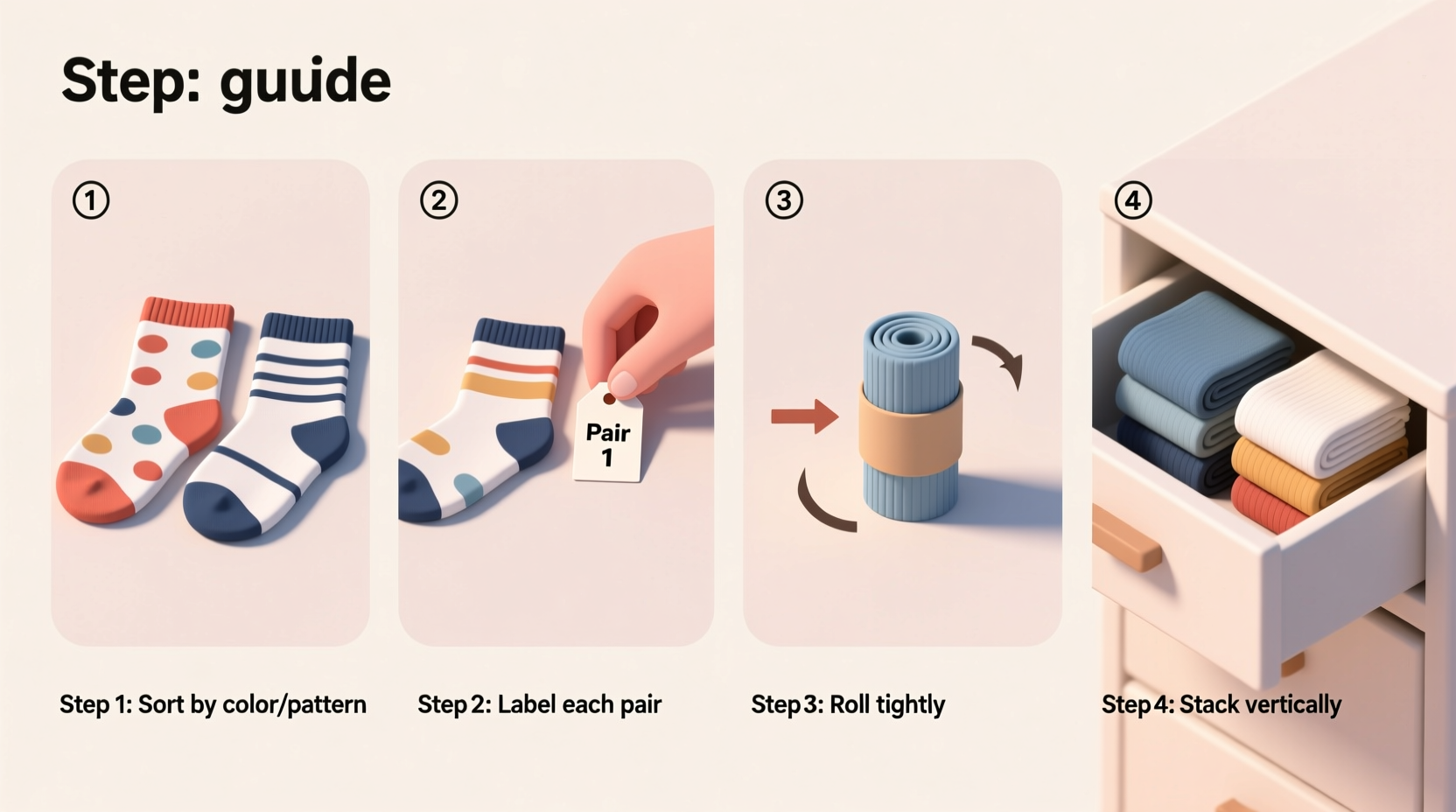
At first glance, pairing socks seems like a minor household task. But when repeated weekly across dozens of loads, it accumulates into hours of lost time. A 2022 productivity study by the Home Efficiency Research Group estimated that the average person spends between 45 and 70 minutes per month just matching and folding socks. Multiply that over a decade, and it totals more than 12 full days spent on a single chore. Beyond time, the mental load of sorting mismatched colors, patterns, and textures adds cognitive fatigue—especially in households with multiple family members or young children.
The root of the problem lies in post-laundry disorganization. When all socks are dumped together, identification becomes a game of visual memory and luck. Instead of treating sock pairing as an inevitable burden, consider it a solvable system failure—one that benefits from preventive design rather than reactive labor.
Method 1: Pre-Sort Using Mesh Laundry Bags
The most effective way to avoid pairing socks after laundry is to never separate them in the first place. By using small mesh laundry bags, you can maintain sock pairs throughout the entire wash cycle. Simply place each pair of socks inside its own bag before tossing clothes into the machine. After drying, the socks emerge already matched and protected from tangling with other garments.
This method works especially well for delicate materials like wool or silk blends, which benefit from reduced friction. It also prevents small socks from slipping through dryer vents or getting lost in folds of towels and jeans.
- Select durable mesh bags with zippers or drawstrings (available in various sizes).
- Assign one bag per person or per type of sock (e.g., work, athletic, casual).
- Drop both socks of a pair into the same bag before washing.
- After drying, transfer directly to drawers—no sorting needed.
For families, color-coded mesh bags can further streamline organization. Use red for dad, blue for son, pink for daughter, etc. This eliminates confusion and teaches kids responsibility in managing their own laundry sets.
Method 2: Clip or Link Socks Before Washing
If mesh bags feel excessive, a simpler alternative is to physically connect socks before laundering. Specialized sock clips, binder rings, or even safety pins can hold pairs together through washing and drying. These tools are inexpensive, reusable, and highly effective.
Sock clips—small plastic connectors designed specifically for this purpose—are particularly user-friendly. They snap securely around both socks without damaging fabric. After drying, simply unclip and store.
| Tool | Pros | Cons |
|---|---|---|
| Mesh Laundry Bag | Durable, protects fabric, keeps multiple items together | Takes extra space; requires remembering to use |
| Sock Clips | Cheap, easy to use, compact storage | Limited to one pair per clip; may break over time |
| Binder Rings | Reusable, strong hold, stackable | Metal may damage machines if forgotten |
| Safety Pins | Always available, secure grip | Risk of snagging fabric; potential rust |
Choose the linking method that best fits your lifestyle. Those who do large weekly loads may prefer mesh bags, while individuals with minimal sock rotation might find clips sufficient.
Method 3: The Speed-Pairing Technique for Mixed Bins
Not everyone can pre-sort. If your socks come out of the dryer in a jumbled pile, a fast, systematic approach can minimize effort. The key is reducing decision fatigue through pattern recognition and spatial organization.
Begin by spreading a clean towel on a flat surface. Dump all socks onto it. Then follow this sequence:
- Sort by category: Separate into groups—ankle, crew, dress, athletic—before identifying matches.
- Line up singles: Lay all unmatched socks in a single row, visible at once.
- Use the “one-match” rule: Pick one sock and immediately search for its twin. Once found, set the pair aside. Repeat.
- Limit retries: If no match appears within 10 seconds, set the sock aside for later review. Don’t linger.
- Scan last: After primary pairing, do one final visual sweep for obvious duplicates or overlooked twins.
This method leverages human visual processing efficiently. According to Dr. Lena Torres, cognitive behavioral researcher at MIT’s Human Systems Lab:
“Grouping similar items reduces cognitive load. When people sort by category first, they cut search time by up to 60% compared to random matching.” — Dr. Lena Torres, MIT Human Systems Lab
Method 4: Embrace Uniformity – Wear Identical Socks
One radical yet increasingly popular solution? Eliminate the need for matching altogether. Many minimalist households and professionals now adopt a uniform sock strategy: owning multiple identical pairs of the same color, length, and brand.
If every black crew sock looks the same, any two can form a wearable pair. No matching required. This approach is common among tech workers, healthcare staff, and frequent travelers who prioritize efficiency over fashion variety.
To implement this:
- Choose a comfortable, high-quality sock model you’re happy wearing daily.
- Purchase at least 14–21 pairs to cover two to three weeks of laundry cycles.
- Stick to neutral colors: black, gray, navy, or white depending on wardrobe needs.
- Store all socks loose in a drawer—grab any two when dressing.
A real-world example comes from James R., a software engineer in Austin:
“I used to spend 20 minutes every Sunday night matching socks. Since switching to 18 identical gray merino wool socks, I’ve saved over 15 hours a year. My wife followed suit with her black ankle socks. Now we both grab and go.”
This method isn’t for everyone—those who enjoy expressing personality through colorful or patterned socks may resist it—but for function-first users, it’s transformative.
Method 5: Designated Drying & Storage Zones
Organization doesn’t end at pairing. How you dry and store socks impacts future ease. Consider integrating dedicated zones into your laundry workflow.
After drying, lay socks on a sorting tray divided into labeled sections: “Matched,” “Unsure,” “Missing Twin.” This creates clarity and prevents re-mixing. Over time, recurring “missing” socks reveal true losses, prompting replacement decisions.
In storage, use shallow drawers with dividers or small bins. Assign one compartment per person or type. Avoid deep stacking, which forces digging and disrupts order. For non-matching sock owners, a single bin suffices. For others, organize by frequency of use—work socks front, seasonal ones in back.
Checklist: Build a No-Fold Sock System
Follow these steps to create a long-term solution:
- ☐ Audit your current sock collection—discard damaged or lonely singles.
- ☐ Decide whether to use pre-wash pairing (mesh bags/clips) or embrace uniformity.
- ☐ Purchase necessary tools: mesh bags, clips, or additional identical socks.
- ☐ Label or color-code systems for multi-person households.
- ☐ Set up a temporary holding zone for uncertain matches.
- ☐ Train household members on the new process with clear instructions.
- ☐ Review effectiveness monthly and adjust as needed.
Common Mistakes That Undermine Efficiency
Even with good intentions, small errors can sabotage progress. Watch for these pitfalls:
- Overbuying mismatched socks: Buying socks individually or in non-uniform packs increases pairing complexity.
- Skipping the purge: Holding onto worn-out or orphaned socks clutters the system and slows searches.
- Inconsistent habits: Forgetting to clip or bag socks occasionally leads to mixed loads and regression.
- Deep storage: Storing socks in deep drawers encourages dumping instead of organizing.
- Delayed action: Leaving socks in the dryer basket invites re-tangling and discourages prompt handling.
Consistency is critical. Like any habit, a streamlined sock system only works when applied reliably.
Frequently Asked Questions
Can I mix different methods?
Absolutely. Many households combine approaches. For example, athletes might use mesh bags for performance socks while adopting uniform dress socks for workwear. Tailor the system to individual needs within the same home.
What should I do with unmatched socks?
Set a monthly reminder to review unpaired socks. If a match hasn’t surfaced in 30 days, assume it’s lost. Repurpose the lone sock—as a dusting cloth, emergency phone protector, or donate to animal shelters (used for bedding). Some crafters turn them into toys or cleaning mitts.
Are sock clips worth buying?
Yes, for most users. High-quality clips cost under $10 for a pack of 10 and last years. They’re especially valuable for homes with children or elderly individuals who struggle with fine motor tasks involved in folding and matching.
Conclusion: Turn Chaos Into Simplicity
Pairing socks doesn’t have to be a ritual of frustration. By shifting focus from post-laundry correction to pre-wash prevention, you reclaim time, reduce stress, and create a smoother household rhythm. Whether you choose mesh bags, linking tools, uniform styles, or a hybrid approach, the goal remains the same: eliminate unnecessary decisions and automate what can be automated.
Start small. Try one method this week. Evaluate what works. Adjust and scale. Within a month, you’ll likely find that the dreaded sock pile no longer dictates your laundry day mood. Efficiency isn’t about doing more—it’s about doing less, smarter.




 浙公网安备
33010002000092号
浙公网安备
33010002000092号 浙B2-20120091-4
Comments
No comments yet. Why don't you start the discussion?