
For decades, fitness advice has been one-size-fits-all: wake up early, hit the gym before work, push through fatigue, and reward yourself with progress. But what if that routine is working against your biology? Your body doesn’t operate on a universal clock—your energy, focus, and physical performance fluctuate based on your internal rhythm, known as your chronotype.
Chronotypes are genetically influenced patterns in your sleep-wake cycle and circadian rhythm. They determine when you naturally feel alert, tired, focused, or sluggish. Ignoring your chronotype when scheduling workouts can lead to burnout, inconsistent results, and unnecessary frustration. By aligning your fitness routine with your biological tendencies, you can train more effectively, recover faster, and sustain long-term motivation.
Understanding Chronotypes: The Science Behind Your Internal Clock
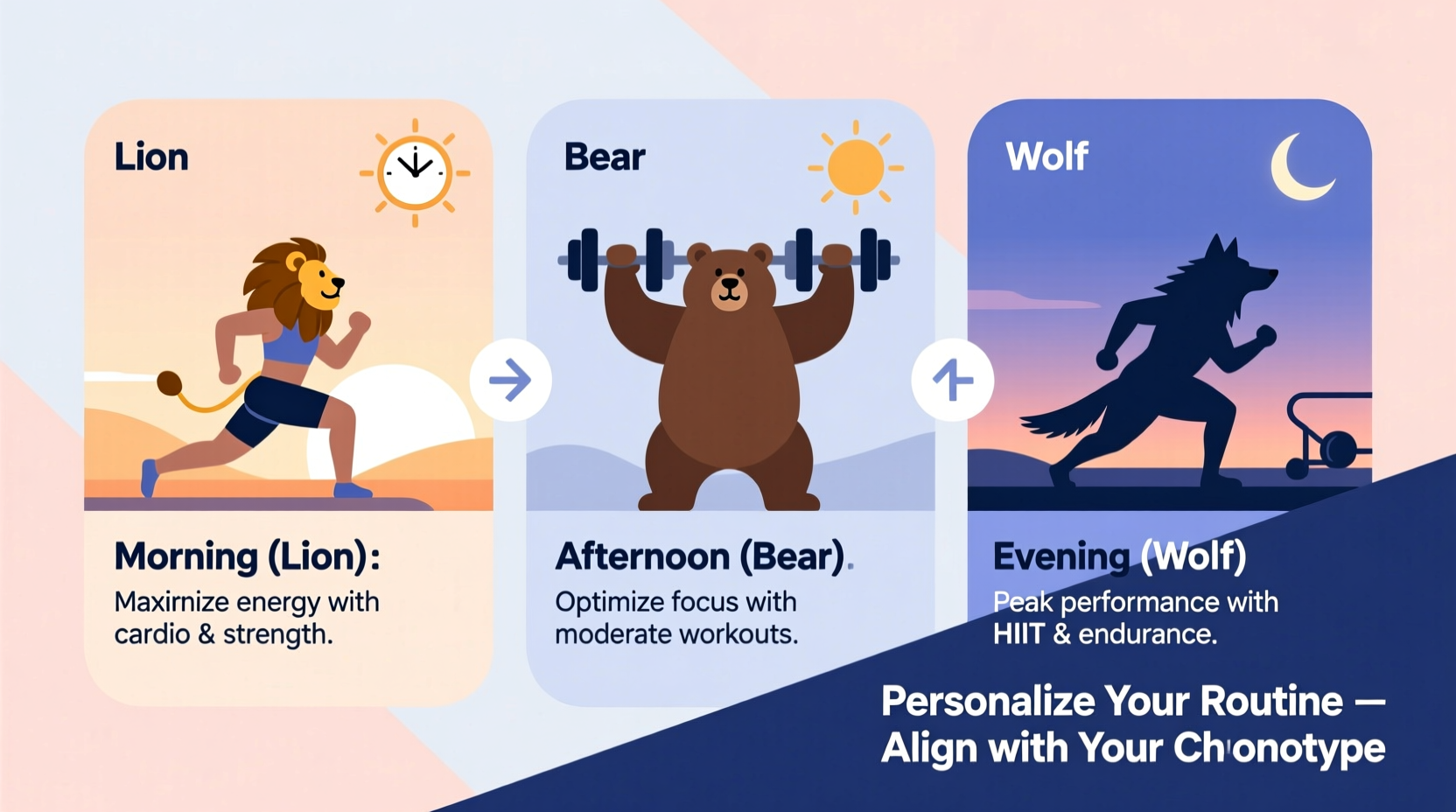
Your chronotype isn’t just about whether you're a “morning person” or a “night owl.” It’s a biological blueprint shaped by genetics, age, environment, and lifestyle. Researchers classify chronotypes along a spectrum, typically identifying four primary types: Bears, Lions, Wolves, and Dolphins.
- Bears: Follow a solar-based rhythm. They rise with the sun, peak midday, and wind down in the evening. About 50–55% of people fall into this category.
- Lions: Early risers with high energy in the morning. They’re most productive before noon and tend to tire by early evening.
- Wolves: Night-oriented individuals who struggle with mornings but come alive in the afternoon and evening. They often do their best creative or physical work after 6 PM.
- Dolphins: Light sleepers with irregular rhythms. They’re prone to insomnia and often feel most alert during short bursts in the late morning or early afternoon.
These types were popularized by sleep expert Dr. Michael Breus in his book *The Power of When*. He emphasizes that trying to force yourself into a schedule misaligned with your chronotype leads to suboptimal performance across all domains—including exercise.
“Your body temperature, hormone levels, and neuromuscular function all follow a daily rhythm. Training at your physiological peak gives you an immediate edge.” — Dr. Michael Breus, Clinical Psychologist & Sleep Specialist
How Chronotype Affects Physical Performance
Your body’s readiness for physical activity shifts throughout the day. Hormonal fluctuations, core temperature, and nervous system activation are all tied to your circadian rhythm—and they directly impact strength, endurance, reaction time, and injury risk.
For example, testosterone and cortisol—both critical for muscle growth and energy mobilization—peak in the morning for Lions but may not rise until late afternoon for Wolves. Meanwhile, core body temperature, which enhances muscle elasticity and joint mobility, typically reaches its highest point between 4 PM and 7 PM. This explains why many athletes set personal records during evening workouts.
Dolphins, who often experience disrupted sleep, may benefit from lower-intensity training earlier in the day to avoid stimulating the nervous system too close to bedtime. Conversely, Wolves might find high-intensity interval training (HIIT) more effective in the evening when their adrenaline and focus are naturally elevated.
Fitness Recommendations by Chronotype
Personalizing your workout schedule begins with honest self-assessment. Track your energy levels over a week without alarms or obligations. When do you naturally wake up? When do you feel strongest? Use these insights to tailor your routine.
| Chronotype | Best Workout Time | Recommended Exercise Type | Training Tips |
|---|---|---|---|
| Lion | 6:00 AM – 9:00 AM | Strength training, moderate cardio | Leverage morning willpower; avoid intense sessions post-3 PM to protect sleep. |
| Bear | 7:00 AM – 8:00 AM or 5:00 PM – 7:00 PM | Hybrid routines (strength + cardio) | Choose morning sessions for consistency or evening for higher intensity. |
| Wolf | 4:00 PM – 8:00 PM | HIIT, functional training, sports | Warm-ups are crucial; avoid early-morning lifting when coordination is low. |
| Dolphin | 10:00 AM – 1:00 PM | Yoga, Pilates, light resistance | Prioritize movement that supports recovery; avoid evening stimulation. |
This table provides a starting point. Individual variation exists within each type, so adjust based on real-world feedback. For instance, a Wolf who works night shifts may need to invert their schedule, while a Dolphin with chronic fatigue might benefit from two short sessions instead of one long one.
Real Example: Maria, the Late-Blooming Wolf
Maria, a 34-year-old graphic designer, struggled for years to maintain a fitness routine. She joined a 6 AM boot camp, believing early workouts were the key to discipline. She lasted three weeks. Fatigued, irritable, and underperforming, she quit—again.
After reading about chronotypes, she realized she wasn’t lazy—she was misaligned. A self-described night person, Maria felt groggy until 10 AM and didn’t hit her stride until 6 PM. She switched to evening classes at 6:30 PM: circuit training and kickboxing. Within two weeks, her energy improved, her performance soared, and she started looking forward to workouts.
“It wasn’t the workout that changed,” she said. “It was the timing. I finally stopped fighting my biology.”
Step-by-Step Guide to Aligning Fitness with Your Chronotype
Adapting your routine doesn’t require drastic changes. Follow this six-step process to create a sustainable, biologically optimized plan.
- Identify your chronotype. Take the free online quiz at ThePowerOfWhenQuiz.com or track your natural sleep/wake times over seven days without alarms.
- Log your energy peaks. For one week, rate your energy, mood, and focus hourly on a scale of 1–10. Note patterns.
- Match workout type to energy level. High-intensity training aligns with peak alertness; recovery-focused movement suits low-energy windows.
- Schedule workouts during optimal windows. Even if life constraints exist, aim to get within 60–90 minutes of your ideal time.
- Adjust gradually. Shift your workout time by 20–30 minutes every few days to allow your body to adapt.
- Evaluate and refine. After four weeks, assess performance, recovery, and enjoyment. Tweak timing or intensity as needed.
Consistency improves when your routine feels effortless. You’re more likely to stick with a 7 PM run if you’re actually excited to go, rather than dragging yourself out of bed at 5:30 AM.
Common Mistakes and How to Avoid Them
Even with good intentions, people often misapply chronotype principles. Here are frequent pitfalls:
- Assuming chronotype = laziness. Labeling someone a “lazy Wolf” ignores biological reality. Respect individual differences.
- Rigid scheduling. Life happens. Flexibility matters. If you miss your ideal window, modify the workout—don’t skip it.
- Ignoring social or job constraints. Not everyone can work out at 7 PM. In such cases, prioritize consistency over perfection. A suboptimal but regular workout beats sporadic “ideal” ones.
- Neglecting warm-up and cool-down. Especially for off-peak training, proper preparation reduces injury risk.
Checklist: Optimizing Your Chronotype-Based Routine
Use this checklist weekly to stay aligned and make adjustments:
- ✅ Identified my dominant chronotype (Lion, Bear, Wolf, Dolphin)
- ✅ Tracked energy levels for at least five days
- ✅ Scheduled workouts within my peak performance window
- ✅ Matched exercise type to energy level (e.g., HIIT in high energy, yoga in low)
- ✅ Adjusted sleep hygiene to support workout timing
- ✅ Evaluated progress every four weeks
- ✅ Allowed flexibility for life disruptions without guilt
Frequently Asked Questions
Can my chronotype change over time?
Yes. Chronotypes shift with age, lifestyle, and health. Adolescents often become Wolves, adults settle into Bear patterns, and older adults frequently transition into Lions. Reassess your chronotype every 12–18 months or after major life changes.
What if I have a job that conflicts with my ideal workout time?
Focus on proximity, not perfection. If you’re a Wolf but work until 7 PM, a 7:30 PM session is better than nothing. Alternatively, split your workout: 20 minutes in the morning (activation), 30 minutes in the evening (intensity). Consistency trumps timing when trade-offs are necessary.
Does chronotype affect nutrition timing around workouts?
Absolutely. Lions benefit from a protein-rich breakfast pre-workout. Wolves may need a small carb-protein snack 60–90 minutes before evening training to fuel performance. Dolphins should avoid heavy meals close to bedtime, especially after late workouts. Tailor fueling to your metabolic rhythm.
Final Thoughts: Train Smarter, Not Just Harder
Fitness success isn’t just about effort, diet, or equipment. It’s about alignment—between your goals and your biology. When you honor your chronotype, you stop fighting your body and start leveraging its natural strengths. Workouts become more enjoyable, recovery improves, and results accelerate.
You don’t need to transform yourself into a morning exerciser if you’re wired to thrive at night. You don’t need to apologize for needing extra time to wake up if you’re a Dolphin. Instead, use science to design a routine that fits your life and physiology.




 浙公网安备
33010002000092号
浙公网安备
33010002000092号 浙B2-20120091-4
Comments
No comments yet. Why don't you start the discussion?