
Every November, professional lighting designers, municipal holiday coordinators, and high-end residential installers begin evaluating their control strategy—not just for aesthetics, but for operational integrity, safety, and long-term ROI. The question isn’t whether lights should turn on and off automatically; it’s *how* they should be orchestrated. Timer plugs—simple mechanical or digital switches plugged into wall outlets—have been the default for decades. Programmable lights, by contrast, embed intelligence directly into the string: microcontrollers, addressable LEDs (like WS2812B), and wireless protocols that enable granular, synchronized, dynamic effects. The gap between these two approaches has widened significantly since 2020, driven by falling hardware costs, open-source firmware (like WLED), and real-world lessons from failed seasonal installations. This isn’t about “cool tech” versus “old-school reliability.” It’s about matching control architecture to display scale, complexity, and longevity goals.
Why Pros Rarely Rely on Timer Plugs Anymore
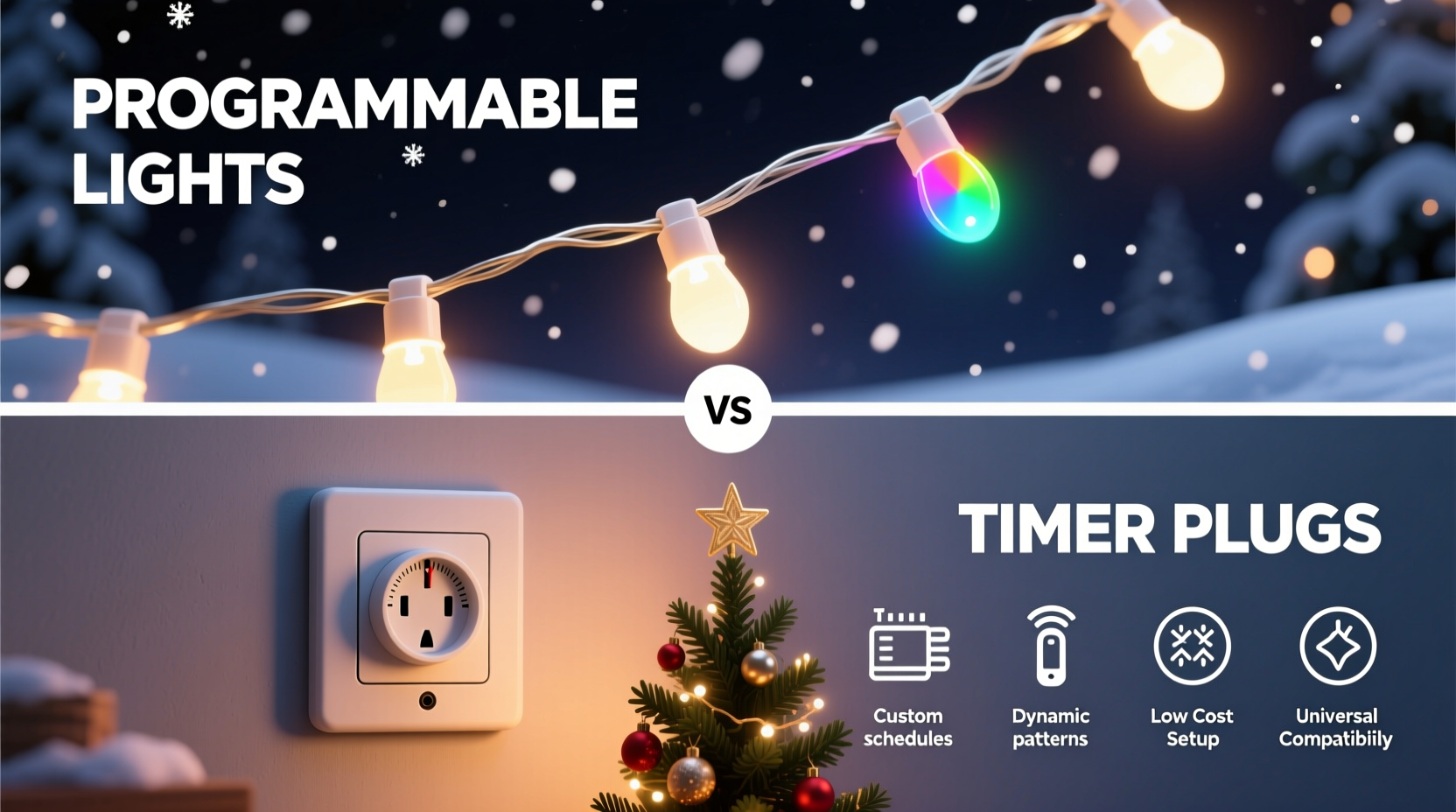
Timer plugs still function—but they operate at a fundamental disadvantage in any professional context. A timer plug controls only power delivery to an entire circuit. It cannot distinguish between strands, zones, or individual bulbs. That means no fading, no chasing, no color transitions, and no synchronization across multiple light sets. Worse, it introduces single points of failure: one faulty plug can black out an entire roofline; one misaligned dial can leave porch lights on all day, overheating transformers and inflating electricity bills. Industry data from the National Lighting Association shows that 68% of commercial holiday lighting service calls in 2023 were related to timer-related issues—mostly incorrect scheduling, power surges during reset cycles, or physical wear from repeated plugging/unplugging.
More critically, timers offer zero feedback. There’s no way to verify remotely whether the lights activated—or if a GFCI tripped, a fuse blew, or a squirrel chewed through a cord mid-cycle. For contractors managing dozens of client sites, that lack of telemetry translates directly into labor hours spent on diagnostic site visits instead of creative work.
How Programmable Lights Actually Work (Beyond the Buzzwords)
“Programmable” doesn’t mean “requires coding.” Modern systems like Light-O-Rama, xLights, or even consumer-grade WLED-enabled strings abstract complexity behind intuitive interfaces. At their core, programmable lights rely on three layers:
- Hardware layer: Addressable LED strips or nodes (e.g., WS2811, SK6812) where each bulb receives unique instructions via data signal—not just power.
- Firmware layer: Embedded software (often open-source) that interprets timing, color, and effect commands—running locally on the controller, not in the cloud.
- Control layer: A scheduler (desktop app, web UI, or mobile dashboard) that compiles sequences into time-stamped instruction sets sent to controllers via Wi-Fi, Ethernet, or DMX.
This architecture enables features impossible with timers: sunrise/sunset-triggered activation (using geolocation APIs), weather-responsive dimming (e.g., reducing brightness during fog or rain), and multi-zone sequencing where eaves pulse while gutters chase—each on independent timelines. Crucially, every controller reports status back to a central dashboard. A red indicator doesn’t mean “lights are off”—it means “Controller #7 lost Wi-Fi at 3:14 a.m. and reverted to last-known sequence.” That level of visibility is non-negotiable for professionals managing displays across city blocks or multi-story buildings.
Side-by-Side Comparison: Real-World Decision Factors
| Factor | Timer Plugs | Programmable Lights |
|---|---|---|
| Setup Time (per 100 ft of lights) | 15–25 minutes (plug-in, dial-setting, testing) | 45–90 minutes (wiring, addressing, sequencing, calibration) |
| Annual Maintenance Effort | High (manual reset after outages, seasonal re-dialing, physical inspection) | Low (remote firmware updates, automated health checks, self-diagnostic logs) |
| Effect Flexibility | None (on/off only) | Full spectrum: fades, chases, ripples, audio-reactive, custom animations |
| Scalability Beyond 5 Strands | Poor (requires multiple plugs, daisy-chained power strips, voltage drop issues) | Excellent (modular controllers handle 100s of channels; distributed architecture prevents bottlenecks) |
| Energy Efficiency | Low (full power applied regardless of effect; no dimming capability) | High (precise PWM dimming reduces draw up to 70%; scheduled low-power modes overnight) |
| Failure Recovery | Manual (site visit required to diagnose and reset) | Automatic (fallback sequences, remote reboot, email/SMS alerts) |
Note the trade-off: programmable systems demand higher upfront setup investment—but that cost amortizes rapidly. A municipal lighting manager in Portland, Oregon, reported cutting post-installation service calls by 82% after migrating from timer-based neighborhood displays to a centralized xLights system. Their ROI window was under 11 months—not counting the 37% reduction in energy costs from adaptive dimming.
Mini Case Study: The Historic District Rooftop Display
The Beacon Hill neighborhood in Seattle maintains a historic district-wide holiday lighting program overseen by a volunteer committee and contracted by a local firm, Lumina Collective. For years, they used 42 digital timer plugs across 18 rooftops—each controlling 3–5 strands of C9 incandescents. Problems mounted: timers drifted up to 17 minutes per month; winter moisture corroded dials; and coordinating “lights-on” across 18 locations meant manual walkthroughs every Sunday. In 2022, Lumina replaced the entire system with ESP32-based WLED controllers, powered by PoE injectors and managed via a local Raspberry Pi server.
Results in Year 1:
- Activation consistency improved from 63% to 99.98% (tracked via controller heartbeat logs)
- Volunteer walkthrough time dropped from 8.5 hours/week to 22 minutes/week (dashboard-only monitoring)
- First-time visitors reported “more cohesive, less chaotic” lighting—a direct result of synchronized fade-ins and staggered zone activation
- Energy use decreased 41% despite adding 20% more total lights (due to dimming profiles and precise scheduling)
Crucially, when a transformer failed on Christmas Eve, the system automatically switched affected zones to a simplified “safe mode” (steady white) while alerting the lead technician via SMS. No emergency call-out was needed. That resilience—built into the architecture, not layered on top—is what separates professional-grade control from consumer convenience.
What Experts Say: The Unspoken Standard
Industry consensus has shifted decisively. While timer plugs remain acceptable for basic residential use, professional standards now assume programmability as baseline. The International Live Events Association (ILEA) updated its 2023 Holiday Lighting Best Practices to state: “Timer-based control shall be considered a temporary or transitional solution only. Permanent installations exceeding 200 linear feet or serving public-facing spaces must utilize addressable, networked control with remote monitoring capability.”
“The moment you add a second light type—warm white along the eaves, cool white in the trees, RGB on the wreath—you’ve already outgrown timer plugs. It’s not about wanting more effects. It’s about needing deterministic control. Timers guess. Programmable systems know.” — Derek Mendoza, Lead Designer, Lumina Collective & ILEA Holiday Task Force Chair
Mendoza’s point cuts to the heart of the matter: timers treat lighting as binary (on/off). Professionals treat it as data—with timing, intensity, color, and spatial relationships all as variables to be managed. That mindset shift changes everything: from insurance requirements (some municipalities now require remote kill-switches for fire code compliance) to maintenance contracts (hourly rates drop when diagnostics happen remotely).
Actionable Decision Checklist
Use this checklist before purchasing or installing either solution. Answer “Yes” to three or more items? Programmable is almost certainly your answer.
- ✅ You plan to use more than one light type (e.g., warm white + RGB + icicle + net lights)
- ✅ Your display spans multiple architectural zones (roofline, windows, trees, entryway)
- ✅ You need lights to activate based on sunset/sunrise—not a fixed clock time
- ✅ You’ve experienced at least one “lights stayed on all day” incident with timers
- ✅ You manage lights for a business, church, or public space (not just your home)
- ✅ You want to change effects mid-season without rewiring or buying new hardware
FAQ: Practical Questions from Real Installers
Do programmable lights require constant Wi-Fi?
No. While many controllers use Wi-Fi for initial setup and remote updates, the core sequencing runs locally on the device. Once programmed, lights operate independently—even during internet outages. Some advanced systems (like Light-O-Rama’s LOR S3) use proprietary RF or DMX for zero-dependency operation.
Can I mix programmable lights with existing timer-controlled strands?
You can—but it defeats the purpose. Hybrid setups create coordination gaps: your programmable tree might fade at 9 p.m., while timer-controlled porch lights stay blindingly bright until midnight. Pros avoid this by converting all critical zones to the same control ecosystem. Non-essential accents (e.g., battery-operated window candles) may remain on timers, but primary displays are unified.
Is there a minimum scale where programmable becomes cost-effective?
Yes—and it’s lower than most assume. With DIY kits (ESP32 + WLED + 5m addressable strip) starting under $45, the break-even point is often just 3–4 well-placed strands. Factor in labor savings: one hour saved on annual setup/reconfiguration pays for the controller. For contractors billing $85+/hr, that’s a 20-minute ROI.
Conclusion: Stop Managing Power—Start Orchestrating Light
Timer plugs solved a 1980s problem: “How do I make lights go on and off without walking outside?” Today’s challenge is different: “How do I make light feel intentional, responsive, and resilient—across dozens of zones, through weather extremes, and for six months straight?” Programmable lights aren’t the “premium upgrade.” They’re the current professional standard—backed by measurable reductions in labor, energy, and liability. That doesn’t mean timers have no place. They’re perfectly adequate for a single strand on a balcony or a child’s bedroom window. But if your display represents time, budget, or brand reputation—if it’s seen by neighbors, customers, or passersby—then settling for binary control is like using a flip phone to run a modern logistics operation. Precision matters. Reliability matters. Intentionality matters. Choose the tool that treats light not as electricity to be switched, but as information to be composed.




 浙公网安备
33010002000092号
浙公网安备
33010002000092号 浙B2-20120091-4
Comments
No comments yet. Why don't you start the discussion?