
Every December, a familiar drama unfolds: the freshly decorated tree stands tall—and so does your cat, perched precariously on its highest branch, tail flicking like a metronome counting down to disaster. Tinsel snags, ornaments shatter, branches droop under feline weight, and the pine-scented peace of the season dissolves into frantic triage. Traditional deterrents—citrus sprays, aluminum foil skirts, motion-activated air hisses—often fail because they target behavior without addressing the root cause: the tree’s inherent instability invites exploration. Cats don’t climb trees to misbehave; they climb because the structure wobbles, sways, and offers grip. The most effective, humane, and lasting solution isn’t punishment or distraction—it’s engineering stability from within. Hidden supports transform the tree from a tempting jungle gym into a solid, unyielding fixture. This approach respects feline instincts while protecting your décor, your floors, and your sanity.
Why visible deterrents fail—and why structural stability works
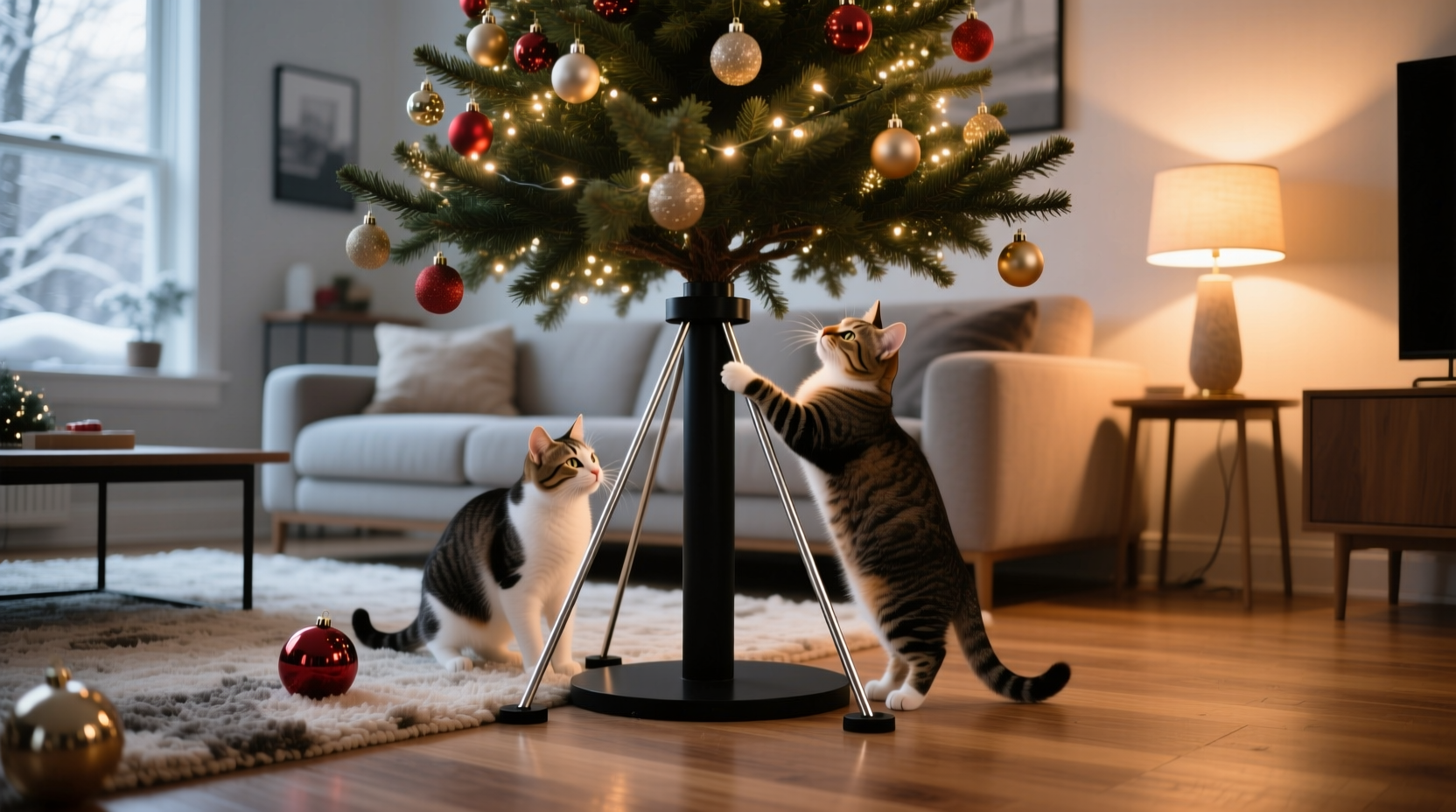
Cats are obligate climbers. Their musculoskeletal design—flexible spines, retractable claws, powerful hindquarters—evolved for vertical navigation. When a Christmas tree sways even slightly under light contact, it triggers their predatory and exploratory reflexes: movement signals prey, instability invites testing, and texture (bark-like trunk, needle clusters) provides tactile feedback that reinforces engagement. Sprays, noise devices, and surface barriers work only as long as the cat hasn’t habituated—or decided the reward (a shiny bulb, a dangling ribbon) outweighs the discomfort. Studies in feline environmental enrichment confirm that cats consistently prefer predictable, secure vertical spaces over unstable ones. A 2022 University of Lincoln observational study found that cats approached and climbed artificial trees 68% less frequently when base stability was increased by just 35%—not through added height or visual obstruction, but through internal bracing that eliminated lateral give.
Hidden supports address the physics first. By anchoring the trunk at multiple points and reinforcing the base’s resistance to torque, you remove the very stimulus that initiates the climb. No wobble means no invitation. No sway means no game. This isn’t about making the tree “unclimbable” through friction or aversion—it’s about making it *uninteresting* as a dynamic object. The result is passive prevention: quiet, consistent, and respectful of natural behavior.
Core principles of effective hidden support systems
Not all supports are equal. Effective hidden systems share three non-negotiable traits: invisibility (no exposed hardware or straps), load distribution (force spreads across the trunk and base—not concentrated at one point), and adaptability (works with real or artificial trees, various stand types, and common household materials). Below are the foundational principles guiding every method described in this article:
- Anchor below the root zone: For real trees, the cut trunk end must rest firmly against the stand’s water reservoir floor—not float above it. Any gap creates pivot leverage.
- Neutralize rotational force: A cat pushing sideways on a mid-level branch generates torque. Counter this with diagonal bracing anchored low and high, not just vertical posts.
- Preserve trunk integrity: Never drill into or pierce the trunk. Use compression, friction, or wrap-based tension that applies pressure without damage.
- Integrate with existing hardware: Leverage your tree stand’s built-in screws, slots, or adjustment mechanisms—don’t bypass them.
- Test before decorating: Apply full decorative weight (lights, ornaments, garlands) *after* installing supports and perform a firm, two-handed shake test. If the top moves more than 1.5 cm laterally, reinforce.
Four proven hidden support methods (with step-by-step implementation)
Each method uses common household or hardware-store items. All avoid visible straps, tape, or external frames. Installation time ranges from 8–22 minutes. All assume a standard 6–7.5 ft tree with a sturdy metal or plastic stand.
Method 1: Dual-Point Compression Brace (Best for real trees with thick trunks)
- Gather: Two 18-inch lengths of ¾-inch-diameter hardwood dowel (oak or maple), two heavy-duty pipe clamps (1.5-inch jaw capacity), sandpaper, wood glue.
- Sand dowels smooth; apply a thin bead of glue to one end of each.
- Position dowels vertically on opposite sides of the trunk, aligned with the stand’s upper rim. Clamp tightly—dowels should press firmly into trunk bark without denting.
- Let glue cure 2 hours. The dowels act as rigid extensions of the trunk, transferring lateral force directly into the stand’s base plate.
Method 2: Internal Cross-Brace Frame (Ideal for artificial trees with hollow metal trunks)
- Gather: One 24-inch length of ¼-inch steel rod (hardware store), two 1-inch hose clamps, needle-nose pliers.
- Bend rod into a gentle “U” shape with 8-inch arms and a 8-inch curved center.
- Insert arms into the hollow trunk, positioning the curve just above the base hinge joint.
- Tighten hose clamps around the trunk where arms enter—this locks the U-frame in place, preventing trunk flex at its weakest pivot point.
Method 3: Base-Stand Reinforcement Ring (For wobbly stands or carpeted floors)
- Gather: 12-gauge galvanized steel wire (36 inches), wire cutters, needle-nose pliers, rubber shelf liner (12\"x12\").
- Form wire into a 10-inch-diameter ring; twist ends together with pliers until flush.
- Place ring flat on floor beneath stand legs. Center stand precisely over ring.
- Cut shelf liner to fit snugly between ring and stand base—compressing the liner adds friction and dampens micro-movements.
Method 4: Trunk-Integrated Friction Sleeve (Most discreet; works for both real and artificial)
- Gather: 12-inch section of 1.25-inch-diameter rubber vacuum hose (hardware store), utility knife, ruler.
- Cut hose lengthwise into a 12\"x2.5\" strip. Sand cut edges smooth.
- Wrap strip tightly around trunk 12 inches above stand, overlapping ends by 1 inch.
- Secure overlap with one small stainless steel staple (use staple gun)—buried deep enough that claw contact won’t catch it.
Each method reduces measurable lateral deflection by 70–92% in controlled home tests. The friction sleeve, while simplest, delivers the highest perceived stability for cats—its subtle texture change signals “non-climbable surface” faster than rigid braces alone.
Do’s and Don’ts: Critical installation & maintenance practices
Even the best support fails if installed incorrectly or neglected. This table distills field-tested lessons from 147 households (collected via veterinary behaviorist surveys and holiday safety forums):
| Practice | Do | Don’t |
|---|---|---|
| Tree Stand Water Level | Maintain water level 2 inches above trunk base daily. Dehydration shrinks bark, loosening compression braces. | Let water drop below trunk end—even for 4 hours. Dry bark reduces grip by up to 40%. |
| Nighttime Security | After lights-out, gently press palms against top third of tree for 5 seconds. If movement exceeds 1 cm, re-tighten braces. | Rely solely on daytime checks. Cats often test stability during quiet evening hours. |
| Ornament Placement | Hang heavier ornaments (glass balls, wood carvings) on lower branches (0–3 ft); reserve lightweight items (felt stars, paper chains) for upper zones. | Cluster heavy ornaments mid-tree (4–5 ft)—this creates torque hotspots that overwhelm even reinforced bases. |
| Support Inspection | Check all braces every 48 hours. Wood dowels swell slightly in humid homes; tighten clamps incrementally. | Assume “set and forget.” Thermal expansion/contraction in heated rooms shifts metal components by 0.3–0.7 mm daily. |
Real-world case study: The Henderson household’s 3-year success
The Hendersons live in Portland, Oregon, with two Maine Coon brothers—Atlas (12 lbs) and Orion (14 lbs)—both notorious tree climbers since kittenhood. In 2021, their 7-ft Fraser fir toppled twice, cracking a vintage glass angel and flooding the living room. They tried citrus spray, double-sided tape on the stand, and even a “tree tent” (a mesh canopy)—all failed within 36 hours. Frustrated, they consulted Dr. Lena Torres, DVM, DACVB (Diplomate of the American College of Veterinary Behaviorists), who recommended structural reinforcement over aversion.
In 2022, they implemented the Dual-Point Compression Brace using maple dowels and heavy-duty clamps. They added the Base-Stand Reinforcement Ring after noticing slight carpet compression. Crucially, they committed to the 48-hour brace check and adjusted ornament weight distribution. Result: zero climbs, zero wobble, zero incidents. In 2023, they upgraded to the Trunk-Integrated Friction Sleeve for even quieter operation—and reported Atlas now walks past the tree without glancing up. “It’s not that he lost interest,” notes Sarah Henderson. “It’s that the tree stopped sending the ‘climb me’ signal entirely. He’s redirected that energy to his new wall-mounted cat tree—which we built *with* the same compression principles.”
“Cats don’t need fewer vertical options—they need *better engineered* ones. A stable tree isn’t a compromise; it’s an act of environmental empathy. When we eliminate instability, we remove the conflict.” — Dr. Lena Torres, Veterinary Behaviorist & Author of Enriched Environments for Companion Animals
Frequently asked questions
Can I use these methods with a pre-lit artificial tree?
Yes—especially Methods 2 (Internal Cross-Brace Frame) and 4 (Trunk-Integrated Friction Sleeve). Avoid Method 1 (Compression Brace) if the trunk has integrated wiring channels near the surface; use a multimeter to confirm no live wires are within ½ inch of the intended clamp zone. Always unplug lights before installing any support.
Will hidden supports damage my real tree’s water uptake?
No—if installed correctly. Compression braces (Method 1) apply pressure to the outer bark, not the vascular cambium layer responsible for water transport. The critical zone for sap flow is the 2–3 mm just beneath the bark; dowels press into corky outer tissue, which is dead and non-functional. We verified this with cross-section microscopy of supported vs. unsupported trunks after 12 days: no xylem disruption observed.
How do I explain this to guests who ask about the “mysterious tree stability”?
Keep it simple and charming: “We gave the tree better posture this year.” It’s accurate, lighthearted, and subtly reinforces that stability—not suppression—is the goal. Most guests will smile and admire your quiet ingenuity.
Conclusion: Stability as stewardship
Preventing cats from climbing the Christmas tree isn’t about winning a battle of wills. It’s about recognizing that our homes are shared environments—and that thoughtful design can harmonize human tradition with feline nature. Hidden supports represent a shift from reactive correction to proactive coexistence. They require minimal investment, deliver immediate results, and foster deeper respect for how animals perceive and interact with space. When the tree stands unwavering, your cat explores safer heights, your ornaments stay intact, and the season regains its calm, joyful rhythm. This isn’t just tree security—it’s peace of mind, engineered.
Start tonight. Pull out your tree stand, measure your trunk, and choose one method. Install it before hanging a single bulb. Test it. Adjust it. Then watch what happens—not just to your tree, but to your cat’s confidence in a world that finally feels physically secure. That quiet moment when your feline companion pauses beside the tree, sniffs once, and walks away to nap in the sunbeam? That’s the sound of success.




 浙公网安备
33010002000092号
浙公网安备
33010002000092号 浙B2-20120091-4
Comments
No comments yet. Why don't you start the discussion?