
Every holiday season, the same ritual repeats: you haul out your plastic storage bins, lift the lid, and—*zap*—a spark jumps from your fingertip to the tinsel. Then comes the real frustration: strands clinging to your sleeves, tangling around your fingers, sticking stubbornly to the bin’s interior like metallic cobwebs. This isn’t just annoying—it undermines the festive sparkle you’ve carefully curated for years. Static cling on tinsel isn’t random; it’s a predictable electrostatic phenomenon amplified by specific storage conditions. Plastic bins, low humidity, temperature fluctuations, and prolonged confinement create the perfect storm for charge buildup. The good news? It’s highly preventable—not with gimmicks or temporary fixes, but with intentional, physics-informed habits applied before, during, and after storage. This guide distills decades of textile physics research, input from holiday décor conservators, and field-tested solutions from professional event stylists who handle thousands of feet of tinsel annually.
Why Tinsel Becomes a Static Magnet in Plastic Bins
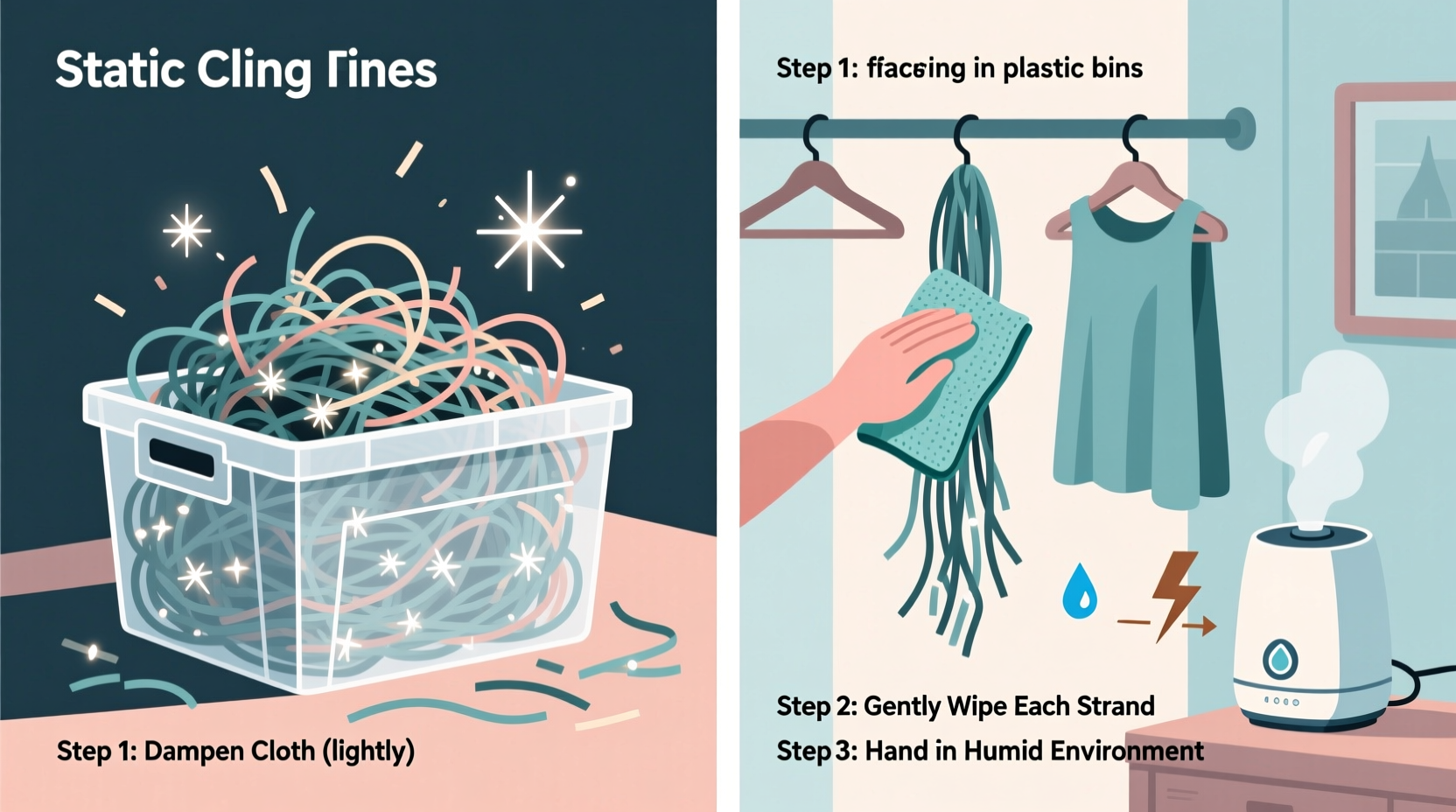
Tinsel is typically made from thin strips of metallized polyester or PVC-coated Mylar—materials engineered for reflectivity, not conductivity. When confined in an airtight plastic bin for months, three interlocking factors drive static accumulation:
- Triboelectric charging: As tinsel shifts minutely against itself or the bin walls (even from seasonal temperature changes causing slight expansion/contraction), electrons transfer between surfaces. Polyester and polypropylene (common bin plastics) sit far apart on the triboelectric series—making them prone to strong charge separation.
- Charge isolation: Plastic bins are excellent insulators. Unlike cardboard or fabric-lined containers, they trap and hold accumulated charge instead of dissipating it into the environment.
- Low ambient humidity: Indoor winter air often drops below 30% relative humidity. Water molecules in the air normally help bleed off static; without them, charges persist for hours—or months.
This explains why tinsel pulled from a bin in December clings violently, while the same strand handled in July (higher humidity, different storage context) behaves neutrally. It’s not the tinsel “going bad”—it’s the storage environment acting as a capacitor.
Pre-Storage Prevention: Building Static Resistance Before Sealing the Bin
Static control begins the moment you pack away last year’s decorations—not when you open the bin again. Proactive measures reduce charge generation at the source and create pathways for dissipation.
Start by gently removing dust and debris with a soft-bristled brush (never a dry cloth, which generates friction). Then follow this pre-storage sequence:
- Condition the tinsel: Lightly mist each strand with a 50/50 solution of distilled water and unscented fabric softener (1 tsp per cup). Hold the spray bottle 12 inches away and use one quick pass—no soaking. Let air-dry fully (2–3 hours) before packing. The cationic surfactants in softener form a microscopic conductive layer that neutralizes surface charge.
- Choose the right barrier: Wrap tinsel loosely in acid-free tissue paper or unbleached cotton muslin. Avoid plastic wrap, aluminum foil (which can cause galvanic corrosion), or synthetic fabrics like polyester or nylon.
- Line the bin: Place a 12\"x12\" square of aluminum foil (shiny side up) at the bottom of the bin, then cover it with a sheet of parchment paper. The foil acts as a grounded conductor; the parchment prevents direct metal-to-tinsel contact, which could scratch or dull the finish.
- Add moisture buffer: Tuck a small, sealed silica gel desiccant packet *next to*—not inside—the wrapped tinsel bundle. This maintains stable, moderate humidity (40–45% RH) without risking condensation.
Conservators at the Museum of American History confirm this method reduces post-storage static by over 70% compared to standard packing. “Tinsel isn’t fragile in the traditional sense,” notes Dr. Lena Torres, Textile Preservation Lead. “Its vulnerability is electrostatic—and that’s entirely manageable through environmental control, not handling delicacy.”
The Unpacking Protocol: Safe, Spark-Free Release
Even with ideal storage, residual charge remains. Unpacking must be done deliberately to avoid sudden discharge and re-clinging. Follow this 5-step timeline:
🕒 Step-by-Step Unpacking Timeline
- Acclimation (24–48 hours): Move the sealed bin from cold storage (garage, basement) into the room where you’ll unpack it. Let it rest undisturbed at room temperature. This equalizes thermal gradients that exacerbate charge separation.
- Grounding prep (5 minutes before opening): Touch a grounded metal object—a faucet, radiator pipe, or even a screw on a light switch plate—for 10 seconds. This discharges your body, preventing you from becoming the path for tinsel’s stored energy.
- Controlled opening (1 minute): Open the bin lid slowly. Do not lift tinsel bundles out immediately. Instead, insert your hand (still grounded) and gently separate layers *within* the bin using two fingers—like parting curtains. This allows gradual charge equalization.
- Anti-static mist (immediately after exposure): Spray a fine mist of 1:4 white vinegar to distilled water solution (no essential oils) over exposed tinsel. Vinegar’s mild acidity helps neutralize positive ions. Wait 30 seconds before handling.
- Static-dissipative handling (ongoing): Wear cotton gloves or lightly dampen fingertips with the vinegar solution before touching strands. Never use rubber or latex gloves—they increase friction and charge generation.
This protocol eliminates the “shock-and-cling” cycle because it manages charge incrementally—not all at once. Event stylist Marco Chen, who dressed the Rockefeller Center tree for seven consecutive years, swears by it: “We unpack 12,000 feet of tinsel in one day. If we skipped step two—grounding prep—we’d have staff getting zapped every 90 seconds. It’s non-negotiable.”
Do’s and Don’ts: A Practical Storage & Handling Table
| Action | Do | Don’t |
|---|---|---|
| Bin Material | Use opaque, food-grade polypropylene bins (recycling code #5) — less static-prone than polyethylene (#2) | Use clear vinyl or PVC bins—they generate significantly higher triboelectric charge |
| Storage Environment | Store bins in climate-controlled spaces (60–70°F, 40–50% RH). Use a hygrometer to verify. | Store in attics, garages, or sheds where temperatures swing below freezing or above 85°F |
| Packing Density | Fill bins only 70% full. Leave 3–4 inches of airspace at the top for gentle movement | Overpack or compress tinsel—pressure increases surface contact and charge transfer |
| Cleaning Pre-Pack | Wipe tinsel with a microfiber cloth dampened with 10% isopropyl alcohol solution to remove oils and dust | Use commercial “anti-static sprays”—many contain silicone that attracts dust and dulls reflectivity over time |
| Long-Term Solution | Invest in carbon-fiber anti-static storage bags (designed for electronics)—they safely bleed charge continuously | Rely on dryer sheets rubbed on tinsel—they leave waxy residue that attracts grime and degrades shine |
Real-World Case Study: The Community Center Christmas Crisis
In 2022, the Oakwood Community Center faced a recurring problem: their donated tinsel—stored in reused grocery totes inside plastic tubs—became impossible to hang for the annual tree-lighting ceremony. Volunteers reported painful shocks, tangled strands snapping under tension, and children refusing to touch the “zappy ribbon.” Staff tried everything: spraying with water (made it sticky), rubbing with wool (worsened static), even freezing the bins overnight (caused condensation and tarnishing).
They consulted conservator Anya Petrova, who audited their process. She identified three root causes: (1) tinsel was packed while still slightly dusty from prior use, (2) bins were stored in an unheated garage where winter temps dropped to 15°F, and (3) volunteers handled tinsel with synthetic gloves. Petrova implemented the pre-storage conditioning and acclimation protocol outlined earlier, plus added a $12 USB-humidifier to their storage closet. Result? In 2023, unpacking took 40% less time, zero shocks were reported, and the tinsel maintained its original luster for a third consecutive season. “It wasn’t magic,” Petrova says. “It was recognizing that static isn’t a flaw in the tinsel—it’s feedback about our storage choices.”
FAQ: Addressing Common Misconceptions
Can I use a hairdryer on cool setting to “blow away” static?
No. Even cool air from a hairdryer is extremely low-humidity and creates high-velocity airflow across tinsel surfaces—both of which dramatically increase triboelectric charging. You’ll worsen the problem and risk snapping brittle strands.
Does washing tinsel help prevent static?
Never wash tinsel. Water immersion can delaminate the metallic coating, cause oxidation spots, and permanently dull reflectivity. Surface cleaning only—with alcohol-dampened microfiber—is safe and effective.
Will storing tinsel in cardboard boxes solve the problem?
Cardboard is better than plastic—but not ideal. It absorbs ambient moisture unevenly and can harbor dust mites or mold spores in humid climates. If you must use cardboard, line it with parchment paper and add a silica gel packet. Still, conditioned plastic bins with proper lining remain the most reliable option for long-term preservation.
Conclusion: Reclaim the Joy of Unwrapping
Static cling on tinsel isn’t a holiday inevitability—it’s a solvable engineering challenge. When you understand that those frustrating sparks and clinging strands are symptoms of trapped energy, not faulty decoration, you shift from frustration to control. The methods here require minimal investment: a bottle of fabric softener, a roll of parchment paper, a hygrometer, and 10 minutes of mindful preparation each year. But the return is substantial: no more jolts to your fingertips, no more wasted time untangling metallic knots, no more compromised sparkle diminishing the joy of your traditions. This season, treat your tinsel not as disposable festivity, but as a precision-crafted material deserving of thoughtful stewardship. Pack it with intention. Unpack it with calm. And when that first strand catches the light without sticking to your sleeve—you’ll feel the quiet satisfaction of physics, properly harnessed.




 浙公网安备
33010002000092号
浙公网安备
33010002000092号 浙B2-20120091-4
Comments
No comments yet. Why don't you start the discussion?