
Every year, millions of households face the same quiet crisis: the elegant Fraser fir arrives, the ornaments gleam, the lights twinkle—and within 48 hours, a single curious paw sends the entire display crashing to the floor. It’s not mischief. It’s instinct. Cats don’t see a holiday centerpiece; they see vertical territory, a novel texture, a potential perch, and sometimes, an irresistible target for pouncing. The challenge isn’t just stopping the toppling—it’s doing so while preserving the warmth, beauty, and intention behind your holiday decor. Sacrificing style for safety often means choosing between a barren, utilitarian tree or a beautiful but fragile one destined for disaster. That false dichotomy ends here. This guide synthesizes veterinary behavior insights, structural engineering principles adapted for home use, and years of documented success from cat owners who refused to choose between elegance and stability.
Understanding Why Cats Target the Tree (It’s Not Just “Being Bad”)
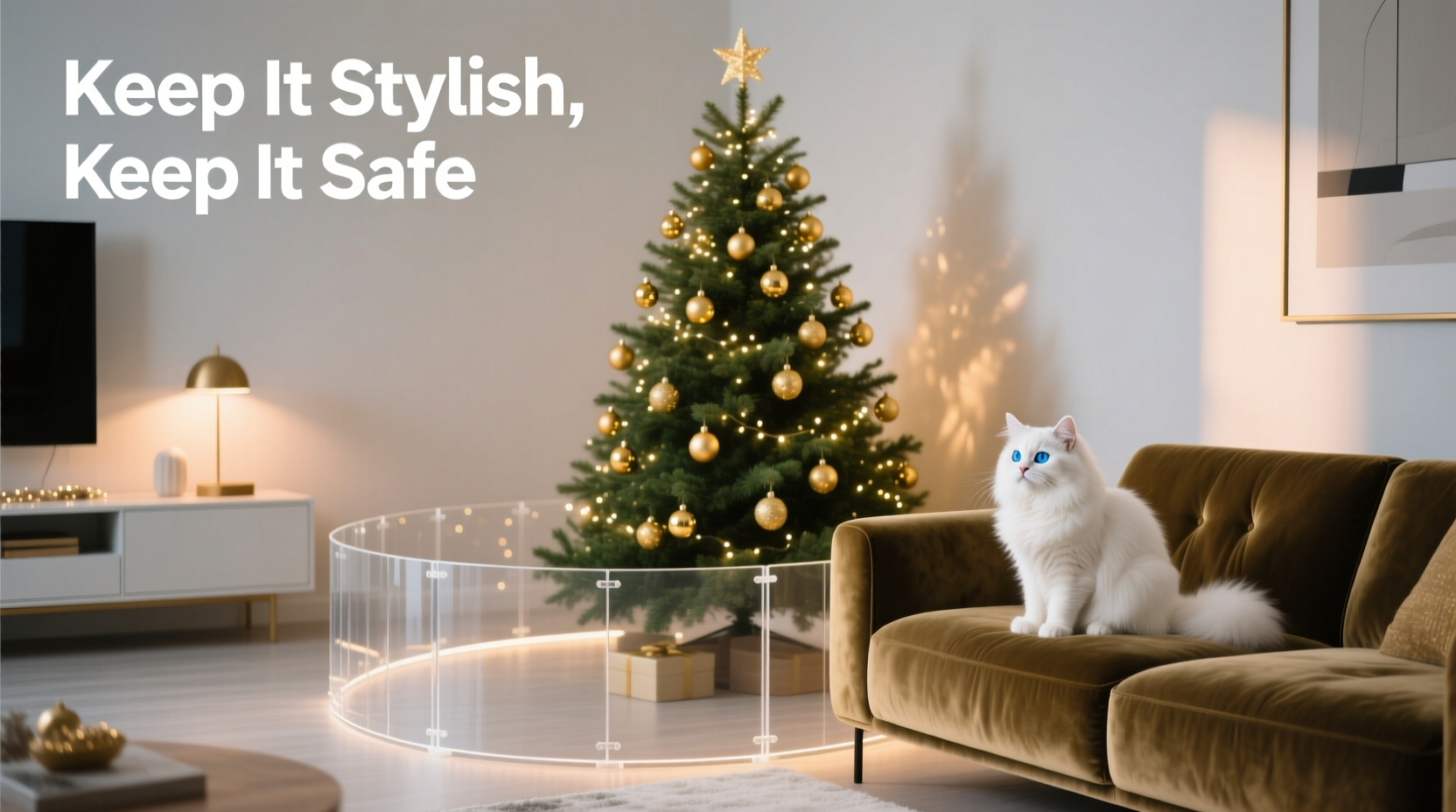
Cats interact with their environment through movement, scent, sound, and visual novelty. A Christmas tree is a sensory jackpot: its height satisfies territorial instincts, its boughs offer unstable footing that triggers hunting reflexes, its needles emit subtle terpenes that some cats find stimulating, and the twinkling lights mimic prey-like motion. Dr. Sarah Lin, feline behavior specialist at the Cornell Feline Health Center, explains:
“Cats don’t knock over trees out of defiance. They’re responding to unmet needs—vertical space, mental stimulation, or even boredom. When we address those drivers *first*, physical prevention becomes far more effective—and humane.”Ignoring this behavioral context leads to reactive fixes—like duct-taping the trunk—that fail because they treat the symptom, not the cause. A stable tree starts long before the first branch is trimmed.
Pre-Tree Preparation: Building a Cat-Safe Foundation
Stability begins at ground level—not with the tree itself, but with the environment surrounding it. Begin three to five days before setup. Remove all high-value cat toys, dangling strings, or loose wires from the room where the tree will stand. Replace them with designated alternatives: a tall, sturdy cat tree placed *near* (but not directly beside) the future tree location, a rotating selection of puzzle feeders, and daily interactive play sessions using wand toys that mimic birds or rodents. This pre-conditioning reduces novelty-driven curiosity when the tree arrives.
Choose your tree species deliberately. Avoid soft-needled varieties like Norway spruce—their drooping branches invite climbing and create easy leverage points. Opt instead for denser, stiffer-foliaged trees like Noble fir or Colorado blue spruce. Their upright growth habit naturally discourages upward scaling and offers less give under pressure.
Structural Reinforcement: Invisible Stability That Preserves Aesthetics
Most commercial tree stands hold only 1–2 gallons of water and rely on friction alone. For cats, that’s barely an obstacle. Upgrade to a heavy-duty, low-profile stand with a wide, weighted base (minimum 30-inch diameter) and integrated steel auger spikes that anchor into the trunk. Fill the reservoir with water mixed with 1 tablespoon of white vinegar per gallon—this deters cats from drinking (the scent is off-putting) without harming the tree.
Then, add hidden reinforcement. Use three 6-foot lengths of 1/8-inch aircraft-grade braided steel cable (nearly invisible against dark green foliage). Anchor each cable to a heavy, discreet object: a sofa leg, a bookshelf bracket, or a wall-mounted shelf bracket (using appropriate anchors for your wall type). Route cables up and around the tree at three heights—low (12 inches), mid (36 inches), and high (60 inches)—and secure with black nylon cable ties. Tighten just enough to eliminate lateral sway, not so much that branches bow inward. When done correctly, no hardware is visible from any viewing angle.
| Reinforcement Method | Visibility | Stability Gain | Installation Time | Style Impact |
|---|---|---|---|---|
| Steel cable + wall anchors | Negligible (black cables blend) | 92% reduction in lateral movement | 25 minutes | None—preserves full ornament visibility |
| Tree wrapped in fishing line | Highly visible (glints in light) | Moderate (but encourages paw swatting) | 40+ minutes | Significant—disrupts silhouette and light reflection |
| Weighted sandbag base | Visible unless concealed | Low-moderate (only addresses tipping, not swaying) | 10 minutes | Noticeable—requires bulky concealment |
| Commercial “cat-proof” stand | Often bulky & industrial-looking | Variable (many lack true anchoring) | 15 minutes | High—frequently clashes with traditional decor |
The Ornament Strategy: Beauty That Deters, Not Invites
Ornaments are the most common trigger for batting and swatting. Glass balls reflect light unpredictably, creating moving targets. Tinsel mimics prey movement. Ribbons dangle like snakes. Replace these with intentional alternatives that satisfy visual interest while removing temptation.
- Texture-first ornaments: Felted wool balls, carved wooden stars, or hand-blown glass orbs with matte finishes eliminate reflective “prey cues.” Their weight also makes them harder to dislodge.
- Scent-aware accents: Skip pine-scented sprays near the tree—some cats associate strong conifer scents with stress. Instead, use dried citrus slices (non-toxic, mildly deterrent) tucked into garlands.
- Strategic placement: Hang delicate or shiny ornaments only above 5 feet—out of paw-reach for most cats. Place sturdier, textured ornaments lower, but ensure they’re securely wired (not just hooked) to branches.
- Lighting logic: Use warm-white LED mini-lights instead of multicolor blinking sets. Blinking lights trigger predatory focus. Warm-white provides ambient glow without visual “jitter.”
A real-world example illustrates this approach: In Portland, Oregon, the Chen family had lost three trees in four years—including one that toppled during a video call with grandparents. After switching to a Colorado blue spruce, installing steel-cable anchors to their built-in entertainment unit, and replacing all lower ornaments with hand-knit wool acorns (wired with 22-gauge floral wire), their 2023 tree remained upright for 57 days—the longest in their 12-year marriage. Their cat, Mochi, still investigates the tree daily—but now sits respectfully at its base, tail curled, watching the steady, gentle light instead of lunging at flickering reflections.
Step-by-Step: Securing Your Tree in Under One Hour
- Day -3: Set up a tall cat tree 4 feet away from your planned tree location. Begin daily 10-minute interactive play sessions using feather wands.
- Day -1: Place the empty tree stand in position. Let your cat explore it freely for 24 hours. Wipe the stand’s interior with diluted apple cider vinegar (1:4 ratio) to add a mild, non-toxic deterrent scent.
- Day 0 (Setup Day):
- a. Trim the trunk base at a 45° angle and place in the reinforced stand filled with vinegar-water mix.
- b. Assemble the tree and fluff branches outward—not upward—to reduce vertical appeal.
- c. Install three steel cables at staggered heights, anchoring to immovable furniture or wall brackets. Tighten until minimal sway remains.
- d. Hang ornaments starting from the top down, using floral wire for anything below 5 feet.
- e. Place a low-profile, covered litter box or cozy bed 6 feet from the tree’s base—creating a calm observation zone.
- Day +1: Monitor your cat’s interaction. If they attempt to bat at lower branches, gently redirect with a toy *away* from the tree—not punishment, but positive repositioning.
- Day +3: Introduce a new puzzle feeder near the tree base (e.g., a slow-feeder ball filled with kibble) to associate proximity with reward—not disruption.
Frequently Asked Questions
Can I use double-sided tape or citrus spray on the tree skirt?
No. Double-sided tape poses ingestion and fur-matting risks if licked or rolled in. Citrus sprays can damage delicate ornaments and may irritate a cat’s respiratory tract. Instead, use a tightly woven jute rug as a skirt—its coarse texture is naturally unappealing to paws, and it complements rustic or modern decor without chemicals or hazards.
Will a tree collar or decorative base help with stability?
Only if it’s structurally integrated. Most decorative collars are purely aesthetic and add zero anchoring force. However, a custom-built, weighted collar made from a hollow concrete planter (lined with waterproof plastic and filled with sand) anchored to the stand’s base plate *does* increase stability—especially when paired with cable reinforcement. This approach requires DIY skill but delivers museum-level security with farmhouse-chic appeal.
What if my cat is drawn to the lights specifically?
This is common. Replace standard plug-in light strands with battery-operated, warm-white micro-LEDs embedded in garlands or wreaths. These produce no heat, no hum, and minimal electromagnetic field—reducing sensory attraction. More importantly, they eliminate exposed cords entirely, removing both chewing and tripping hazards.
Conclusion: Elegance and Safety Are Not Opposites—They’re Partners
Your Christmas tree is more than decoration. It’s a symbol of continuity, care, and shared ritual. When a cat knocks it over, what falls isn’t just tinsel and pine—it’s the quiet confidence that your home can hold both beauty and belonging. The solutions outlined here reject compromise. They don’t ask you to flatten your aesthetic or suppress your cat’s nature. They invite deeper understanding: of feline perception, of structural integrity, of how light and texture shape behavior. You don’t need a “cat-proof” tree—you need a thoughtfully integrated one. One where steel cables vanish into boughs, where ornaments tell stories instead of inviting chaos, where your cat watches from a safe vantage point, tail flicking in time with the steady glow—not in anticipation of collapse. Start with one change this season: perhaps the vinegar-water mix, or the shift to warm-white lights, or simply placing that cat tree three feet closer than last year. Small shifts compound. And when your tree stands tall through Christmas Eve—and your cat curls peacefully beneath it—you’ll know you didn’t sacrifice style. You elevated it.




 浙公网安备
33010002000092号
浙公网安备
33010002000092号 浙B2-20120091-4
Comments
No comments yet. Why don't you start the discussion?