
Traveling across multiple time zones can leave you feeling disoriented, fatigued, and mentally foggy. This disruption—commonly known as jet lag—is caused by a misalignment between your body’s internal clock and the local time at your destination. The circadian rhythm, which regulates sleep, hormone release, body temperature, and other vital functions, struggles to adapt quickly when faced with abrupt shifts in daylight and darkness. While unavoidable, jet lag is manageable. With deliberate strategies grounded in chronobiology—the study of biological rhythms—you can significantly shorten recovery time and regain full energy within days, sometimes even hours.
Understanding Your Circadian Rhythm
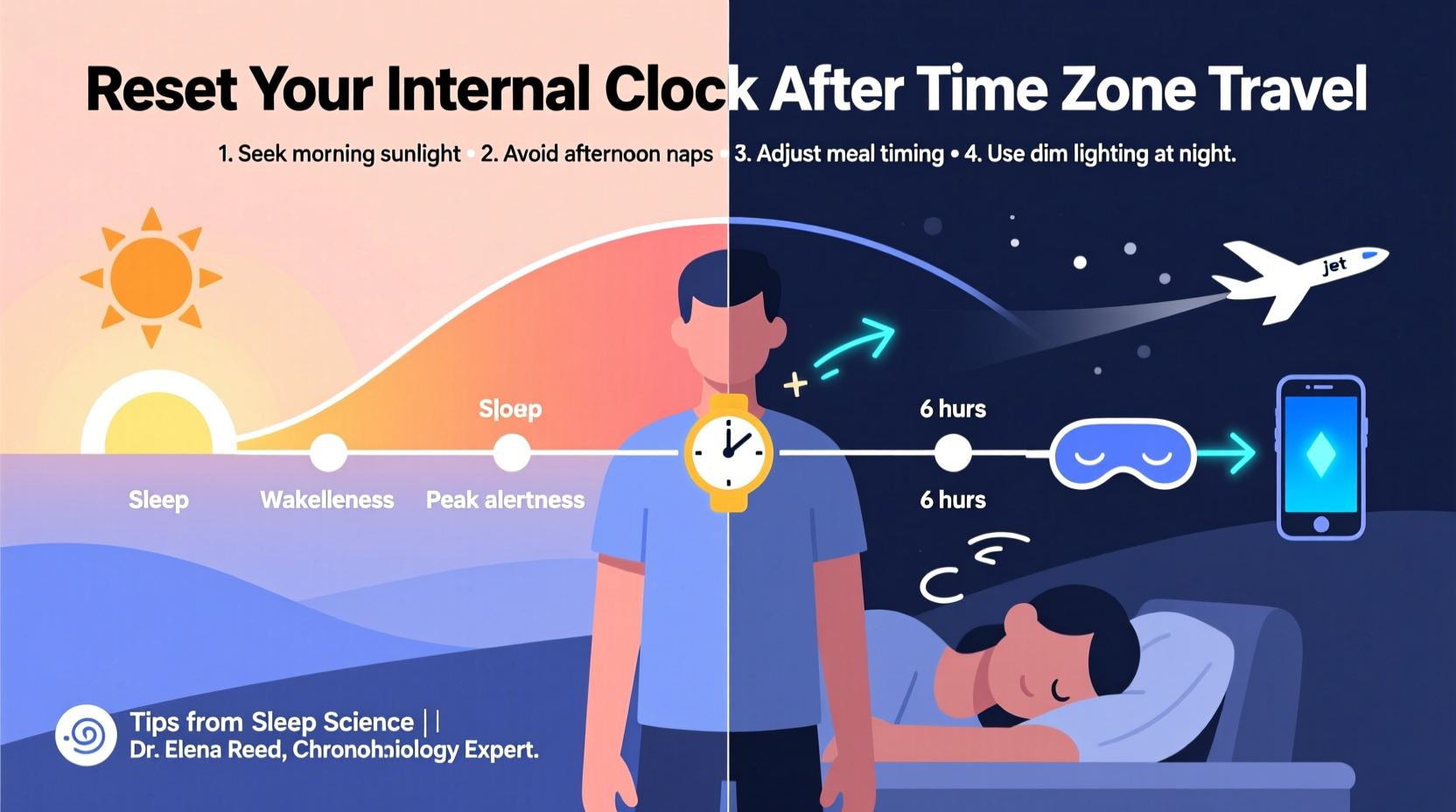
Your internal clock, or circadian rhythm, operates on a roughly 24-hour cycle influenced primarily by light exposure. Specialized cells in the retina detect changes in ambient light and signal the suprachiasmatic nucleus (SCN) in the brain, which then coordinates hormonal responses like melatonin production. When you travel rapidly across time zones, this system becomes confused. For example, if you fly from New York to Tokyo, your body may still be operating on Eastern Time while the sun rises and sets according to Japan Standard Time. The result? You feel sleepy during meetings, wide awake at bedtime, or sluggish during peak activity hours.
The severity of jet lag generally increases with the number of time zones crossed, particularly when flying eastward. Research shows that it takes approximately one day per time zone crossed to fully adjust. So crossing six time zones could mean up to six days of suboptimal performance—unless you intervene strategically.
“Light is the most powerful zeitgeber—external cue—for resetting the human circadian clock.” — Dr. Charles Czeisler, Chief of Sleep Medicine at Harvard Medical School
Step-by-Step Guide to Resetting Your Internal Clock
Resetting your internal clock isn’t passive; it requires active management of light, food, sleep, and activity. Follow this timeline-based approach before, during, and after your flight to accelerate adaptation.
- 3–5 Days Before Departure: Gradually shift your sleep schedule toward the destination time zone. If traveling east, go to bed 30–60 minutes earlier each night. If heading west, delay bedtime by the same amount.
- During the Flight: Adjust your watch to the destination time immediately. Avoid heavy meals, alcohol, and caffeine. Stay hydrated and try to sleep only during what would be nighttime at your destination.
- Upon Arrival: Expose yourself to natural sunlight as soon as possible, especially in the morning. Avoid napping during the first day unless absolutely necessary—and limit it to 20 minutes.
- Days 1–3 Post-Arrival: Maintain consistent meal times aligned with local schedules. Exercise outdoors in daylight to reinforce circadian cues. Go to bed at a reasonable hour, even if you’re not sleepy.
- Use Melatonin Strategically: Take 0.5–3 mg of melatonin 30 minutes before desired bedtime for 2–4 nights to help initiate sleep onset at the right time.
Optimizing Light Exposure for Faster Adjustment
Light is the most effective tool for shifting your internal clock. Strategic timing of bright light and darkness can advance or delay your circadian phase as needed.
For eastward travel (e.g., U.S. to Europe), you need to advance your clock—go to sleep and wake up earlier. Seek bright light in the morning upon arrival and avoid bright light in the evening. Conversely, for westward travel (e.g., Asia to California), you must delay your rhythm. Expose yourself to bright light in the late afternoon and early evening, while minimizing morning light.
Smartphone apps like Timeshifter or Entrain use algorithms based on peer-reviewed research to provide personalized light and sleep recommendations based on your itinerary, chronotype, and flight details.
| Travel Direction | Clock Shift Needed | Best Light Exposure Time | Avoid Light At |
|---|---|---|---|
| Eastward (e.g., NY → London) | Advance (earlier sleep/wake) | Morning to midday | Late afternoon/evening |
| Westward (e.g., LA → Sydney) | Delay (later sleep/wake) | Late afternoon to evening | Morning |
| North/South (same time zone) | Minimal adjustment | Natural daylight patterns | No major restrictions |
Diet, Hydration, and Activity: Supporting Your Biological Transition
Nutrition plays a surprisingly strong role in circadian entrainment. Emerging research suggests that restricting eating windows can help reset peripheral clocks in organs like the liver, which respond more quickly to food cues than the brain’s master clock.
The \"Dollaghan Method,\" developed by the U.S. Air Force, uses timed fasting followed by a high-protein breakfast to reduce jet lag symptoms. Travelers fast for 16 hours starting before departure and break the fast with a protein-rich meal upon arrival during local morning hours. This signals the body that it's time to start the day, enhancing alertness and synchronization.
- Stay well-hydrated during flights—dehydration amplifies fatigue and cognitive dullness.
- Eat meals aligned with destination mealtimes, even if you're not hungry.
- Engage in moderate physical activity during daylight hours—walking, stretching, or light workouts boost circulation and reinforce wakefulness.
- Avoid large meals close to bedtime, as digestion interferes with melatonin release.
Real-World Example: A Business Traveler Crossing Eight Time Zones
Sophie, a marketing executive based in San Francisco, had to present at a client meeting in Berlin the morning after her overnight flight. Departing at 7 PM PST, she arrived at 3 PM CET—eight hours ahead. Despite being exhausted, she knew sleeping immediately would prolong adjustment.
Using a pre-travel plan, Sophie shifted her bedtime earlier by 90 minutes over three nights. During the flight, she wore blue-light-blocking glasses after dinner, avoided alcohol, and used an eye mask to prevent accidental light exposure. Upon landing, instead of checking into her hotel, she walked outside under overcast skies for 45 minutes. She ate a protein-heavy lunch at 4 PM local time and stayed awake until 10 PM, taking a low-dose melatonin supplement before bed.
By the next morning, she felt alert enough to deliver her presentation confidently. By day three, her sleep felt natural, and her energy levels normalized—cutting typical adjustment time in half.
Jet Lag Recovery Checklist
Use this checklist to systematically reset your internal clock after international travel:
- ✅ Adjust sleep schedule gradually 3–5 days before departure
- ✅ Change watch to destination time upon boarding
- ✅ Use blue-light-blocking glasses during flight if trying to sleep
- ✅ Stay hydrated; avoid alcohol and caffeine
- ✅ Get outdoor light exposure within 1–2 hours of waking at destination
- ✅ Eat meals at local times, prioritizing protein in the morning
- ✅ Limit naps to 20 minutes, only if essential
- ✅ Consider melatonin (0.5–3 mg) at bedtime for 2–4 nights
- ✅ Exercise during daylight hours
- ✅ Maintain consistent sleep/wake times for at least 3 days
Common Mistakes That Delay Circadian Adjustment
Even well-intentioned travelers often undermine their own recovery. These habits prolong jet lag:
- Sleeping in late after arrival: Oversleeping reinforces the old time zone and delays re-synchronization.
- Excessive screen use at night: Blue light suppresses melatonin, making it harder to fall asleep at the correct local time.
- Indoor confinement during daylight: Being inside all day deprives you of the strongest circadian cue—natural sunlight.
- Over-reliance on sleeping pills: While occasionally useful, they don’t reset the clock and may cause grogginess.
- Ignoring meal timing: Eating late at night sends conflicting signals to metabolic clocks throughout the body.
“The key to beating jet lag is not waiting for your body to ‘catch up’—it’s actively guiding it to the new time zone through disciplined light, food, and sleep habits.” — Dr. Jamie Zeitzer, Stanford Center for Sleep Sciences
Frequently Asked Questions
How long does it take to reset your internal clock after long-haul travel?
Most people adjust at a rate of about one day per time zone crossed. For example, crossing six time zones typically takes 5–7 days. However, using light therapy, strategic melatonin use, and behavioral adjustments can reduce this to 2–4 days.
Is it better to nap or push through fatigue when adjusting?
Short naps (20 minutes or less) are acceptable if you must function safely (e.g., driving). However, longer or poorly timed naps can interfere with nighttime sleep. It’s generally better to stay awake until local bedtime, even if difficult, to establish a new rhythm faster.
Can artificial light replace sunlight for resetting my clock?
Yes—bright light therapy boxes (10,000 lux) can be effective substitutes when natural sunlight isn’t available. Use them for 20–30 minutes at the recommended time based on your travel direction. However, natural daylight remains superior due to its dynamic spectrum and intensity.
Conclusion: Take Control of Your Biological Timing
Jet lag doesn’t have to derail your travel plans or business trips. By understanding how your internal clock works and applying targeted interventions, you can reset your rhythm efficiently and reclaim your energy. Success lies not in enduring discomfort but in proactive planning—shifting sleep schedules early, harnessing light strategically, aligning meals with local time, and supporting your body’s biology with hydration and movement. Whether you're a frequent flyer or embarking on a once-in-a-lifetime journey, these tools empower you to arrive not just physically, but biologically, at your destination.




 浙公网安备
33010002000092号
浙公网安备
33010002000092号 浙B2-20120091-4
Comments
No comments yet. Why don't you start the discussion?