
Stringing Christmas lights is one of the most joyful parts of holiday decorating. But when enthusiasm meets electricity, safety can take a back seat. One common mistake—especially among enthusiastic decorators—is daisy chaining too many light sets together, which risks circuit overload, blown fuses, or even fire. The good news: with the right knowledge, you can create a dazzling display while keeping your home and family safe.
Daisy chaining refers to connecting multiple strands of lights end-to-end using their built-in plug-and-socket design. While convenient, this practice has limits defined by electrical capacity, wire gauge, and manufacturer specifications. Exceeding these limits stresses circuits, overheats wires, and increases fire risk. Understanding how to calculate load, choose compatible lights, and distribute power correctly is essential for a safe and spectacular holiday setup.
Understanding Electrical Load and Circuit Capacity
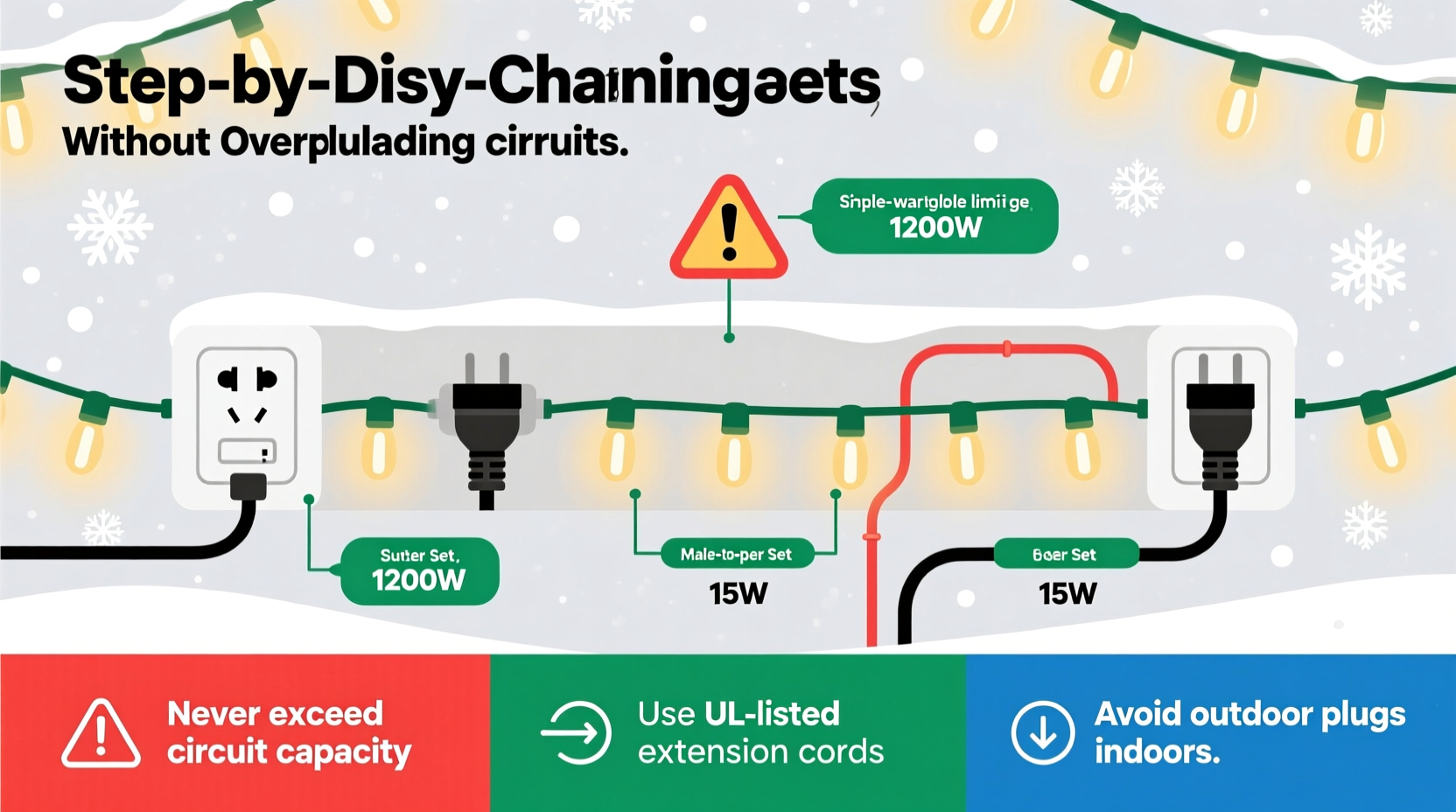
Your home’s electrical system operates on circuits, each protected by a breaker or fuse that trips when current exceeds safe levels. Most household outlets in living areas are on 15-amp circuits operating at 120 volts. To determine how much power a circuit can handle, use the formula:
Watts = Volts × Amps
For a 15-amp circuit: 120V × 15A = 1,800 watts. However, electrical codes recommend using only 80% of a circuit’s capacity for continuous loads (those running three hours or more)—a standard that applies to Christmas lights. That brings the safe maximum to 1,440 watts per circuit.
Each string of lights consumes a certain number of watts. Older incandescent mini-lights can use 40–50 watts per strand, while modern LED strings typically use only 4–10 watts. The difference is significant. You could connect up to 360 LED strings on a single circuit (theoretically), but physical and manufacturer limitations make that impractical.
How Many Light Sets Can You Safely Connect?
The safest way to avoid overload is to follow the manufacturer’s stated limit for daisy chaining. This number is usually printed on the packaging or molded into the light set’s male plug. For example, “Max 3 Sets Connected” means no more than three identical strands should be linked together.
Why such low numbers? Even if the total wattage seems under the circuit limit, the issue lies in the weakest link: the thin wiring and connectors between individual strands. These components are not designed to carry high cumulative loads over time. Overheating can occur at connection points, especially if plugs are loose or covered by insulation like snow or fabric.
LED lights have revolutionized holiday lighting not just because they’re energy-efficient, but because they generate less heat and draw far less current. A typical 100-light LED string uses about 4.8 watts and draws roughly 0.04 amps. In contrast, an incandescent set of the same length might draw 0.4 amps—ten times more.
“Many homeowners don’t realize that daisy chaining isn’t just about wattage—it’s about connector integrity. Those little plastic plugs aren’t industrial-grade. They’re meant for light residential use.” — Daniel Reeves, Licensed Electrician and Home Safety Inspector
Step-by-Step Guide to Safe Daisy Chaining
Follow this sequence to decorate safely and effectively:
- Identify your outlet circuit: Use a circuit tester or breaker map to know which outlets share the same breaker. Avoid plugging multiple light strings into outlets on the same circuit unless you’ve calculated total load.
- Check light specifications: Look for the “max connected sets” rating and wattage per string. Assume worst-case if information is missing.
- Group by type and voltage: Never mix LED and incandescent strings in a daisy chain. They have different electrical characteristics and failure modes.
- Limits per chain: Adhere strictly to the manufacturer’s max set count. If it says “3,” do not connect a fourth—even if the math seems safe.
- Use extension cords wisely: Plug daisy-chained groups into heavy-duty outdoor-rated extension cords (16-gauge or thicker for longer runs), then into the wall. Do not daisy chain extension cords.
- Distribute across circuits: Spread your light displays across multiple circuits. For example, front yard lights on one breaker, porch on another, inside tree on a third.
- Test before finalizing: Let lights run for at least 30 minutes. Check connectors for warmth—any heat indicates overload or poor connection.
Do’s and Don’ts of Daisy Chaining Lights
| Do | Don’t |
|---|---|
| Use LED lights for longer chains and lower load | Mix different types of lights (LED + incandescent) |
| Follow the “max connected sets” rule | Exceed manufacturer limits based on your own calculations |
| Use grounded (3-prong) extension cords outdoors | Daisy chain multiple extension cords together |
| Plug large clusters into GFCI-protected outlets | Hide warm or hot connectors under mulch, rugs, or snow |
| Inspect cords for frays, cracks, or bent prongs | Use indoor-rated lights or cords outside |
Real Example: The Overloaded Porch Display
In suburban Chicago, the Miller family loved going all-out for Christmas. One year, they connected 12 incandescent mini-light strands along their roofline, believing the extension cord would handle it. Each strand used 40 watts (480 watts total), well under the 1,440-watt circuit limit. But the manufacturer’s label clearly stated “Max 3 Sets.” They ignored it.
By the second week, neighbors noticed flickering lights. On a cold December evening, a connector near the gutter began to smolder. Smoke triggered the smoke detector, and the homeowner unplugged the display just in time. An electrician later explained that while total wattage was acceptable, the current density at the third and fourth connection points exceeded the plastic housing’s thermal tolerance. The result: degraded insulation and a fire hazard.
The fix? They replaced all incandescent sets with LEDs (4 watts each), limited chains to three per group, and spread the load across two circuits using separate extension cords. The display now shines brighter, cooler, and safer.
Using Power Strips and Timers for Safer Control
A smart alternative to long daisy chains is using a high-quality power strip rated for outdoor use. Choose one with individual switches, surge protection, and an automatic shutoff if it detects overheating. This allows you to plug multiple light sets directly into the strip—each on its own terminal—avoiding daisy chain stress.
Add a programmable timer to turn lights on at dusk and off at bedtime. Not only does this save energy, but it reduces exposure time, minimizing wear and potential failure. Timers also prevent lights from being accidentally left on during daylight, which can degrade bulbs and increase utility bills.
For large displays, consider splitting zones: roofline on one timer, trees on another, walkway on a third. This modular approach simplifies troubleshooting and reduces strain on any single circuit.
Frequently Asked Questions
Can I connect more LED strings than incandescent ones?
Yes, but with caution. While LEDs use significantly less power, the limiting factor is still the manufacturer’s “max connected sets” rating. Even low-wattage LEDs can overload internal wiring if too many are chained. Always follow product guidelines.
What happens if I overload a daisy chain?
Overloading can cause overheating at connection points, melting insulation, short circuits, tripped breakers, or fire. In extreme cases, damaged cords can remain energized and pose electrocution risks, especially outdoors or in damp conditions.
Is it safe to leave Christmas lights on overnight?
If installed correctly—with proper wattage, intact cords, and no daisy chain violations—modern LED lights can be left on overnight. However, it’s best to use a timer to limit runtime and reduce risk. Never leave questionable or homemade setups unattended.
Essential Checklist for Safe Holiday Lighting
- ✔️ Confirm the “max connected sets” number on each light package
- ✔️ Use only identical light sets in a single daisy chain
- ✔️ Avoid mixing LED and incandescent strands
- ✔️ Use outdoor-rated extension cords for exterior displays
- ✔️ Plug into GFCI outlets when possible (especially outdoors)
- ✔️ Inspect all cords for damage before use
- ✔️ Test connections for warmth after 30 minutes of operation
- ✔️ Distribute light groups across multiple household circuits
- ✔️ Install a timer to automate on/off cycles
- ✔️ Keep connectors elevated and exposed, not buried under snow or fabric
“The safest Christmas display isn’t the brightest one—it’s the one that follows the rules. A few extra extension cords are cheaper than a house call from the fire department.” — National Fire Protection Association (NFPA) Holiday Safety Bulletin
Conclusion: Shine Bright, Stay Safe
Daisy chaining Christmas lights doesn’t have to be dangerous—if you respect electrical limits and manufacturer guidelines. The key is balance: between creativity and caution, between tradition and technology. Modern LED lights offer unprecedented flexibility, but they still require thoughtful installation.
Start small. Test one chain. Feel the connections. Expand only when you’re confident in your setup. Use timers, power strips, and multiple circuits to stay within safe boundaries. Your holiday spirit doesn’t need to be limited by fear—but it should always be guided by knowledge.
This season, let your lights shine not just with color and cheer, but with the confidence that your home is protected. A little planning today ensures memories that last far beyond New Year’s Day.




 浙公网安备
33010002000092号
浙公网安备
33010002000092号 浙B2-20120091-4
Comments
No comments yet. Why don't you start the discussion?