
Every November, thousands of homeowners begin planning elaborate outdoor light displays—archways, rooflines, animated figures, synchronized trees, and driveway tunnels that rival professional installations. But behind the festive glow lies a serious electrical reality: most residential outlets supply only 15 or 20 amps at 120 volts, and a single strand of 100 LED mini-lights draws about 0.04 amps—yet a full display can easily exceed 10 amps per circuit. When you chain extension cords to reach distant areas or daisy-chain them to power multiple zones, you introduce real risks: overheating, voltage drop, tripped breakers, melted insulation, and—worst case—electrical fires. This isn’t seasonal speculation. According to the U.S. Fire Administration, an estimated 790 home fires each year are caused by decorative lighting, with improper cord use cited in over 42% of those incidents.
This article cuts through holiday hype with actionable, NEC (National Electrical Code)-informed practices. It’s written for the dedicated DIYer—not electricians—who wants their display to shine brightly, reliably, and safely from Thanksgiving through New Year’s Eve. Every recommendation aligns with Article 400 (Flexible Cords), Article 210 (Branch Circuits), and UL 817 standards for cord sets. No shortcuts. No assumptions. Just clarity grounded in physics and code.
Why Daisy-Chaining Extension Cords Is Dangerous—And Why People Do It Anyway
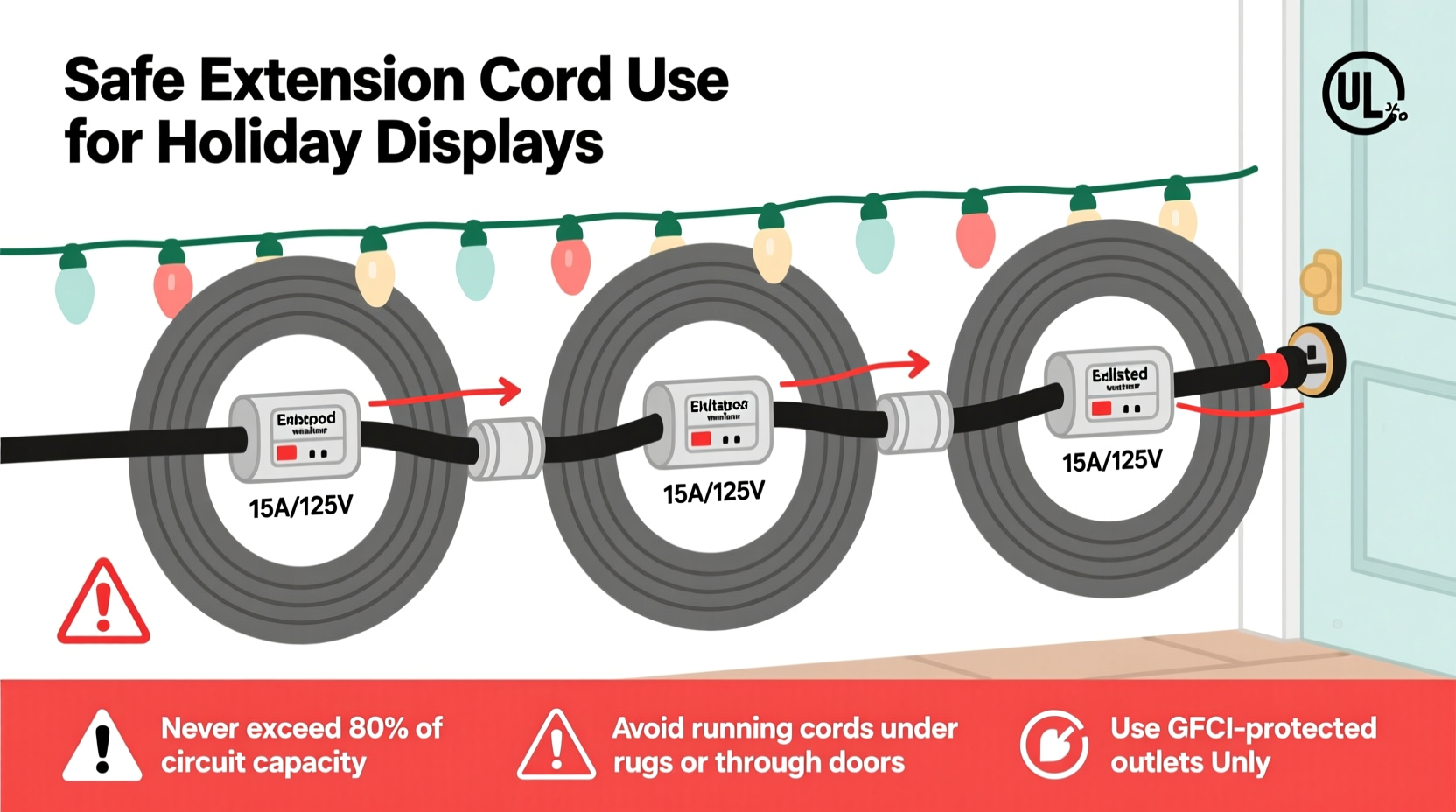
Daisy-chaining—plugging one extension cord into another—is the single most common mistake in large-scale holiday lighting. It seems logical: “If one cord reaches 50 feet, two should reach 100.” But electricity doesn’t work that way. Each cord adds resistance, and resistance generates heat. As current flows through longer or undersized conductors, voltage drops. A 12-gauge cord rated for 15 amps may deliver only 105 volts at its far end when loaded near capacity—enough to dim LEDs, flicker animatronics, or cause transformer hum. Worse, if the first cord is 16-gauge (common in low-cost “indoor” cords), its 13-amp max rating is quickly exceeded when feeding downstream loads—even if those loads appear modest on paper.
People chain cords because they’re convenient, inexpensive, and widely available. Hardware stores stock 100-foot spools labeled “heavy-duty,” but few shoppers check the wire gauge stamped on the jacket—or realize that “heavy-duty” refers only to jacket thickness, not conductor size. And retailers rarely clarify that UL 817 explicitly prohibits connecting more than one cord set together unless specifically listed for series connection (a rare exception reserved for commercial-grade, permanently installed systems).
Step-by-Step: Calculating Your Load and Selecting the Right Cord
Safety starts with math—not guesswork. Follow this sequence before buying a single cord:
- Inventory every device: List all lights, inflatables, controllers, fog machines, and transformers. Note wattage (W) or amperage (A) from labels or manuals. If only watts are given, divide by 120 to get amps (e.g., 480W ÷ 120V = 4A).
- Group by circuit: Identify which outdoor GFCI-protected outlets serve your display zones. Most homes have 2–4 dedicated 15- or 20-amp circuits outdoors. Label each outlet (e.g., “Garage East GFCI,” “Porch West GFCI”).
- Apply the 80% rule: Per NEC 210.20(A), continuous loads (those operating >3 hours) must not exceed 80% of circuit capacity. So a 15-amp circuit supports only 12 amps (1,440W); a 20-amp circuit supports only 16 amps (1,920W). Deduct 10% headroom for safety—so aim for ≤1,300W on a 15-amp circuit.
- Calculate total amp draw per zone: Add all devices assigned to one outlet. Include controllers (often 0.5–1.2A) and power adapters (0.3–0.8A each).
- Select cord gauge and length: Use the table below. Match cord amp rating to your zone’s total load—not the circuit’s max. Choose the shortest practical length; avoid coiling excess cord while in use.
| Max Load (Amps) | Recommended Wire Gauge | Max Safe Length (120V) | Notes |
|---|---|---|---|
| ≤5A | 16 AWG | 50 ft | Indoor-only; never for outdoor use or continuous operation |
| 6–10A | 14 AWG | 100 ft | UL-listed outdoor cord required; verify “WT” (weather-resistant) or “W” rating |
| 11–15A | 12 AWG | 150 ft | Minimum for most large displays; look for “12/3 SJTW” (3-conductor, thermoplastic, weather-resistant) |
| 16–20A | 10 AWG | 200 ft | Required for high-wattage elements (e.g., incandescent net lights, heated props); often sold as contractor-grade reels |
Example: Your front-yard zone includes 300’ of LED icicle lights (0.04A/ft × 300 = 12A), a 24V transformer (0.6A), and a motion-sensor controller (0.4A). Total = 13A. You need a 12 AWG outdoor-rated cord, no longer than 150 feet, plugged directly into a 20-amp GFCI outlet. No exceptions.
Real-World Example: The Elm Street Display Incident
In December 2022, a homeowner in Portland, Oregon, installed a 2,800-light display across his roofline, garage, and front lawn. He used three 100-foot, 14 AWG “heavy-duty” cords purchased online—daisy-chained from a single 15-amp porch outlet. On night three, the middle cord began emitting a burnt-plastic odor. His neighbor noticed smoke curling from beneath the gutter where the second cord was taped to the fascia. The homeowner shut off power just before the outer insulation ignited.
An inspection by the local fire marshal revealed the root cause: the 14 AWG cords were rated for 15 amps *only at 50 feet*. At 100 feet, their effective capacity dropped to ~10.5 amps due to resistance. The display drew 14.2 amps continuously. The first cord ran at 112°F—well above its 105°F UL temperature rating. The second cord, carrying the same load plus added resistance, reached 138°F. Its PVC jacket softened, exposing conductors. When moisture condensed overnight, arcing occurred at a nick in the insulation—igniting nearby pine needles.
After replacing all cords with a single 12 AWG, 150-foot reel and splitting the load across two GFCI outlets, the display ran flawlessly for 37 nights. No tripped breakers. No flickering. No heat buildup.
Do’s and Don’ts: Outdoor Extension Cord Safety Checklist
- DO inspect every cord before use: check for cracked, brittle, or swollen insulation; bent or corroded prongs; exposed wires; and loose strain reliefs.
- DO plug all outdoor cords into GFCI-protected outlets—even if the cord has a built-in GFCI. Test GFCIs monthly using the “TEST” button.
- DO elevate cords off wet grass, gravel, or snow using cord protectors or PVC conduit sections. Never run cords under rugs, mats, or mulch.
- DO use only cords rated “Outdoor,” “WT,” or “W” (per UL 817). Indoor cords lack UV inhibitors and moisture resistance.
- DO unplug cords during heavy rain, snowstorms, or high winds—even if they’re “weatherproof.” Water ingress at connections remains a top failure point.
- DON’T overload outlets with multi-plug adapters or power strips. These create hotspots and bypass GFCI protection.
- DON’T coil live cords tightly. Heat builds rapidly inside loops—especially with 12 AWG or smaller.
- DON’T use tape, staples, or nails to secure cords. Use UV-resistant cable ties or purpose-built cord clips that don’t pierce insulation.
- DON’T ignore warm-to-the-touch cords. If any section feels warmer than ambient air, unplug immediately and investigate load or cord rating.
- DON’T store cords coiled tightly after use. Loosely coil in figure-eights and hang vertically to prevent memory kinks and insulation stress.
Expert Insight: What Electricians See Behind the Lights
“The biggest misconception I hear is ‘It’s only lights—they don’t draw much.’ But modern displays aren’t just strings anymore. They’re networks: Wi-Fi controllers drawing constant power, RGB pixel controllers pulsing at 40+ amps peak, motorized props with surge currents, and timers that cycle dozens of circuits simultaneously. I’ve measured 18-amp draws on what looked like a simple 10-light arch. Voltage drop across poorly sized cords causes controllers to reset mid-show—and that’s when people start adding more cords, thinking ‘more is safer.’ It’s the opposite. Every extra connection point is a potential arc-fault site.”
“The NEC doesn’t prohibit extension cords—but it treats them as temporary wiring. That means no permanent mounting, no burial, no stapling, and no daisy-chaining. If your display runs more than 90 days, treat it like a permanent installation: consult a licensed electrician for dedicated circuits, subpanels, or low-voltage landscape transformers.” — Marcus Delaney, Master Electrician & NFPA 70E Instructor, Chicago Electrical Safety Institute
Frequently Asked Questions
Can I use indoor extension cords outdoors if I cover them with a tarp?
No. Indoor cords lack UV stabilizers and moisture-resistant jackets. Even brief sun exposure degrades PVC insulation, making it brittle and prone to cracking. Tarps trap condensation and accelerate corrosion at plugs and receptacles. Only UL-listed outdoor cords (marked “W,” “WT,” or “SJOOW”) are approved for exterior use.
My 12 AWG cord gets warm near the plug—but not along the length. Is that normal?
Minimal warmth at the plug is common due to contact resistance, especially with older outlets or corroded contacts. However, if the plug housing exceeds 110°F (use an infrared thermometer), or if you smell ozone or plastic, stop using it immediately. Replace both the cord and the outlet—it may be worn, loose, or improperly torqued. Never force a plug that feels tight or wobbly.
How do I know if my GFCI outlet is working properly?
Press the “TEST” button monthly. The outlet should cut power instantly and the “RESET” button should pop out. Press “RESET” to restore power. If it doesn’t trip, or won’t reset, replace the GFCI immediately. Also test downstream outlets protected by the same GFCI—they may share the same circuit but lack individual testing capability.
Conclusion: Light Responsibly, Shine Confidently
A magnificent Christmas display isn’t defined by sheer wattage or number of bulbs—it’s defined by reliability, longevity, and peace of mind. When your lights stay bright night after night without tripping breakers, overheating cords, or triggering neighborhood fire alarms, you’re not just celebrating the season—you’re honoring craftsmanship, safety, and respect for the invisible systems that make modern celebration possible.
Start small this year. Audit one zone. Measure its actual load. Swap out that frayed 14 AWG cord for a properly rated 12 AWG reel. Plug it directly into a tested GFCI. Watch how much steadier your animations run, how quieter your transformers hum, and how confidently you welcome guests under steady, unwavering light. Then scale thoughtfully—not by adding more cords, but by adding more circuits, better planning, and deeper understanding.
The most beautiful displays aren’t the loudest or longest—they’re the ones that glow safely, consistently, and joyfully, all season long.




 浙公网安备
33010002000092号
浙公网安备
33010002000092号 浙B2-20120091-4
Comments
No comments yet. Why don't you start the discussion?