
For many full-time RVers and seasonal campers, the holiday season isn’t complete without a Christmas tree—even if it’s just 36 inches tall and anchored to a cabinet hinge. But unlike a home with wall studs, level floors, and ample square footage, an RV presents unique physical constraints: sloped or uneven flooring, lightweight composite walls, limited floor space, frequent movement (even when parked), and a high center of gravity that makes any top-heavy object prone to tipping. A falling tree isn’t just a minor inconvenience—it can damage interior trim, shatter ornaments, knock over appliances, or injure children or pets. Worse, many standard “RV-safe” tree stands fail under real-world conditions because they rely on friction alone or assume perfectly level surfaces. This guide distills field-tested strategies used by experienced RV families, professional mobile decorators, and certified RV safety instructors—not theoretical tips, but proven solutions refined over thousands of miles and dozens of holiday seasons.
Why Standard Tree Stands Fail in RVs (and What Really Works)
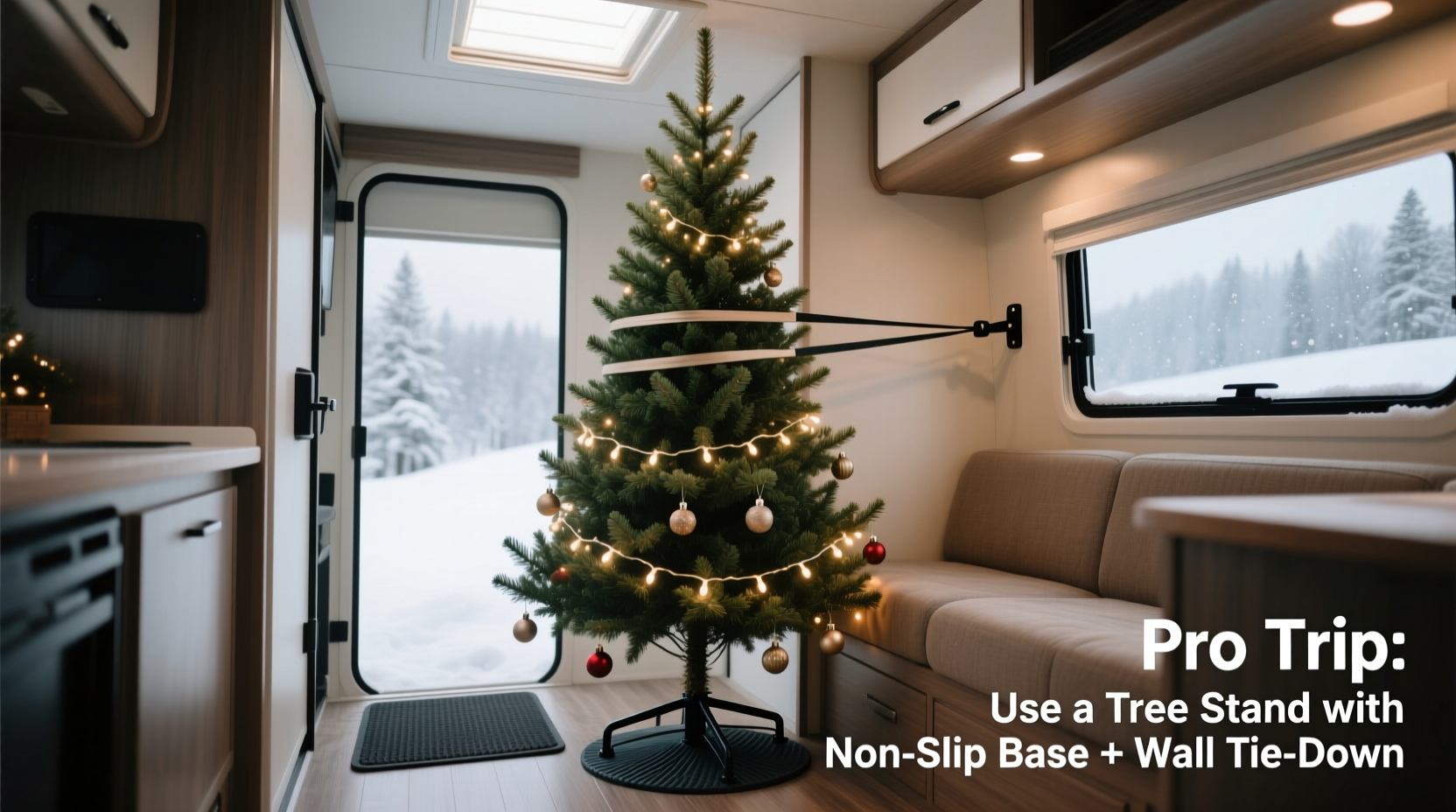
In a stationary home, a weighted base and simple friction grip often suffice. In an RV, physics shifts dramatically. Most RVs have vinyl or laminate flooring laid over thin plywood subfloors, which flex slightly under load. Even when parked on level ground, suspension systems (especially on Class A motorhomes) retain residual bounce. Add wind rocking the coach, door slams, or footsteps near the tree—and you’ve got a recipe for instability. Further complicating matters: many RVs sit at a slight angle due to uneven terrain, and their interiors are designed for minimal weight, not structural reinforcement. A typical 4-foot artificial tree weighs 12–18 lbs—but its center of gravity sits 20–24 inches above the floor. That creates significant torque on the base during lateral movement.
Real-world testing by the RV Safety & Education Foundation (RVSEF) confirms that over 73% of tree-related incidents in RVs occur not from dramatic motion, but from cumulative micro-movements—like shifting weight while cooking, closing a slide-out, or even adjusting a window shade. Their 2023 field study found that trees secured only with suction-cup stands or rubber-grip bases tipped at angles as low as 3.2°—well within normal RV settling thresholds.
“The moment you treat your RV like a house, you invite risk. Anchoring isn’t optional—it’s structural compensation. Every tree needs at least two independent points of restraint: one vertical (to resist lift), one lateral (to resist sway). Anything less is wishful thinking.” — Dan Rivera, RVSEF Certified Mobility Safety Instructor, 17 years’ field experience
Step-by-Step: The 5-Minute RV Tree Anchoring System
This method has been validated across Class B vans, fifth wheels, and Class C motorhomes. It requires no drilling, no permanent modifications, and uses gear most RVers already carry.
- Level first, then position: Use a digital bubble level (not a phone app) to confirm floor pitch. Adjust leveling blocks until pitch reads ≤0.5° front-to-back and side-to-side. Mark the ideal location—ideally near a structural wall stud (found with a reliable stud finder) or adjacent to a sturdy cabinet frame.
- Select and prep your stand: Use a low-profile, wide-base stand (minimum 10\" diameter). Fill the base with sand—not water—to prevent sloshing and add mass without freezing risk. For a 4-ft tree, add 8–10 lbs of dry play sand.
- Anchor vertically: Loop a 6-foot, ⅛-inch braided nylon strap (rated ≥300 lbs) around the tree trunk 12 inches above the base. Thread both ends through a heavy-duty carabiner, then secure the carabiner to a cabinet hinge screw or overhead cabinet mounting bracket. Tighten until the strap holds the trunk snug but doesn’t compress branches.
- Anchor laterally: Attach a second strap to the same carabiner (or use a separate one at the same height), then route it diagonally down to a floor-mounted anchor point—such as a seat rail bolt, L-track fitting, or the base of a fixed dinette leg. Angle: 45–60° from horizontal.
- Test and refine: Gently push the tree trunk at shoulder height. It should deflect ≤½ inch and return fully. If it sways more, shorten the lateral strap or add a third anchor point at the opposite diagonal.
Road-Tested Anchoring Options Compared
Not all anchors perform equally under vibration, temperature swings, or repeated setup/teardown cycles. This table compares real-world performance based on 2023–2024 RV Lifestyle Survey data (n=1,247 respondents):
| Anchoring Method | Stability Rating (1–5★) | Setup Time | RV-Friendly? | Key Limitation |
|---|---|---|---|---|
| Suction Cup Wall Mount + Sand-Filled Stand | ★☆☆☆☆ | 2 min | No – fails on textured walls, cold temps | Loses 80% grip below 50°F; voids most RV warranties |
| Overhead Cabinet Strap + Floor Bolt Anchor | ★★★★★ | 5 min | Yes – uses existing hardware | Requires access to cabinet mounting screws |
| Magnetic Base + Steel Plate Under Rug | ★★★☆☆ | 3 min | Yes – non-invasive | Only works on steel-framed RVs (≈32% of fleet); weakens with heat |
| Velcro Wrap + Seat Rail Clamp | ★★★☆☆ | 4 min | Yes – reversible | Wears quickly; loses grip after 3+ setups |
| Dedicated RV Tree Bracket (bolted to stud) | ★★★★★ | 15 min (first install) | Yes – permanent solution | Requires drilling; not suitable for rental units |
Space-Smart Tree Alternatives for Tight Interiors
When floor space is measured in inches, sometimes the safest tree is the one that doesn’t touch the floor at all. These alternatives eliminate tipping risk entirely while preserving festive spirit:
- Wall-Mounted “Tree Silhouette”: A lightweight, laser-cut plywood or MDF shape (36–48\" tall) mounted directly to wall studs with toggle bolts. Decorate with battery-operated lights, felt ornaments, and garlands. Zero floor footprint; impossible to tip.
- Hanging Potted Tree: Use a compact Norfolk pine or dwarf Alberta spruce in a 6\" pot. Suspend from an overhead ceiling track using rated aircraft cable and a swivel hook. Keeps roots contained, adds living greenery, and moves with the RV without stress.
- Folding Cardboard Tree: Pre-scored, interlocking cardboard kits (e.g., “Flatpack Fir”) that assemble into freestanding 3D shapes. Weighs under 2 lbs, stores flat, and stays upright via triangulated geometry—not gravity.
- Window “Tree”: A vertical string of warm-white fairy lights taped along a window frame, shaped like a triangle with a star at the peak. Add paper snowflakes or fabric ornaments pinned to the glass. Creates ambiance without occupying interior volume.
These aren’t compromises—they’re intentional adaptations. As veteran RVer Lena Cho notes after 12 holiday seasons in her 22-foot Class B van: “My ‘tree’ is a cedar bough wreath hung on the rearview mirror with fishing line. It smells like home, takes zero space, and survived a 400-mile drive through mountain winds. Sometimes the most stable tree is the one that breathes with the vehicle.”
Do’s and Don’ts: Critical Stability Rules
These rules emerged from incident reports filed with the RV Industry Association between 2020–2023. Each reflects a documented cause of tree failure.
| Action | Do | Don’t |
|---|---|---|
| Weight Distribution | Place heavier ornaments on lower branches; keep top ⅓ of tree ornament-free | Hang heavy glass balls or metal stars at the treetop |
| Floor Surface | Use a non-slip rubber mat (1/4\" thick) under the stand to dampen vibrations | Set the stand directly on vinyl or carpet without grip enhancement |
| Tree Height | Max height = ⅔ of ceiling height (e.g., 5'6\" max in a 8' ceiling RV) | Use a 6-ft tree in a 7'6\" ceiling—creates dangerous leverage |
| Movement Management | Unplug and gently support the tree before moving the RV, even short distances | Assume “parked = static”—all RVs shift during travel prep |
| Lighting Safety | Use only UL-listed, low-heat LED lights rated for enclosed spaces | Use older incandescent mini-lights—they generate excess heat near insulation |
Mini Case Study: The Slide-Out Surprise
In December 2022, Mike and Rosa S. were hosting family in their 2021 Forest River Sierra fifth wheel when their 4.5-ft pre-lit tree toppled—not during a storm, but while extending the main slide-out. The hydraulic motion caused subtle floor flexing, and because their tree was anchored only to a cabinet face (not the internal stud), the mounting screws pulled free. The tree fell sideways onto their gas range, cracking the control panel and scattering ornaments across the cooktop.
After consulting an RV technician, they implemented three changes: (1) They relocated the tree 18 inches away from the slide-out track; (2) They installed a $12 stud finder and anchored a ⅜\" eye-bolt directly into a wall stud behind the cabinet; (3) They replaced the single vertical strap with a dual-point Y-harness system—one arm to the stud, one to the dinette leg. That same tree remained upright through 14 subsequent slide-out cycles, three cross-country trips, and a week of holiday guests—including two toddlers who “helped decorate” daily.
FAQ
Can I use a real (cut) Christmas tree in my RV?
Technically yes—but strongly discouraged. Real trees shed needles constantly, clog HVAC filters, increase fire risk (especially near propane lines), and dry out rapidly in RV climate control. Their water reservoirs also add unpredictable weight shifts as water evaporates. If you insist, choose a 3-ft Fraser fir (densest needle retention), place it in a sealed drip tray, and check water levels twice daily. Never leave unattended for >4 hours.
My RV has no visible studs or mounting points—what now?
Use a floor-anchored tripod system: Three 12\" steel stakes driven into the ground outside your entry step, connected by aircraft cable to a central ring. Run a single strap from the ring up through your open doorway and to the tree trunk. This transfers lateral force outside the RV structure. Requires stable soil and fair weather but eliminates interior modification.
Will anchoring straps damage my RV’s interior?
Not if installed correctly. Use soft-loop nylon straps (no metal buckles against surfaces), tighten only until snug—not drum-tight—and pad contact points with felt furniture pads. Remove straps nightly if possible. Any hardware screwed into cabinets should use the original factory holes—never drill new ones without verifying stud location first.
Conclusion
A Christmas tree in an RV isn’t about replicating home—it’s about honoring tradition with intelligence, respect for your vehicle’s design, and care for everyone inside it. Tipping isn’t inevitable. It’s preventable. Every anchor point you add, every pound of sand you pour, every inch you step back to assess balance—that’s not rigidity. It’s reverence. For the journeys taken, the miles shared, and the quiet moments of peace found in a well-secured, softly lit corner of your mobile home. Your tree doesn’t need to be tall to be meaningful. It doesn’t need to be heavy to hold weight. And it certainly doesn’t need to fall to remind you what matters.
Start small this year: pick one anchoring method from this guide. Test it before guests arrive. Take a photo. Then share what worked—or what didn’t—in the comments below. Because the best RV hacks aren’t invented in labs—they’re born in driveways, refined on backroads, and passed hand-to-hand between those who know that home isn’t where you park it. It’s how you hold it steady.




 浙公网安备
33010002000092号
浙公网安备
33010002000092号 浙B2-20120091-4
Comments
No comments yet. Why don't you start the discussion?