
Slicing an onion may seem like a simple kitchen task, but doing it correctly makes a profound difference in cooking outcomes. Uneven pieces lead to inconsistent cooking—some bits burn while others remain raw. A poorly sliced onion releases too much moisture or fails to caramelize properly. Professional chefs treat onion preparation as a foundational skill, not just a prep step. Mastering this technique improves flavor distribution, texture control, and overall dish quality. More importantly, proper slicing minimizes tears by reducing cell rupture and volatile compound dispersion. This guide breaks down the exact method used in professional kitchens, including knife selection, cutting board stability, grain alignment, and precision cuts that ensure uniformity and safety.
Definition & Overview
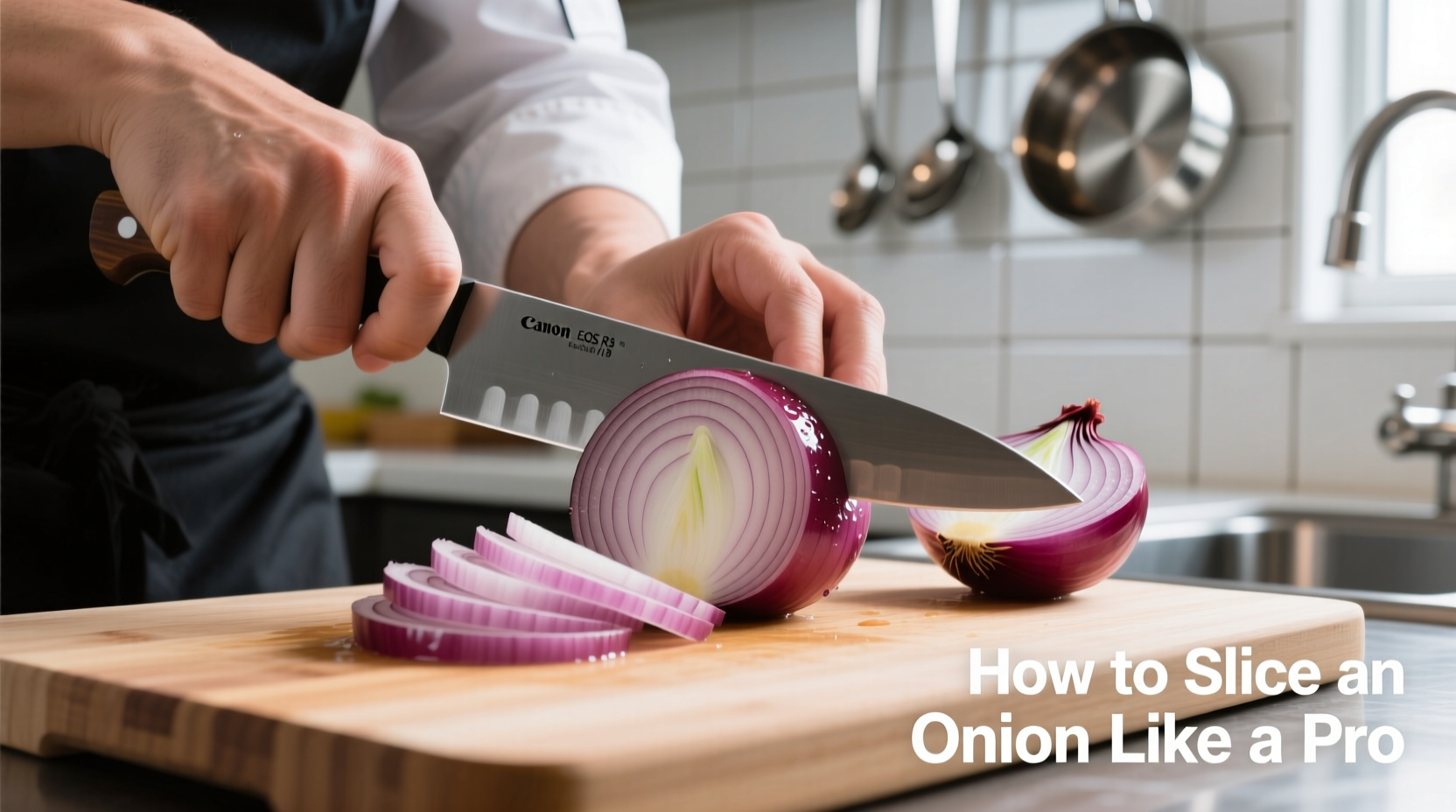
An onion slice refers to a cross-section of the bulb cut perpendicular or parallel to its fibrous central axis, producing flat surfaces ideal for sautéing, caramelizing, grilling, or layering in dishes. Onions belong to the *Allium* genus, which includes garlic, leeks, and shallots. The most commonly used variety in Western cooking is the yellow storage onion (*Allium cepa*), prized for its balance of pungency and sweetness when cooked. When sliced correctly, onions soften evenly, develop deep flavor, and integrate seamlessly into sauces, soups, stir-fries, and salads.
The act of slicing differs from dicing or chopping: slicing produces flat, continuous sections rather than small cubes. These slices can be further separated into rings or cut into strips depending on the recipe’s needs. Understanding the internal structure of the onion—the layered concentric rings surrounding a central core—is essential to executing clean, efficient cuts without crushing the tissue.
Key Characteristics of Onions
- Flavor Profile: Raw onions are sharp, sulfurous, and slightly sweet; cooking transforms them into rich, mellow, and aromatic components.
- Aroma: Pungent when raw due to sulfur-containing compounds released upon cell damage; becomes warm and savory when heated.
- Color/Form: Opaque white to pale yellow flesh with papery brown skin; firm, layered globe shape.
- Heat Level: Moderate to high pungency when raw (especially yellow and red varieties); diminishes significantly with heat.
- Culinary Function: Base aromatics in mirepoix, sofrito, and holy trinity; provides depth, sweetness, and body to sauces, stews, and braises.
- Shelf Life: 2–3 weeks at room temperature in a cool, dry, dark place; longer if stored properly away from potatoes.
Pro Tip: Always use a sharp chef’s knife—dull blades crush cells instead of slicing through them, increasing tear-inducing vapors and creating ragged edges.
Practical Usage: How to Slice an Onion Step by Step
To achieve restaurant-quality onion slices, follow this precise method. It ensures even thickness, structural integrity, and minimal waste.
- Prepare Your Tools: Use a stable cutting board (preferably non-slip or damp towel-lined). Select a sharp 8-inch chef’s knife. Wash hands and work surface before handling produce.
- Trim the Ends: Place the onion on the board. Cut off the root end (the hairy base) entirely, leaving about ¼ inch if you want to keep layers intact during slicing. Remove the stem end (top) flush with the onion’s surface.
- Peel the Onion: Remove the outer papery skin and any discolored outer layers. Rinse briefly only if needed, then pat dry—excess moisture hinders clean cuts.
- Halve Lengthwise: Position the onion vertically, aligning the knife with the natural pole-to-pole axis (from root to stem). Slice straight down through the center to create two mirrored halves. Keep the root intact on one half until final cuts if desired for stability.
- Lay Flat Side Down: Take one half and place the freshly cut side down on the board. This creates a stable base and exposes the concentric rings.
- Make Crosswise Slices: Holding the onion steady with a claw grip (fingertips curled under), make parallel cuts across the width of the onion, moving toward the root end. For thick slices (ideal for grilling or frying rings), space cuts ½ inch apart. For thinner slices (sautéing, caramelizing), aim for ⅛ to ¼ inch. Do not cut through the root unless separating rings.
- Separate the Slices: Once all cuts are made, gently pull apart the individual slices. If the root remains attached, trim it off now.
- Repeat with Second Half: Process the remaining half identically for consistent results.
This method yields uniform slices that cook at the same rate, preventing some pieces from turning mushy while others stay crisp. Uniformity also enhances presentation in dishes where onions are visible, such as fajitas, burgers, or French onion soup.
When to Use Different Slice Thicknesses
| Thickness | Cooking Method | Dish Examples |
|---|---|---|
| ⅛ inch (thin) | Sautéing, sweating, quick-cooking | Omelets, risottos, creamy soups |
| ¼ inch (medium) | Caramelizing, simmering, braising | Beef bourguignon, gravy bases, casseroles |
| ½ inch (thick) | Grilling, roasting, frying | Onion rings, kebabs, grilled sandwiches |
Knife Safety Note: Maintain a consistent knuckle guard using the claw grip. Never flatten your fingers—always curl them so fingertips are tucked safely behind the middle joint.
Variants & Types of Onion Slices
Depending on the dish, different slicing techniques produce distinct textures and functions:
- Rounds / Rings: Created by slicing horizontally across the equator of the whole onion. Ideal for breading and frying into crispy onion rings or stacking on burgers.
- Half-Moons: Formed by halving the onion pole-to-pole, then slicing crosswise. Most common in sautés, stir-fries, and soups due to their open structure and even cooking.
- Lengthwise Strips: After halving, make vertical cuts from top to bottom, following the grain. Used in julienned salads or Asian-style slaws where crunch and length matter.
- Wedges: Cut from unpeeled onion quarters extending through the root. Often roasted with skin on to hold shape, e.g., in Persian or Mediterranean cuisine.
Each form interacts differently with heat and oil. Rings retain more moisture and require longer frying times. Half-moons expose more surface area, promoting faster browning and flavor development.
Comparison with Similar Ingredients
While other alliums resemble onions, they behave differently when sliced:
| Ingredient | Texture When Sliced | Flavor Intensity | Best Use Case |
|---|---|---|---|
| Yellow Onion | Firm, layered, holds shape well | Moderate pungency, sweetens when cooked | All-purpose; foundation for most savory dishes |
| Red Onion | Crisper, more watery, vivid color | Sharper raw, less sweet when cooked | Raw applications: salads, salsas, pickling |
| White Onion | Tender, higher water content | Bright, clean bite | Mexican cuisine, pico de gallo, quick sautés |
| Shallot | Delicate, fine-grained | Milder, garlicky-sweet | Emulsified sauces, vinaigrettes, fines herbes |
| Leek | Soft, fibrous stalks | Subtle, grassy-sweet | Braised sides, potato leek soup, gratins |
Unlike minced garlic or diced shallots, onion slices serve as both flavor builders and textural elements. Their larger size means they contribute bulk and mouthfeel, not just background notes.
Practical Tips & FAQs
Why do onions make me cry—and how can I reduce it?
When onion cells are ruptured, enzymes convert sulfoxides into sulfenic acid, which quickly becomes syn-propanethial-S-oxide—a volatile gas that irritates the eyes. To minimize tears:
- Chill the onion for 30 minutes before slicing; cold slows enzyme activity.
- Use a sharp knife to minimize cell damage.
- Cut near a running fan or vent hood to draw vapors away.
- Slice quickly with decisive strokes—prolonged exposure increases irritation.
Can I slice onions ahead of time?
Yes, but store them properly. Pre-sliced onions oxidize and lose freshness within 7–10 days. Store in an airtight container in the refrigerator at 40°F (4°C) or below. For best results, use within 5 days. Avoid storing peeled onions in metal containers—they react and darken.
What’s the best knife for slicing onions?
An 8-inch forged stainless steel chef’s knife offers optimal balance, weight, and edge retention. Japanese-style Gyuto knives provide thinner, sharper blades ideal for precision work. German-style knives like Wüsthof or Zwilling are heavier and better suited for rocking motions. Whichever you choose, maintain a honed edge with regular stropping or sharpening.
Should I wash onions after peeling?
Rinse only if visibly dirty. Excessive moisture causes slipping on the cutting board and dilutes flavor. Pat dry thoroughly before slicing.
How thin is too thin for onion slices?
Slices thinner than 1/16 inch begin to break down rapidly during cooking and turn into a paste. Reserve ultra-thin slicing for raw garnishes (e.g., shaved red onions in tacos) where texture contrast matters.
Is there a way to slice onions faster without sacrificing quality?
Practice the “rock chop” motion: anchor the tip of the knife on the board and rock the blade up and down while advancing the onion forward. This allows rapid, controlled slicing once muscle memory develops. However, speed should never compromise safety or uniformity.
“In professional kitchens, we judge a cook’s skill by how they handle the basics. If someone can’t slice an onion cleanly, we assume they’ll struggle with timing, seasoning, and consistency.” — Chef Elena Ruiz, Culinary Instructor, San Francisco Cooking School
Summary & Key Takeaways
Slicing an onion like a pro is not about flair—it's about function, precision, and understanding ingredient behavior. Proper slicing begins with selecting the right onion and maintaining a sharp knife. The process involves trimming, halving pole-to-pole, stabilizing the cut face, and making parallel crosswise cuts to achieve uniform thickness. Whether preparing half-moons for a stew or thick rounds for grilling, consistency ensures even cooking and superior flavor integration.
Different onion types yield varying results: yellow onions offer versatility, red onions add color and bite, and white onions deliver brightness. Compared to shallots or leeks, true onions provide heft and depth critical to foundational dishes. By mastering slicing technique, cooks eliminate common pitfalls—uneven doneness, excessive tearing, wasted product, and compromised texture.
Storage, knife care, and workflow efficiency round out the complete skill set. Chilling onions reduces eye irritation. Refrigerated pre-sliced onions last up to a week. And above all, repetition builds confidence and speed without sacrificing control.
Ultimately, the ability to slice an onion efficiently and safely reflects broader culinary competence. It signals attention to detail, respect for ingredients, and readiness to execute complex recipes with confidence. No advanced gadget replaces the fundamental coordination between hand, knife, and vegetable. In kitchens worldwide, this single act remains a benchmark of skill—one every serious home cook can and should master.
Final Thought: Practice this technique weekly until it becomes second nature. Set a timer, refine your grip, and focus on achieving identical slice widths. Within a month, you'll slice faster, cleaner, and with greater confidence than 90% of home cooks.




 浙公网安备
33010002000092号
浙公网安备
33010002000092号 浙B2-20120091-4
Comments
No comments yet. Why don't you start the discussion?