
Despite being a staple in kitchens around the world, the word spinach is frequently misspelled—often as “spinich,” “spinnach,” or “spinash.” These errors may seem minor, but consistent accuracy in spelling matters, especially in recipe writing, food labeling, culinary education, and professional communication. Knowing how to spell \"spinach\" correctly ensures clarity, credibility, and precision whether you're writing a menu, publishing a cookbook, or simply sharing a grocery list. This guide clarifies the correct spelling, explores the origins of common mistakes, and reinforces proper usage through linguistic, culinary, and practical contexts.
Definition & Overview
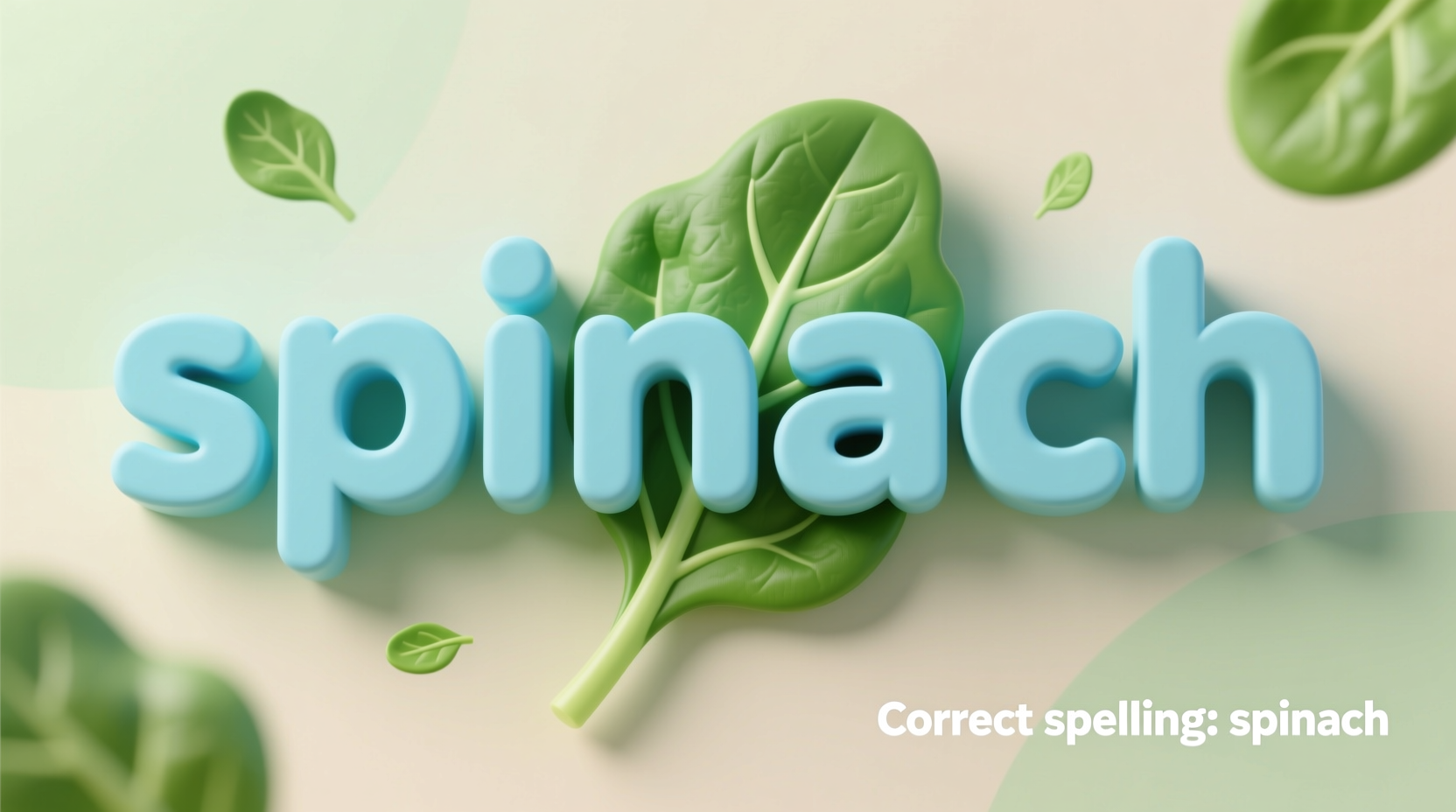
Spinach (Spinacia oleracea) is a nutrient-dense leafy green vegetable belonging to the Amaranthaceae family. Native to Central and Western Asia, it has been cultivated for over two millennia and gained global prominence for its versatility, health benefits, and mild, slightly earthy flavor. The word itself comes from the Latin *spinarium* or *spina*, possibly referencing the plant’s spiny seeds in certain heirloom varieties. Over time, the term evolved through Old French (*espinache*) into Middle English as “spinage” before settling into the modern spelling: spinach.
In culinary terms, spinach is valued not only for its nutritional profile—rich in iron, vitamin K, folate, and antioxidants—but also for its adaptability across raw, sautéed, steamed, baked, and blended applications. From smoothies to spanakopita, its presence in diverse cuisines underscores the importance of accurately representing the ingredient in both speech and writing.
Key Characteristics of Spinach (the Ingredient)
While this article focuses on spelling, understanding the physical and culinary properties of spinach helps reinforce why precise language matters when describing such a widely used ingredient. Below are the core characteristics:
| Attribute | Description |
|---|---|
| Flavor Profile | Mild, slightly sweet when young; becomes more earthy and mineral-rich when mature or cooked. |
| Aroma | Fresh, green, grassy; minimal scent when raw, deeper vegetal notes when heated. |
| Color & Form | Deep green leaves; can be flat (Savoy), crinkled (semi-Savoy), or smooth (baby spinach). |
| Texture | Tender when young; fibrous stems may require trimming. Wilts easily under heat. |
| Culinary Function | Bulk addition, nutrient booster, color enhancer, binder in fillings, base for sauces. |
| Shelf Life | 3–7 days refrigerated, depending on freshness and storage method. |
Why Spelling Matters in Culinary Contexts
Accurate spelling supports professionalism and prevents confusion, particularly in environments where precision is paramount. A misspelled ingredient name on a menu, label, or instructional guide can undermine credibility and lead to misunderstandings. For example:
- A recipe calling for “spinich” may raise doubts about the author’s attention to detail.
- In educational materials, incorrect spelling can inadvertently teach bad habits to students.
- On packaging or dietary information, misspellings may suggest poor quality control.
The correct spelling—spinach—contains seven letters: S-P-I-N-A-C-H. It ends with “-ach,” not “-ash” or “-ich,” and does not double the “n” or “p.” Understanding this structure helps prevent common errors rooted in phonetic assumptions.
Common Misspellings and Why They Occur
Learners and even experienced writers often misspell “spinach” due to phonetic interpretation, regional accents, or typographical slips. The most frequent errors include:
- Spinich – Likely influenced by pronunciation where the “a” sounds closer to “i,” especially in fast speech.
- Spinnach – Double consonant confusion, similar to “cinnamon” or “running.”
- Spinash – Mishearing the final syllable as “ash” instead of “ach” (pronounced like “ack”).
- Spinige – Rare, but occurs when attempting a phonetic transliteration.
- Espenache – Archaic or non-English variant derived from French, now obsolete in standard English.
These variations stem from the way the word is pronounced in different dialects. In American English, “spinach” is typically pronounced /ˈspɪnətʃ/ (“SPIN-uhj”), with a soft “ch” sound at the end. The middle syllable is reduced, making it easy to overlook the “a” and misrepresent the spelling.
Tip: To remember the correct spelling, break the word into syllables: spi-na-ch. Focus on the “a” before the “ch”—this distinguishes it from words like “lunch” or “pitch,” which follow different patterns.
Variants & Types of Spinach (and Their Naming Conventions)
Spinach appears in multiple forms in the marketplace, each with specific naming conventions that should also be spelled correctly:
- Baby spinach – Young leaves harvested early; tender and sweet. Often sold pre-washed. Never “babyspinach” or “bayby spinich.”
- Savoy spinach – Crinkly, dark green leaves; holds up well to cooking. Named after the Savoy region in Italy.
- Flat-leaf spinach – Smooth leaves, easier to clean; commonly used in commercial kitchens.
- Spinach powder – Dehydrated and ground spinach used in supplements or natural coloring.
- Blanched spinach – Pre-cooked and frozen; sometimes labeled “chopped spinach.”
Each form retains the root word “spinach,” and altering the spelling in compound terms (e.g., “spinach dip,” “spinach quiche”) compromises consistency. Always use the correct base spelling regardless of preparation method.
Practical Usage: Writing About Spinach in Recipes and Menus
Using “spinach” correctly enhances readability and trust in culinary writing. Whether drafting a home recipe, designing a restaurant menu, or teaching a cooking class, adhere to these guidelines:
- Always spell “spinach” with an “a” after the “n” and end with “-ch.”
- Capitalize only at the beginning of sentences or in proper nouns (e.g., “Creamed Spinach” as a dish title).
- In plural form, add “-es”: spinaches (rare but acceptable when referring to multiple types, e.g., “the many spinaches of Mediterranean cuisine”).
Example of correct usage in a recipe step:
Add 2 cups of fresh spinach to the sauté pan and cook until wilted, about 2–3 minutes.
Incorrect versions to avoid:
- “Add 2 cups of fresh spinich…” ❌
- “Stir in the spinnach slowly…” ❌
- “Use organic spinash leaves…” ❌
Consistency extends to derivatives: spinach-based, spinach-filled, spinach-enriched—all rely on the correctly spelled root.
Comparison with Similar Ingredients and Terms
Some ingredients are confused not only in use but also in spelling. Below is a comparison of “spinach” with commonly mistaken counterparts:
| Word | Correct Spelling | Common Errors | Key Difference |
|---|---|---|---|
| Spinach | S-P-I-N-A-C-H | Spinich, spinnach, spinash | Leafy green, mild flavor, versatile in raw/cooked dishes. |
| Kale | K-A-L-E | Colle, cale, kayle | Hardier texture, more bitter; unrelated botanically. |
| Chard | C-H-A-R-D | Charde, card, shard | Also called Swiss chard; has prominent stalks, belongs to beet family. |
| Spring mix | S-P-R-I-N-G + M-I-X | Springmiks, sprin mix | Blend of young greens; includes baby spinach but is not synonymous. |
Note that while “spring mix” contains the same first five letters as “spinach,” the words are entirely distinct. Do not conflate them in spelling or usage.
Practical Tips & FAQs
Q: Is “spinach” spelled differently in British vs. American English?
A: No. Unlike words such as “color/colour,” “spinach” is spelled identically in all varieties of standard English.
Q: How do I remember the correct spelling?
A: Use a mnemonic: “Spin A Coin And Catch It Happily” — each word starts with the letters S-P-I-N-A-C-H. Alternatively, associate it with Popeye, the iconic spinach-eating sailor, whose name reinforces the correct pronunciation and spelling.
Q: Can I use “spinach” as a verb?
A: Not in formal English. While informal usage like “I got spinach’d” (referring to sudden strength) exists colloquially, it remains nonstandard. Stick to noun or adjective forms in writing.
Q: What if I see “spinach” misspelled on a menu or product label?
A: Politely inform the provider if possible. In customer-facing industries, spelling accuracy reflects attention to detail and respect for the audience.
Q: Are there any homophones for “spinach”?
A: There are no true homophones, but “spinach” sounds similar to “spoon hatch” or “spin a chute” in rapid speech. This auditory ambiguity contributes to misspellings.
Checklist: Ensuring Correct Spelling in Practice
- Verify spelling before publishing recipes or menus.
- Use spell-check tools, but don’t rely solely on them—“spinich” may not be flagged if added to custom dictionaries.
- Teach correct spelling in cooking classes or workshops.
- Proofread labels, signage, and digital content regularly.
- Encourage peer review among culinary teams to catch errors.
Expert Insight: Language and Culinary Professionalism
“In gastronomy, every detail counts—from seasoning to syntax. Spelling ‘spinach’ correctly isn’t pedantry; it’s part of maintaining standards. When a chef writes a menu, they’re communicating culture, care, and craft. One misspelled ingredient can quietly erode that message.”
— Chef Elena Torres, Culinary Instructor, Institute of Gastronomic Arts
Educational Application: Teaching Spelling in Cooking Schools
Culinary schools increasingly integrate literacy components into their curricula, recognizing that graduates must write clear recipes, cost sheets, and operational documents. At the New York Culinary Academy, instructors use ingredient spelling drills as part of foundational training.
One exercise involves matching flashcards with correct spellings to samples of actual produce. Students handling a bunch of leafy greens must identify and write “spinach” correctly within 10 seconds. Repetition solidifies muscle memory for both hands-on cooking and written documentation.
This approach addresses a real-world gap: many aspiring cooks come from diverse linguistic backgrounds and benefit from structured reinforcement of key terms. Standardizing spelling across languages and accents ensures clarity in multicultural kitchens.
Digital Considerations: SEO and Online Visibility
For food bloggers, recipe developers, and restaurant marketers, correct spelling directly impacts search engine optimization (SEO). Search engines prioritize accurate, authoritative content. A blog titled “How to Cook Fresh Spinich” will rank poorly compared to one using “spinach” due to lower relevance and user intent alignment.
Google processes billions of searches monthly, including queries like:
- “spinach recipes” (~135,000 monthly searches)
- “how to store spinach” (~40,000 monthly searches)
- “spinach nutrition facts” (~33,000 monthly searches)
Content containing misspelled variations fails to capture this traffic. Moreover, repeated errors can trigger algorithmic downgrading of page quality. Always optimize with the correct spelling to maximize reach and engagement.
Summary & Key Takeaways
Spelling “spinach” correctly is a small but significant act of culinary professionalism. The correct form—S-P-I-N-A-C-H—should be used consistently across all written formats, from personal notes to published works. Avoid common pitfalls like “spinich,” “spinnach,” or “spinash” by remembering the three-syllable breakdown: spi-na-ch.
Key points to retain:
- The word has seven letters, ends in “-ach,” and contains a single “n.”
- No regional variations exist in English spelling.
- Accuracy supports credibility in recipes, menus, education, and digital content.
- Misspellings arise from phonetic confusion but can be prevented with practice.
- Correct spelling improves SEO and aligns with user search behavior.
Call to Action: Review your last three recipes or social media posts. Did you spell “spinach” correctly every time? Commit to proofreading future content, and share this guide with fellow cooks to promote linguistic precision in the kitchen.




 浙公网安备
33010002000092号
浙公网安备
33010002000092号 浙B2-20120091-4
Comments
No comments yet. Why don't you start the discussion?