
Staggering multiple Christmas trees in a single room is no longer a festive indulgence—it’s a deliberate interior design strategy embraced by stylists, hospitality designers, and discerning homeowners alike. When executed with intention, layered trees create rhythm, depth, and narrative momentum across a space. They invite the eye to travel, encourage conversation, and transform static corners into dynamic vignettes. But haphazard placement—trees of identical height clustered too closely, mismatched ornaments competing for attention, or lighting that cancels rather than complements—can quickly devolve into visual clutter. This guide distills proven spatial principles, material considerations, and real-world execution tactics used by professional holiday stylists to achieve layered, harmonious, and unforgettable tree arrangements.
Why Staggering Works: The Design Principles Behind Layered Trees
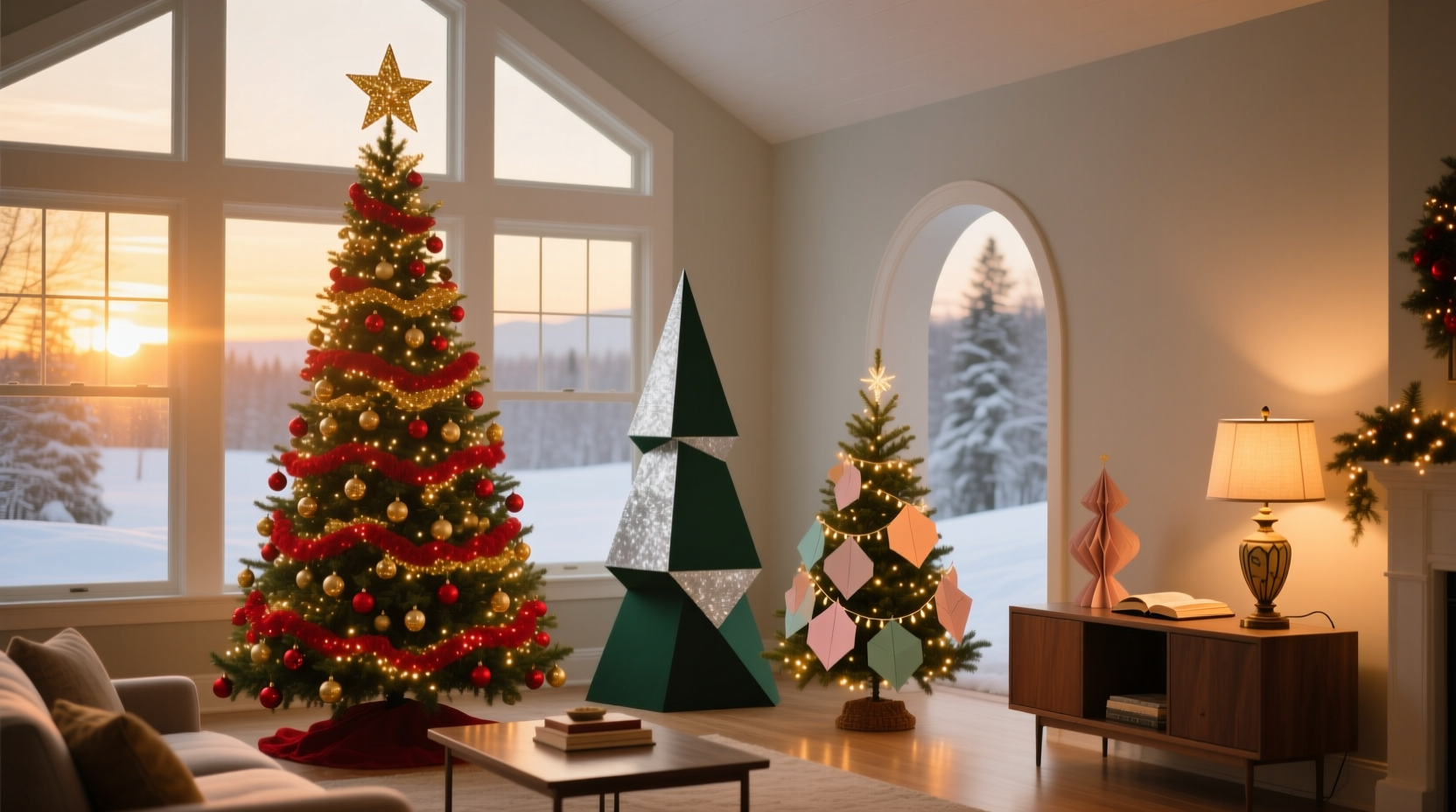
Staggering isn’t about randomness—it’s rooted in three foundational design concepts: hierarchy, rhythm, and focal modulation. A single tree establishes one focal point. Two or more trees, when thoughtfully staggered, create a *visual sequence*: the eye moves from tallest to shortest (or vice versa), from warm to cool light, from dense texture to airy silhouette. Interior designer Lena Torres explains this shift in perspective: “Clients often say, ‘I want more wow,’ but what they’re really asking for is *spatial storytelling*. A staggered arrangement doesn’t just fill space—it choreographs how people experience the room over time.”
This approach also solves common spatial challenges. In open-plan living areas, staggered trees can subtly define zones without walls—e.g., a 7-foot flocked tree near the fireplace anchors the seating area, while a 4-foot minimalist birch trunk tree on a side console suggests a quiet reading nook. In narrow hallways or stairwells, vertical layering (a floor-standing tree below, a suspended mini-tree above) adds dimension where horizontal space is limited. Crucially, staggering allows each tree to retain individuality while contributing to a unified whole—a balance that’s impossible with uniform repetition.
Step-by-Step: Building Your Staggered Tree Composition
Follow this five-phase process to build a cohesive, visually resonant multi-tree arrangement:
- Assess & Map: Measure your room’s key dimensions—not just floor space, but ceiling height, door swing paths, traffic flow, and existing furniture anchors. Sketch a simple floor plan and mark fixed elements (sofa, fireplace mantel, windows). Note natural light sources and electrical outlets.
- Select Scale Progression: Choose trees with at least 18–24 inches difference in height between adjacent specimens. For example: 8' (main anchor), 5.5' (secondary focal point), and 3' (accent). Avoid mid-range gaps (e.g., 7', 6.5', 6')—they flatten hierarchy.
- Assign Roles & Locations: Designate one tree as the *Anchor* (tallest, most detailed, placed in primary sightline), one as the *Counterpoint* (medium height, contrasting texture or color tone), and one or more as *Accents* (smallest, simplest, used to echo a motif or soften edges).
- Unify Through Light & Line: Use identical bulb types (warm white LEDs, 2700K CCT) across all trees—even if ornament palettes differ. Run extension cords discreetly under rugs or along baseboards; avoid visible tangles. Ensure light directionality creates continuity (e.g., all top-lit stars facing the same cardinal direction).
- Refine & Edit: Step back. Turn off overhead lights. View the arrangement at night. Remove any ornament, ribbon, or base element that interrupts the eye’s path between trees. If you find yourself looking *at* a tree instead of *through* it to the next, simplify its top third.
Theme Cohesion Without Monotony: Balancing Unity and Contrast
Thematic consistency prevents chaos—but strict uniformity kills interest. The solution lies in selecting *one unifying element* and varying everything else around it. This creates what design studios call “controlled divergence.”
| Unifying Element | Variation Options | Why It Works |
|---|---|---|
| Lighting Temperature (2700K) | Different bulb shapes (pear, candle, globe); varied strand densities (100 bulbs/tree vs. 300); mixed wiring colors (black, white, clear) | Creates warmth continuity while allowing textural distinction|
| Trunk Material (natural wood) | Species variation (birch, pine, driftwood); finish (raw, whitewashed, stained); base treatment (bare, moss-wrapped, ceramic) | Grounds composition in organic authenticity|
| Ornament Shape (sphere) | Material (glass, matte ceramic, hammered metal, dried citrus); size range (1\", 2.5\", 4\"); surface texture (glossy, frosted, ribbed) | Maintains rhythmic repetition without visual fatigue|
| Color Anchor (deep forest green) | Secondary palette per tree (tree 1: gold + ivory; tree 2: rust + charcoal; tree 3: sage + cream) | Provides chromatic through-line while enabling mood shifts
Avoid the “theme soup” trap—where every tree tries to represent a different holiday trope (vintage, woodland, glam, coastal). Instead, choose one overarching mood (e.g., “modern rustic”) and express it through differentiated interpretations: one tree emphasizes raw texture and asymmetry, another focuses on refined simplicity, the third introduces subtle metallic contrast.
Real-World Execution: The Brooklyn Loft Case Study
In a 1,200-square-foot industrial loft with exposed brick, 12-foot ceilings, and an open kitchen/living zone, client Maya R. wanted “festive but not kitschy” energy for her annual holiday open house. Her initial instinct was three identical 6-foot pre-lit firs—until the stylist pointed out the space’s inherent verticality and lack of defined zones.
The revised staggered plan included:
- Anchor Tree (8' Noble Fir): Placed 2 feet left of the fireplace opening, wrapped in matte black iron stand, decorated with oversized matte-black ceramic spheres, brass antler silhouettes, and minimal warm-white micro-lights. Its height draws the eye upward, emphasizing ceiling height.
- Counterpoint Tree (5' White Spruce): Positioned on a low walnut platform beside the dining table, featuring hand-blown glass orbs in deep emerald and amber, draped with undyed linen ribbon. Its lower profile creates intimacy around the table without blocking sightlines.
- Accent Tree (30\" Birch Trunk): Mounted vertically on the brick wall above the kitchen island using custom steel brackets, adorned only with miniature copper bells and bare branches. It functions as vertical punctuation—visible from the sofa, dining chairs, and kitchen sink.
The result? Guests consistently gravitated first to the tall tree, then naturally circled toward the dining area, pausing to admire the wall-mounted accent. No single tree dominated; instead, movement through the space felt curated and intentional. As Maya noted in her follow-up: “People didn’t say ‘How many trees do you have?’ They said, ‘This whole room feels like it breathes differently now.’”
“Staggering isn’t about quantity—it’s about choreography. Every tree must earn its place by answering a spatial question: Where does the eye need to land next? What transition needs softening? Which void requires gentle definition?” — Derek Lin, Principal Stylist, Evergreen Collective (12+ years staging commercial and residential holiday spaces)
Practical Considerations: Safety, Logistics & Maintenance
Layered trees introduce unique operational demands. Ignoring these undermines aesthetics and invites risk:
- Fire Safety: Maintain minimum 36-inch clearance between any tree and heat sources (fireplaces, radiators, space heaters). For wall-mounted or suspended trees, ensure mounting hardware is rated for 3x the assembled weight and installed into structural framing—not drywall anchors.
- Electrical Load Management: Calculate total wattage (LED strings draw ~4–7 watts each). Do not exceed 80% of circuit capacity (e.g., 1,440W max on a 15-amp/120V circuit). Use surge-protected power strips with individual switches for easy control.
- Tree Stability: Anchor all freestanding trees taller than 4 feet to wall studs using aircraft cable or heavy-duty picture-hanging wire (not twine or ribbon). Test sway before decorating.
- Water Management: Place drip trays under every live tree—even small ones. Use moisture-retaining gel crystals in reservoirs to reduce daily refills. Check water levels twice daily for first 72 hours.
FAQ: Addressing Common Staggering Challenges
Can I stagger trees with different species or artificial vs. real?
Absolutely—and it’s often recommended. Real trees provide organic texture and scent; high-quality artificial trees offer consistent shape, flame resistance, and longevity. The key is unifying through non-biological elements: lighting temperature, trunk finish, base treatment, or ornament material. A 7-foot real Fraser fir paired with a 4-foot artificial Nordmann spruce works seamlessly when both feature matte-black iron stands and identical warm-white micro-lights.
What’s the minimum room size for staggered trees?
There’s no strict minimum square footage—only minimum *functional clearance*. You need at least 24 inches of unobstructed floor space around each freestanding tree for safe access and visual breathing room. In a 10’ x 12’ bedroom, a 5-foot anchor tree and a 2.5-foot accent on a dresser can work beautifully. Prioritize vertical layering (floor + surface) over horizontal sprawl in tight spaces.
How do I prevent the arrangement from looking cluttered?
Clutter arises from competing focal points, not quantity. Apply the “Rule of Three Distinctions”: limit variations to three categories maximum (e.g., height + ornament material + ribbon width). Eliminate fourth variables (e.g., don’t vary height, color, texture, AND light type simultaneously). Also, edit ruthlessly: remove 20% of ornaments from each tree after initial styling—you’ll almost always prefer the cleaner result.
Conclusion: Your Space Deserves Intentional Joy
Staggering multiple Christmas trees is an act of spatial generosity. It acknowledges that joy isn’t monolithic—it has layers, rhythms, and moments of quiet intensity alongside exuberant peaks. When you choose distinct heights, unify through light, assign purposeful roles, and edit with discipline, you’re not just decorating. You’re composing a three-dimensional experience that honors how people actually move, pause, gather, and reflect in your home. This approach transforms seasonal decoration from a temporary overlay into a meaningful expression of your space’s character and your own thoughtful presence within it.
Start small: identify one room where a single tree feels insufficient. Measure, sketch, select your first two heights. Then commit to one unifying thread—light, trunk, or shape—and let everything else serve that decision. The magic isn’t in perfection; it’s in the confidence that comes from knowing each tree has earned its place.




 浙公网安备
33010002000092号
浙公网安备
33010002000092号 浙B2-20120091-4
Comments
No comments yet. Why don't you start the discussion?