
Procrastination isn’t a failure of discipline—it’s often a signal. When you're overwhelmed, your brain interprets the weight of a task as a threat. The result? Avoidance. This isn’t laziness; it’s a psychological reflex designed to protect you from stress. But while avoidance offers temporary relief, it compounds pressure over time. The good news: by understanding the mental mechanisms behind procrastination, you can bypass resistance and regain momentum—starting with just one small action.
The key isn’t willpower. It’s strategy. Drawing from cognitive psychology, behavioral neuroscience, and real-world productivity research, this guide delivers practical, science-based methods to help you begin tasks even when everything feels too much.
Why Overwhelm Triggers Procrastination (And What to Do About It)
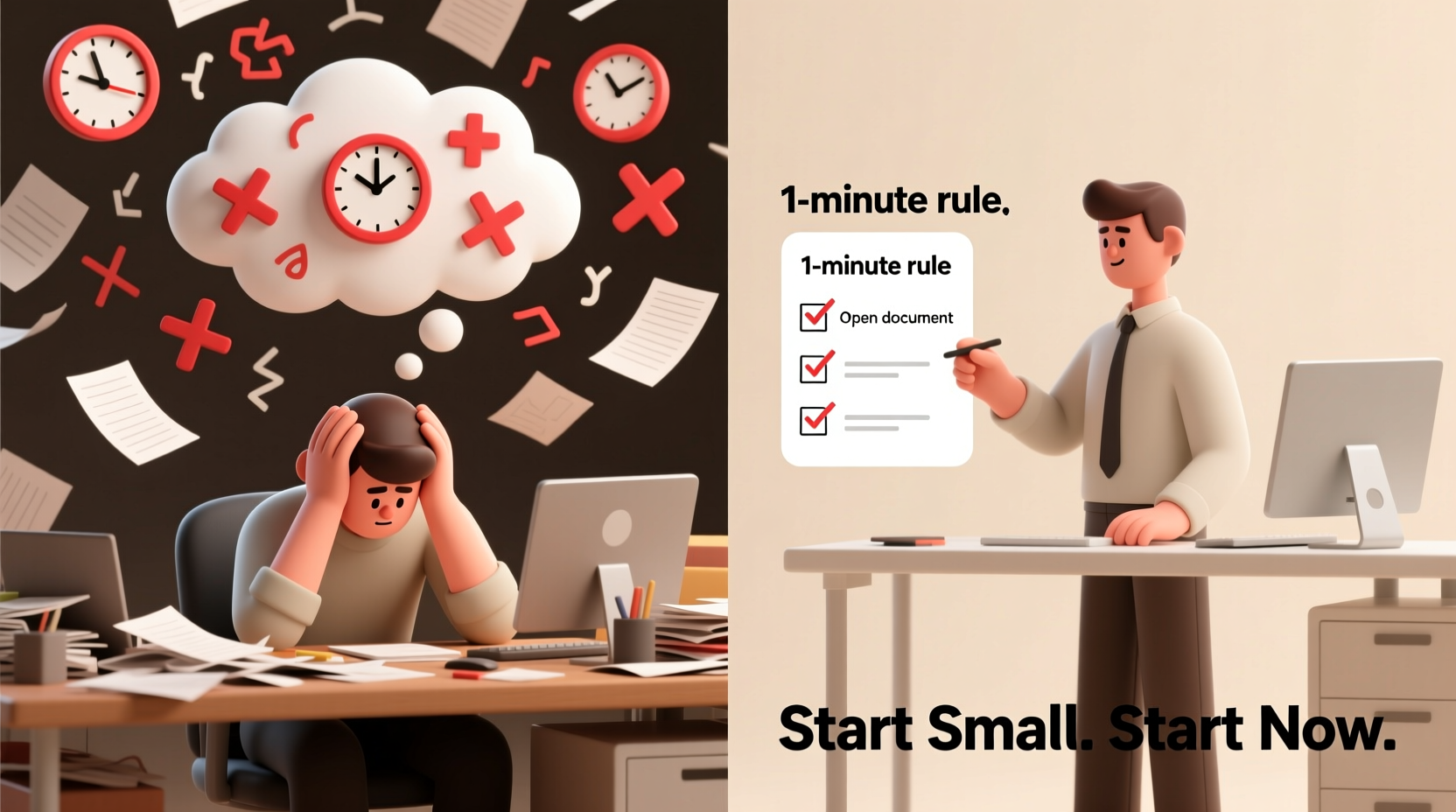
When faced with a complex or emotionally taxing task, the prefrontal cortex—the part of your brain responsible for planning and decision-making—can become overloaded. Simultaneously, the limbic system, which governs emotions and survival instincts, activates stress responses. This internal conflict creates a mental gridlock: you *want* to act, but your brain *resists* doing so.
Dr. Piers Steel, author of The Procrastination Equation, identifies four key factors that increase procrastination:
- Low task expectancy – Doubt about success (“I probably won’t do well”)
- Low value – The task feels meaningless or unpleasant
- High impulsiveness – Easily distracted by more immediate rewards
- Long delay – Rewards are far in the future
When overwhelm enters the picture, all four factors intensify. Tasks seem harder (lower expectancy), less rewarding (lower value), and easier to escape through distractions (higher impulsiveness).
The 5-Minute Rule: Trick Your Brain into Starting
One of the most effective psychological hacks for overcoming initial resistance is the 5-Minute Rule. The idea is simple: commit to working on a task for only five minutes. You don’t have to finish it—just start.
This works because starting is the hardest part. Once you begin, the Zeigarnik Effect—a psychological phenomenon where incomplete tasks occupy mental space—kicks in. Your brain starts seeking closure, making it more likely you’ll continue beyond the initial window.
“Action isn’t just the effect of motivation—it’s the cause of it.” — James Clear, author of Atomic Habits
To apply the 5-Minute Rule:
- Choose a single, tiny subtask (e.g., “open the document,” “write one sentence,” “gather research links”)
- Set a timer for five minutes
- Work without judgment or expectation
- When the timer ends, decide: stop or continue?
In most cases, continuing feels easier than stopping. The momentum carries you forward.
Break the Task-Overwhelm Cycle with Micro-Chunking
Overwhelm thrives on vagueness. “Write the report” or “plan the project” are not actions—they’re outcomes. Your brain struggles to engage with abstract goals.
Solution: break tasks into micro-chunks—steps so small they feel almost trivial. This reduces cognitive load and increases perceived control.
For example, instead of “work on presentation,” try:
- Create a new folder for slides
- Title slide: add topic and name
- Find three relevant statistics
- Sketch one diagram on paper
Each step is low-effort and clearly defined. Completing them builds a sense of progress, triggering dopamine release—a natural motivator.
Do’s and Don’ts of Task Breakdown
| Do | Don’t |
|---|---|
| Use action verbs: write, call, draft, list | Use vague terms: handle, deal with, manage |
| Limit each step to under 20 minutes | Combine multiple actions in one item |
| Arrange steps in logical sequence | Start with high-effort items |
| Include environmental prep (e.g., “close email tab”) | Assume ideal focus or energy levels |
Reframe Your Self-Talk: From Pressure to Permission
The way you talk to yourself shapes your behavior. Under pressure, many people adopt harsh inner dialogue: “I should’ve started earlier,” “I’m so behind,” “This has to be perfect.” This increases anxiety and reinforces avoidance.
Instead, practice self-compassionate reframing. Research by Dr. Kristin Neff shows that self-compassion improves motivation and resilience. People who treat themselves kindly during setbacks are more likely to persist.
Replace judgment with permission:
- Instead of: “I need to get this done perfectly” → Try: “I’m allowed to start messy”
- Instead of: “I’m so lazy” → Try: “I’m feeling overwhelmed, and that’s okay”
- Instead of: “I have no time” → Try: “I can give this five minutes”
Permission lowers the stakes. It signals safety to your brain, reducing the threat response that fuels procrastination.
Mini Case Study: From Paralysis to Progress
Sarah, a marketing manager, had a quarterly report due in three days. The night before, she hadn’t opened the file. She felt nauseous thinking about it. Instead of forcing herself, she paused and asked: What’s the smallest possible thing I can do?
She decided: open the template, type her name, and save it. That was it. After saving, she thought, Maybe I’ll add the date too. Then, I could list the sections. Within 20 minutes, she’d outlined the entire report. The next morning, writing felt manageable.
Sarah didn’t rely on motivation. She used micro-commitments and self-permission to bypass resistance. The task hadn’t changed—but her approach did.
Design Your Environment for Action (Not Avoidance)
Your surroundings shape your behavior more than willpower does. When overwhelmed, decision fatigue makes you vulnerable to distraction. Reduce friction by designing an environment that supports starting.
Step-by-Step: Prepare a \"Launch Pad\" for Tasks
- Identify your top priority task for the next day or session.
- Gather all materials: documents, links, tools, notes—everything needed.
- Eliminate barriers: close unrelated tabs, silence notifications, set up physical space.
- Create a starter prompt: leave an unfinished sentence, open a blank doc, or write “Begin here” at the top.
- Store it visibly—on your desk, pinned in your browser, or as your phone wallpaper if digital.
This method leverages the Propinquity Principle: things that are closer in space and time are more likely to be acted upon. By reducing the steps between intention and action, you make starting automatic.
“The environment is the invisible hand that shapes human behavior.” — James Clear
Checklist: Stop Procrastination When Overwhelmed
Action Plan: Start Now, Even When Stuck
- Pause and name your emotion (stress, fear, guilt)
- Break the task into the smallest possible step
- Commit to just 5 minutes of work
- Use kind, encouraging self-talk (“I can start small”)
- Prepare your workspace the night before
- Remove distractions (phone, email, social media)
- Celebrate starting—not just finishing
Frequently Asked Questions
Isn’t procrastination just a lack of motivation?
No. Procrastination is rarely about motivation. It’s a coping mechanism for emotional discomfort. People often delay tasks not because they don’t care, but because they care too much—and fear falling short. The solution isn’t more inspiration; it’s reducing the emotional cost of starting.
What if I start but lose focus after five minutes?
That’s normal. The goal of the 5-Minute Rule isn’t to finish—it’s to disrupt inertia. If you stop, acknowledge that you started. That small win builds self-trust. Try again later with the same rule. Consistency matters more than duration.
How do I prevent overwhelm from coming back?
Build preventive habits: daily planning with micro-tasks, regular breaks using the Pomodoro technique, and weekly reviews to adjust priorities. Also, schedule “buffer time” between tasks to absorb delays without panic.
Conclusion: Start Before You’re Ready
Stopping procrastination when overwhelmed doesn’t require heroic effort. It requires strategy, self-awareness, and a willingness to start small. Your brain isn’t broken—it’s protecting you. By using psychology hacks like the 5-Minute Rule, micro-chunking, and compassionate self-talk, you align with your mind instead of fighting it.
You don’t need to feel ready. You don’t need to feel motivated. You just need to begin—once, briefly, gently. Momentum builds from motion, not perfection. Every completed micro-step rewires your relationship with work, turning dread into agency.




 浙公网安备
33010002000092号
浙公网安备
33010002000092号 浙B2-20120091-4
Comments
No comments yet. Why don't you start the discussion?