
When stress piles up, tasks multiply, and deadlines loom, it’s easy to freeze. You know what needs to be done, but instead of acting, you scroll, delay, or avoid. This isn’t laziness—it’s overwhelm hijacking your brain’s ability to act. The good news? You don’t need more willpower. You need smarter psychological strategies that work with your mind, not against it. These aren’t grand overhauls; they’re subtle shifts in perception, behavior, and environment that make starting easier, reduce mental resistance, and help you regain control—without burnout.
The Overwhelm-Procrastination Loop: Why It Happens
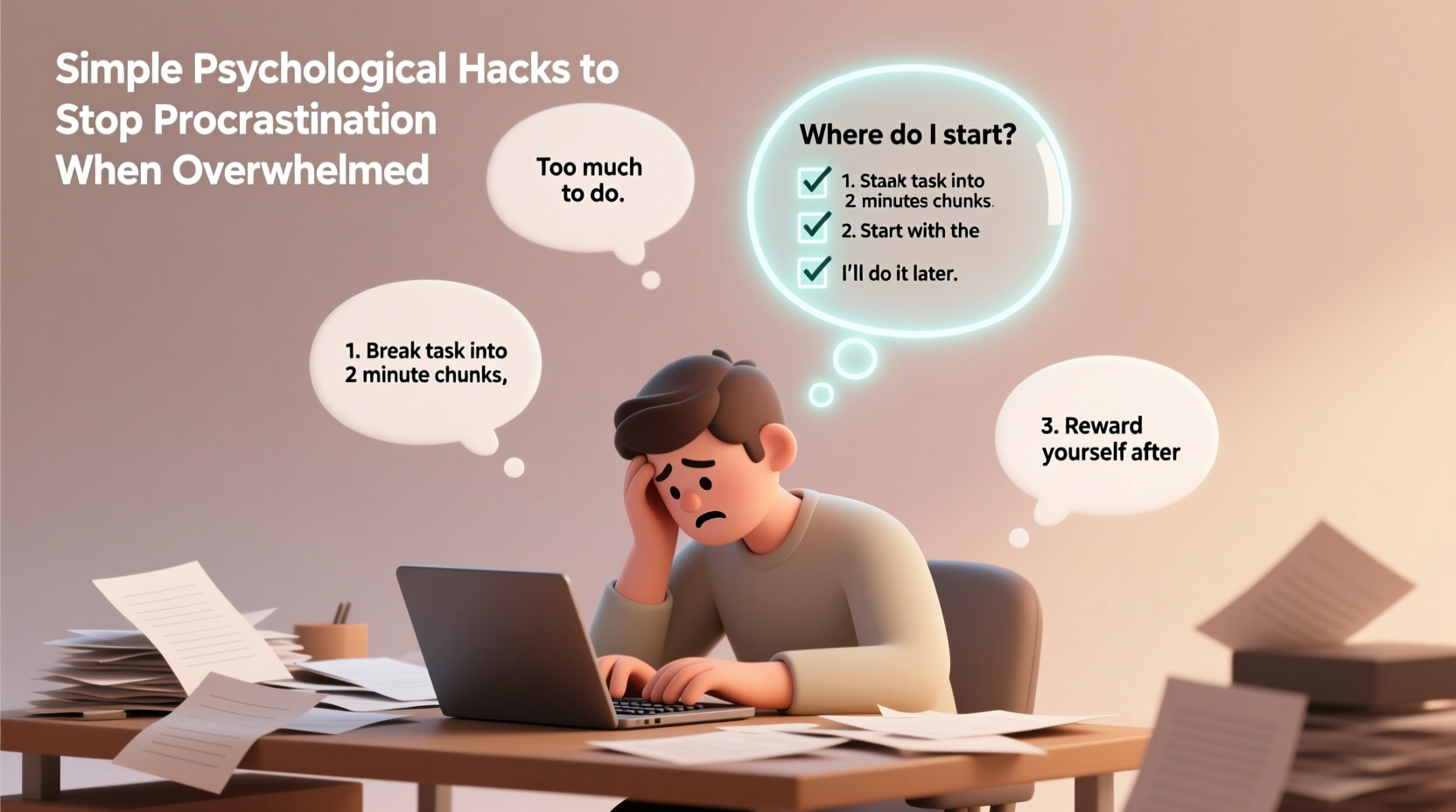
Procrastination under pressure isn’t a moral failing. It’s a neurological response. When the prefrontal cortex—the part responsible for planning and decision-making—gets flooded with stress hormones like cortisol, it becomes less effective. Simultaneously, the limbic system, which governs emotions and survival instincts, takes over. Your brain defaults to avoidance because it perceives the task as a threat.
This creates a cycle: the bigger the task feels, the more anxiety it triggers. The more anxious you feel, the more you delay. And the longer you delay, the larger and more intimidating the task becomes. Breaking this loop doesn’t require heroic effort. It requires understanding how to reduce perceived threat and create conditions where action feels safe and achievable.
Reframe the Task: The 5-Minute Rule
One of the most effective psychological tools is the “5-Minute Rule.” Commit only to working on a task for five minutes. No more, no less. This bypasses the brain’s resistance by making the commitment feel trivial. Once you start, momentum often carries you far beyond the initial window.
Why does this work? Tasks feel daunting not because of their actual difficulty, but because of the anticipated discomfort of beginning. Starting is the real barrier. The 5-Minute Rule tricks your brain into thinking, “It’s just five minutes—I can survive anything for that long.” And once you’re in motion, inertia works in your favor.
For example, if you’re avoiding writing a report, tell yourself: “I’ll open the document and write one sentence.” That’s all. Often, that single sentence turns into a paragraph, then a section. The key is lowering the entry cost so much that refusal feels irrational.
“Action isn’t the result of motivation. Motivation is the result of action.” — Dr. Art Markman, cognitive scientist and author of *Smart Change*
Break the Invisible Wall: Chunking + Naming
Large projects exist in your mind as vague, monolithic blocks: “finish presentation,” “clean apartment,” “apply for jobs.” Vagueness breeds anxiety. The brain struggles to plan around abstract goals. To dismantle overwhelm, break tasks into micro-steps and give each one a clear, specific name.
Instead of “work on project,” try:
- Email Sarah for updated sales data
- Create slide outline in Google Slides
- Insert Q3 charts into deck
Naming transforms invisible expectations into visible actions. Each named step becomes a discrete unit of progress. Completing one gives a small dopamine hit, reinforcing forward movement. More importantly, naming removes ambiguity—your brain no longer has to decide what to do next. It just follows the list.
Do’s and Don’ts of Task Breakdown
| Do | Don't |
|---|---|
| Use action verbs (write, call, draft) | Use vague nouns (project, work, stuff) |
| Limit steps to under 30 minutes | Allow steps that take hours |
| Name physical actions | Leave steps open-ended |
| Order steps logically | Jump between unrelated tasks |
Create Psychological Safety: The Pre-Commitment Hack
When overwhelmed, your brain treats unfinished tasks as open loops. Each one consumes background attention, contributing to mental fatigue. One way to reduce this load is through pre-commitment: scheduling a concrete time to act, even if you don’t follow through immediately.
Say you’re avoiding a difficult conversation. Instead of leaving it floating in your mind, schedule a 10-minute block tomorrow at 10:00 AM to draft the message. Put it in your calendar. Now, your brain registers it as “handled”—not completed, but managed. This reduces anxiety because the decision about when to act has already been made.
Even if you reschedule later, the act of planning reduces the emotional weight. You’re no longer resisting an undefined obligation. You’ve assigned it a place in time. This is especially powerful for emotionally charged tasks, where avoidance stems from fear of discomfort.
Shift Focus from Outcome to Input
Overwhelm intensifies when you fixate on the end result: “I need to finish this entire proposal.” But outcomes are often outside your immediate control. What you *can* control is your input—the time, energy, and attention you dedicate right now.
Switch from outcome-based thinking (“I must complete this”) to input-based thinking (“I will spend 25 minutes focused on this”). This shift reduces performance pressure and redirects attention to process. It’s the difference between “I have to win” and “I’m going to play my best.”
Try this: define your day not by tasks completed, but by focused intervals invested. Two 25-minute sessions on a project may not finish it, but they build momentum and reduce the paralysis of perfectionism. Progress compounds, even when invisible at first.
Mini Case Study: Maria’s Turnaround
Maria, a freelance designer, was drowning in client revisions, personal projects, and admin work. She spent days paralyzed, watching her to-do list grow. After reading about input-based focus, she changed her morning routine. Instead of reviewing her entire backlog, she picked one task and set a timer for 25 minutes. She committed only to showing up—not to finishing.
The first day, she worked on a logo revision for 25 minutes. She didn’t finish, but she made progress. The next day, she returned with less resistance. Within a week, she’d cleared three overdue revisions. The breakthrough wasn’t more time or energy—it was releasing the expectation of completion. By focusing only on her input, Maria reclaimed agency without burnout.
Reset Your Environment: The 2-Minute Physical Trigger
Your surroundings shape your behavior more than willpower ever will. When overwhelmed, cluttered desks, noisy rooms, or digital distractions amplify stress. But changing your environment doesn’t require a full redesign. Use the 2-Minute Physical Trigger: adjust one element of your space to signal “it’s time to work.”
This could be:
- Putting on noise-canceling headphones
- Clearing your desk of everything except one notebook
- Lighting a candle or turning on a specific lamp
- Opening a dedicated workspace tab in your browser
These cues become conditioned triggers. Over time, your brain associates the action with focused work, reducing the friction to start. Unlike motivation, which fluctuates, environmental design is consistent. You don’t need to feel ready—you just need to follow the cue.
“We are continually shaping and being shaped by our environments. Small changes in context can lead to big changes in behavior.” — Dr. BJ Fogg, founder of the Behavior Design Lab at Stanford
Step-by-Step Guide: Break the Freeze in 20 Minutes
If you’re stuck right now, use this sequence to regain momentum:
- Pause and breathe (2 min): Sit still. Take five slow breaths. Acknowledge, “I’m overwhelmed.” Name the emotion without judgment.
- Pick one tiny task (3 min): Scan your list. Find the smallest possible action. Not the most important—just the easiest to start.
- Apply the 5-Minute Rule (5 min): Set a timer. Work only until it rings. Stop even if you’re in flow.
- Review and choose next (5 min): Ask: “Did that reduce the weight?” If yes, pick another micro-task. If not, switch contexts (e.g., from work to personal).
- Reset your space (2 min): Adjust one physical element—close unused tabs, stand up, move to a different chair. Reinforce a fresh start.
- Repeat or rest (3 min): Either continue with another round or take a 10-minute break. Progress is measured in movement, not marathon sessions.
This isn’t about productivity hacking. It’s about restoring psychological balance. Each step reduces cognitive load and rebuilds a sense of agency.
Checklist: Daily Reset for Overwhelm
Use this checklist each morning or when you feel stuck:
- ✅ Identify the top source of stress—write it down in one sentence
- ✅ Break it into the next physical action (use verb + object format)
- ✅ Schedule a 25-minute block for it (even if you don’t use all the time)
- ✅ Set up one environmental trigger (e.g., headphones, clean desk)
- ✅ Commit to starting for just 5 minutes
- ✅ Afterward, acknowledge completion—even if partial
Frequently Asked Questions
What if I start but can’t keep going?
That’s normal. The goal isn’t endurance—it’s initiation. Even 90 seconds of effort breaks the inertia. Return later with less resistance. Progress isn’t linear. Small starts accumulate.
Does this work for chronic procrastination?
Yes, but consistency matters. These hacks reduce acute overwhelm. For persistent patterns, combine them with habit tracking and self-compassion practices. Underlying causes like fear of failure or perfectionism may require deeper reflection or professional support.
How do I handle multiple overwhelming tasks at once?
Prioritize based on urgency and emotional weight. Pick the one causing the most anxiety and apply the 5-Minute Rule. Often, reducing the emotional load of one task frees mental space to tackle others. Remember: you don’t need to solve everything—just unblock one thing.
Conclusion: Start Small, Stay Sane
Overwhelm doesn’t disappear with sheer force. It dissolves with strategy. You don’t need to overhaul your life or summon endless discipline. You need psychological leverage—small, smart interventions that align with how your brain actually works. By reframing tasks, chunking steps, designing your environment, and shifting focus from outcomes to inputs, you create conditions where action becomes inevitable, not exhausting.
The next time you feel frozen, remember: motion precedes motivation. You don’t have to finish. You don’t have to be perfect. You just have to begin—for five minutes. That’s where control returns. That’s where change begins.




 浙公网安备
33010002000092号
浙公网安备
33010002000092号 浙B2-20120091-4
Comments
No comments yet. Why don't you start the discussion?