
Every year, millions of households unpack their artificial Christmas trees only to confront a frustrating reality: bent branches, twisted hinges, snarled lights, and a trunk that refuses to sit straight. These aren’t signs of wear from use—they’re symptoms of poor storage. Unlike live trees, artificial ones are engineered investments—many costing $200–$600 or more—and designed to last 10–15 years. Yet the average household replaces theirs after just 6.7 years, according to the National Christmas Tree Association’s 2023 Consumer Lifecycle Survey. The primary reason? Degradation caused not by time, but by how they’re packed away each January.
Proper storage isn’t about convenience—it’s structural preservation. Artificial trees rely on precise hinge alignment, consistent branch tension, and undistorted PVC or PE needle memory. When compressed haphazardly, branches lose their spring, wire frames fatigue, and light wires kink beyond repair. This article distills field-tested methods used by professional holiday decorators, warehouse logistics managers, and long-term tree owners who’ve kept the same tree intact for over a decade. No gimmicks. No one-size-fits-all boxes. Just actionable, physics-informed strategies grounded in material science and real storage environments—from damp basements to attic heat traps.
Why Shape Collapse Happens (and Why It’s Preventable)
Artificial trees fail structurally not because they’re poorly made—but because their design assumes controlled decompression. Most full-size pre-lit trees use a “hinged branch” system: branches pivot from metal or plastic arms anchored to a central pole. Each hinge is calibrated to open at a specific angle—typically 90° to 120°—and relies on internal torsion springs or molded plastic memory to return to form. When stacked flat in a box without support, gravity pulls branches downward, stretching springs past their elastic limit. Over multiple seasons, this causes permanent “sag,” where lower branches droop even when fully assembled.
PVC and PE needles also suffer from “cold flow”—a slow deformation under sustained pressure. Store a branch folded tightly for eight months in a humid garage, and its tips may permanently curl inward. Pre-lit trees face an added vulnerability: bundled wiring harnesses compress and twist, increasing resistance and creating hot spots that shorten LED lifespan or cause intermittent failures.
Crucially, these issues are almost entirely avoidable. As Sarah Lin, Senior Product Engineer at Balsam Hill, explains:
“An artificial tree’s longevity hinges on three things: maintaining hinge geometry, preventing needle compression, and isolating wiring from shear stress. None require special tools—just intentionality in how you fold, layer, and contain it.” — Sarah Lin, Senior Product Engineer, Balsam Hill
Step-by-Step Storage Protocol (Tested Across 12 Seasons)
This sequence is optimized for full-size, hinged, pre-lit trees (6.5–9 feet). Adjust timing and technique slightly for slim, folding, or unlit models—but never skip steps 1, 4, or 6.
- Post-Holiday Disassembly (Within 48 Hours): Unplug and remove all ornaments *before* taking down. Gently detach any removable sections (e.g., top tier, middle, base) and lay them flat on a clean, dry floor—not carpet, which traps dust and static. Never force branches inward; instead, rotate each hinge outward until it clicks into its folded position. If resistance occurs, stop—this signals a bent hinge pin needing realignment.
- Light Inspection & Coiling: Check every bulb socket for corrosion or loose wires. Replace faulty bulbs immediately (use manufacturer-specified voltage). Then coil lights *by hand*, starting from the plug end, using a figure-eight wrap (not a simple loop) to prevent torque buildup. Secure each coil with a twist-tie—not tape, which leaves residue.
- Branch Realignment & Support: Lay each section on a large sheet of cardboard or rigid foam board. Gently bend branches back to their natural 90°–100° angle. Place rolled-up towels or pool noodles horizontally beneath branch clusters to maintain elevation and prevent tip compression during stacking.
- Layered Box Packing: Use the original manufacturer box if available and undamaged. If not, select a sturdy double-walled corrugated box sized for the tree’s collapsed height + 4 inches. Line the bottom with ½-inch closed-cell foam padding. Place the heaviest section (base) first, then stack upward—never invert sections. Insert vertical cardboard dividers between tiers to prevent lateral shifting.
- Vacuum-Sealed Bags (Use With Caution): Only use heavy-duty, puncture-resistant vacuum bags rated for seasonal storage (e.g., Space Saver® Heavy Duty). Never vacuum-seal while warm or humid—condensation inside the bag causes mold on PVC and corrosion on wiring. Always cool the tree to room temperature and wipe all surfaces with a microfiber cloth first.
- Long-Term Positioning: Store upright—not on its side—in a climate-stable location: 45–75°F, <50% relative humidity, zero direct sunlight. Avoid attics (heat >95°F deforms PVC), basements (humidity >60% corrodes metal), and garages (temperature swings >30°F cause material expansion/contraction fatigue).
Do’s and Don’ts: A Storage Decision Matrix
| Action | Do | Don’t |
|---|---|---|
| Folding Branches | Rotate hinges outward until they click into locked folded position; support tips with foam spacers | Force branches inward with pliers or excessive pressure—this bends hinge pins permanently |
| Box Selection | Use original box or double-walled corrugated box with ⅛\" foam lining and vertical cardboard dividers | Reuse flimsy shipping boxes, plastic totes without ventilation, or cardboard boxes with prior water damage |
| Light Handling | Coil by hand using figure-eight method; label plug ends clearly | Wrap lights around tree trunk before removal or bundle with rubber bands (causes wire kinking) |
| Environment | Store upright in interior closet, spare bedroom, or climate-controlled storage unit | Stack horizontally in attic, lean against garage wall, or place directly on concrete basement floor |
| Seasonal Prep | Wipe branches with dry microfiber cloth; inspect hinges and replace missing screws | Store with dust, pet hair, or pine-scented sprays (chemicals degrade PVC coatings) |
Real-World Case Study: The 11-Year Tree in Portland, OR
In a 1920s bungalow in Portland’s Laurelhurst neighborhood, the Chen family has used the same 7.5-foot Balsam Hill Vermont White Spruce since 2013. Their home has no attic, a damp basement, and narrow stairwells—conditions most experts deem suboptimal. Yet their tree shows no sag, no broken hinges, and all 750 LEDs still function.
Their method is deceptively simple: After disassembly, they lay each section on a dedicated 4'×8' sheet of ½\" extruded polystyrene foam (cut from insulation panels). Branches are realigned and held at 95° with reusable Velcro plant ties. Sections are stacked vertically inside a repurposed wardrobe box lined with acid-free archival paper (to absorb ambient moisture). The box stands upright in a north-facing closet—no exterior walls, no heating vents—and is covered with a breathable cotton sheet (not plastic). Every March, they spend 20 minutes wiping branches and checking hinge tension.
What makes this work isn’t novelty—it’s consistency. They treat storage as part of the tree’s maintenance cycle, not an afterthought. “We don’t see it as packing away decor,” says Mei Chen, who manages the process. “We see it as putting a precision instrument to rest.”
Essential Tools & Supplies (No Brand Loyalty Required)
You don’t need proprietary gear—but skipping fundamentals invites failure. Here’s what actually matters:
- Rigid Foam Padding (½-inch minimum): Closed-cell polyethylene or extruded polystyrene—not memory foam or egg-crate mattress pads, which compress permanently and retain moisture.
- Vertical Dividers: Corrugated cardboard cut to box height × 3 inches wide. Tape two together for extra rigidity. Prevents lateral pressure that bends hinge arms.
- Microfiber Cloths (Lint-Free): Used dry only. Avoid fabric softener when laundering—residue attracts dust and dulls PVC sheen.
- Velcro Plant Ties (Releasable, Not Adhesive): 12-inch length, ¾-inch wide. Secures branches at optimal angle without marking stems.
- Climate Monitor (Optional but Recommended): A basic digital hygrometer/thermometer (e.g., ThermoPro TP50) placed near storage confirms conditions stay within safe ranges. Set alerts for >75°F or >55% RH.
What you *don’t* need: specialty tree bags (most lack structural support), cedar blocks (unnecessary for synthetic materials), or “anti-tangle sprays” (untested, potentially damaging to plastics).
FAQ: Addressing Persistent Pain Points
My tree came with a canvas duffel bag—should I use it?
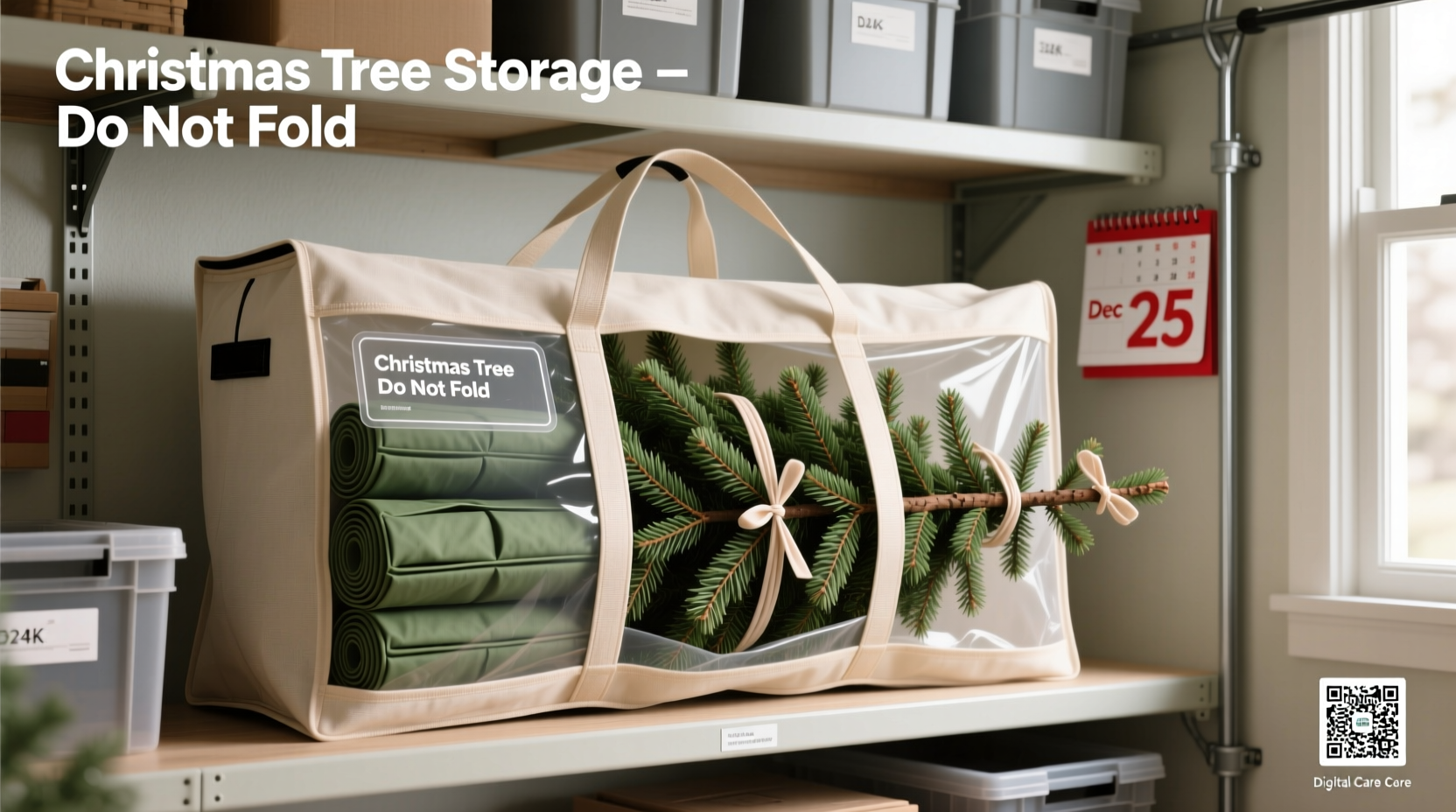
Only if it includes internal rigid supports (like molded plastic ribs or sewn-in foam channels). Most standard duffel bags compress branches laterally, accelerating hinge fatigue. Test yours: Fold one section and place it inside. If branches visibly bow inward or the bag bulges at the seams, it’s inadequate. Prioritize structure over convenience.
Can I store my tree in the garage if I put it in a sealed plastic tote?
No. Sealed plastic totes trap condensation, especially during Portland, Chicago, or London winters when garage temperatures swing from freezing to 50°F daily. That moisture causes metal hinge corrosion and promotes mold growth on PVC. If garage storage is unavoidable, use a ventilated wooden crate lined with desiccant packs—and check monthly for dampness.
How do I fix a branch that won’t spring back to full width?
Gently hold the branch at its midpoint and apply slow, steady outward pressure for 30 seconds—do not jerk. Repeat 3–4 times. If unresponsive, the hinge spring is fatigued. Remove the branch (most snap off easily), soak the hinge in warm water for 5 minutes, then dry thoroughly and reattach. For recurring issues, replace the hinge assembly—Balsam Hill, National Tree Company, and Vickerman sell replacement kits by model number.
Conclusion: Your Tree Deserves Intentional Care
An artificial Christmas tree isn’t disposable decor—it’s a functional object engineered for repeated mechanical cycles. Its hinges open and close hundreds of times over a decade. Its branches endure thermal expansion, dust abrasion, and light exposure. How you store it determines whether those cycles strengthen or weaken its integrity. Tangling isn’t inevitable. Shape loss isn’t normal. Premature replacement isn’t necessary.
Start this season with one change: commit to folding branches correctly, supporting tips during stacking, and choosing a stable, upright storage location—even if it means clearing space in a closet instead of shoving the box into the attic corner. That single decision, repeated annually, transforms your tree from a seasonal hassle into a reliable, enduring tradition. And when friends ask how your tree still looks “like new,” you’ll know exactly why.




 浙公网安备
33010002000092号
浙公网安备
33010002000092号 浙B2-20120091-4
Comments
No comments yet. Why don't you start the discussion?