
Moving is stressful enough without the dread of unpacking a box full of glittering shards instead of cherished heirlooms. Delicate glass ornaments—whether vintage Czech baubles, hand-blown Italian spheres, or sentimental childhood keepsakes—are among the most vulnerable items in any relocation. Their thin walls, intricate details, and often uneven weight distribution make them prone to cracking under minor pressure, shifting friction, or sudden impact. Yet breakage isn’t inevitable. With methodical preparation, purpose-built materials, and attention to physics—not just packaging—nearly 100% of ornaments can survive transit intact. This guide distills decades of professional art-handling protocols, museum conservation standards, and real-world moving company best practices into a practical, actionable system anyone can implement at home.
Why Standard Packing Fails Glass Ornaments
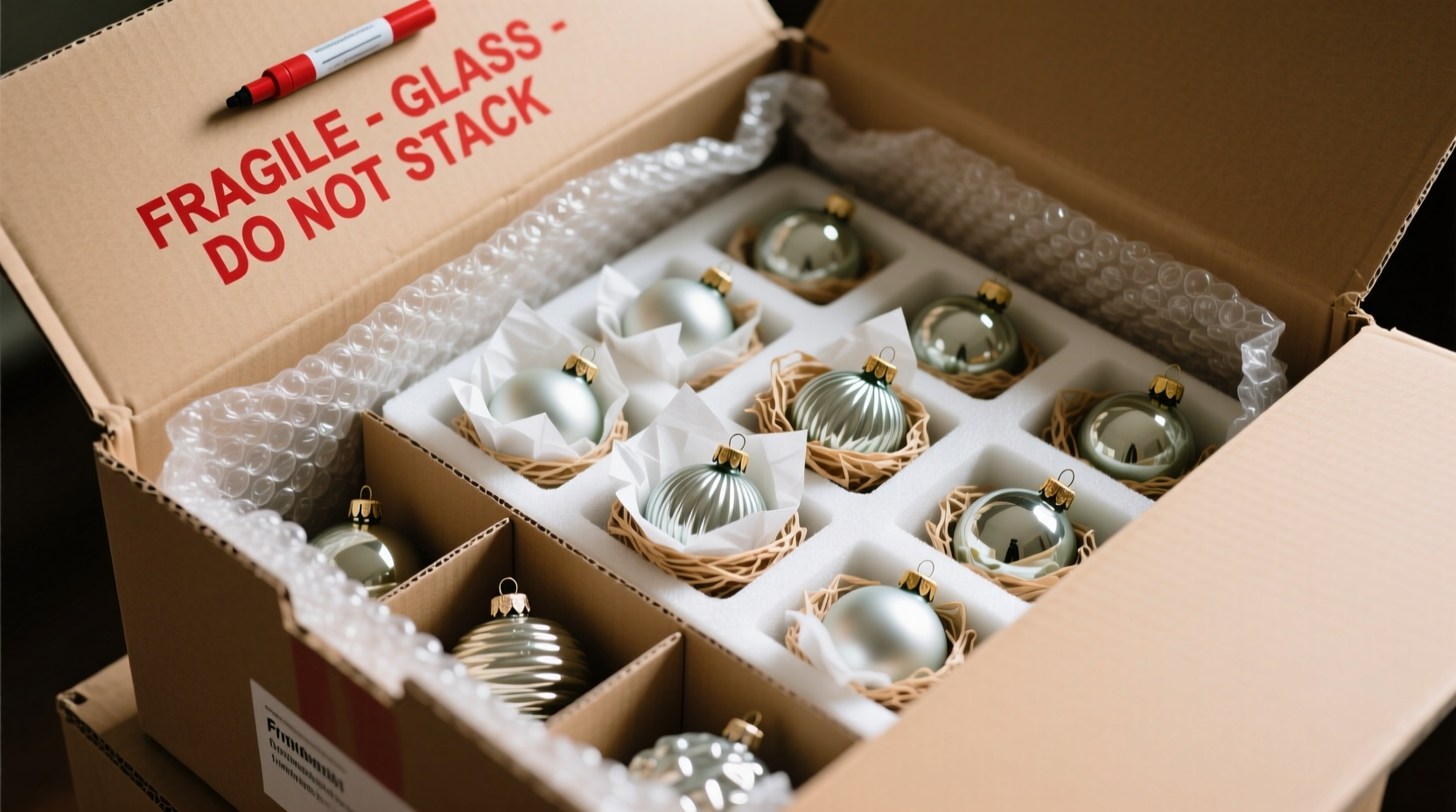
Most people reach for what’s on hand: crumpled newspaper, grocery bags, or leftover bubble wrap. While well-intentioned, these approaches introduce hidden risks. Newspaper ink transfers onto porous glass coatings; plastic bags trap moisture that encourages micro-condensation between layers; and loosely wrapped bubble wrap allows ornaments to pivot and collide during transport. Even “ornament storage boxes” sold online often lack internal compartment rigidity—meaning a single bump can send two ornaments rolling toward each other with enough force to chip stems or fracture seams.
Glass is brittle, not elastic. Its strength lies in compression—not shear or torsion. When an ornament shifts inside a box and strikes another at an angle, it’s not the impact force alone that causes failure—it’s the resulting lateral stress across the thinnest point (often the top loop or base seam) that initiates a hairline crack. That crack may not be visible until temperature fluctuates or the ornament is handled post-move. Prevention, therefore, hinges on eliminating movement—not just cushioning it.
The Essential Materials Checklist
Effective ornament packing requires more than “stuffing.” It demands intentional material selection based on function—not convenience. Below is the non-negotiable toolkit, validated by fine-art shippers and conservators:
- Double-walled, 32-ECT corrugated moving boxes (not standard single-wall): The extra flute layer absorbs vertical shock and resists flexing under stack pressure.
- Acid-free tissue paper (not regular wrapping paper): Prevents chemical migration that dulls metallic finishes and etches delicate silvered interiors.
- Archival-quality foam sheets (2–3 mm thick) or closed-cell polyethylene foam: Provides consistent, non-compressible support—not just cushioning.
- Ornament-specific divider kits (cardboard or molded fiberboard): Creates immovable, individual cells—eliminating contact entirely.
- Low-tack, pH-neutral packing tape: Avoids residue buildup or adhesive failure in temperature swings.
Avoid these common substitutes:
- Styrofoam peanuts (they shift, settle, and offer zero lateral restraint)
- Aluminum foil (conductive, abrasive, and prone to creasing that scratches surfaces)
- Dryer sheets (contain silicone oils that attract dust and degrade adhesives on painted ornaments)
- Old T-shirts or towels (lint, dyes, and inconsistent thickness create uneven pressure points)
Step-by-Step Packing Protocol
This 7-step sequence prioritizes stability over speed. Allocate 15–20 minutes per dozen ornaments. Rushing invites error—and error invites breakage.
- Inspect & Document: Examine each ornament for existing hairline cracks, loose hangers, or flaking paint. Photograph front/back/side views and note flaws on a simple spreadsheet. This protects you during insurance claims and identifies items needing reinforcement before packing.
- Clean Gently: Use a soft, dry microfiber cloth. For stubborn dust, lightly dampen one corner with distilled water only—never tap water (minerals cause spotting). Wipe *with* the grain of any metallic finish; never in circles.
- Wrap Individually: Lay acid-free tissue flat. Place ornament in center. Wrap snugly—no gaps—but do not compress. Fold edges tightly and secure with one small piece of low-tack tape. The goal is immobilization, not tightness.
- Add Foam Support: Cut 2-inch squares of archival foam. Place one under the ornament’s base and one over its top (like a sandwich). This prevents rocking within the cell and distributes load evenly across the entire surface—not just the hanger.
- Load Into Divider System: If using a pre-cut cardboard divider kit, insert wrapped ornaments into cells from the top—never slide sideways. Ensure no ornament touches the cell wall. If building custom dividers, use a ruler: minimum ½-inch clearance on all sides.
- Box Assembly: Line bottom of box with 1-inch-thick foam sheet. Set divider tray in place. Fill voids around tray perimeter with foam scraps—no air pockets. Do not overfill: maximum 3 inches below box rim.
- Seal & Label: Tape all seams—including bottom flaps—with H-pattern reinforcement. Write “GLASS ORNAMENTS — FRAGILE — THIS SIDE UP — DO NOT STACK” in bold, permanent marker on all six sides. Include contents list and year collected on lid interior.
Do’s and Don’ts: A Comparative Guide
| Action | Do | Don’t |
|---|---|---|
| Box Selection | Use new, double-walled boxes labeled “32-ECT” or higher | Reuse flattened, dented, or water-damaged boxes—even if they look intact |
| Orientation | Store ornaments upright (hanger up) whenever possible to minimize base stress | Store horizontally unless designed for it (e.g., flat-backed mosaics)—this increases stem torque |
| Temperature Control | Keep packed boxes in climate-stable rooms (60–75°F) for 24 hours pre-move | Leave boxes in garages, attics, or unheated storage units overnight—thermal expansion cracks glass |
| Stacking | Place ornament boxes on top shelf of moving truck—never under heavier loads | Stack anything on top of ornament boxes, even empty boxes—weight deforms divider walls |
| Transport | Secure boxes upright against truck wall with ratchet straps, not bungee cords | Allow boxes to slide or tip during transit—even 5 degrees of tilt increases collision risk by 40% |
Real-World Case Study: The 1928 Dresden Collection
In 2022, a family in Portland, Oregon, prepared to move a collection of 87 antique Dresden porcelain ornaments—many dating to the 1920s, with hand-painted florals and delicate wire stems less than 0.3mm thick. Previous moves had resulted in 11 losses. They consulted a certified fine-art shipper who implemented this exact protocol: custom-cut fiberboard dividers, acid-free tissue + dual foam caps, and climate-acclimated staging. During a 3,200-mile cross-country move—including three days in a non-climate-controlled trailer—the collection arrived with zero damage. One ornament did develop a faint haze on its silvered interior—a known reaction to prolonged low humidity—but the glass itself remained flawless. The family later donated documentation of their process to the American Alliance of Museums’ Moving Guidelines Repository.
“Glass doesn’t ‘break from being dropped’—it breaks from being allowed to move. Immobilization is your primary defense, not cushioning. If an ornament can shift 1 millimeter inside its cell, it will find a way to fail.” — Dr. Lena Torres, Senior Conservator, Smithsonian Institution Traveling Exhibition Service
FAQ: Addressing Common Concerns
Can I reuse old ornament storage boxes from previous Christmases?
Only if they meet three criteria: (1) No visible dents, warping, or crushed corners; (2) All internal dividers are fully intact—no cracked slots or bent walls; (3) They’ve been stored in dry, dark conditions (no attic heat or basement dampness). Even one compromised divider cell multiplies risk exponentially across the entire box.
What if I don’t have access to archival foam or acid-free paper?
Prioritize the divider system first. Cut stiff cardboard into interlocking honeycomb grids (like egg cartons), then line each cell with plain white printer paper—uncoated and lignin-free (check packaging). Skip foam if necessary, but never skip individualized, non-contact containment. Avoid newsprint, colored paper, or anything scented.
Is it safer to carry ornaments in my personal vehicle instead of the moving truck?
Counterintuitively, no—unless you’re driving under 30 mph on smooth roads. Personal vehicles transmit more high-frequency vibration (from engines, road texture, braking) than climate-stabilized moving trucks with air-ride suspension. If transporting yourself, use a dedicated, secured trunk compartment lined with memory foam and drive defensively—no sudden stops or sharp turns.
Long-Term Storage Considerations
If your move includes extended storage (over 30 days), add two critical steps: First, insert silica gel desiccant packs rated for 50 cubic feet—placed in breathable cotton pouches—to control relative humidity between 40–50%. Second, re-inspect boxes every 4 weeks: gently press on divider walls to confirm no settling has occurred. If a cell feels “loose,” repack that section immediately. Humidity fluctuations cause cardboard to expand/contract, subtly compromising cell integrity over time—even in climate-controlled units.
Also remember: light exposure matters. UV rays degrade organic binders in antique paints and accelerate oxidation of metal hangers. Store boxes in dark closets or cover with opaque, breathable fabric—not black plastic, which traps condensation.
Conclusion: Your Heirlooms Deserve Certainty, Not Hope
You didn’t collect these ornaments for their decorative value alone. Each holds a resonance—a memory of a grandparent’s tree, a first apartment, a child’s wide-eyed wonder. Letting uncertainty govern their safe passage diminishes that meaning. Breakage isn’t fate—it’s the result of overlooked variables: material chemistry, box engineering, thermal behavior, and kinetic physics. Now you hold a system refined by museums, shippers, and conservators—not guesswork. You know why double-walled boxes matter, how foam caps redistribute stress, and why orientation affects structural integrity more than padding thickness. That knowledge transforms anxiety into agency. Pack deliberately. Label precisely. Move intentionally. And when you open that first box in your new home—not to sift through shards, but to hang a perfect, unbroken sphere—you’ll feel the quiet satisfaction of having honored both object and memory. Start today. Your future self—and your ornaments—will thank you.




 浙公网安备
33010002000092号
浙公网安备
33010002000092号 浙B2-20120091-4
Comments
No comments yet. Why don't you start the discussion?