
A black Christmas tree is a bold, modern twist on holiday decor. It instantly sets a dramatic tone and serves as a striking backdrop for festive styling. When paired with colorful lights, it can become the centerpiece of your seasonal display—but only if done thoughtfully. The contrast between dark branches and vibrant bulbs holds immense visual potential, yet it also risks looking chaotic or overwhelming if not balanced correctly. The key lies in intentional design: understanding color theory, layering lighting effectively, and curating ornaments that harmonize rather than compete.
Styling a black tree with multicolored lights isn’t about avoiding color—it’s about controlling it. With the right approach, you can create a dazzling yet cohesive look that feels celebratory, not jarring. This guide walks through proven strategies to achieve that balance, from choosing the right light tones to coordinating ornaments and incorporating texture for depth.
Understanding Color Dynamics on a Black Background
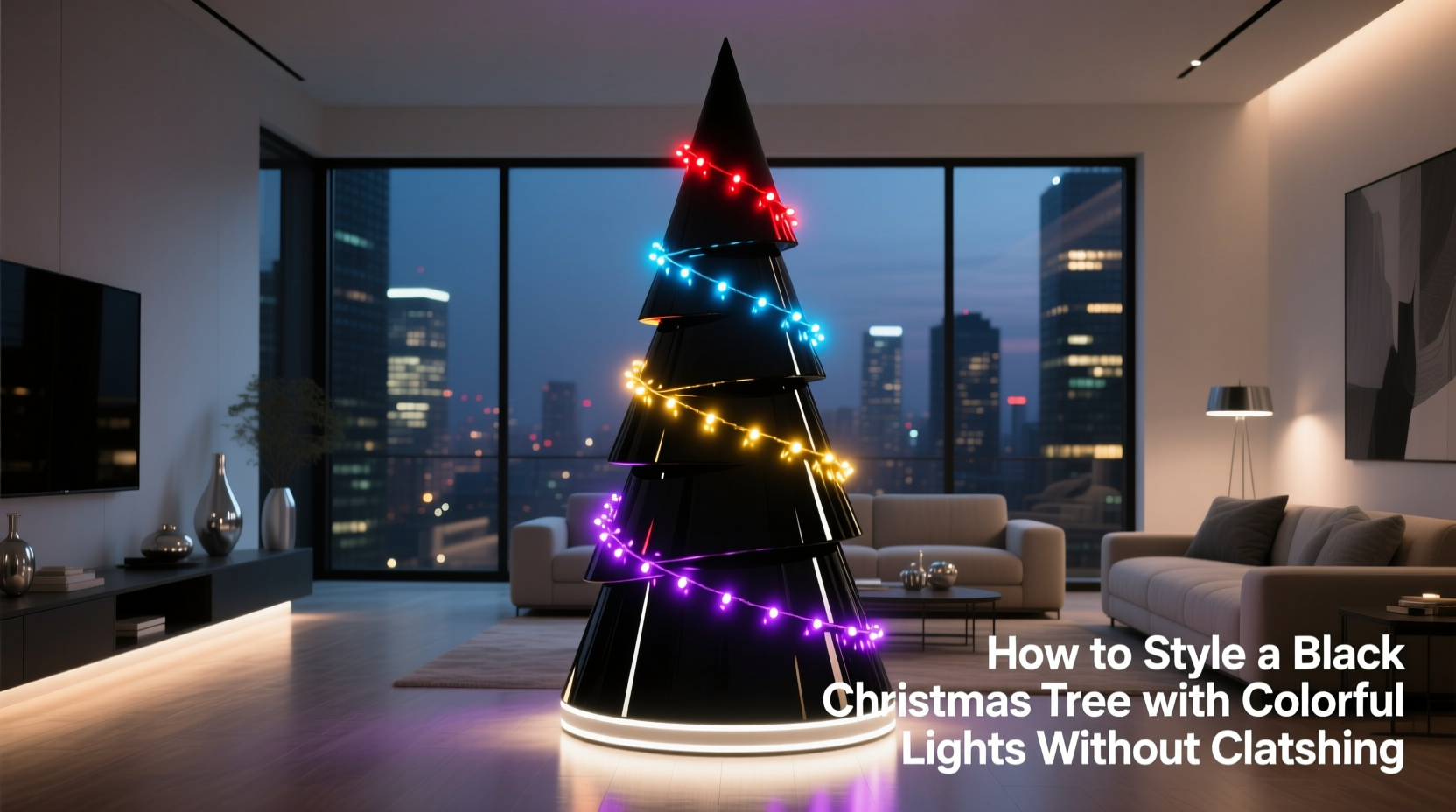
The deep, near-void hue of a black Christmas tree absorbs light differently than traditional green or white trees. Instead of reflecting ambient tones, it creates a high-contrast canvas where colors appear more saturated and intense. This amplification effect means even soft pastels or warm whites will stand out vividly. When using multiple colors, this intensity can lead to visual noise if hues clash or lack cohesion.
Color theory plays a critical role here. Complementary colors (like red and green or blue and orange) placed side by side on a black background may vibrate too strongly, creating an optical strain. Analogous colors (those adjacent on the color wheel—such as red, orange, and yellow) tend to flow more naturally and feel unified. Triadic schemes (three evenly spaced colors like red, yellow, and blue) can work but require careful spacing and balancing with neutral elements to prevent chaos.
Another consideration is the temperature of the colors. Cool tones (blues, purples, greens) recede visually, while warm tones (reds, oranges, yellows) advance. On a black tree, this can create a sense of depth—use it intentionally. For example, placing cooler lights deeper within the tree and warmer ones toward the tips can add dimensionality.
Selecting the Right Type and Quality of Lights
Not all Christmas lights are created equal—especially when used on a non-traditional tree. The brightness, bulb shape, and color consistency significantly impact the final look. LED string lights are ideal for black trees because they offer brighter, truer colors and generate less heat, reducing fire risk around synthetic foliage.
Opt for lights with uniform color saturation. Cheap sets often have slight variations in hue—for instance, some “red” bulbs leaning pink, others orange—which becomes glaringly obvious against a monochromatic backdrop. High-quality, professional-grade strings ensure each color is consistent and balanced.
Bulb size matters too. Mini lights blend smoothly and allow for denser coverage, making them perfect for wrapping around branches without drawing excessive attention to individual points. Larger C7 or C9 bulbs make a bolder statement and work better in minimalist designs or outdoor displays. For a black tree indoors with colorful lights, mini LEDs provide the most control and elegance.
“Lighting is the foundation of any tree design. On a black tree, it doesn’t just illuminate—it defines the mood. Choose quality over quantity.” — Lena Reyes, Interior Stylist & Holiday Design Consultant
Step-by-Step Guide to Installing Colorful Lights on a Black Tree
How you apply the lights determines whether the final effect feels random or refined. Follow this sequence for optimal distribution and harmony:
- Start with a plan: Decide on your color scheme (e.g., classic primary triad, retro neon, jewel tones) and test combinations beforehand.
- Use a base layer of white or warm white lights: Before adding colored bulbs, wrap the tree with a single strand of warm white LEDs. This adds depth and prevents the black branches from feeling flat or hollow.
- Divide the tree into sections: Mentally segment the tree into thirds—bottom, middle, top—and assign colors strategically. Avoid clustering all reds on one side and blues on another.
- Weave lights from trunk outward: Begin at the base of each branch and spiral the strand toward the tip. This mimics natural light filtering through foliage and avoids a tangled, web-like appearance.
- Limit color transitions: If using multiple strings, keep each strand to one color. Switching colors mid-string looks haphazard. Instead, use separate strands for each hue.
- Balance density: Aim for 100 lights per vertical foot of tree. Over-lighting can overwhelm; under-lighting makes colors look sparse.
- Test before finalizing: Turn off room lights and view the tree in darkness. Adjust any hotspots or gaps.
Ornament Strategy: Coordinating Decor Without Overpowering
Once the lights are in place, ornaments should enhance—not compete with—the existing palette. A common mistake is selecting baubles that duplicate the exact same colors as the lights, which can make the tree feel redundant or cluttered.
Instead, use ornaments to introduce texture, metallic accents, and subtle tonal variation. Clear crystal balls reflect light beautifully and add sparkle without introducing new colors. Matte black or charcoal ornaments echo the tree’s base and ground the design. Metallic finishes—gold, silver, copper—are especially effective because they complement all colors and elevate the overall sophistication.
If you choose colored ornaments, stick to one or two dominant hues from your light set and use them sparingly. For example, if your lights include red, blue, and green, select only red and gold ornaments. This creates rhythm without repetition. Distribute them evenly, focusing on areas where light density is lower to maintain visual balance.
| Ornament Type | Best Paired With | Avoid If... |
|---|---|---|
| Metallic (gold/silver) | Vibrant or pastel lights | Using overly shiny lights that cause glare |
| Clear glass | Dense, colorful lighting | Lights are dim or unevenly spaced |
| Felt or fabric | Soft white base + pastel lights | Going for a sleek, modern look |
| Glow-in-the-dark | Black tree with minimal lighting | Already using bright, saturated lights |
Consider adding dimensional pieces like ribbons, pinecones, or tinsel garlands in neutral tones. A wide satin ribbon in ivory or champagne, looped from top to bottom, draws the eye vertically and unifies the color scheme. Just avoid anything too bulky—it can obscure the lights you’ve worked so hard to position.
Real Example: A Brooklyn Apartment’s Statement Tree
In a loft-style apartment in Williamsburg, designer Mara Lin was tasked with creating a festive yet stylish corner for holiday entertaining. The space featured industrial finishes—exposed brick, black steel beams, and polished concrete floors. A traditional green tree would have looked out of place.
She installed a 7-foot pre-lit black tree and began with a base of 400 warm white micro-LEDs. Then, she added three additional strands: 200 in deep ruby red, 200 in emerald green, and 200 in sapphire blue—all from the same premium brand to ensure color consistency. Rather than mixing them randomly, she assigned each color to specific zones: red on the lower third, green in the middle, and blue at the crown. Warm white lights bridged the transitions.
Ornaments were limited to 18 total: six matte gold spheres, six clear teardrop prisms, and six hand-blown black-and-silver swirls. A champagne velvet ribbon spiraled down from the star topper, tying the layers together. The result was dynamic but controlled—a tree that sparkled with energy without overwhelming the room.
Guests consistently commented on how “expensive” it looked, mistaking it for a custom installation. The secret? Restraint. Mara used fewer decorations than typical, trusting the lighting and structure to carry the design.
Checklist: Key Steps to Prevent Clashing
- ✅ Choose a cohesive color palette (analogous or split-complementary)
- ✅ Use warm white lights as a base layer
- ✅ Invest in high-quality, uniformly colored LED strings
- ✅ Apply lights in a spiral pattern from trunk to tip
- ✅ Limit colored ornaments to 1–2 accent hues
- ✅ Incorporate metallic, clear, or black decorations for balance
- ✅ Step back frequently during setup to assess overall harmony
- ✅ Use dimmer switches or smart bulbs to adjust brightness as needed
Frequently Asked Questions
Can I use rainbow-colored lights on a black tree?
Yes, but with caution. Pre-strung \"rainbow\" sets often alternate colors too quickly, creating a carnival effect. Instead, use individual monochrome strands and place them deliberately—grouping similar tones or spacing them evenly for rhythm. Alternatively, opt for a gradient sequence (e.g., red to violet) for a more intentional look.
What if my lights look too harsh at night?
Dimmable LED strings solve this issue. Many modern sets connect to apps or remotes that allow brightness adjustment. You can also layer sheer curtains nearby or use indirect room lighting to soften the glow. Another trick: intersperse fairy lights with lower lumens among the brighter strands to diffuse intensity.
Should I avoid certain colors on a black tree?
Not entirely, but fluorescent or neon shades (like electric pink or lime green) can appear garish without careful context. These work best in themed setups (e.g., 80s retro party) or when balanced with ample black and neutral elements. Muted or jewel-toned versions of the same hues are generally safer for elegant interiors.
Final Thoughts and Call to Action
Styling a black Christmas tree with colorful lights is an opportunity to embrace creativity while mastering restraint. The darkness of the tree isn't a limitation—it's a powerful design tool that allows color to shine with precision and drama. By applying thoughtful color selection, strategic lighting techniques, and balanced ornamentation, you can craft a display that feels both festive and sophisticated.
Don’t be afraid to experiment, but always edit ruthlessly. Sometimes, removing one strand or swapping out a few ornaments is all it takes to shift from chaotic to captivating. Your black tree doesn’t need to follow tradition—it can redefine it.




 浙公网安备
33010002000092号
浙公网安备
33010002000092号 浙B2-20120091-4
Comments
No comments yet. Why don't you start the discussion?