
Studio apartments demand intentionality—not just in furniture selection or storage, but in seasonal expression. When December arrives, many residents face the same quiet dilemma: how to welcome the warmth, tradition, and visual joy of a Christmas tree without sacrificing precious square footage or inviting visual chaos? The answer isn’t smaller trees alone—it’s smarter vertical layering, structural awareness, and design discipline. This isn’t about compromise; it’s about curating holiday presence with architectural intelligence. In studios under 500 square feet—where the sleeping nook doubles as a dining area and the entryway serves as a coat closet—every inch of height is an opportunity, not an afterthought.
Why Vertical Space Is Your Studio’s Greatest Asset
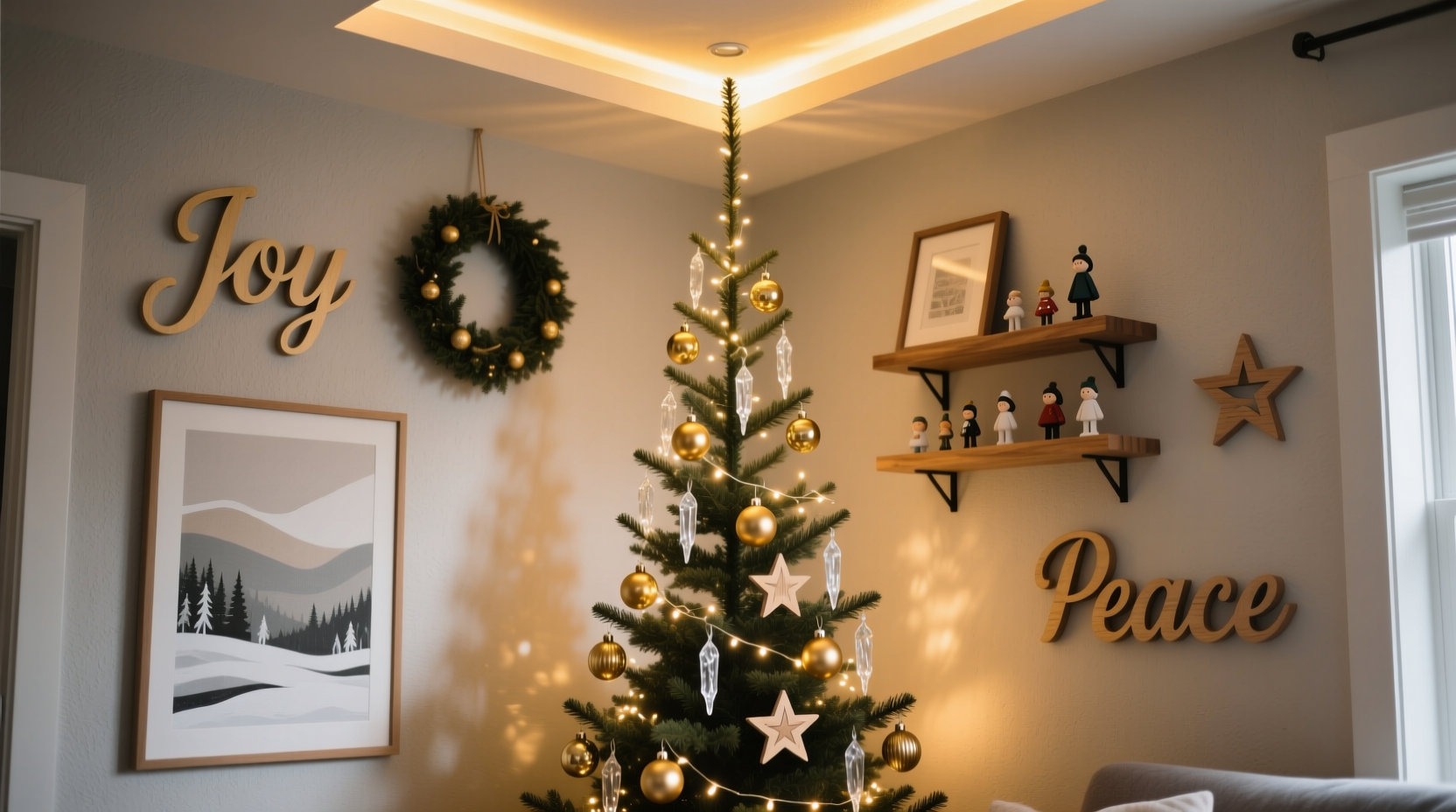
In a studio, floor space is non-negotiable real estate. A standard 6-foot pre-lit tree occupies roughly 36–49 square feet at its base—nearly 10% of a 400-square-foot unit. But ceiling heights remain generous: most modern studios feature 9- to 10-foot ceilings, offering 30–50% more usable volume than the floor suggests. Yet this vertical potential often goes untapped. Instead of treating height as background, treat it as foreground—layering light, texture, and symbolism upward, not outward. Consider how retail displays in compact boutiques use wall-mounted shelves, suspended garlands, and ceiling-hung ornaments to create festive density without ground-level intrusion. That same principle applies at home: verticality isn’t decorative scaffolding—it’s spatial strategy.
Tree Selection: Form, Scale, and Structural Intelligence
Choosing the right tree is the first act of spatial stewardship. Forget “the bigger, the better” logic. Prioritize silhouette, density, and adaptability over height alone. Slim-profile firs (like Fraser or Balsam) offer tight branch spacing and natural vertical emphasis—ideal for narrow corners. Artificial options should be evaluated not by total height, but by footprint-to-height ratio. A 7-foot “slim fit” artificial tree with a 28-inch base diameter delivers nearly double the height-per-square-inch of a traditional 6-foot full-profile model.
Also consider structural integration: does the tree stand allow for concealed cord routing? Can it anchor safely against a wall without tipping risk? For studios with hardwood or tile floors, weighted stands with rubberized bases prevent slippage—and eliminate the need for bulky stabilizing furniture nearby.
| Tree Type | Base Diameter | Optimal Height Range | Vertical Advantage | Studio Risk Factor |
|---|---|---|---|---|
| Slender Artificial (PVC) | 24–30\" | 6–7.5 ft | Narrow profile fits beside doorways or behind sofas; easy to store disassembled | Low—no water mess, minimal assembly time |
| Live Balsam Fir (cut) | 32–36\" | 5–6 ft | Natural upward taper draws eye vertically; strong scent fills small space efficiently | Medium—requires daily watering, needle drop needs frequent sweeping |
| Wall-Mounted “Tree” (Felt/wood) | 0\" | 4–8 ft (wall height) | No floor footprint; customizable height; doubles as art year-round | Low—zero maintenance, but lacks traditional sensory experience |
| Mini Tabletop + Hanging Canopy | 12–16\" | 18\" tree + 3–4 ft hanging element | Ground-level focus stays contained; overhead elements add dimension without mass | Low—ideal for renters or ultra-tight spaces |
The Vertical Styling Framework: Four Layers of Festive Height
Think of your studio’s vertical plane as a curated column divided into four functional zones—each serving distinct aesthetic and practical roles. This framework ensures visual rhythm while preventing top-heavy imbalance or cluttered midsections.
- Zone 1: Foundation (0–24\") — Reserved for grounding elements: a woven basket base, stacked vintage books wrapped in kraft paper, or a low-profile wooden planter holding pinecones and dried orange slices. Keep this zone clean, uncluttered, and intentional—no gift piles here unless they’re neatly stacked and color-coordinated.
- Zone 2: Trunk & Mid-Canopy (24–54\") — The primary ornament zone. Use lightweight, reflective ornaments (glass, acrylic, mirrored) to catch ambient light and visually lift the eye. Cluster in threes—small, medium, large—for rhythm. Avoid oversized or dangling ornaments below shoulder height—they snag clothing and disrupt flow.
- Zone 3: Upper Canopy (54–78\") — Where light lives. String micro-LEDs *inside* the branches—not just around the perimeter—to create depth. Add subtle texture with feathered wire ornaments, thin birch twigs, or hand-cut paper snowflakes suspended on clear fishing line. This layer feels ethereal, not heavy.
- Zone 4: Skyline (78\"+ to ceiling) — The invisible crown. Install a single, elegant topper (a brass star, minimalist antler silhouette, or origami dove) anchored securely. Then extend *beyond* the tree: run a single strand of warm-white LEDs along the ceiling’s perimeter or up a nearby wall to a framed print or shelf. This subtly connects the tree to the architecture—making height feel intentional, not incidental.
Real-World Application: Maya’s 420-Square-Foot Loft
Maya, a graphic designer in Brooklyn, lives in a converted warehouse loft with exposed brick, 10-foot ceilings, and a galley kitchen that opens directly into her living-sleeping zone. Her initial attempt at holiday styling—a 6-foot full-profile artificial tree placed centrally—made her 7-foot sofa feel cramped and blocked sightlines to her reading nook. She rethought her approach using vertical layering:
- She replaced the tree with a 6.5-foot slim-profile artificial fir (26\" base), positioned flush against a windowless interior wall beside her Murphy bed—using the wall as both backdrop and structural support.
- She installed three floating walnut shelves above the tree (at 60\", 72\", and 84\" heights), each holding a curated trio: dried eucalyptus bundles, ceramic bud vases with white amaryllis, and miniature brass bells.
- Instead of a traditional tree skirt, she used a single 5'x7' handwoven jute rug—anchoring the entire composition without adding visual weight.
- For lighting, she ran battery-operated LED string lights vertically up the adjacent brick column, terminating in a cluster of frosted glass icicles suspended from the ceiling joist.
The result? A cohesive, airy holiday presence that enhanced—not obstructed—her daily routines. Guests consistently comment on how “spacious” it feels, despite the added seasonal elements. “It doesn’t look like I added a tree,” Maya says. “It looks like the apartment was *designed* for this moment.”
Expert Insight: Spatial Psychology Meets Seasonal Design
“Human perception of space is heavily influenced by vertical continuity. When visual elements align across multiple heights—especially with consistent color, material, or light temperature—the brain reads the environment as unified and intentionally scaled. In small spaces, that coherence reduces cognitive load and increases perceived spaciousness. A well-styled tree doesn’t shrink a studio—it teaches the eye to travel upward, expanding psychological volume.” — Dr. Lena Torres, Environmental Psychologist and Author of Small Space, Full Presence
Essential Studio Tree Styling Checklist
- ✅ Measure ceiling height and identify wall anchors (studs or toggle bolts) before purchasing any hanging hardware
- ✅ Choose a tree with a base diameter no wider than 30% of your shortest room dimension
- ✅ Use only battery-powered or UL-listed low-voltage lighting for ceiling/wall extensions
- ✅ Limit ornament weight on upper branches—anything over 1.5 oz per branch risks drooping or breakage
- ✅ Test sightlines: sit on your primary seating surface and verify the tree’s top third remains visible without neck strain
- ✅ Store all non-essential decor (extra garlands, backup lights, spare ornaments) in vacuum-sealed bags under the bed or inside ottomans—not on open shelves
FAQ
Can I safely hang ornaments from my studio’s ceiling?
Yes—if you locate and anchor into ceiling joists (not drywall alone). Use threaded eye hooks rated for at least 10 lbs per point, and suspend ornaments on clear monofilament no thicker than 0.3mm. Never hang anything directly above beds or cooking surfaces. For renters, opt for removable adhesive hooks rated for textured ceilings (e.g., Command Ceiling Hooks), and test adhesion on a small, inconspicuous area first.
What if my studio has low ceilings (under 8 feet)?
Shift emphasis entirely upward—but differently. Choose a 4-foot tabletop tree on a tall, slender pedestal (30\" minimum height), then install a vertical garland along the wall behind it—from floor to ceiling—using faux greenery with integrated micro-LEDs. This creates the illusion of height without demanding actual ceiling clearance. Pair with a mirror opposite the tree to reflect light and double the visual volume.
How do I avoid making my studio feel “too Christmassy” and hard to transition back post-holiday?
Adopt a “layered minimalism” approach: invest in high-quality, neutral-toned core pieces (natural wood ornaments, matte black stars, ivory ribbons) that can remain displayed through January as winter decor. Rotate only 30% of your elements seasonally—swap out bright red bulbs for amber ones, or trade tinsel for dried lavender sprigs. Your tree becomes part of your permanent aesthetic vocabulary, not a temporary overlay.
Conclusion: Celebrate Within Your Dimensions—Not Despite Them
Styling a Christmas tree in a studio apartment isn’t about shrinking your joy to fit the space. It’s about refining your expression—choosing fewer, more meaningful objects; honoring architectural lines instead of fighting them; and trusting that height, when used with purpose, multiplies atmosphere rather than constraining it. The most memorable holiday moments in small spaces aren’t defined by scale, but by intention: the way light catches a single brass ornament at dusk, the quiet rustle of pine boughs near a window, the way a well-placed shelf transforms a bare wall into a curated celebration. Your studio doesn’t need to mimic a suburban living room to hold wonder. It simply needs to hold *you*—and everything you love—more thoughtfully.




 浙公网安备
33010002000092号
浙公网安备
33010002000092号 浙B2-20120091-4
Comments
No comments yet. Why don't you start the discussion?