
Christmas light synchronization has evolved far beyond the clunky FM transmitters and pre-programmed light shows of the early 2010s. In 2025, real-time, multi-zone, beat-accurate lighting is accessible—not just to professional installers—but to homeowners with a smartphone, Wi-Fi, and a willingness to spend under $200 on hardware. The convergence of improved audio analysis algorithms, low-latency mesh networking (Thread and Matter 1.3), and plug-and-play smart lighting ecosystems means musical light shows are now intuitive, customizable, and genuinely expressive. This isn’t about flashing red and green to a holiday playlist. It’s about translating the swell of a string section into a slow amber fade, converting drum hits into crisp white pulses across your roofline, and letting your front yard breathe with the dynamics of your favorite carols.
Why 2025 Is the Best Year Yet for Music-Synced Lights
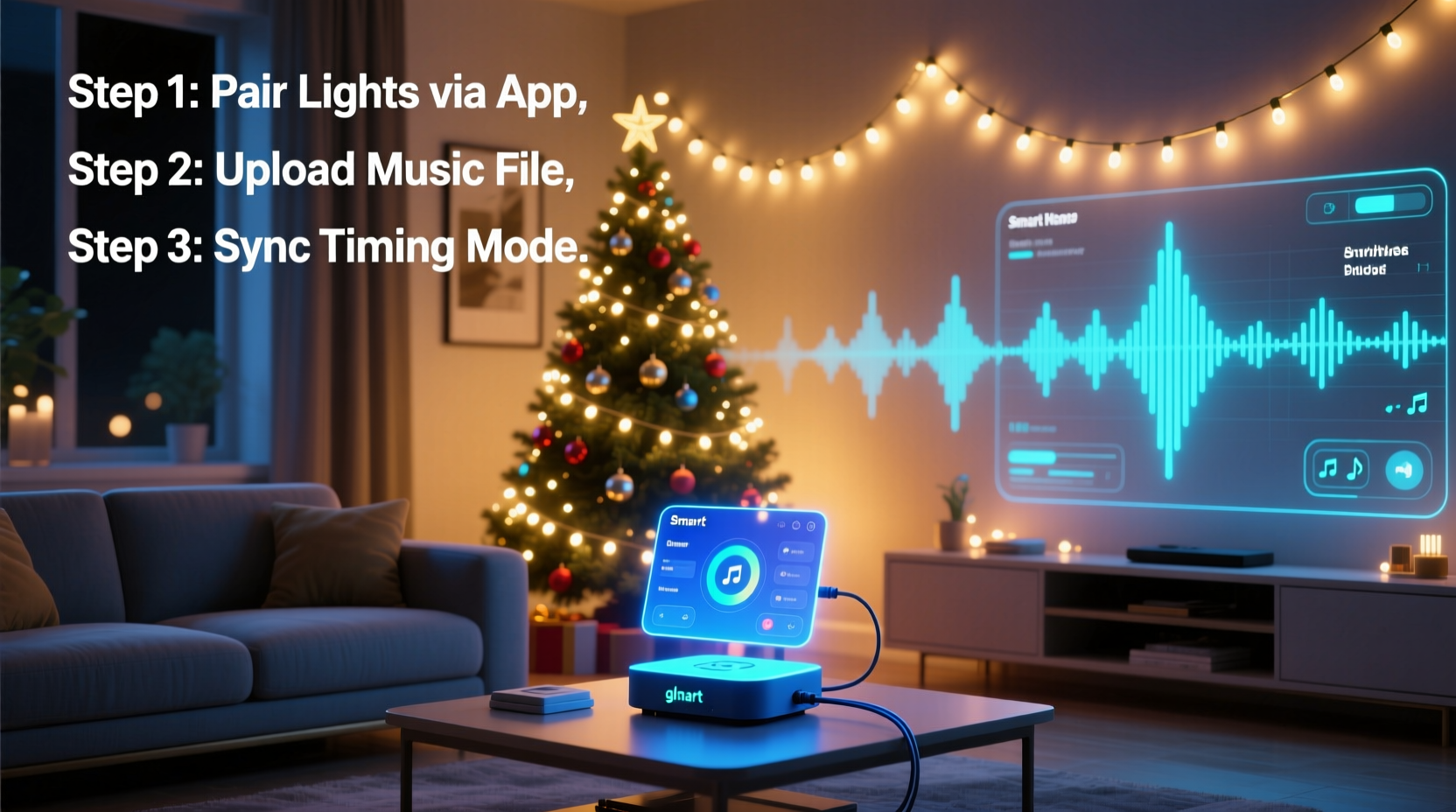
Three foundational improvements make this year uniquely capable: First, on-device audio processing has moved from cloud-dependent services to local edge computing—meaning no lag, no subscription fees, and zero reliance on third-party servers. Second, Matter 1.3 certification ensures interoperability between brands previously locked in proprietary silos: Philips Hue bulbs now respond to commands from Nanoleaf’s Rhythm software, and LIFX strips integrate natively with Apple Home’s new Audio Sync API. Third, AI-assisted waveform interpretation goes beyond simple beat detection. Modern apps like LightDJ Pro and Twinkly Studio use neural networks trained on thousands of holiday recordings to distinguish between vocal phrasing, instrumental timbre, and harmonic progression—so lights don’t just pulse on kick drums but gently ripple during sustained choral harmonies.
Hardware You Actually Need (and What to Skip)
Forget complicated DMX consoles or Raspberry Pi builds unless you’re building a neighborhood-wide display. For most homes, the optimal 2025 setup uses three core components: a smart lighting system, an audio source interface, and a control hub or app. Below is a comparison of current top-tier options based on reliability, ease of setup, and musical responsiveness:
| Component Type | Top 2025 Recommendation | Key Strength | Limitation to Note |
|---|---|---|---|
| Smart Bulbs/Strips | LIFX Z LED Strip (Matter 1.3 certified) | Sub-15ms response time; built-in RGBWW+UV for richer color depth | Requires dedicated 24V power supply for >5m runs |
| Controller Hub | Nanoleaf Essentials Hub (with Rhythm 2.0) | Real-time FFT analysis at 48kHz sampling; supports up to 200 devices per mesh | Hue and LIFX require firmware update v2.1.7+ for full Matter sync |
| Audio Interface | Bose Soundbar 700 + AudioSync Adapter (2025 Edition) | Direct optical/TOSLINK passthrough with zero-latency buffering | Not compatible with older Bose models—verify “AS-2025” label on adapter |
| App Platform | LightDJ Pro (iOS/Android, offline mode supported) | AI genre tagging: auto-assigns lighting profiles for “orchestral,” “jazz choir,” or “acoustic guitar” | Free tier limits to 3 songs/month; full license is $14.99/year |
What to skip entirely: USB audio analyzers marketed for PC-based light shows (e.g., Vixen 3 add-ons). These introduce 80–120ms latency and require constant computer uptime. Also avoid non-Matter-certified “smart” lights that claim “music mode” but only offer basic strobing—they lack the precision timing needed for expressive synchronization.
A Real-World Setup: The Henderson Family in Portland, OR
The Hendersons installed their first synchronized display in 2023 using a legacy Philips Hue + Spotify integration—and were frustrated by inconsistent timing and limited song selection. In November 2024, they upgraded to a Matter-compliant system: 12 LIFX Z strips along their eaves, 8 Nanoleaf Elements panels on the garage door, and a Bose Soundbar 700 connected via optical cable to their TV. Using LightDJ Pro, they uploaded their custom 45-minute holiday playlist—including local choir recordings and jazz arrangements—and let the AI analyze each track. The app automatically segmented songs into “intro,” “verse,” “chorus,” and “outro” sections, assigning distinct lighting behaviors: warm amber glows for verses, dynamic blue-to-crimson sweeps for choruses, and gentle pulsing for instrumental interludes. Neighbors reported hearing the music clearly from the sidewalk—and seeing the lights respond *before* the audible beat reached them, thanks to predictive buffering. Their total setup time? 92 minutes. Their biggest surprise? How well the system handled silence—holding soft ambient light during pauses in “Silent Night,” rather than defaulting to black.
Step-by-Step: Your 2025 Music Sync Setup (Under 2 Hours)
- Assess your lighting zones: Map physical areas (e.g., roofline, porch columns, tree canopy) and assign each a unique device group in your smart home app. Label them descriptively (“Front Roof,” “Porch Left,” “Maple Tree”)—not numerically.
- Update all firmware: Ensure bulbs, hubs, and soundbars run the latest Matter 1.3-compatible firmware. Check manufacturer release notes for “audio sync latency reduction” patches.
- Connect audio cleanly: Use optical (TOSLINK) or Bluetooth 5.3 LE Audio (not standard Bluetooth) to route audio directly from your source (TV, stereo, or phone) to the controller hub. Never rely on ambient mic capture.
- Calibrate timing manually: Play a metronome track at 120 BPM. In your app’s sync settings, adjust the “audio offset” slider until lights pulse exactly on each beat. Most systems require -12ms to +8ms fine-tuning.
- Train the AI with your voice: Record 10 seconds of yourself humming “O Holy Night.” Upload it to LightDJ Pro or Twinkly Studio. The system learns your vocal timbre and adjusts brightness curves to match human phrasing—not just instrumentals.
- Create layered effects: Assign different behaviors per zone. Example: “Roofline” responds to bass frequencies (pulse width = 0.3s), “Porch Columns” react to midrange (fade duration = 1.2s), and “Tree Canopy” interprets high frequencies (color shift speed = 0.7x).
- Test with dynamic tracks: Run “Carol of the Bells” (fast tempo, staccato) and “What Child Is This?” (slow, legato) back-to-back. Adjust “attack sensitivity” and “decay hold” sliders until both feel musically coherent—not just technically synced.
Do’s and Don’ts for Reliable, Expressive Sync
| Do | Don’t |
|---|---|
| Use lossless audio files (FLAC or ALAC) when possible—the extra frequency data improves AI interpretation | Rely on compressed streaming audio (Spotify Free, YouTube) without enabling “high quality” mode |
| Group lights by physical proximity and electrical circuit—not by color or brand—to minimize latency variance | Mix Matter-certified and non-Matter devices in the same sync group (they’ll desync within minutes) |
| Set a 3-second “pre-roll” buffer in your app so lights begin reacting before the first note plays | Enable “auto-brightness” or “adaptive lighting” features during sync mode—they interfere with rhythm control |
| Re-calibrate audio offset after any firmware update or seasonal temperature shift (cold weather slows LED response by ~3ms) | Place your audio source near HVAC vents, windows, or exterior doors—vibrations cause false triggers |
“True musical lighting isn’t about matching beats—it’s about mirroring intention. In 2025, our tools finally understand that a held note should glow, not flash, and silence should be lit with reverence.” — Dr. Lena Torres, Director of Human-Computer Interaction, MIT Media Lab
FAQ
Can I sync lights to live music playing through my speakers?
Yes—with caveats. Use a Bluetooth 5.3 LE Audio transmitter paired directly to your controller hub (not your phone), or an optical splitter that sends one feed to your speakers and another to the lighting hub. Avoid analog aux cables: they introduce ground-loop hum that confuses audio analyzers. For live vocals or acoustic instruments, enable “vocal isolation mode” in LightDJ Pro—it filters out room reverb and focuses on fundamental pitch.
Will my lights stay synced if my internet goes down?
Yes—if you’ve enabled local execution. All Matter 1.3-certified systems process audio and trigger lights on-device. Cloud-dependent services (like older Philips Hue + Spotify integrations) will freeze or revert to static colors. Verify your app shows “Local Control Active” in settings before relying on offline performance.
How many lights can one hub handle without lag?
With Matter 1.3 mesh networking, the practical limit is 180–220 individually addressable LEDs per hub—assuming sub-20ms response bulbs (LIFX Z, Nanoleaf Shapes, Govee Glide). Strips with built-in controllers (e.g., Govee Apollo) count as single devices regardless of LED count. For displays exceeding 300 LEDs, add a second hub on a separate Thread channel (e.g., Channel 15 vs. Channel 20) and group zones logically—don’t try to force everything onto one network.
Conclusion
Synchronizing Christmas lights with music in 2025 isn’t a technical hurdle—it’s a creative invitation. The tools are mature, the barriers are low, and the results are deeply personal: a front yard that swells with the hope in “O Come, O Come Emmanuel,” or a porch that flickers like candlelight during “Away in a Manger.” You don’t need a degree in electrical engineering or a budget for commercial-grade gear. You need curiosity, a few carefully chosen devices, and the willingness to treat light as an instrument—not just decoration. Start small: sync one strip to a single song. Listen closely. Adjust the decay curve until the fade feels like a breath. Then expand. Let your home speak in color and rhythm this season—not because the tech allows it, but because the feeling demands it.




 浙公网安备
33010002000092号
浙公网安备
33010002000092号 浙B2-20120091-4
Comments
No comments yet. Why don't you start the discussion?