
Holiday lighting is more than decoration—it’s an experience. When your smart lights pulse, shift, and shimmer in time with music, the atmosphere transforms. But what if you own Philips Hue, LIFX, Nanoleaf, and Govee lights? Most people assume syncing them requires a universal hub or expensive software. That’s no longer true. With modern automation platforms and audio-responsive tools, you can synchronize diverse smart lighting systems to a single holiday playlist—without purchasing additional hardware.
The key lies not in proprietary ecosystems but in open integrations, cloud-based automation, and real-time audio analysis. This guide walks through how to unify different brands under one musical rhythm, using only what you likely already have: a smartphone, Wi-Fi network, and access to free or low-cost apps.
Why multi-brand light syncing is now possible
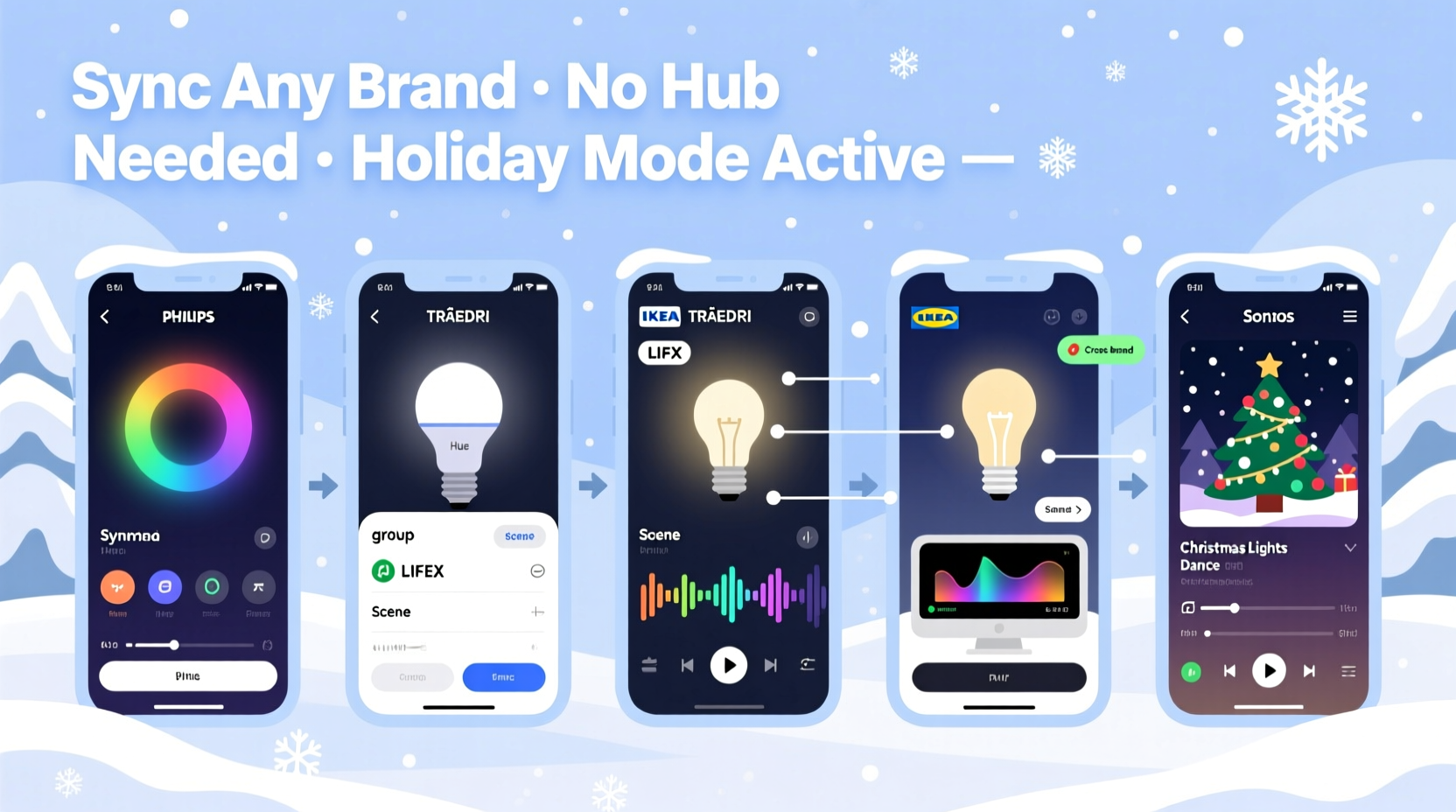
Until recently, smart home devices were siloed. Each brand operated within its own app, requiring specific hubs and limited third-party control. But the rise of platform-agnostic automation tools like IFTTT, Home Assistant, and Node-RED has changed that. These services act as translators between ecosystems, allowing commands from one source to trigger actions across multiple devices.
Additionally, advancements in audio-reactive lighting software—such as Hyperion.ng and Aurora HDR—have enabled real-time color extraction from sound. These tools analyze music playback and convert beats, tones, and volume into dynamic RGB signals sent directly to compatible bulbs.
As long as your lights support standard protocols (like Wi-Fi, Bluetooth, or Zigbee) and are connected to a controllable platform (Google Home, Apple HomeKit, or standalone APIs), they can be synchronized—even if they come from entirely different manufacturers.
“Cross-platform compatibility used to be the biggest hurdle in smart lighting. Now, the bottleneck isn’t technology—it’s awareness.” — Daniel Ruiz, Smart Home Integration Specialist at OpenHome Labs
Step-by-step: Syncing multi-brand lights to a holiday playlist
This process uses a combination of automation triggers and audio analysis. You’ll set up a central system that listens to music and sends corresponding lighting effects to all connected bulbs, regardless of brand.
- Ensure all lights are on the same Wi-Fi network
For smooth communication, connect every smart bulb—Philips Hue, LIFX, Govee, etc.—to the same 2.4 GHz Wi-Fi band. Avoid mixing networks or VLANs. - Link each device to a central automation platform
Use IFTTT (If This Then That) or Home Assistant to integrate each brand:- Connect Philips Hue via its official IFTTT service.
- Add LIFX using its native API or through Home Assistant.
- Pair Govee through its app integration or direct HTTP calls.
- Nanoleaf panels work best with WebSockets or their public API.
- Choose an audio-reactive engine
Select one of these two options based on technical comfort:- Beginner: Use Ambience (iOS/Android), which captures audio from your phone and sends synced effects to IFTTT-enabled lights.
- Advanced: Install Hyperion.ng on a Raspberry Pi or PC. It analyzes system audio and outputs to multiple LED controllers simultaneously.
- Set up the music source
Play your holiday playlist from a single output:- Spotify, YouTube Music, or local files played through VLC or Windows Media Player.
- If using Hyperion.ng, route audio through the computer where it's installed.
- If using Ambience, play music directly on your mobile device.
- Create synchronization rules
In your automation tool, define triggers:- In IFTTT, create an applet: “When Ambience detects music → change LIFX color loop.”
- In Home Assistant, use the
media_playerandlightentities to tie audio state to lighting scenes. - Map bass drops to red flashes, high notes to cool whites, and sustained chords to slow fades.
- Test and calibrate timing
Delays between audio and light response can occur due to buffering or network lag. Adjust:- Audio delay settings in Hyperion.ng (usually 100–300ms).
- IFTTT reaction speed by minimizing intermediate steps.
- Light transition durations—set to 50–150ms for responsiveness.
Comparison of methods: Simplicity vs. control
| Method | Setup Difficulty | Multi-Brand Support | Real-Time Audio Sync? | Cost |
|---|---|---|---|---|
| IFTTT + Ambience | Easy | High (via applets) | Moderate (~500ms delay) | Free |
| Home Assistant + Spotify Sensor | Medium | Very High | Good (200–400ms) | Free (requires self-hosting) |
| Hyperion.ng + USB Controllers | Hard | Full customization | Excellent (~100ms) | Free (hardware optional) |
| Commercial Hub (e.g., Nanoleaf Shapes + Canvas) | Easy | Low (same brand only) | Good | $150+ |
As shown, DIY solutions offer superior flexibility and cost efficiency. While commercial hubs provide plug-and-play simplicity, they lock you into a single ecosystem. The open-source path may require more initial effort but pays off in long-term versatility.
Real-world example: A unified Christmas display across five brands
Mark T., a homeowner in Portland, wanted his front porch, living room, and tree lights to dance together during nightly holiday shows. He owned:
- Philips Hue outdoor strips
- LIFX Mini Day & Dusk bulbs in the foyer
- Govee LED TV backlight
- Nanoleaf Shapes behind the couch
- String lights controlled by a Kasa Smart Plug
Instead of buying a new hub, Mark used Home Assistant running on an old laptop. He configured each brand through their respective integrations. Then, he installed the spotify-media-player add-on and wrote an automation script that triggered lighting effects whenever a song started.
For real-time reactivity, he ran Hyperion.ng in parallel, capturing audio from the same machine. He mapped low frequencies to warm pulses across all lights and set high mids to ripple through the Nanoleaf panels. The Kasa plug cycled the string lights rapidly during drumbeats using timed on/off toggles.
The result? A fully synchronized, immersive light show driven by his Spotify holiday playlist—all without a dedicated hub. Neighbors began gathering outside each evening, and Mark shared his configuration files online for others to replicate.
Checklist: Pre-sync preparation
Before launching your synchronized display, complete this checklist:
- ✅ Confirm all smart lights are powered and connected to Wi-Fi
- ✅ Update firmware on all devices to prevent glitches
- ✅ Group lights logically in your automation platform (e.g., “Front Yard,” “Living Room”)
- ✅ Test individual color changes remotely via app or voice command
- ✅ Choose a primary music source and ensure it’s accessible to the sync tool
- ✅ Disable conflicting automations (e.g., sunset schedules) during playback
- ✅ Run a dry test with a short track to verify timing and brightness levels
Frequently asked questions
Can I sync lights from different rooms to the same beat?
Yes. As long as all devices are on the same network and controlled by a centralized system (like Home Assistant or IFTTT), they can react simultaneously. Minor latency differences may occur based on signal strength, but these are usually imperceptible.
Do I need a powerful computer for audio analysis?
Not necessarily. Tools like Ambience run efficiently on smartphones. For Hyperion.ng, even a Raspberry Pi 3B+ handles basic audio-to-light translation. Only high-resolution ambient backlights or large installations require stronger hardware.
Will this work with Alexa or Google Play music?
Yes, but with caveats. If the music plays on a device with accessible audio output (like a PC or Android phone), the sync tool can capture it. However, streaming directly from an Echo speaker without screen mirroring or audio routing won’t allow external analysis. Route audio through a controllable source instead.
Maximizing impact: Creative lighting strategies
Synchronization isn’t just about turning lights on and off. To elevate the experience, consider choreographing layers of motion:
- Zoned rhythm: Set outdoor lights to flash boldly on beats while indoor strips fade softly in the background.
- Color themes: Match palettes to songs—cool blues for “Winter Wonderland,” gold-red pulses for “Carol of the Bells.”
- Dynamic intensity: Program lights to brighten during crescendos and dim during quiet verses.
- Sequential waves: Create a “domino effect” where lights activate in sequence across rooms, following the melody.
These techniques transform passive illumination into storytelling. With thoughtful design, your home doesn’t just play music—it performs it.
“The most memorable smart lighting setups aren’t the brightest—they’re the ones that feel intentional.” — Lena Cho, Interactive Environment Designer
Conclusion: Light up the season, your way
You don’t need a new hub to create a breathtaking, music-synchronized smart lighting display. By leveraging existing tools and open automation platforms, you can unify Philips Hue, LIFX, Govee, and other brands into a cohesive, responsive ensemble. Whether you're hosting a neighborhood event or simply enjoying a cozy night in, synchronized lights deepen the emotional resonance of your favorite holiday songs.
The technology is accessible, the cost is minimal, and the results are magical. Start small—sync two lights to a single track. Then expand. Experiment with colors, timing, and spatial layering. Share your setup with friends or post it online. The smart home community thrives on collaboration, and your innovation might inspire someone else’s festive breakthrough.




 浙公网安备
33010002000092号
浙公网安备
33010002000092号 浙B2-20120091-4
Comments
No comments yet. Why don't you start the discussion?