
Parrots are among the most intelligent birds in the animal kingdom, capable of mimicking human speech with astonishing clarity. For many owners, a talking parrot is a source of joy, companionship, and even amusement. However, that amusement can quickly turn into embarrassment when your bird starts repeating inappropriate language you didn’t realize it was absorbing. The good news: teaching a parrot to talk doesn’t have to come with the risk of offensive outbursts. With intentional training, environmental control, and consistent reinforcement, you can guide your parrot toward speaking clearly—and respectfully.
This guide walks through scientifically supported methods for encouraging vocal learning in parrots while actively preventing exposure to undesirable language. Whether you’re starting with a young bird or retraining an older one, these strategies will help foster positive communication habits from day one.
Understanding Parrot Vocalization: Why They Mimic
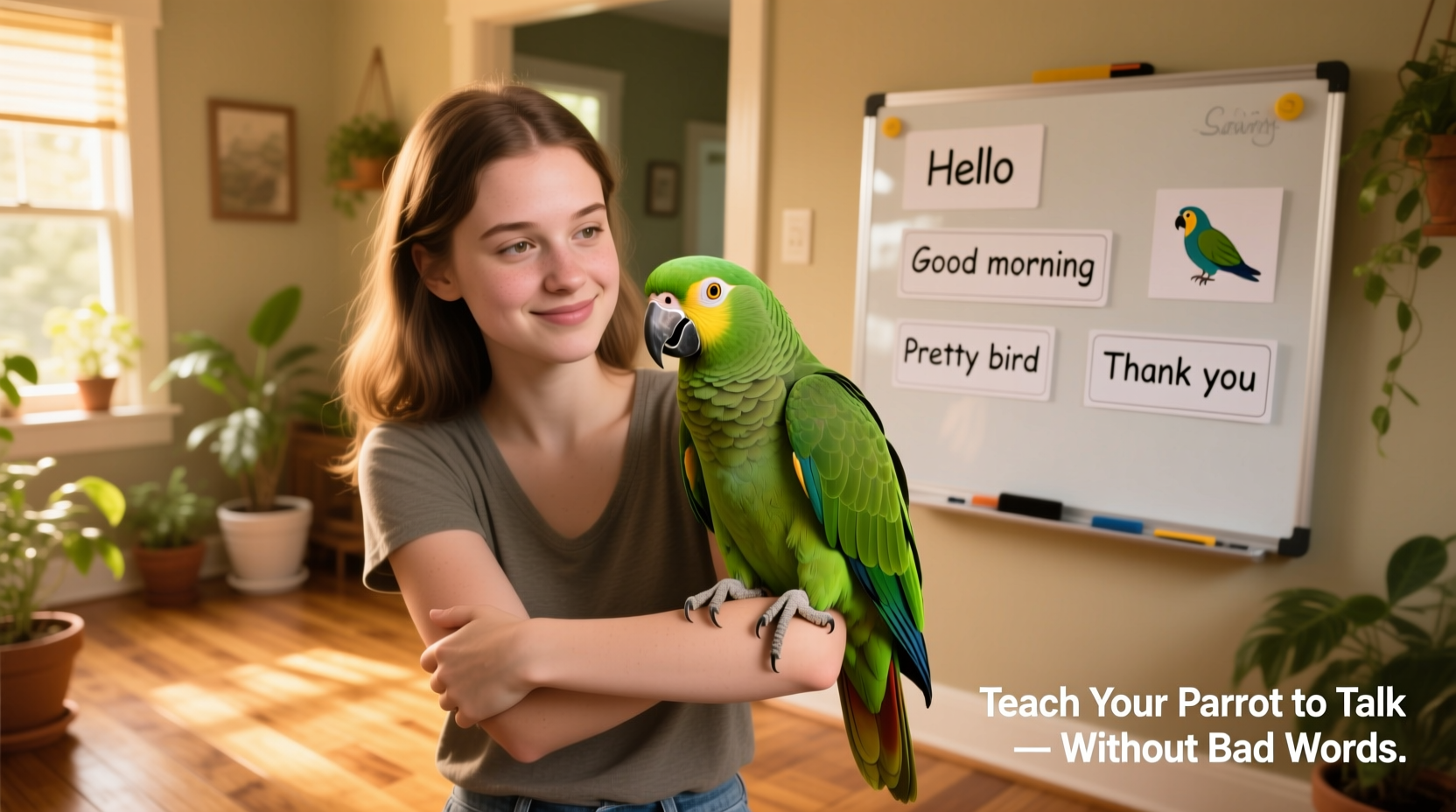
Parrots don’t speak for the same reasons humans do—they lack the cognitive structures for complex grammar or abstract thought. Instead, their mimicry is rooted in social bonding and environmental adaptation. In the wild, parrots use calls to maintain flock cohesion, signal danger, or establish territory. Captive parrots transfer this instinct to human households, treating their owners as part of their \"flock.\"
When a parrot repeats words, it’s often trying to gain attention, express emotion, or imitate sounds associated with rewards. Research shows that species like African Greys, Amazon parrots, and Budgerigars have particularly advanced vocal learning abilities. Dr. Irene Pepperberg, renowned avian cognition researcher, found that Grey parrots can associate words with meanings, not just repeat them mindlessly.
“Parrots aren’t just mimicking—they’re attempting to communicate. How we respond shapes what they choose to say.” — Dr. Irene Pepperberg, Animal Behavior Scientist
This insight underscores a critical point: every word your parrot learns is tied to context and consequence. If swearing gets laughter or strong reactions, the bird will repeat it more frequently. To prevent unwanted speech, you must shape the linguistic environment deliberately.
Step-by-Step Guide: Teaching Positive Speech Habits
Training a parrot to speak appropriately requires patience, repetition, and consistency. Follow this structured approach to build a foundation for clear, constructive vocalization.
- Start Early (If Possible): Young parrots, especially under one year old, are most receptive to new sounds. Begin training during this sensitive period for optimal results.
- Choose Simple, Positive Words: Focus on short, clear phrases like “Hello,” “Good bird,” or “Pretty.” Avoid emotionally charged or ambiguous language.
- Use Repetition in Context: Say the target word clearly several times per session, ideally when the bird is calm and attentive. Pair it with a gesture or action (e.g., waving when saying “Hello”).
- Reinforce Immediately: Reward your parrot with a treat, praise, or head scratch the moment it attempts the word—even if unclear. Timing is crucial for associative learning.
- Practice Daily: Conduct short sessions (5–10 minutes) two to three times a day. Overloading leads to frustration; consistency builds confidence.
- Phase Out Unwanted Sounds: If your parrot says something negative, do not react. Turn away silently. Reacting—even negatively—reinforces the behavior.
- Introduce New Words Gradually: Master one phrase before adding another. Jumping between too many sounds confuses the bird.
Preventing Bad Words: Environmental Control Strategies
The single most effective way to stop a parrot from learning bad words is to never let it hear them in the first place. Birds have exceptional auditory memory and can recall sounds heard only once. Once a word is learned, unteaching it becomes significantly harder.
- Avoid swearing, yelling, or playing media with explicit language around your bird.
- Inform all household members and visitors about your no-swear policy.
- Turn off TVs, radios, or phones when inappropriate content might play.
- Never joke about teaching your bird to curse—even if you think it's funny, the bird doesn't understand sarcasm.
If your parrot already knows a few bad words, don’t panic. The key is to eliminate reinforcement. Do not laugh, shout, or react in any way when the bird uses them. Instead, redirect with a known positive phrase and reward correct responses.
Do’s and Don’ts When Training Speech
| Do | Don’t |
|---|---|
| Say words slowly and clearly | Slur or mumble during training |
| Reward attempts at speaking | Punish incorrect sounds |
| Use consistent phrases daily | Change target words too frequently |
| Train in a quiet, distraction-free area | Train during loud or chaotic moments |
| Involve family members in positive training | Allow others to tease or provoke the bird |
Real Example: Retraining Max, the Curious Congo African Grey
Max, a 4-year-old Congo African Grey, came to his new owner with a vocabulary that included several expletives picked up from a previous home where TV was always on. His new caregiver, Sarah, wanted to transform his speech into something more appropriate.
She began by eliminating all sources of bad language in the house. She turned off the TV during the day, asked guests not to swear, and used headphones for music. Then, she introduced a simple training routine: each morning, she greeted Max with “Hi, buddy!” in a cheerful tone, followed by a sunflower seed if he chirped back.
After two weeks, Max started approximating “hi.” Sarah ignored all curse words completely—no eye contact, no sound. When Max said anything close to “hello,” she celebrated enthusiastically.
Within three months, Max replaced most of his offensive repertoire with friendly phrases like “Good morning!” and “Want snack?” The old words surfaced occasionally, but without attention, they faded. Today, Max greets visitors politely—a testament to consistent redirection and environmental control.
Checklist: Building a Safe Linguistic Environment
Use this checklist to ensure your home supports healthy vocal development in your parrot:
- ✅ Audit your home for audio sources (TVs, radios, phones) that might expose your bird to bad language.
- ✅ Establish a “parrot-safe” media rule: no uncensored content when the bird is present.
- ✅ Teach family members and regular visitors how to interact positively with the bird.
- ✅ Designate a quiet space for daily training sessions free from distractions.
- ✅ Choose 3–5 positive, useful phrases to focus on initially (e.g., “Hello,” “All done,” “Wanna play?”).
- ✅ Keep treats ready for immediate reinforcement during training.
- ✅ Monitor progress weekly and adjust phrases based on your bird’s success.
- ✅ Never use punishment—redirect instead.
FAQ: Common Questions About Parrot Speech Training
Can older parrots learn new words or unlearn bad ones?
Yes. While younger birds pick up speech more easily, adult parrots remain capable of learning throughout life. Unlearning bad words is possible through consistent non-reinforcement and positive redirection. It may take longer, but persistence pays off.
What if my parrot only copies the microwave beep or phone ring?
These are common default sounds because they’re loud and repetitive. To shift focus, increase verbal interaction during calm moments. Introduce words during feeding or petting, when your bird is most engaged with you. You can also pair mechanical sounds with words—say “Beep! Oven’s on!”—to give meaning to the noise.
How long does it take for a parrot to start talking?
It varies by species and individual. Budgies may begin mimicking within a few months; larger parrots like Amazons or Greys might take 6–12 months. Some never speak, and that’s normal. Focus on communication, not just speech—body language and whistles matter too.
Expert Insight: The Role of Social Interaction in Learning
Dr. Susan Friedman, a psychologist specializing in animal behavior, emphasizes that parrots learn best in enriched, socially interactive environments. “Parrots are not audio recorders,” she notes. “They’re relational learners. They pay attention to who says what, when, and how people respond.”
“The most powerful teacher isn’t repetition alone—it’s consequence. If a word brings connection, the bird will use it again.” — Dr. Susan Friedman, Behavioral Psychologist
This means that emotional context matters. A word spoken with warmth and followed by affection becomes meaningful. A shouted phrase, even if negative, carries high emotional weight and is more likely to be repeated. Therefore, emotional neutrality toward bad words—and enthusiasm for good ones—is essential.
Conclusion: Raising a Respectful, Vocal Companion
Teaching your parrot to talk is one of the most rewarding aspects of bird ownership. But with that ability comes responsibility. Your parrot is listening—constantly—and every sound in its environment shapes its vocabulary. By curating that environment, using positive reinforcement, and staying consistent, you can guide your bird toward becoming a polite, articulate companion.
Remember, success isn’t measured by how many words your parrot knows, but by the quality of communication you share. A well-trained parrot doesn’t just repeat phrases—it participates in your world using the tools you’ve given it.




 浙公网安备
33010002000092号
浙公网安备
33010002000092号 浙B2-20120091-4
Comments
No comments yet. Why don't you start the discussion?