
Authenticating a Louis Vuitton bag can be a challenge, especially when counterfeiters have become increasingly sophisticated in mimicking design elements. However, two of the most reliable indicators of authenticity—stitching and date codes—are often overlooked or misunderstood by buyers. Unlike logos or monograms, which can be easily replicated, the craftsmanship behind stitching and the structure of date codes are difficult to forge accurately. Understanding these details empowers you to make informed decisions whether shopping at a consignment store, online marketplace, or even a high-end boutique.
Louis Vuitton has maintained strict production standards for decades. Every stitch, thread color, and stamp is intentional and consistent across its global manufacturing network. By learning what to look for—and more importantly, what not to ignore—you can protect yourself from costly mistakes and ensure your investment holds value over time.
Understanding Louis Vuitton’s Craftsmanship Legacy
Since 1854, Louis Vuitton has built its reputation on durability, elegance, and meticulous attention to detail. Unlike many luxury brands that outsource production, Louis Vuitton maintains full control over its manufacturing facilities, primarily located in France, Spain, the United States, and Italy. Each bag is handcrafted by trained artisans using proprietary techniques that remain largely unchanged for generations.
This consistency means that genuine Louis Vuitton bags exhibit uniformity in construction. Variations in stitching tension, thread thickness, or alignment are rare—even between different models. Counterfeit versions, no matter how convincing they may appear at first glance, typically fail under close inspection due to inconsistencies in these foundational elements.
“Authenticity isn’t just about the logo—it’s in the micro-details. A single misplaced stitch can reveal an entire forgery.” — Clara Moreau, Luxury Authentication Specialist
Analyzing Stitching: The Hidden Signature of Quality
Stitching is one of the most telling signs of a genuine Louis Vuitton bag. It serves both functional and aesthetic purposes, reinforcing structural integrity while contributing to the brand’s signature clean finish. Here's what to examine closely:
1. Stitch Count and Consistency
Genuine Louis Vuitton bags feature tightly spaced, evenly distributed stitches. On average, there are approximately 7–9 stitches per inch on most styles. This density ensures strength without compromising flexibility. Replicas often use fewer stitches (typically 4–6 per inch), resulting in looser seams that wear out faster.
2. Thread Color Matching
Louis Vuitton uses thread colors that precisely match the hardware or trim. For example:
- Cream-colored canvas bags use light tan thread.
- Black leather trims are sewn with dark brown or black thread.
- Gold-tone hardware models typically use warm-toned thread.
3. Straightness and Tension
All stitching on an authentic Louis Vuitton bag runs perfectly straight, even around curves and corners. The tension remains consistent throughout, with no loose loops, skipped stitches, or puckering. If the thread appears wavy, uneven, or pulled too tightly, it’s likely not authentic.
4. Hand-Stitched vs. Machine-Stitched Debate
A common misconception is that all Louis Vuitton bags are entirely hand-stitched. In reality, modern production combines precision machine stitching with hand-finishing touches. Seams are machine-sewn for accuracy, but final adjustments—like securing end knots—are done by hand. The result is near-perfect symmetry with slight human variation, which counterfeits lack entirely due to fully automated processes.
Decoding the Date Code: Location, Format, and Meaning
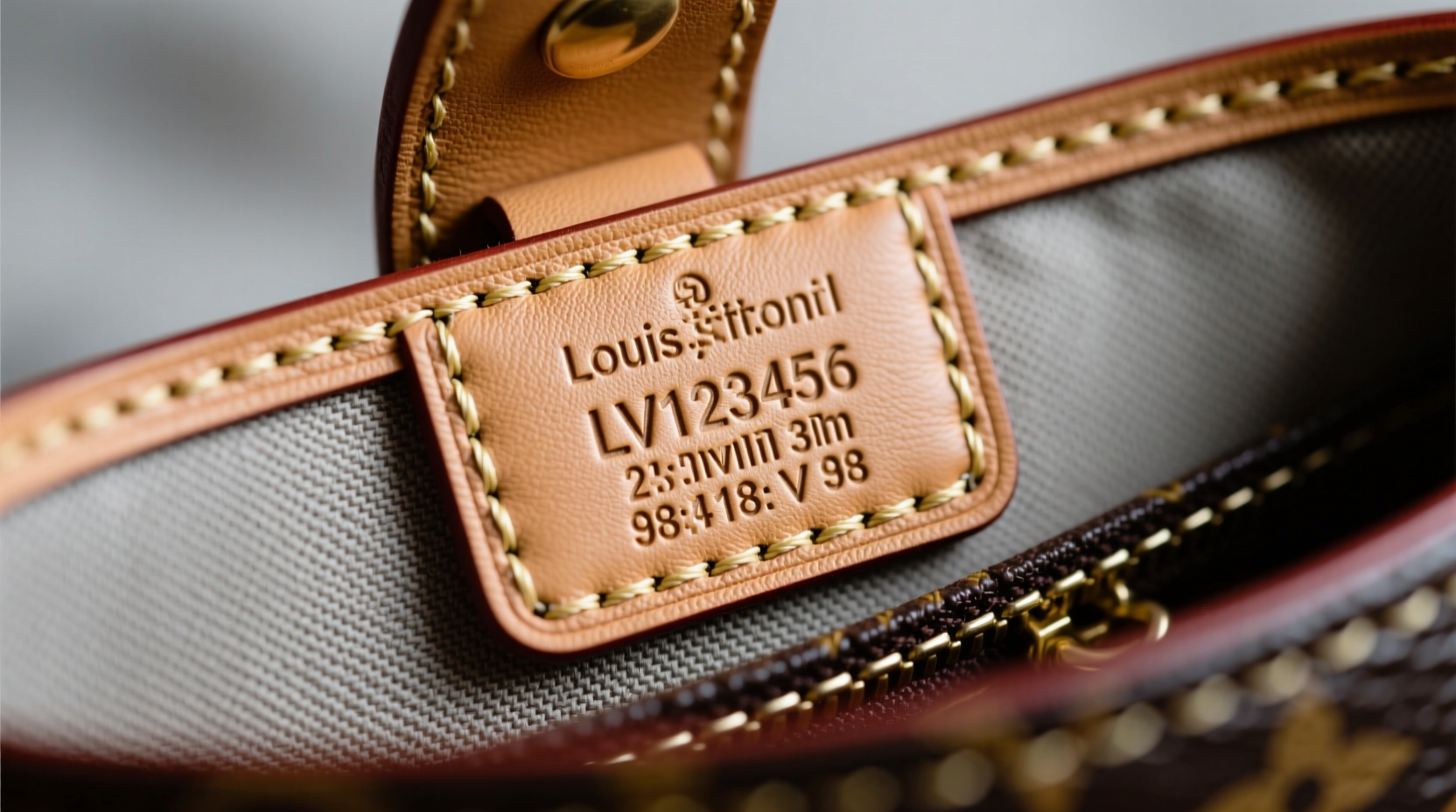
The date code is a small alphanumeric stamp found inside every Louis Vuitton bag produced after the early 2000s. While not a serial number, it provides valuable information about the bag’s origin and production period. Unlike older “style numbers” or “ID tags,” the date code is stamped directly onto the interior lining or leather tag and cannot be removed without damage.
Where to Find the Date Code
Location varies slightly depending on the model, but common spots include:
- Sewn into a leather tab near the interior zipper pocket
- Stamped on the vachetta leather trim inside the bag
- Near the seam of the interior wall lining
Interpreting the Format
Post-2007 date codes follow a standardized format: two letters followed by four digits.
| Format | Example | Meaning |
|---|---|---|
| AB1234 | VI2308 | First two letters = factory code (VI = France). Last four digits = week/year (23rd week of 2008). |
| XX9999 | SP1512 | SP = Spain, 15th week of 2012 |
| FRXXXX | FR4519 | FR = France, 45th week of 2019 |
Note: Prior to 2007, date codes used only four digits (e.g., 2308), making them harder to verify. These older formats do not include factory codes, so authentication relies more heavily on stitching, materials, and hardware.
Common Date Code Red Flags
- Inconsistent formatting: Codes like \"A1B2C3\" or \"LV2023\" are not used by Louis Vuitton.
- Missing factory letter: Authentic codes always begin with two letters (factory code).
- Fake factory codes: LV does not use codes like \"US,\" \"IT,\" or \"CH.\" Correct country codes include FR, SP, US, and CA.
- Future dates: A bag stamped with a date beyond the current year is suspicious.
Step-by-Step Guide to Authenticating a Louis Vuitton Bag
Follow this systematic approach when evaluating a pre-owned or new Louis Vuitton bag:
- Inspect the exterior stitching: Check for consistent spacing, correct thread color, and straight lines. Pay special attention to handle attachments and corner seams.
- Locate the date code: Open the bag and search for the stamped code on leather tags or interior linings. Ensure it’s not printed or贴纸-like.
- Decode the stamp: Identify the factory code and production week/year. Verify against known manufacturing locations.
- Compare with official references: Use trusted databases or consult authentication services to confirm the model’s release timeline matches the date code.
- Examine overall balance: Assess weight, shape, and proportion. Fakes often feel lighter or stiffer than originals.
“The date code alone doesn’t prove authenticity—but combined with flawless stitching, it forms a powerful verification duo.” — Marcus Lin, Vintage Luxury Curator
Real Example: Spotting a Fake During a Secondhand Purchase
Jessica, a fashion consultant based in Austin, was offered a Louis Vuitton Neverfull Tote at a local consignment shop for $800—well below retail. The monogram looked right, and the bag had a leather tag inside. But upon closer inspection, she noticed several issues.
The stitching near the base had inconsistent tension, with some threads visibly sagging. More concerning, the date code read “LV1223”—a clear red flag. “LV” is not a valid factory code, and the format didn’t align with any known Louis Vuitton standard. She asked the seller for proof of purchase, which they couldn’t provide. After consulting an authentication service, the bag was confirmed as counterfeit.
This case illustrates how relying solely on appearance can lead to costly errors. Had Jessica not checked the stitching and decoded the stamp, she might have walked away believing she scored a deal.
Checklist: How to Verify Authenticity Through Stitching and Code
Use this checklist before purchasing or accepting a Louis Vuitton bag:
- ✅ Stitch count is 7–9 per inch
- ✅ Thread color matches trim/hardware
- ✅ All seams are straight and evenly tensioned
- ✅ No loose ends, knots, or fraying
- ✅ Date code is present and properly stamped (not printed)
- ✅ Format follows AA#### (e.g., FR2318)
- ✅ Factory code corresponds to real production site (FR, SP, US, CA)
- ✅ Production date aligns with model availability
- ✅ Interior lining shows no glue residue or misaligned panels
- ✅ Overall craftsmanship feels balanced and precise
Frequently Asked Questions
Do all Louis Vuitton bags have date codes?
No. Bags manufactured before 2000 generally do not have date codes. Some limited editions or custom orders may also lack them. In such cases, authentication depends more heavily on materials, stitching, hardware, and provenance.
Can date codes be faked?
Yes, but poorly. While counterfeiters can stamp fake codes, they often get the format wrong—using incorrect factory letters or impossible combinations. Additionally, the stamping technique differs: authentic codes use precise, evenly pressed lettering, while fakes may appear shallow, smudged, or misaligned.
Is a bag without a date code automatically fake?
Not necessarily. Older vintage pieces (pre-2000) were not required to carry date codes. However, absence of a code in a bag claimed to be from 2007 onward raises serious doubts and warrants professional appraisal.
Final Thoughts: Trust Your Eyes, Not Just the Label
Spotting a counterfeit Louis Vuitton bag starts with knowing what to look for—and being willing to look closely. The stitching and date code are not flashy features, but they are foundational to the brand’s identity. When examined together, they form a compelling narrative of origin, quality, and legitimacy.
Whether you're building a collection, reselling, or treating yourself to a timeless piece, taking a few extra minutes to inspect these details can save hundreds—or thousands—of dollars. Don’t let branding distract you from craftsmanship. True luxury lies in the precision of a single stitch and the clarity of a well-placed code.




 浙公网安备
33010002000092号
浙公网安备
33010002000092号 浙B2-20120091-4
Comments
No comments yet. Why don't you start the discussion?