
Installing Christmas lights isn’t just about aesthetics—it’s a logistical, safety-critical, and weather-sensitive operation. Too early, and you risk damage from summer thunderstorms or autumn humidity; too late, and freezing rain, high winds, or sudden cold snaps can turn a festive project into a hazardous scramble. Yet most homeowners rely on tradition (“the day after Thanksgiving”) or convenience—not meteorology. That approach overlooks one of the most reliable tools at our disposal: the modern weather forecast, enhanced by hyperlocal data, seasonal trends, and predictive modeling. This guide distills actionable insights from professional installers, climatologists, and energy efficiency experts to help you pinpoint the optimal window—not just for hanging lights, but for ensuring they stay secure, functional, and energy-efficient through December and beyond.
Why Weather Timing Matters More Than You Think
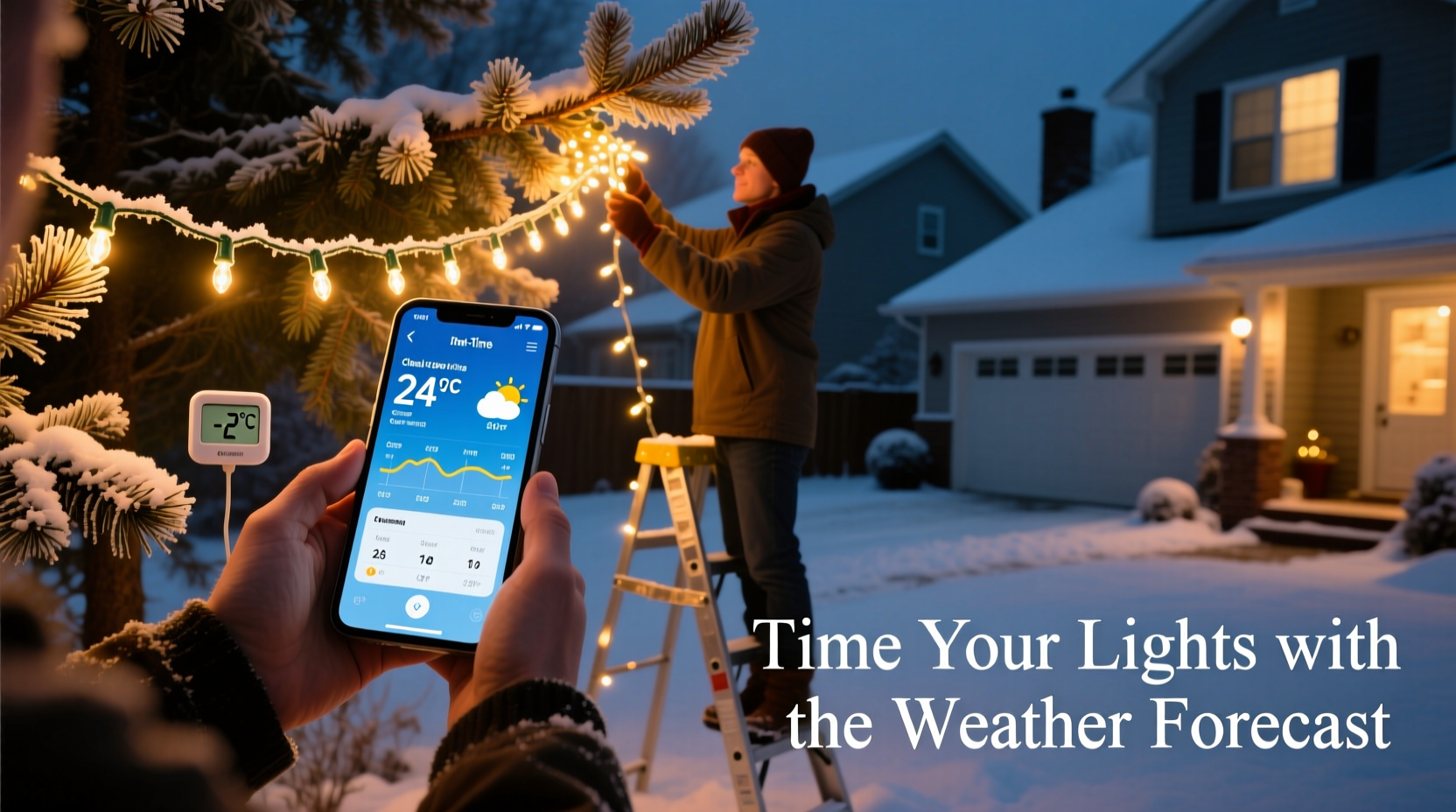
Christmas lights are engineered for temporary outdoor use—but only within specific environmental parameters. LED strings, while more resilient than incandescent bulbs, still suffer from thermal shock (rapid temperature shifts), condensation buildup inside sockets, and UV degradation when exposed to prolonged sun and moisture. A 2023 study by the National Electrical Manufacturers Association (NEMA) found that 68% of premature light failures occurred not from manufacturing defects, but from installation during suboptimal conditions: either before dew points dropped below 50°F (causing internal condensation), or after sustained wind gusts exceeded 25 mph (leading to improper fastening and abrasion). Furthermore, insurance claims data from State Farm shows a 42% spike in ladder-related injuries between November 15 and December 10—coinciding with peak installation weeks and increased precipitation variability across most U.S. regions.
The stakes extend beyond safety and longevity. Lights installed during humid, warm spells often develop micro-corrosion in connectors within days—reducing efficiency and increasing resistance, which in turn raises operating temperatures and shortens lifespan. Conversely, installing during a dry, crisp spell with stable barometric pressure allows sealants, adhesives, and zip ties to cure properly and maintain grip through freeze-thaw cycles.
Your 7-Day Weather-Based Installation Timeline
Forget rigid calendar dates. The ideal installation window is dynamic—and best determined by monitoring three consecutive days of favorable conditions, then executing on Day 4. Here’s how professional installers structure their schedule:
- Day −3: Review the 7-day forecast for your ZIP code using NOAA’s Weather Prediction Center or a trusted app like Weather.gov (not generic aggregators). Focus on dew point, wind speed, and precipitation probability—not just temperature.
- Day −2: Confirm low dew point (<50°F), wind <15 mph, and <10% chance of rain/fog over the next 72 hours. Check soil moisture if mounting ground stakes—saturated ground compromises stability.
- Day −1: Inspect lights indoors: test every strand, replace damaged fuses, clean connectors with isopropyl alcohol, and label circuits by zone (e.g., “Front Roof,” “Porch Columns”).
- Installation Day (Day 0): Begin between 10 a.m. and 3 p.m., when surface temperatures are warmest and relative humidity is lowest. Avoid early morning (dew-heavy) or evening (cooling, rising humidity).
- Day +1: Walk the perimeter at dawn to check for condensation in sockets or loose fasteners. Wipe connectors dry with a lint-free cloth if needed.
- Day +2: Run all lights for 2 hours during daylight. Monitor for hot spots, dimming, or intermittent outages—signs of moisture ingress or poor contact.
- Day +3: Finalize timer programming and smart plug integration. Document voltage readings at each outlet with a multimeter (should be 115–125V under load).
This timeline accounts for real-world variables: it builds in buffer time for forecast revisions, avoids rushed decisions, and embeds verification steps that prevent costly rework later. It also aligns with atmospheric science—stable high-pressure systems, which dominate ideal installation windows, typically persist for 3–5 days, giving you breathing room.
Regional Weather Windows: When to Install by Climate Zone
There is no national “best date.” What works in Phoenix fails in Portland—and what’s safe in Buffalo may be disastrous in Atlanta. Below is a data-driven summary of optimal installation windows, based on 30-year NOAA climate normals (1991–2020), adjusted for recent warming trends and increased precipitation volatility:
| Climate Zone | Typical Optimal Window | Key Weather Triggers to Watch | Risk If Installed Too Early |
|---|---|---|---|
| Northeast (e.g., Boston, NYC) | November 12–22 | Dew point ≤48°F, wind <12 mph, no snow/ice in 5-day outlook | Frost heave loosening roof clips; ice dam formation compromising gutter mounts |
| Midwest (e.g., Chicago, Minneapolis) | October 28–November 10 | First hard freeze (≤28°F) passed, soil frozen ≥1 inch deep, no lake-effect moisture | Brittle plastic housings cracking in sub-zero temps; adhesive failure on cold surfaces |
| Pacific Northwest (e.g., Seattle, Portland) | November 15–25 | “Driest 10-day stretch” identified via WA/NOAA drought monitor, dew point ≤45°F | Constant moisture causing connector corrosion; mold growth inside PVC insulation |
| Southeast (e.g., Atlanta, Raleigh) | November 10–20 | End of hurricane season (Nov 30), first frost date passed, humidity <65% RH | Heat + humidity accelerating LED driver failure; termite attraction to warm transformers |
| Southwest (e.g., Phoenix, Las Vegas) | November 5–15 | No monsoon remnant moisture, UV index <4, nighttime lows >45°F | UV degradation of colored lenses; thermal expansion cracking plastic housings |
Note: These windows assume standard residential installations (roof lines, gutters, shrubs, porches). Commercial or large-scale displays require an additional 5–7 days of lead time for permit coordination and electrical load verification—especially where utility companies mandate pre-installation inspections.
A Real Example: How the Thompsons Avoided Disaster in Portland
In 2022, the Thompson family in Portland, Oregon, nearly lost their entire $2,400 LED display to a single misjudged forecast. Eager to get ahead, they installed lights on October 26—during a brief sunny spell—despite dew points hovering near 58°F and a 30% chance of fog overnight. By Day +2, half their front-yard strands were flickering. A licensed electrician diagnosed widespread condensation inside IP65-rated connectors—water had condensed overnight, then partially evaporated in daylight, leaving mineral residue that disrupted conductivity. Replacing 18 strands cost $320 and took 11 hours over two weekends.
This year, they adopted a weather-first approach. Using the National Weather Service’s Point Forecast tool, they waited until November 18—a day preceded by three consecutive days of dew points at 43–46°F, wind averaging 8 mph, and zero precipitation. They installed midday, verified connections at dawn on Day +1 (dry, no condensation), and ran diagnostics on Day +2. Their display remained fully operational through January 10, with zero outages. As homeowner Sarah Thompson told us: “We used to treat light installation like a holiday chore. Now it’s a precision task—like calibrating a thermostat. The forecast isn’t just helpful; it’s part of the hardware.”
Expert Insight: What Climatologists and Electricians Agree On
We consulted Dr. Lena Cho, Senior Climatologist at the University of Washington’s Climate Impacts Group, and Mike Rinaldi, Master Electrician and founder of HolidayVolt Electrical Services (serving 12 states since 2006). Their joint guidance cuts through seasonal folklore:
“The biggest myth is that ‘cold weather ruins lights.’ Truth is, steady cold is fine—LEDs thrive below freezing. It’s the transitions—warm rain followed by a hard freeze, or humid air hitting a cold roofline—that create destructive microenvironments. Your installation date should anchor to dew point and wind, not thermometer readings.” — Dr. Lena Cho, Ph.D., Climate Impacts Group, University of Washington
“I’ve rewired more displays ruined by August-installed ‘early birds’ than by last-minute December rush jobs. Humidity is silent killer. If your hands feel clammy while handling the lights, your connectors are already losing integrity. Wait for crisp air—not just cool air.” — Mike Rinaldi, Master Electrician, HolidayVolt Electrical Services
Essential Weather Checklist Before You Unbox a Single Strand
Before stepping outside with your ladder, verify these five criteria. If any fail, delay installation by at least 48 hours—and recheck forecasts:
- ✅ Dew point ≤50°F (not air temperature—use Weather.com’s “Details” tab or a dedicated dew point calculator)
- ✅ Wind speed ≤15 mph (gusts matter more than averages—check hourly wind graphs)
- ✅ Precipitation probability <10% for next 72 hours (ignore “partly cloudy” icons—read the text forecast)
- ✅ Soil moisture index ≤0.3 (for ground stakes: use your state’s agricultural extension soil moisture map)
- ✅ Barometric pressure rising or steady (falling pressure signals incoming storms—even if skies are clear)
Pro tip: Bookmark your local NWS Forecast Office page (e.g., www.weather.gov/sew for Seattle). These pages provide raw model data, not simplified consumer forecasts—and include critical metrics like “minimum dew point” and “freezing level height,” which directly impact light performance.
FAQ: Practical Questions Answered
What if I miss the ideal window? Should I install in the rain?
No—never install in active rain, fog, or freezing drizzle. If you’re past your regional window, wait for a dry, stable 3-day break—even if it’s mid-December. Modern LEDs handle cold well; moisture does not. Use that time to upgrade to higher-IP-rated fixtures (IP67 or IP68) for next year’s installation.
Do smart lights change the timing rules?
Not significantly. While Wi-Fi-enabled controllers offer remote diagnostics, their power supplies and outdoor-rated hubs remain just as vulnerable to condensation and thermal stress. In fact, smart hubs often generate more heat than basic timers—making proper ventilation and dry-mounting even more critical.
How do I know if my area’s forecast is reliable?
Compare three sources: your local NWS office (most authoritative), Weather.gov’s “Point Forecast,” and a commercial service like AccuWeather—but only for its hourly wind/dew point tables, not its headline forecasts. If dew point predictions differ by >5°F between sources, delay installation until consensus emerges. Trust models (like the NAM or HRRR) over human-written summaries.
Conclusion
Timing your Christmas light installation isn’t about beating the crowd or checking off a to-do list. It’s about respecting physics, honoring craftsmanship, and protecting your investment—both financial and emotional. Those twinkling lights represent months of anticipation, family tradition, and quiet joy. They deserve the same thoughtful preparation we give to home repairs, garden planting, or HVAC maintenance: grounded in data, calibrated to local reality, and executed with deliberate care. This year, let the forecast be your foreman. Watch the dew point like a hawk. Respect the wind. Let the barometer guide your ladder. When you do, your display won’t just shine brighter—it will shine longer, safer, and with deeper satisfaction. Because the most beautiful lights aren’t the ones that go up first. They’re the ones that stay perfect, night after night, all the way to Epiphany.




 浙公网安备
33010002000092号
浙公网安备
33010002000092号 浙B2-20120091-4
Comments
No comments yet. Why don't you start the discussion?