
Bringing home a puppy during the holidays is joyful—but it can quickly become stressful when your excited young dog treats the Christmas tree like a chew toy, tug-of-war partner, or interactive light sculpture. Biting branches, tugging at garlands, and gnawing on electrical cords isn’t just destructive; it’s dangerous. Electrical shock, ingestion of toxic pine needles or ornament shards, and accidental toppling pose real risks to your puppy’s health—and your peace of mind.
This isn’t about “waiting it out” until the puppy matures. Bite inhibition, environmental management, and positive reinforcement training must begin immediately. With consistency, empathy, and science-informed techniques, most puppies learn appropriate boundaries around the tree within 7–14 days. What follows is a field-tested, veterinarian-reviewed approach grounded in canine development, learning theory, and real-world holiday logistics.
Why Puppies Target the Tree (and Why It’s Not Just “Teething”)
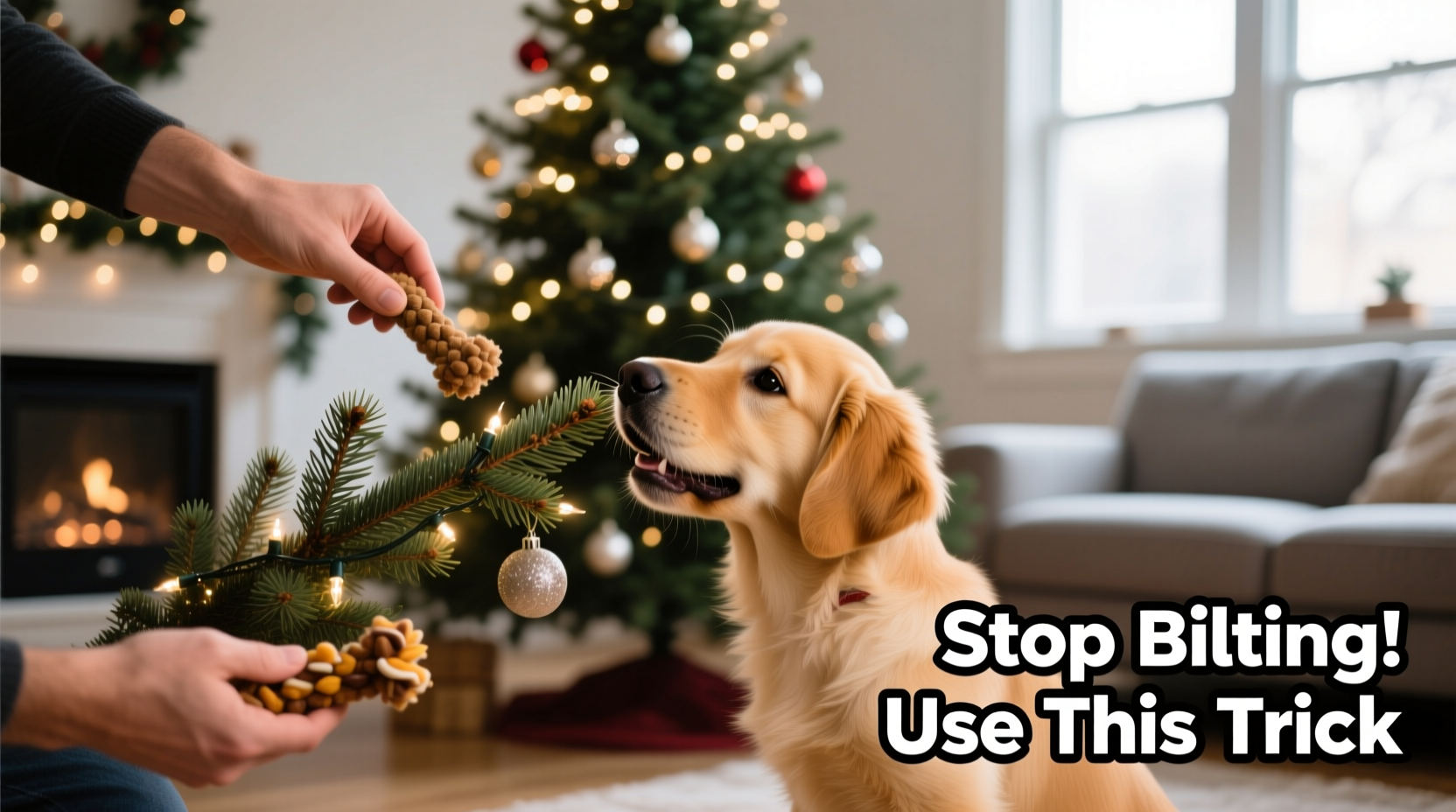
Puppies don’t bite the tree because they’re “naughty” or “testing limits.” They do it for three biologically rooted reasons: sensory curiosity, oral motor development, and environmental reinforcement.
First, the tree is a multisensory explosion: the scent of pine resin (which many dogs find intriguing), the rustle of branches, the flicker of lights, and the crinkle of tinsel all trigger exploratory behavior. Second, puppies aged 8–20 weeks are in peak teething and oral exploration phases—their mouths are their primary tools for understanding the world. Third, and most critically, the tree often *rewards* biting. Lights blink brighter when jostled. Ornaments clink and swing. A branch bends and springs back. To a puppy, this looks like play—not danger.
Veterinary behaviorist Dr. Sarah Lin, DVM, DACVB, explains:
“A puppy doesn’t distinguish between a squeaky toy and a dangling bulb cord. If the action produces movement, sound, or resistance, it’s reinforcing—even if that reinforcement is unintentional. The goal isn’t to suppress curiosity, but to redirect it with equal or greater appeal.”
Step-by-Step Prevention & Training Protocol (Days 1–14)
Effective intervention requires simultaneous action across four domains: physical safety, environmental structure, behavioral redirection, and consistent reinforcement. Follow this timeline precisely—it aligns with canine neuroplasticity windows and habit-formation research.
- Day 1: Secure & Assess
Install a sturdy, waist-high barrier (e.g., baby gate, exercise pen) around the tree base. Unplug all lights and remove low-hanging ornaments. Inspect wiring: coil excess cord tightly, cover with PVC conduit or cord protectors, and secure to the wall with adhesive clips—no loose loops on the floor. - Days 2–3: Introduce “Tree Time” with Zero Access
Bring your puppy into the room on leash. Sit calmly near the barrier. Offer high-value chews (frozen KONG stuffed with pumpkin + peanut butter) *only* during these sessions. Do not allow sniffing or pawing at the barrier. Reward calm sitting with quiet praise and small treats. Goal: associate the tree’s presence with relaxation—not arousal. - Days 4–6: Add Structured Interaction
With the puppy leashed and under gentle tension (not restraint), walk slowly around the barrier perimeter. Pause every 3 feet. If the puppy glances at the tree without lunging, mark with a soft “yes” and deliver a treat. If they pull or whine, calmly pivot and walk away—then restart. Repeat 3x/day for 5 minutes. This teaches impulse control using classical conditioning. - Days 7–10: Introduce Safe Alternatives
Place two designated “tree-safe” chew stations 3 feet from the barrier: one with a durable rubber toy infused with calming chamomile oil, another with a food puzzle frozen overnight. Rotate toys daily. Never place alternatives *inside* the barrier—this blurs boundaries. When the puppy chooses a safe chew over fixating on the tree, offer enthusiastic praise and a jackpot reward (3–5 tiny treats). - Days 11–14: Gradual Access & Proofing
Remove the barrier for 5-minute supervised intervals. Keep your puppy leashed. If they approach the trunk, gently guide them to a safe chew station. If they mouth a branch, interrupt with a neutral “eh” (not yelling), then redirect. After three successful 5-minute sessions, extend to 10 minutes. Only after 7 consecutive distraction-free sessions should you consider unsupervised access—and only if all cords are fully concealed and ornaments hang above 36 inches.
What to Use (and What to Avoid) Around the Tree
Not all barriers, toys, or training aids are equally effective—or safe. Below is a vet-verified comparison of common options based on efficacy, safety, and practicality.
| Item | Recommended? | Why / Notes |
|---|---|---|
| Baby gate (pressure-mounted) | ✅ Yes | Stable, adjustable, no drilling. Choose one with vertical bars (not horizontal) to prevent climbing. |
| Exercise pen (metal, 36\"+) | ✅ Yes | Most reliable for active puppies. Anchor legs to furniture with bungee cords for stability. |
| Christmas tree skirt (fabric) | ❌ No | Creates hiding space for chewing cords and traps heat—increasing fire risk. Use only after puppy is fully trained and supervised. |
| LED battery-operated lights | ✅ Yes | Eliminate electrocution risk. Ensure batteries are secured in locked compartments—puppies pry open flimsy covers. |
| Ornament hooks (metal vs. plastic) | ✅ Metal only | Plastic hooks snap easily. Use S-shaped metal hooks screwed into branch for security. |
| “Bitter apple” spray | ❌ No | No peer-reviewed evidence of long-term effectiveness. May cause gastrointestinal upset if licked off surfaces. |
Real-World Case Study: Luna, 12-Week-Old Labrador Mix
Luna’s family brought her home the week before Thanksgiving. By December 3rd, she’d snapped three light cords, swallowed two glass bauble fragments (requiring emergency endoscopy), and knocked over the tree twice. Her owners tried scolding, crate confinement during “tree time,” and covering the base with aluminum foil—all ineffective.
Working with a certified veterinary behavior technician, they implemented the 14-day protocol above. Key adjustments made: switching to battery-powered micro-LEDs, installing a 42-inch metal exercise pen anchored to a sofa leg, and introducing a rotating “chew calendar” (different high-value items each day: frozen marrow bone Day 1, elk antler Day 2, etc.). By Day 9, Luna walked past the barrier without breaking stride. On Christmas Eve, she napped 4 feet from the tree while it sparkled—her favorite plush reindeer toy beside her.
Her owner notes: “We stopped seeing the tree as something to guard—and started seeing it as a chance to teach focus. The biggest shift wasn’t in Luna. It was in us realizing that consistency isn’t rigid—it’s loving repetition.”
Critical Do’s and Don’ts Checklist
- ✅ Do unplug lights whenever the puppy is unsupervised—even for 90 seconds.
- ✅ Do keep the tree stand filled with water mixed with 1 tsp white vinegar (deters licking without toxicity).
- ✅ Do rotate chew toys daily to maintain novelty and oral satisfaction.
- ✅ Do practice “leave-it” with low-value items (e.g., crumpled paper) before applying it to tree elements.
- ✅ Do reward calm proximity—not just zero biting. A relaxed sit 6 feet from the tree earns praise.
- ❌ Don’t use punishment (yelling, spraying water, grabbing muzzle). This increases anxiety and may generalize to all shiny objects—or people decorating.
- ❌ Don’t leave tinsel, ribbon, or flocking within reach. These cause life-threatening intestinal blockages.
- ❌ Don’t assume “he’ll grow out of it.” Unchecked oral exploration around hazards becomes a reinforced habit loop.
- ❌ Don’t rely solely on crate training during tree time. Puppies need guided exposure—not avoidance—to learn boundaries.
- ❌ Don’t decorate the lower third of the tree at all until your puppy has passed 14 days of flawless supervised access.
Frequently Asked Questions
My puppy only bites the tree when I’m decorating—why?
This is social facilitation: your focused energy, movement, and vocalizations elevate your puppy’s arousal state. To break the link, decorate only when the puppy is crated or in another room—with enrichment provided. Once decoration is complete, introduce the puppy to the finished tree using the Day 2 protocol (calm presence + high-value chew), not during active hanging.
Can I use a pet-safe repellent on pine branches?
No safe, effective, non-toxic repellent exists for live trees. Pine resin itself is mildly irritating to mucous membranes, and adding substances increases ingestion risk. Instead, make the tree *boring*: avoid shiny ornaments at puppy height, minimize movement (skip rotating bases), and eliminate dangling elements. Boredom is your strongest ally.
What if my puppy is already injured from tree-related incidents?
Consult your veterinarian immediately—even for minor shocks or swallowed fragments. Internal injuries (e.g., oral burns, intestinal perforations) may not show symptoms for 24–72 hours. Document all incidents (date, object involved, observed behavior) to share with your vet. Post-incident, double down on barrier integrity and add a “stress-reduction protocol”: 10 minutes of gentle massage and quiet time before each supervised tree session.
When to Seek Professional Help
While most puppies respond well to the 14-day protocol, consult a board-certified veterinary behaviorist (DACVB) or certified professional dog trainer (CPDT-KA) if any of the following occur:
- Your puppy shows escalating fixation—staring, whining, or circling the tree for >30 seconds without redirection;
- Biting escalates to aggression (growling, snapping) when you approach the tree;
- You observe signs of anxiety unrelated to the tree (panting, pacing, destructive chewing elsewhere);
- Training progress stalls for >5 consecutive days despite strict adherence to the protocol.
Early intervention prevents learned helplessness and reduces long-term stress. Remember: seeking expert guidance isn’t failure—it’s responsible stewardship.
Conclusion: Your Puppy’s First Holiday Can Be Calm, Safe, and Joyful
The Christmas tree doesn’t have to be a battleground. With thoughtful preparation, respectful understanding of canine development, and unwavering consistency, you can transform a potential hazard into a shared moment of quiet wonder. Your puppy isn’t trying to ruin the season—they’re trying to figure out where they belong in it. Every redirected chew, every calm sit beside the barrier, every moment of shared stillness beneath the lights reinforces that belonging.
This isn’t about perfection. It’s about presence. It’s about choosing patience over panic, science over superstition, and kindness over correction. When your puppy rests peacefully near the tree—not because they’re afraid, but because they feel safe and satisfied—you’ll know the real gift of the season has arrived.




 浙公网安备
33010002000092号
浙公网安备
33010002000092号 浙B2-20120091-4
Comments
No comments yet. Why don't you start the discussion?