
Christmas trees are festive focal points—but for cats, they’re irresistible vertical playgrounds: swaying branches mimic prey movement, dangling ornaments glitter like moving toys, and the scent of pine resin carries novelty that triggers curiosity and exploration. Unfortunately, this natural feline behavior can lead to toppled trees, broken ornaments, chewed wires, and stressed humans. Traditional deterrents—citrus sprays, aluminum foil, or startling noises—may suppress behavior temporarily but often damage trust, increase anxiety, or simply fail when motivation peaks. Positive reinforcement offers a more humane, effective, and lasting alternative: it doesn’t ask your cat to stop doing something; instead, it teaches them what *to do instead*, rewarding calm, distant, or alternative behaviors until they become the default choice. This approach aligns with modern feline behavior science, respects your cat’s instincts, and strengthens your bond—not erodes it.
Why Positive Reinforcement Works Better Than Deterrents
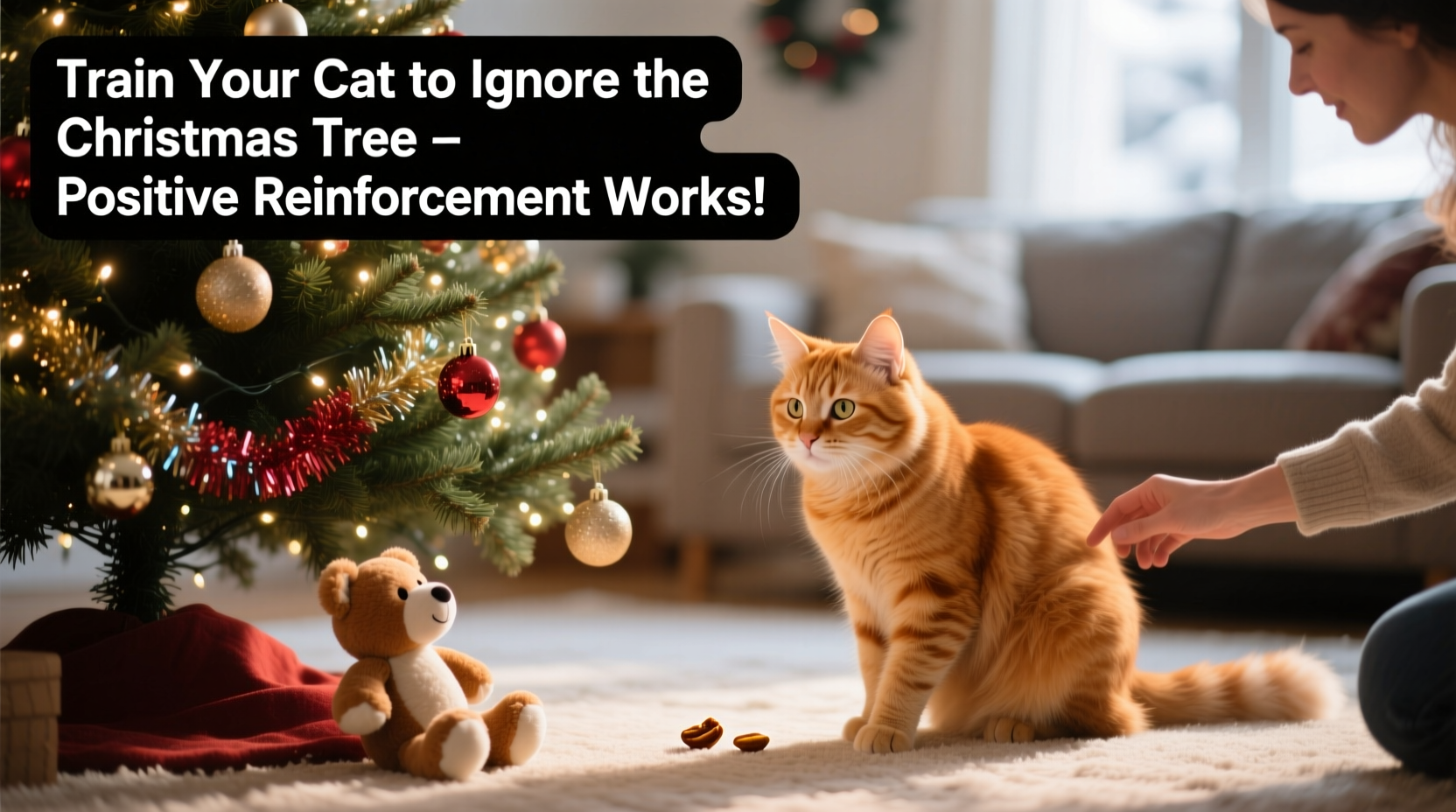
Cats don’t respond well to punishment-based training. Their nervous systems are wired for vigilance and quick retreat—not compliance under threat. When startled by a spray bottle or hissed at near the tree, a cat may associate the human (not the tree) with fear, leading to avoidance, hiding, or redirected aggression. Worse, punishment rarely addresses the underlying drivers: boredom, lack of vertical enrichment elsewhere, or unmet predatory needs. Positive reinforcement, by contrast, taps directly into feline learning biology. Cats learn through association: if sitting calmly three feet from the tree consistently results in high-value treats, gentle chin scratches, or interactive play, their brain begins to link proximity-with-distance—and stillness—with reward. Neurologically, this activates dopamine pathways tied to anticipation and satisfaction, reinforcing the desired behavior far more reliably than fear-based suppression.
“Cats aren’t ‘misbehaving’ around the tree—they’re behaving exactly as evolution designed them to. Our job isn’t to break their instincts, but to redirect them with clarity, consistency, and kindness.” — Dr. Sarah Wilson, DVM, Certified Feline Behavior Consultant, International Association of Animal Behavior Consultants (IAABC)
A 7-Day Positive Reinforcement Training Timeline
Start training *before* the tree goes up—or within 24 hours of installation. Consistency over seven days builds reliable neural pathways. Use this timeline whether your cat is a curious kitten or a seasoned 12-year-old tree climber.
- Day 1: Prep & Baseline Observation — Set up the tree in its final location. Observe your cat’s natural approach patterns for 30 minutes: Where do they first pause? How close do they get before touching? Note body language (dilated pupils, tail flicks, crouching). Stock up on high-value rewards: freeze-dried chicken, tuna flakes, or commercial treats your cat only receives during training.
- Day 2: Reward Distance — With the tree unadorned (or minimally decorated), stand nearby holding treats. The *instant* your cat enters a “safe zone” (e.g., 6 feet away), mark with a quiet “yes!” or clicker and deliver one treat. Repeat 8–10 times per session, 3x daily. Never lure closer—only reward existing distance.
- Day 3: Shape Calm Posture — Now reward only when your cat is not just *in* the zone, but also relaxed: sitting or lying down. If they stand and stare, wait. The moment they shift weight onto haunches or lower their head, mark and treat. This teaches stillness—not just space—as valuable.
- Day 4: Introduce the “Tree Zone” Boundary — Place a small, low barrier (a 2-inch-tall wooden dowel, a strip of non-slip shelf liner, or even painter’s tape on the floor) 3 feet from the trunk. Reward generously each time your cat pauses *before* crossing it—even for half a second. Do not block access physically; let them choose to stop.
- Day 5: Add Enrichment Elsewhere — Place a new cardboard box, a cat tree, or a puzzle feeder 4 feet *opposite* the tree. Reward heavily when your cat engages there *instead* of approaching the tree. You’re building a competing, rewarding habit.
- Day 6: Gradual Ornament Introduction — Hang only 2–3 secure, lightweight ornaments (avoid glass, tinsel, or anything dangling below 18 inches). Continue rewarding distance and calm. If your cat investigates, calmly walk over *without speaking*, place a treat *on the floor beside them* (not near the trunk), and step back. This redirects attention without confrontation.
- Day 7: Maintain & Generalize — With full decorations, maintain 2–3 short sessions daily. Vary reward types (treat → play → petting) to prevent satiation. Celebrate small wins: a glance toward the tree followed by turning away earns a treat. Your goal isn’t perfection—it’s reliable impulse control.
Do’s and Don’ts: A Practical Decision Guide
What you do—or don’t do—in real-time interactions shapes long-term success. This table reflects evidence-based practices observed in hundreds of feline households during holiday seasons.
| Action | Do | Don’t |
|---|---|---|
| When your cat approaches the tree | Mark and reward the *moment they pause* at your designated boundary—even if briefly. | Chase them away, yell, or clap. This makes the tree a source of excitement or conflict. |
| Using treats | Use pea-sized, ultra-high-value rewards delivered *immediately* after the desired behavior. Rotate flavors to sustain interest. | Offer treats *after* they’ve already touched the tree—or use low-value kibble that won’t motivate focused attention. |
| Environmental setup | Anchor the tree securely to the wall. Place engaging alternatives *within sight* of the tree (e.g., a perch by a window opposite the tree). | Rely solely on unstable stands, tinsel, or fragile ornaments as “deterrents”—they invite disaster and risk ingestion. |
| Consistency | Ensure all household members use the same cues, boundaries, and rewards. One person rewarding curiosity while another scolds creates confusion. | Let children “play” with the cat near the tree or allow unsupervised access during training days. |
| Progress tracking | Keep a simple log: date, duration of calm near tree, number of successful pauses, and reward type used. | Expect overnight change. Feline learning requires repetition—setbacks are normal and part of the process. |
Real-World Success: Luna’s Story
Luna, a 3-year-old rescue tabby in Portland, had knocked over three consecutive trees—including one that crashed onto her owner’s laptop. Her owner, Maya, tried double-sided tape on the base, citrus spray on lower branches, and even a motion-activated air canister. Luna learned to avoid the *sound*, not the tree—and began waiting until Maya left the room to investigate. Frustrated, Maya consulted a certified feline behaviorist. They implemented the 7-day plan—but added one critical adaptation: Luna loved batting at strings, so Maya hung a lightweight, securely anchored feather wand *beside* the tree (not on it), rewarding Luna each time she batted *there* instead of at ornaments. By Day 5, Luna was choosing the wand 80% of the time. On Christmas Eve, she sat serenely on her cat tree across the room, watching the lights—while Maya enjoyed her coffee, uninterrupted. No scolding. No stress. Just mutual understanding, built one tiny reward at a time.
Essential Tools & Setup Strategies
Positive reinforcement isn’t just about treats—it’s about designing an environment where the right choice is the easiest, most rewarding one. These tools reduce temptation without coercion:
- Physical anchoring: Use L-brackets or a sturdy strap to secure the tree trunk to a wall stud. A wobbly tree invites investigation; a stable one feels less “playable.”
- Strategic placement: Position the tree away from furniture your cat uses to launch upward (sofas, bookshelves, side tables). Create a “no-launch zone” of at least 2 feet around the base.
- Alternative vertical space: Install a tall, stable cat tree or wall-mounted shelves *facing* the tree—giving your cat a vantage point to observe without contact. Top it with a soft bed and a favorite toy.
- Scent substitution: Place a small, open container of catnip or silver vine *away* from the tree (e.g., on a nearby shelf). Many cats prefer these scents over pine—and will choose them voluntarily.
- Light redirection: Use battery-operated LED lights instead of incandescent bulbs (which generate heat and attract pawing). Avoid lights that blink erratically—these overstimulate prey drive. Steady, warm-white lights are least provocative.
Frequently Asked Questions
What if my cat is already obsessed with the tree—can I still start positive reinforcement?
Absolutely. Obsession signals high motivation—which means rewards will be especially effective. Begin on Day 1 of the timeline, but add extra sessions (5x/day for the first 3 days) to accelerate learning. Focus intensely on rewarding *any* disengagement: turning away, blinking slowly, or walking to a different room. High motivation + high-value rewards = rapid progress.
My kitten is too young to understand training—should I wait?
No—start now. Kittens’ brains are exceptionally plastic between 2–7 months. Early exposure to boundaries paired with rewards builds lifelong impulse control. Use smaller treats, shorter sessions (2–3 minutes), and emphasize safety: ensure no electrical cords are accessible, and avoid ornaments within pawing range. What you teach in December becomes instinct by next year.
Can I use a clicker—or is verbal marking enough?
Both work—but a clicker offers precision. The distinct, consistent sound marks the *exact millisecond* your cat performs the desired behavior (e.g., sitting at the boundary line), which is harder to replicate verbally. If using voice, choose one clear, quiet word (“yes”) and say it *only* during training—never in conversation. Whichever method you choose, always follow the marker immediately with a treat.
Conclusion: Cultivating Calm, Not Control
Training your cat to ignore the Christmas tree isn’t about enforcing silence or stillness—it’s about honoring their nature while guiding them toward safer, more satisfying choices. Positive reinforcement transforms a potential source of seasonal stress into an opportunity: to deepen trust, sharpen communication, and witness your cat’s intelligence and adaptability firsthand. You won’t eliminate curiosity—but you’ll give your cat compelling reasons to express it elsewhere. And when December 26 arrives, and the tree comes down, you’ll have more than an intact holiday display. You’ll have a stronger relationship, proven tools for future challenges, and the quiet pride of knowing you chose kindness over correction. That’s the kind of tradition worth keeping.




 浙公网安备
33010002000092号
浙公网安备
33010002000092号 浙B2-20120091-4
Comments
No comments yet. Why don't you start the discussion?