
Christmas trees are festive, fragrant, and full of sensory intrigue—for dogs, they’re also a high-value chew target. The scent of pine resin, the texture of bark and needles, the crinkling sound of fallen branches, and the novelty of a towering object in the living room all converge into a powerful behavioral magnet. But chewing on tree branches isn’t just messy—it’s dangerous. Pine needles can puncture the gastrointestinal tract; sap may cause drooling, vomiting, or dermatitis; and broken branches pose choking or splintering risks. Traditional corrections—yelling, spraying water, or dragging the dog away—often backfire by increasing anxiety or inadvertently reinforcing attention-seeking behavior. The more effective, humane, and sustainable path lies in positive cue-based training: teaching your dog *what to do instead*, rewarding calm proximity, and reshaping their relationship with the tree through clarity, consistency, and choice.
Why Positive Cues Work Better Than Correction
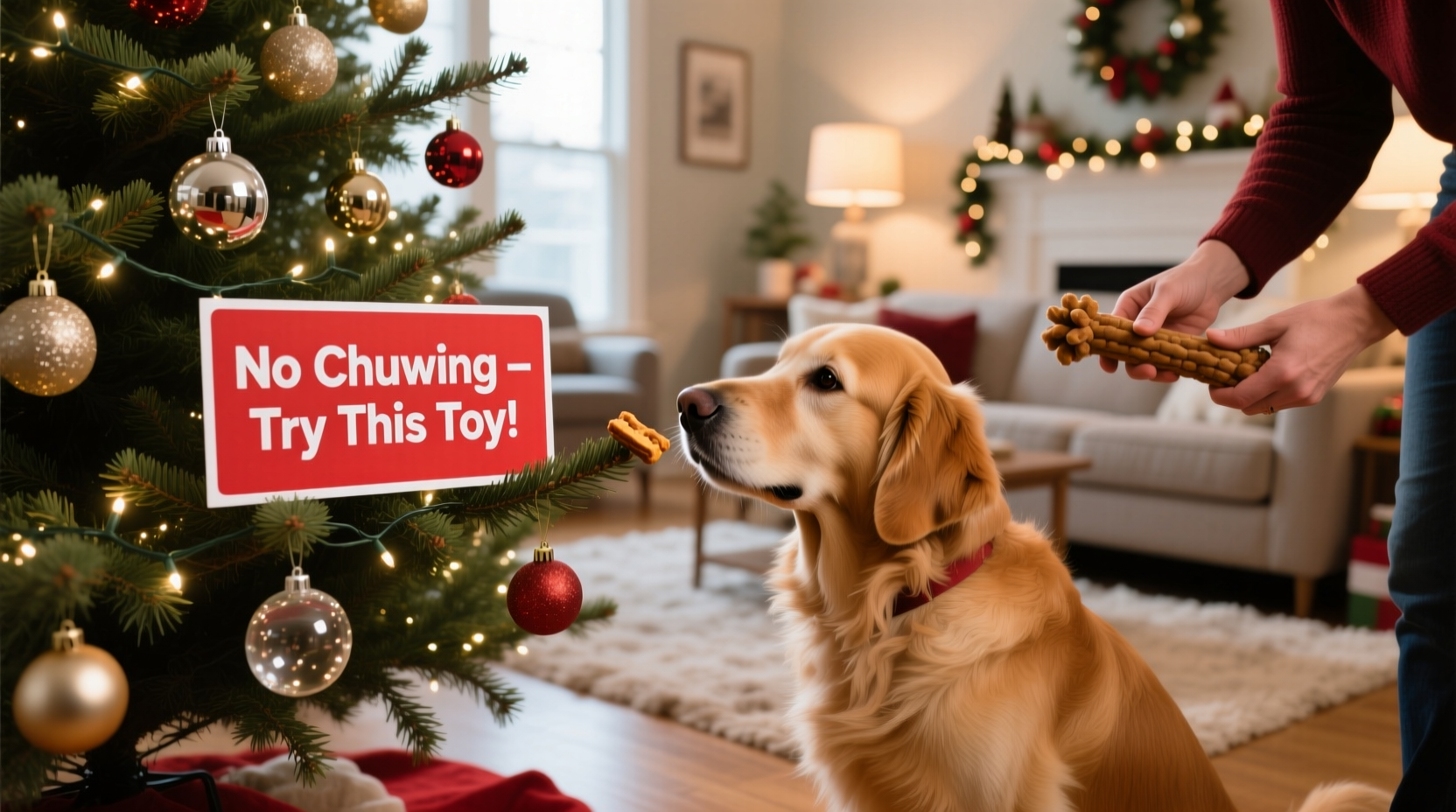
Dogs don’t generalize abstract rules like “the tree is off-limits.” They learn through association, consequence, and repetition. When you shout “No!” as your dog approaches the tree, you’re delivering an aversive stimulus—but you’re not telling them what *is* acceptable. Worse, the timing is almost always imperfect: by the time you intervene, the dog has already experienced the reward (the smell, the texture, the novelty). That momentary reinforcement—however brief—strengthens the behavior more than your correction weakens it.
Positive cue-based training flips this dynamic. Instead of suppressing unwanted behavior, it builds an alternative response that competes with it. A well-timed “Leave it” paired with a high-value treat teaches the dog that walking past the tree earns better rewards than investigating it. A “Settle” cue reinforced near the tree’s base teaches stillness as a pathway to calm attention—and ultimately, quiet coexistence. Neurobiologically, this approach activates the brain’s reward circuitry (ventral tegmental area and nucleus accumbens), releasing dopamine during successful choices. Over time, the tree transforms from a temptation into a neutral or even positive context—associated not with restriction, but with treats, praise, and shared calm.
“Dogs don’t misbehave—they communicate unmet needs. Chewing the tree isn’t defiance; it’s often boredom, teething discomfort, or a lack of clear alternatives. Our job isn’t to punish curiosity—it’s to redirect it with precision and kindness.” — Dr. Sarah Lin, Certified Professional Dog Trainer (CPDT-KA) and Veterinary Behavior Consultant
Step-by-Step Positive Cue Training Protocol
This 5-phase protocol is designed for real homes—not labs. It accounts for holiday time pressure, household chaos, and varying dog temperaments. Implement each phase for at least three days before advancing—consistency matters more than speed.
- Phase 1: Environmental Setup & Safety First
Secure the tree stand firmly (use wall anchors if needed). Place a low, wide barrier (like a baby gate or decorative rope-and-stake perimeter) 3 feet around the base—wide enough to prevent leaning or jumping, narrow enough to allow supervised access. Remove all low-hanging ornaments, tinsel, and lights within reach. This isn’t punishment—it’s setting your dog up to succeed while you build new habits. - Phase 2: Teach “Leave It” with Real-World Precision
Start away from the tree. Place a low-value item (e.g., a dry kibble) on the floor, cover it with your palm, and say “Leave it” clearly. The instant your dog looks away—even briefly—say “Yes!” and deliver a high-value treat (boiled chicken, freeze-dried liver) *from your other hand*, held at nose level. Repeat 10x per session, 2x daily. Once reliable, progress to uncovered items, then to items placed near the tree (but outside the barrier), then finally *just inside* the barrier—always rewarding disengagement *before* contact. - Phase 3: Build “Tree Zone” Calm with “Settle” and “Watch Me”
With your dog on leash and outside the barrier, walk toward the tree. At 6 feet away, pause and say “Settle.” Reward stillness for 2 seconds. Gradually increase duration (to 10+ seconds) and proximity (to 3 feet). Simultaneously, practice “Watch me”: hold a treat near your eyes, say the cue, and reward eye contact *before* the dog glances at the tree. This builds impulse control and redirects focus to you—not the environment. - Phase 4: Reinforce Alternative Behaviors Near the Tree
Place a designated chew mat or puzzle toy *just outside* the barrier. Every time your dog chooses it over approaching the tree, mark (“Yes!”) and reward. Add a verbal cue like “Go to your spot” when they move toward the mat. Later, place the mat *inside* the barrier—but only when the tree is unadorned and you’re fully present. This teaches voluntary, rewarded proximity. - Phase 5: Generalize & Maintain During Peak Holiday Activity
Practice cues during high-distraction moments: when guests arrive, when wrapping presents nearby, or when turning on lights. Keep sessions short (90 seconds max) and reward generously. If your dog breaks focus, calmly lead them 3 steps back and restart—never scold. After the holidays, continue weekly “tree zone” practice for 2 minutes to preserve the association.
Do’s and Don’ts: A Practical Decision Guide
Every interaction with your dog near the tree sends a message. This table clarifies which actions reinforce safety—and which accidentally invite trouble.
| Action | Do / Don’t | Why It Matters |
|---|---|---|
| Using bitter apple spray on branches | Don’t | It teaches avoidance through aversion—not choice. Many dogs ignore it; others lick it off and ingest toxins. It also doesn’t address the underlying motivation (boredom, teething, curiosity). |
| Giving your dog a frozen KONG *while* you decorate | Do | Creates positive association with the tree’s presence and provides appropriate oral stimulation during high-risk moments. |
| Saying “Good boy!” *after* your dog walks away from the tree | Don’t | Too delayed. Reward must occur *within 1.5 seconds* of the desired behavior to form a clear link. Use a clicker or sharp “Yes!” for precision. |
| Placing your dog’s bed or crate *next to* the tree (with supervision) | Do | Builds relaxed, non-chewy proximity. Pair with quiet petting and soft treats to reinforce calm. |
| Leaving your dog unsupervised near the tree—even for “just 2 minutes” | Don’t | One act of chewing can cause injury or create a strong habit loop. Supervision is non-negotiable until Phase 5 is fully solidified. |
Mini Case Study: Luna, a 2-Year-Old Australian Shepherd
Luna had chewed through two live Christmas trees in prior years—ripping off bark, snapping lower branches, and swallowing pine needles that triggered mild gastritis. Her owners tried citronella collars, shouting, and moving the tree to the dining room (which she accessed via chair-jumping). Nothing stuck. In early December, they began the positive cue protocol. On Day 1, Luna earned 27 treats for looking away from a branch placed 5 feet from the bare tree. By Day 4, she’d voluntarily lie on her mat beside the barrier while her owner strung lights—receiving quiet praise and slivers of turkey breast every 30 seconds. On Day 12, during a family gathering, she chose her puzzle toy over investigating the tree—even when a child dropped a candy cane near the base. Her owners didn’t eliminate her drive to explore; they gave her a better, more rewarding way to engage with the season.
Essential Tools & Timing Tips
Success hinges less on fancy gear and more on strategic timing and thoughtful preparation. Here’s what actually helps—and what to skip.
- High-value treats matter more than quantity: Use pea-sized pieces of cooked salmon, tripe, or commercial treats with >30% protein. Avoid kibble—it lacks the dopamine-triggering punch needed for high-distraction learning.
- A 6-foot leash is ideal: Long enough to allow movement, short enough to prevent lunging. Never use retractable leashes—they encourage pulling and reduce your control during redirection.
- Timing trumps intensity: Three 90-second sessions spaced throughout the day outperform one 15-minute drill. Dogs learn best in frequent, low-fatigue bursts.
- Start *before* the tree goes up: Begin Phase 1 (barrier setup + “Leave it” foundation) 3–5 days pre-tree. Your dog learns the rules before the temptation arrives.
- Involve everyone in the household: Inconsistent cues undermine progress. Hold a 10-minute family huddle: agree on the exact words (“Leave it,” not “Drop it”), the reward system, and who supervises when.
FAQ
My dog only chews the tree when I’m not watching—can positive cues still work?
Yes—because the goal isn’t surveillance, it’s building automatic, self-reinforced behavior. Dogs trained with positive cues begin choosing alternatives *even without prompts*. The key is consistent reinforcement during supervised windows so the new habit becomes their default. If unsupervised chewing persists, add a motion-activated pet deterrent (like the PetSafe Spray Shield—uses compressed air, not shock) *only* as a neutral interrupt—not a punishment—to break the pattern while you strengthen the positive cue.
What if my dog is a puppy or teething? Won’t they chew anything?
Puppies *do* need to chew—but they can learn *where* and *what*. Introduce multiple appropriate chew options *before* the tree arrives: frozen washcloths, rubber toys stuffed with yogurt and frozen, and food-dispensing puzzles. Pair each with a specific cue (“Chew here”) and reward heavily when used near the tree barrier. Teething pain subsides by 7 months; use this window to cement lifelong boundaries.
Can I use clicker training alongside verbal cues?
Absolutely—and it’s highly recommended. The click is a precise, emotion-free marker that bridges the gap between behavior and reward. Click the *instant* your dog’s nose turns away from a branch, then deliver the treat. Over time, the click itself becomes reinforcing, allowing you to fade treats gradually while maintaining reliability.
Conclusion
Training your dog not to chew Christmas tree branches isn’t about control—it’s about collaboration. It’s about recognizing that their curiosity is natural, their mouth is their primary tool for understanding the world, and your role is to guide that exploration toward safety and mutual respect. Positive cues don’t suppress instinct; they refine it. They replace confusion with clarity, anxiety with confidence, and impulse with intention. When your dog walks past the tree, pauses, looks up at you, and waits for a cue—you haven’t just protected your holiday decor. You’ve deepened trust. You’ve practiced patience in the midst of seasonal frenzy. And you’ve given your dog something far more valuable than a chew-free tree: the quiet joy of knowing exactly how to belong in your shared space.




 浙公网安备
33010002000092号
浙公网安备
33010002000092号 浙B2-20120091-4
Comments
No comments yet. Why don't you start the discussion?