
Christmas should be joyful—not a high-stakes game of canine hide-and-seek with electrical cords and pine-scented plastic stands. Every year, veterinarians report spikes in emergency visits for puppies who’ve ingested tree stand water (often containing fertilizers or preservatives), chewed through live wires, or toppled decorated trees during unsupervised exploration. These aren’t just “puppy antics.” They’re preventable risks rooted in natural instincts: teething, curiosity, scent attraction, and the irresistible crinkle-and-resistance of plastic stands and insulated cords. The good news? With science-informed behavior principles—not punishment—you can protect both your holiday setup and your puppy’s safety, all while building trust and reinforcing calm, respectful coexistence.
Why Puppies Target Tree Stands and Cords (It’s Not Misbehavior)
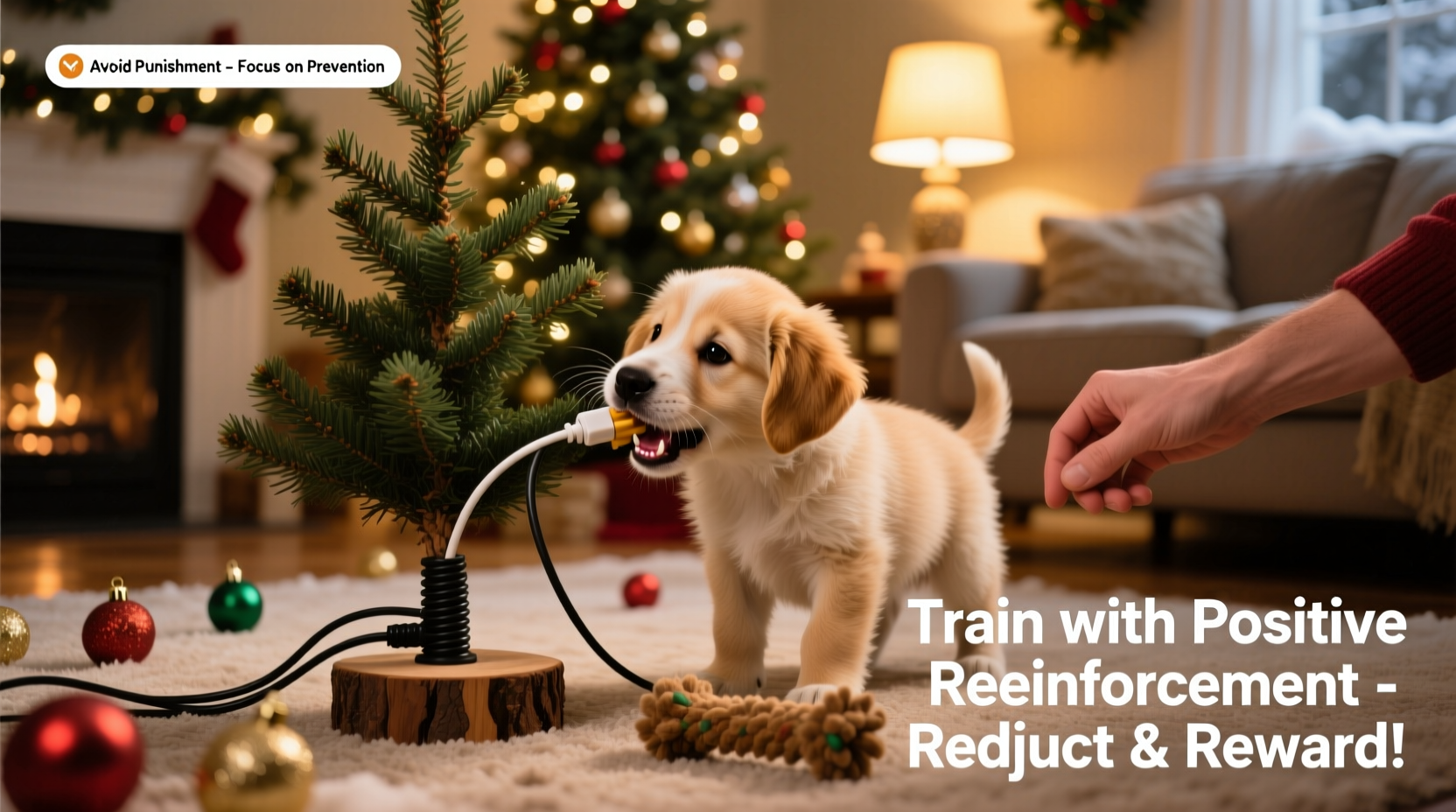
Puppies don’t chew stands and cords out of defiance. Their behavior follows predictable biological and developmental patterns. Between 3 and 6 months, most puppies enter peak teething—gnawing relieves gum pressure and helps loosen baby teeth. But even past teething, environmental triggers amplify risk:
- Scent lure: Tree stands hold stagnant water mixed with sugar, aspirin, or commercial preservatives—sweet, medicinal, and highly aromatic to dogs’ 300 million olfactory receptors.
- Texture appeal: Plastic stands offer satisfying resistance and audible crunch; cords provide flexible, rope-like feedback that mimics prey movement.
- Novelty + access: A newly erected tree transforms a familiar space into an enriched, uncharted territory—especially when guarded by adults who suddenly say “no” more often (which, to a puppy, can signal something worth investigating).
- Attention reinforcement: Even negative attention—a sharp “No!” or scooping up the puppy—can unintentionally reward the behavior if it happens consistently after chewing begins.
Understanding this removes blame and centers your response on management, redirection, and consistent learning—not correction.
Step-by-Step Prevention & Training Protocol (Weeks 1–4)
Effective prevention isn’t about barricading your tree—it’s about layering safeguards while actively teaching your puppy what *is* acceptable. Follow this progressive, low-stress sequence:
- Week 1: Full Environmental Management
Remove temptation entirely. Place the tree in a room with a baby gate or closed door. Use cord concealers (spring-wound sleeves or PVC raceways) *before* the tree goes up—not as an afterthought. Fill the stand with fresh, cool water daily—and add 1 tsp white vinegar per quart to neutralize scent without toxicity. - Week 2: Controlled Exposure + Redirection
Allow 5-minute supervised sessions near the tree. Carry high-value chews (frozen Kongs with pumpkin + peanut butter, or elk antlers for heavy chewers). The *instant* your puppy glances toward the stand or cord, calmly say “Leave it,” then immediately present the chew. Reward sustained chewing on the appropriate item with quiet praise—not excited petting, which can overstimulate. - Week 3: Cue Fluency & Distance Building
Practice “Leave it” away from the tree first: place a treat on the floor, cover it with your hand, say “Leave it,” wait until your puppy looks away, then mark (“Yes!”) and reward from your other hand. Once reliable at 3 feet, practice near the tree—but keep the puppy on leash for gentle redirection if focus drifts. - Week 4: Real-World Proofing
Gradually increase session length to 15 minutes. Introduce mild distractions: turn on lights, play soft carols, walk past the tree yourself. If your puppy pauses to sniff the stand, redirect *before* contact—not after. End every session on a success: one clean “Leave it” followed by a long chew session elsewhere.
This protocol works because it pairs classical conditioning (tree = calm + treats) with operant conditioning (chewing the right thing earns reinforcement), all within your puppy’s cognitive capacity. Rushing steps invites regression; consistency builds neural pathways faster than any shortcut.
Do’s and Don’ts: What Actually Works (and What Makes It Worse)
Not all advice is equal—some popular “solutions” escalate stress or reinforce the very behaviors you’re trying to stop. This table reflects evidence-based practices verified by veterinary behaviorists and certified dog trainers:
| Action | Do / Don’t | Why |
|---|---|---|
| Using citrus-scented sprays on cords | ✅ Do | Citrus oils (diluted 1:10 in water) are non-toxic and aversive to most dogs’ sensitive noses—unlike bitter apple, which some puppies learn to ignore. |
| Yelling “No!” when puppy touches the stand | ❌ Don’t | Startles the puppy but doesn’t teach replacement behavior; often increases arousal and fixation on the object. |
| Providing frozen food-stuffed toys at scheduled times | ✅ Do | Reduces oral frustration during peak teething hours (7–9 a.m. and 5–7 p.m.) and builds positive association with downtime near the tree. |
| Leaving the tree unattended—even for “just 2 minutes” | ❌ Don’t | It takes under 90 seconds for a determined puppy to chew through thin insulation or tip a lightweight stand. Supervision is non-negotiable. |
| Using shock or citronella collars near the tree | ❌ Don’t | Creates fear-based associations with the entire holiday environment—not just the stand—potentially triggering anxiety or avoidance of family gatherings. |
Real Example: How Maya Saved Her Miniature Schnauzer—and Her Peace of Mind
Maya adopted 12-week-old Finn just before Thanksgiving. By early December, he’d chewed through two cord covers, knocked over her 5-foot Fraser fir twice, and developed a habit of licking the tree stand until his lips were sticky with preservative residue. Her vet warned of potential gastrointestinal upset and electrocution risk. Instead of isolating Finn in another room (which increased his whining and door-scratching), Maya implemented the Week 1–4 protocol—but added one key adaptation: she placed a low, wide crate beside the tree, lined with a soft bed and a chew-resistant nylon bone. She fed Finn all meals inside it during tree time, gradually moving the crate closer over five days. Within 10 days, Finn chose the crate voluntarily during tree sessions—napping or chewing while the tree stood undisturbed. “He didn’t stop being curious,” Maya shared. “He just learned the tree zone was where calm things happened—and where his favorite person stayed close.”
“Puppies don’t generalize well. ‘Don’t chew the cord’ doesn’t mean ‘don’t chew anything electrical.’ You must teach the *principle*—‘When you see wires, look to me for a better option’—not just suppress one behavior.” — Dr. Sarah Lin, DACVB, Veterinary Behaviorist and Author of Puppy Learning in Real Time
Essential Tools & Supplies (Beyond the Obvious)
Investing in the right gear prevents frustration—and avoids costly ER visits. Prioritize safety, durability, and ease of use:
- Cord management: Braided nylon cord sleeves (not thin plastic) resist puncture; adhesive-backed raceways mount securely to baseboards, keeping cords fully enclosed and out of reach.
- Stand security: Weighted metal tree stands (minimum 25 lbs empty) resist tipping far better than plastic tripods. Anchor the stand to a wall stud using a 30-lb rated aircraft cable—visible, yes, but far safer than a fallen tree.
- Water safety: Use a covered tree stand with a built-in reservoir lid (e.g., Krinner models) or fashion a DIY cover from a stiff plastic lid drilled with tiny air holes—prevents access while allowing evaporation.
- Chew alternatives: Avoid rawhide or synthetic rubber bones that splinter. Opt for USA-made nylon chews (Nylabone DuraChew), sterilized beef tendons, or food-grade silicone toys frozen with broth.
One often-overlooked tool? A white noise machine set to “gentle rain” or “forest sounds” near the tree area. It masks the faint hum of transformers and reduces auditory triggers that spark investigative chewing.
FAQ
What if my puppy already has a strong habit of chewing the stand?
Reversing established habits requires resetting the association. For three days, remove the tree entirely. Then reintroduce it—but only in a new location, with all cords fully concealed and the stand covered with a cloth drape (secured tightly). Begin Week 1 of the protocol from scratch. Do not scold or punish prior behavior—focus entirely on building new neural connections.
Is it safe to use essential oils like eucalyptus or peppermint around the tree?
No. Many essential oils—including eucalyptus, tea tree, and cinnamon—are toxic to dogs if inhaled, licked, or absorbed through skin. Citrus oils (grapefruit, lemon, orange) are safer *when properly diluted*, but avoid diffusers near the tree. Stick to vinegar-water sprays or commercially formulated pet-safe deterrents approved by the ASPCA.
My puppy ignores “Leave it” near the tree. What am I doing wrong?
Most likely, the cue hasn’t been proofed in distraction-rich environments. Practice “Leave it” first with low-value items (kibble on the floor), then medium-value (cheese cubes), then high-value (hot dog pieces)—all in quiet spaces. Only introduce the tree once your puppy responds reliably at 10 feet with moderate distractions. If they still ignore it, your reinforcer isn’t valuable enough *in that moment*. Try higher-value options: freeze-dried liver, tripe, or a small piece of cooked chicken breast.
Conclusion
Your puppy’s curiosity isn’t a flaw—it’s the foundation of their intelligence, adaptability, and bond with you. Chewing on Christmas tree stands and cords isn’t rebellion; it’s communication. It says, “This smells interesting,” “My mouth hurts,” or “I want to know what this does.” When you respond with patience, structure, and science-backed tools—not frustration or force—you do more than protect holiday decorations. You teach your puppy how to navigate novelty safely, how to trust your guidance, and how to find comfort in calm presence rather than frantic exploration. That’s the real gift under the tree: a relationship rooted in mutual understanding, built one redirected chew, one secured cord, and one quiet, confident “Leave it” at a time.




 浙公网安备
33010002000092号
浙公网安备
33010002000092号 浙B2-20120091-4
Comments
No comments yet. Why don't you start the discussion?