
Fine chopping of onions is a foundational technique in cooking, essential for building flavor in sauces, soups, stews, and spice pastes. While most home cooks reach for a knife, an often-overlooked kitchen tool—the box grater—can deliver a more consistent, ultra-fine texture with less effort and greater efficiency. When used correctly, a grater transforms onions into a uniform pulp ideal for dishes where smoothness and deep flavor integration are paramount. This method not only saves time but also enhances the culinary outcome by releasing more volatile compounds responsible for aroma and taste. Understanding how to leverage this simple tool elevates everyday prep work into a precision craft.
Definition & Overview
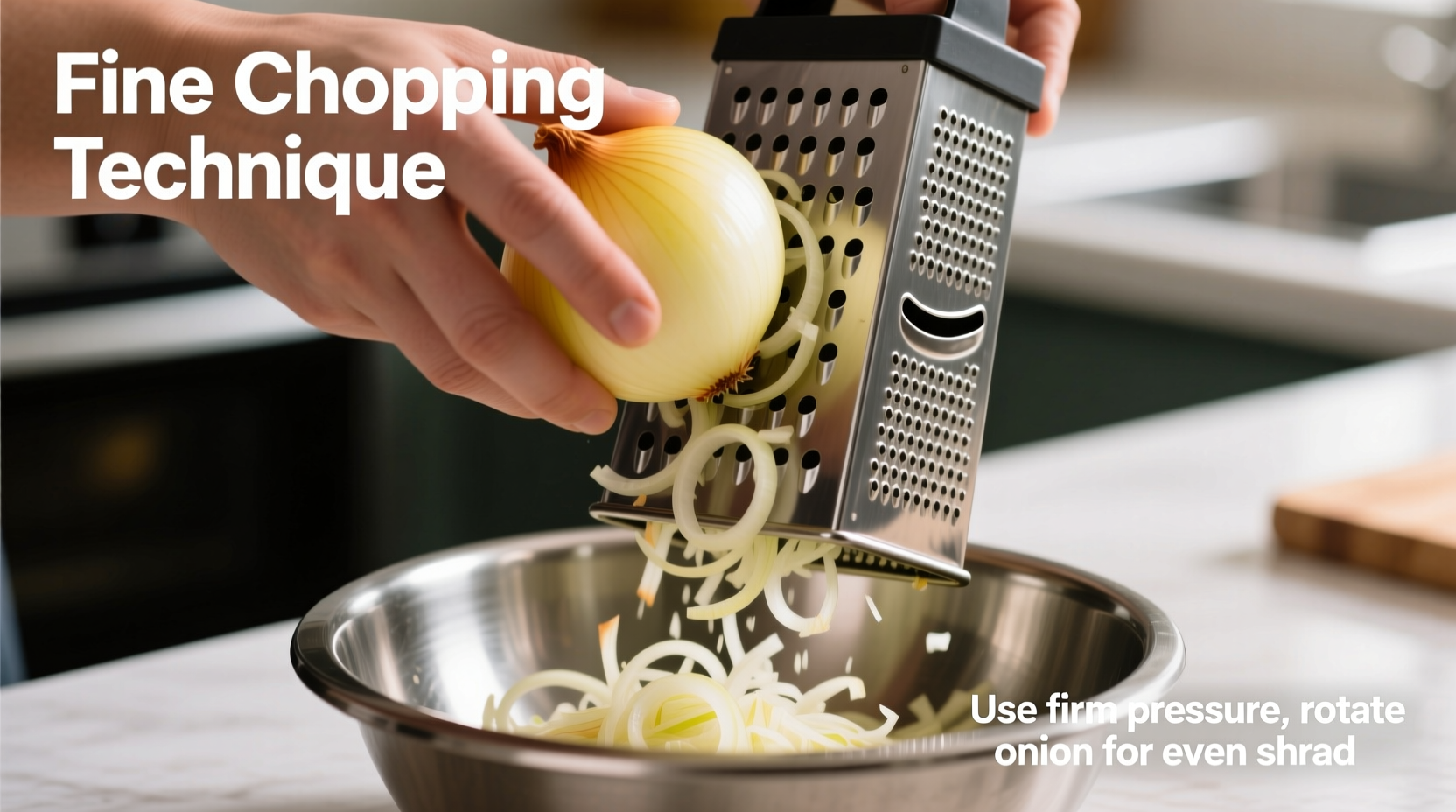
An onion, botanically classified as Allium cepa, is a bulbous vegetable belonging to the Amaryllidaceae family, closely related to garlic, leeks, and chives. It consists of layered, fleshy scales that store nutrients and develop pungent sulfur-containing compounds when cut. These compounds—primarily syn-propanethial-S-oxide—are released upon cellular disruption and react with moisture to form mild sulfuric acid, which causes eye irritation. Onions vary widely in color (yellow, red, white), sweetness, and sharpness, making them versatile across global cuisines.
Chopping traditionally involves slicing with a chef’s knife to achieve desired size and consistency. However, \"finely chopping\" refers to reducing the onion into particles small enough to dissolve into a dish during cooking, ensuring even distribution without textural interruption. Using a grater bypasses the limitations of manual knife skills by mechanically shredding the onion into micro-pieces, accelerating both cell rupture and flavor dispersion.
The box grater—a multi-sided metal tool with perforated surfaces of varying coarseness—is commonly associated with cheese or vegetables like carrots and potatoes. Its utility extends far beyond these applications, particularly when preparing aromatics. The finest side of the grater, typically labeled “fine” or “mincing,” produces results comparable to a food processor but with greater control and minimal oxidation.
Key Characteristics of Grated Onion vs. Knife-Chopped
| Characteristic | Grated Onion | Knife-Chopped Onion |
|---|---|---|
| Particle Size | Uniform, sub-millimeter shreds | Variable, depending on skill |
| Moisture Release | High—immediate juice extraction | Moderate—gradual release |
| Flavor Intensity | Bolder, faster-developing aroma | More restrained, gradual infusion |
| Cooking Time Integration | Dissolves quickly; integrates fully | Takes longer to break down |
| Texture in Final Dish | Smooth, invisible base | Noticeable bits unless cooked long |
| Eye Irritation Level | Higher due to increased surface exposure | Moderate |
Practical Usage: How to Use a Grater to Finely Chop Onions
To achieve optimal results when grating onions, follow a systematic approach that balances safety, efficiency, and quality.
- Select the right onion: Choose firm, dry-skinned bulbs without soft spots. Yellow onions are preferred for general cooking due to their balanced sweetness and pungency. White onions offer sharper bite, ideal for salsas or Latin dishes, while red onions are sweeter and better suited for raw applications.
- Prepare your workspace: Place the grater on a stable, non-slip surface. A damp kitchen towel underneath prevents movement. Position a bowl beneath the grating side to catch juices and pulp.
- Peel and halve the onion: Remove the papery skin and root end. Cut the onion in half from pole to pole (through the stem and root). Keep one half at a time for grating; the flat cut-side provides stability.
- Use the fine grating side: Most box graters have four sides: coarse, medium, fine, and slicing. For fine chopping, use the side with the smallest holes—often labeled “mince” or marked with tiny perforations. Press the cut face of the onion against the grater using gentle, downward pressure.
- Grate in controlled strokes: Move the onion up and down along the grater, applying even pressure. Let the tool do the work; forcing it may cause slipping or bruising. Rotate the onion slightly as edges become uneven to maintain contact.
- Stop before reaching the root core: The fibrous center resists grating and can clog the holes. Discard the remaining core after extracting usable flesh.
- Collect and manage liquid: As you grate, significant juice will accumulate. Retain this liquid—it contains soluble flavors and sugars critical for browning and depth. Stir it back into the grated mass before use.
Pro Tip: For recipes requiring very fine, paste-like consistency (e.g., curry bases or meat marinades), press the grated onion through a fine-mesh sieve to remove excess water. This concentrates flavor and prevents dilution in oil-based dishes.
In professional kitchens, grated onions are favored in spice blends, adobo pastes, and emulsified sauces where homogeneity is key. Indian chefs often grate onions directly into hot oil to create a caramelized foundation for curries, achieving silkier textures than knife-chopped versions. Similarly, French mirepoix purée for consommé benefits from grating, allowing faster clarification and deeper extraction.
When to Use Grated Onions in Cooking
- Sauces and gravies: Bolognese, tomato sauce, béchamel with aromatic base—grated onion melts seamlessly.
- Curries and stews: Especially in South Asian and Caribbean cuisine, where smooth texture enhances mouthfeel.
- Meat mixtures: Burgers, meatloaf, kofta—adds moisture and binding without chunkiness.
- Marinades: Enzymes and acids penetrate faster when onion is pre-grated.
- Raw applications: Quick pickles, chutneys, or relishes where intense onion flavor is desired.
Variants & Types of Graters for Onion Preparation
Not all graters perform equally when processing onions. Understanding the differences ensures selection of the appropriate tool.
Box Grater
The standard stainless steel box grater offers multiple grating surfaces. The finest side yields the best results for chopping simulation. Look for models with sharp, laser-cut holes and a handle for secure grip. Drawbacks include difficulty cleaning and potential for hand fatigue.
Microplane Grater
Originally designed for citrus zest and hard cheeses, high-quality Microplanes with ultra-fine blades can produce delicate onion dust. Ideal for small quantities or finishing touches. Not recommended for large volumes due to clogging and fragility.
Rotary Grater (Mandoline with Grating Attachment)
Some mandolines come with interchangeable discs for grating. These provide ergonomic advantages and consistent output but require careful handling to avoid injury.
Food Processor with Grating Disc
While not a manual grater, this electric alternative achieves similar results at scale. Best for batch preparation, though risk of over-processing exists. Pulse briefly to mimic hand grating.
| Type | Best For | Limits |
|---|---|---|
| Box Grater (Fine Side) | Daily use, moderate volume | Hand strain, cleaning effort |
| Microplane | Paste, garnish, small batches | Clogs easily, fragile |
| Rotary/Mandoline Grater | Speed, uniformity | Safety concerns, cost |
| Food Processor | Large batches, meal prep | Less control, noisy |
Comparison with Similar Ingredients and Techniques
Understanding how grating compares to other onion preparation methods clarifies its unique value.
Grated vs. Minced (Knife-Cut)
Minced onions, achieved with a rocking knife motion, typically range from 1–3 mm in size. They retain more structure and release flavor gradually. Grated onions, being smaller and more fragmented, oxidize faster and integrate immediately into liquids or fats. In dishes requiring prolonged simmering, the difference diminishes. However, in quick-cooked meals, grated onions offer superior blending.
Grated vs. Blended (Using Blender or Food Processor)
Blending creates a slurry that includes cell walls, fibers, and abundant liquid. While convenient, it often results in a watery mixture prone to separation. Grating allows partial drainage and selective use of solids versus juice. Additionally, blenders generate heat through friction, potentially altering volatile compounds. Grating preserves freshness and avoids thermal degradation.
Grated vs. Juiced (Using Juicer or Press)
Onion juice extracted via juicer removes all fiber, leaving only liquid essence. Useful for cocktails or injectable marinades but lacks body. Grated onion maintains a balance between pulp and juice, functioning as both flavorant and thickener.
\"In our test kitchen, we found that curries made with grated onions reached flavor maturity 20% faster than those with diced. The increased surface area accelerates Maillard reactions and emulsification.\" — Chef Elena Torres, Culinary Development Lead, Modern Table Institute
Practical Tips & FAQs
How can I reduce tears when grating onions?
Cold temperatures suppress enzyme activity. Chill onions in the refrigerator for 30 minutes before grating. Alternatively, work near a running fan or under a vent hood to direct vapors away from your face. Wearing kitchen goggles is highly effective—professional line cooks often use them during high-volume prep.
Can I grate onions ahead of time?
Yes, but with caveats. Store grated onions in an airtight container in the refrigerator for up to 24 hours. Oxidation darkens color and dulls flavor over time. For longer storage, freeze in ice cube trays with a bit of oil or water. Thaw before use in cooked dishes.
Is there a substitute for grating if I don’t have a grater?
A sharp chef’s knife with a fine mince technique is the closest alternative. Use a claw grip and rock steadily until pieces are nearly powdery. A mezzaluna (curved chopping knife) on a board also mimics grating through repetitive rocking.
Do different onion varieties behave differently when grated?
Yes. Sweeter onions like Vidalia or Walla Walla contain more water and less pungency, yielding juicier, milder grates. Storage onions (yellow, white) have higher sulfur content, producing stronger aroma and better browning. Red onions fall in between, suitable for raw or lightly cooked uses.
Can I use a grater for other aromatics?
Absolutely. Garlic, ginger, shallots, and lemongrass respond exceptionally well to grating. Ginger, in particular, releases more essential oils when finely grated, enhancing both fragrance and spiciness. Always clean the grater immediately after use to prevent cross-contamination of flavors.
Storage Tip: To extend shelf life, spread freshly grated onion thinly on parchment paper and freeze for 1 hour before transferring to a sealed bag. This prevents clumping and allows portioned use later.
Does grating affect nutritional content?
Grating increases oxidation, which may degrade some heat- and air-sensitive compounds like vitamin C. However, beneficial organosulfur compounds—linked to anti-inflammatory and cardiovascular benefits—are more readily released and bioavailable when cells are thoroughly broken down. From a health perspective, grating may enhance certain functional properties despite minor nutrient loss.
Summary & Key Takeaways
Using a grater to finely chop onions is a powerful yet underutilized technique that delivers tangible benefits in both home and professional kitchens. By creating uniformly small particles, grating accelerates flavor development, improves texture integration, and reduces overall cooking time. It excels in applications where smoothness and depth are priorities—from rich curries to silky meat fillings.
The process requires attention to detail: selecting the correct grater side, managing moisture, and minimizing waste. Safety and comfort—especially regarding eye irritation—can be mitigated with chilling, ventilation, or protective gear. Among grater types, the standard box grater remains the most accessible and effective for daily use.
Compared to traditional chopping or mechanical blending, grating strikes an ideal balance between control, efficiency, and culinary performance. While not universally appropriate—chunky salsas or roasted vegetable medleys still demand knife work—it shines in dishes built on foundational aromatics.
Mastering this method expands a cook’s repertoire, enabling faster, more consistent results without sacrificing quality. With practice, grating becomes second nature—an indispensable shortcut for anyone serious about flavor precision.
Next time you’re building a sauce or seasoning a patty, skip the knife and reach for the grater. Notice how the dish comes together faster, smells richer, and tastes more cohesive. Small changes in prep yield profound differences on the plate.




 浙公网安备
33010002000092号
浙公网安备
33010002000092号 浙B2-20120091-4
Comments
No comments yet. Why don't you start the discussion?